
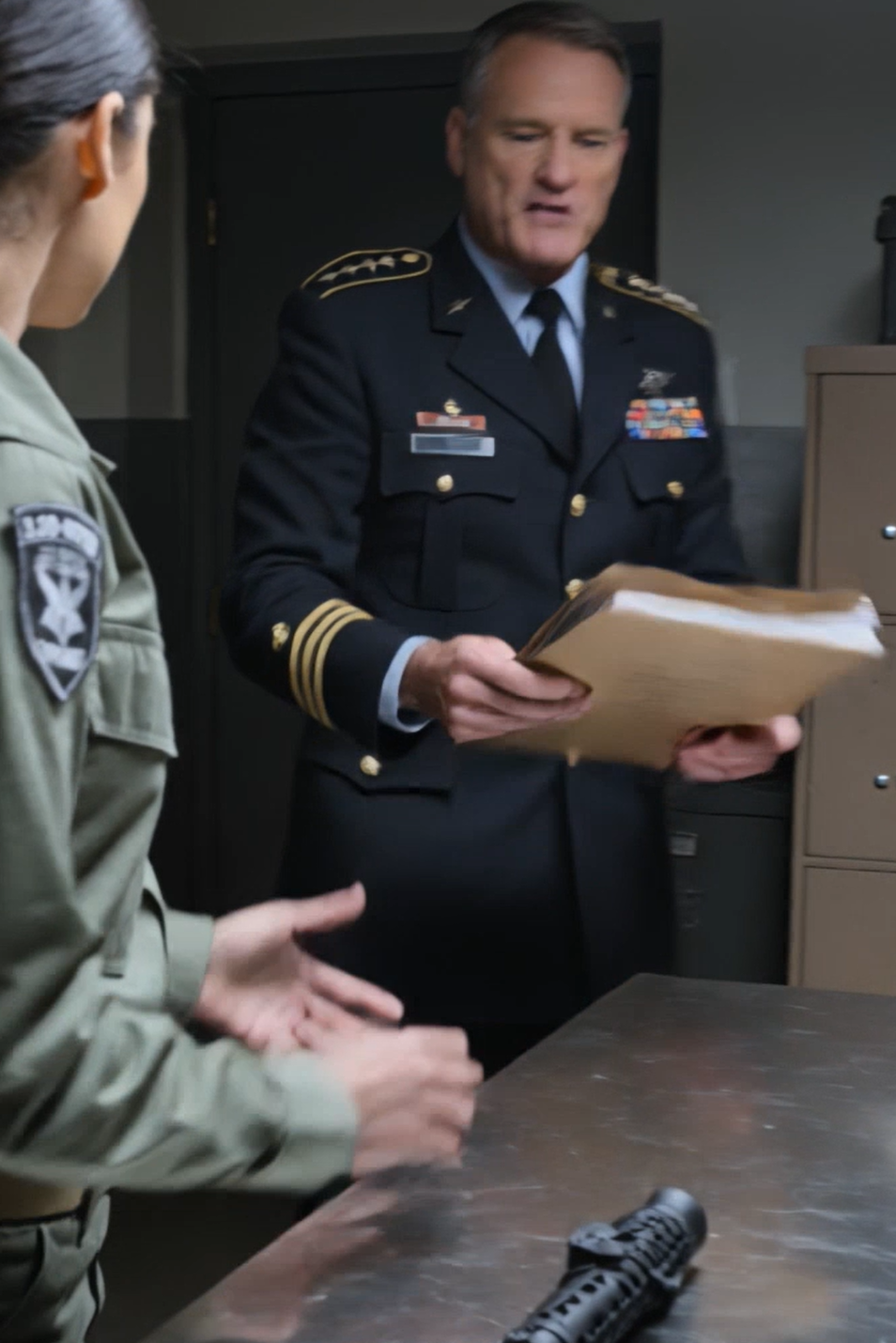
Staff Sergeant Tina Valdez was alone in the underground weapons vault, breaking down a Barrett .50 cal the same way she had a hundred times before.
For her, the rifle was not a weapon. It was routine. Muscle memory. Quiet.
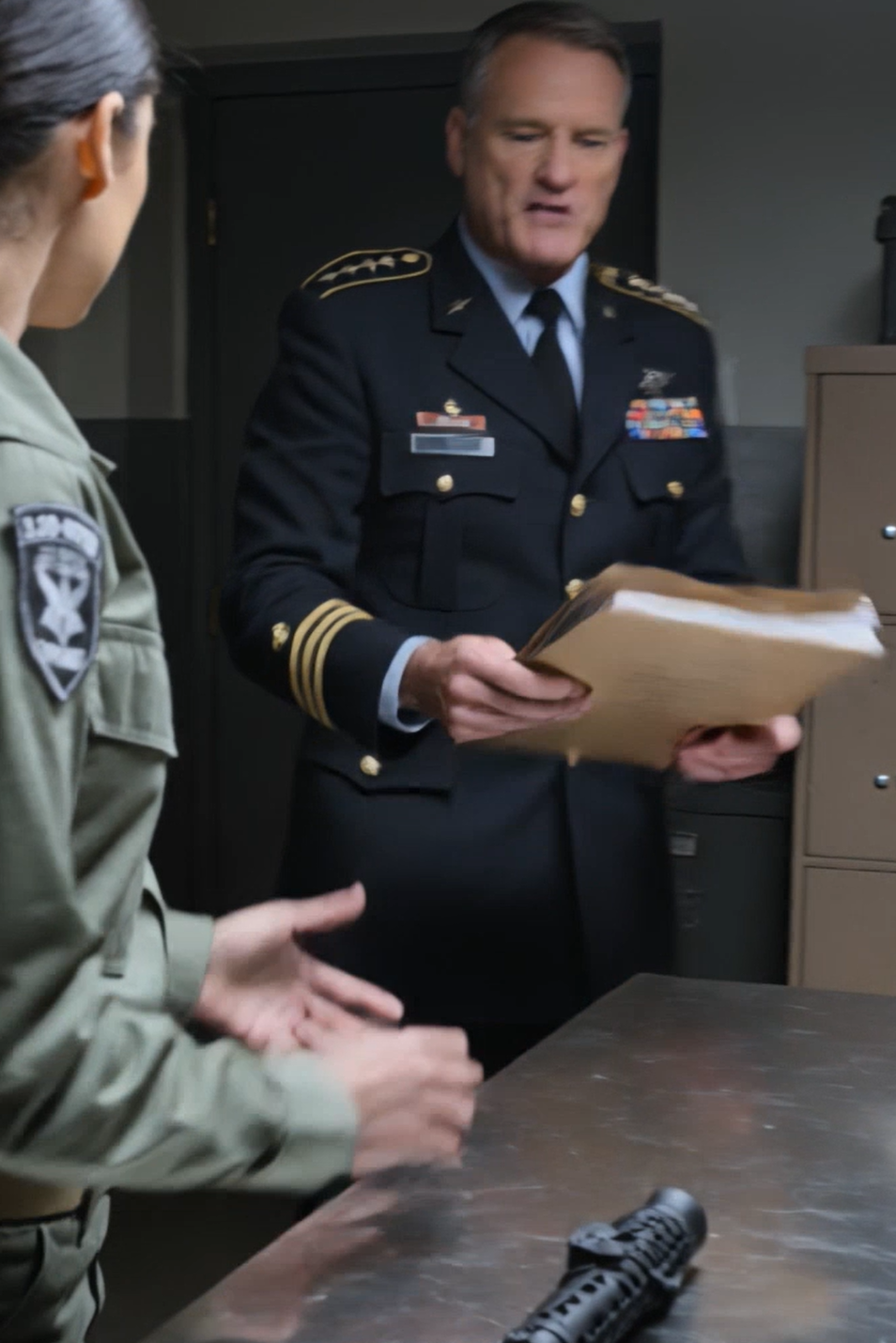
Then her eyes caught the patch on her shoulder.
Three words stitched in black thread:
3,200-METER CONFIRMED.
A shot most snipers would not even attempt. A shot that had turned into legend inside her unit.
She had never really asked about it.
Until today.
Across the room, Major Brent Williams stood watching her. He had not said a word in twenty minutes. When she finally turned and asked him what the patch actually meant, the air in the vault shifted.
He did not smile.
He did not congratulate her.
He walked to a locked steel cabinet, punched in a code she did not recognize, and pulled out a thick folder with her name printed across the front.
She thought it was old mission paperwork.
It was not.
Page after page. Operations she barely remembered. Distances that should not have been possible. Training programs she had never been enrolled in – at least, not that she could recall.
Then she saw it. Stamped in red across the top of one page:
SPECIAL OPERATIONS SNIPER DIVISION – TOP SECRET.
Her hands went cold.
“What is this?” she asked.
Williams did not answer right away. He just looked at her – the way you look at someone you have already mourned.
“That 3,200-meter shot everyone talks about?” he finally said. “That was not your first impossible shot, Valdez.”
She kept flipping pages. Faster now. Her own name everywhere. Dates she could not account for. Locations she had never been briefed on. Psychological evaluations she had never sat for.
She had not been recruited.
She had been selected.
Trained. Conditioned. Built.
Williams stepped closer and lowered his voice until it was barely a whisper.
“You were not trained to be a soldier, Valdez. You were trained to be the weapon.”
Her throat went dry. She forced herself to ask the only question that mattered.
“So what happens now that I know?”
The major glanced once at the door. Then at the camera in the corner – the one with the red light that was not blinking anymore.
And when he turned back to her, what he said next made her reach for the rifle still lying in pieces on the table…
“You have about four minutes before they get here,” he said, his voice flat and urgent. “The camera going offline was the silent alarm. They know.”
Her hands did not shake. Her mind did not race.
Instead, a strange calm settled over her. The kind of focus she only ever felt looking through a scope.
Her fingers found the bolt carrier group of the Barrett. They moved with a life of their own, sliding pieces into place with oiled clicks that echoed in the silent vault.
“They won’t kill you. Not at first,” Williams continued, his eyes darting towards the heavy steel door. “They’ll wipe you. A ‘recalibration,’ they call it. You’ll wake up in a med bay with no memory of this conversation. Or me. Or that file.”
His words hit her harder than any bullet. The idea of them reaching into her head and deleting parts of her, turning her back into an obedient tool, was a violation she could not stomach.
She slammed the bolt home. The rifle was whole again.
“Four minutes isn’t enough to fight my way out of this base,” she stated, her voice low. She was not asking.
“You’re not fighting your way out,” he replied, pulling a small, featureless keycard from his pocket. “You’re walking out.”
He slid the card across the table. It was matte black. No markings.
“That gives you Level Four access for ten minutes. Go to the east-side motor pool. There’s a maintenance gate there, rarely used at this hour. A blue pickup truck is parked by the fence. Keys are under the driver’s side floor mat.”
She looked from the card back to his face. “Why are you helping me?”
A flicker of something – guilt, maybe regret—crossed his features. “Let’s just say I’ve been carrying this long enough. The weapon shouldn’t have to carry the sins of the man who aimed it.”
A buzzer sounded softly, an alert from the command terminal in the corner.
“Two minutes,” he said, his face hardening again into the major she knew. “The file. You can’t take it.”
She looked down at the damning pages, at the ghost of a life she had apparently lived.
Without a word, she grabbed a single sheet—the one detailing the 3,200-meter shot—and stuffed it inside her uniform blouse. It felt cold against her skin.
“Go, Valdez. Now.”
She did not say thank you. There was no time.
She grabbed the keycard and moved toward the door, leaving the Barrett on the table. It had been her shield for years, but now it felt like a cage.
As she reached the door, she paused and looked back at Major Williams. He was standing perfectly still, his hands clasped behind his back, ready to face whatever was coming for him.
He simply nodded.
The corridors were quiet, almost peaceful. Her boots made no sound on the polished concrete. She moved with a purpose that felt both new and old.
The skills they had honed in her—situational awareness, pathfinding, stealth—were now her tools of escape. She saw the patrol routes in her mind, the sweep of the cameras, the blind spots.
She passed two armed guards who barely gave her a second glance. A staff sergeant moving with confidence belonged. Doubt was what got you noticed.
The keycard worked on the motor pool door. The night air was cool and smelled of diesel and rain.
Her eyes scanned the lot. There, just as he said. A beat-up blue pickup truck, looking completely out of place among the olive-drab Humvees.
She slipped into the driver’s seat. The keys were right where he promised.
The engine turned over with a low rumble. She did not peel out. She drove slowly, calmly, toward the maintenance gate.
She swiped the card one last time. The gate arm lifted.
As she pulled onto the dark, empty road leading away from the base, she looked in the rearview mirror. The distant flash of red and blue lights was just beginning to swarm the weapons vault.
She was out. She was free. And she was utterly, completely alone.
Tina drove for six hours straight, paying for gas with cash she had stashed in her go-bag. She ditched the truck in a long-term parking lot at a bus station in a town she did not know the name of.
She bought a ticket to a place she picked at random off the board: Harmony Creek, Colorado. It sounded peaceful. It sounded like everything she was not.
On the bus, surrounded by sleeping strangers, she finally pulled out the folded page from her blouse.
OPERATION NIGHTFALL. TARGET: OMAR AL-KADRI.
She remembered the name. He was a high-level insurgent financier, the official briefing had said. Responsible for dozens of attacks.
The location was a remote mountain pass. The distance was 3,204 meters, to be exact. A shot made in high winds, at dusk. Impossible.
But the file said more. It listed Al-Kadri’s real identity. Dr. Omar Basiri. A chemical engineer and outspoken critic of a powerful defense contractor, a company called Sterling Defense.
He was not a financier. He was a whistleblower.
He was on his way to meet a journalist with proof that Sterling Defense was selling defective body armor to the military while pocketing billions.
Tina felt sick.
The legend, the shot that defined her career, was the murder of an innocent man who was trying to save soldiers’ lives.
The patch on her shoulder burned like a brand.
She arrived in Harmony Creek two days later, a ghost of her former self. She used her remaining cash to rent a small, secluded cabin at the edge of town.
For the first week, she just existed. She watched the mountains, listened to the wind in the pines, and tried to reconcile the soldier she thought she was with the assassin they had made her.
The memories were still fractured. She remembered the recoil of the rifle. The intense focus. The satisfaction of a mission completed.
But she could not remember Dr. Basiri’s face. They had made sure of that. The targets were just data points, coordinates on a map.
One day, while buying groceries, she saw a flyer on a community board. It was for a support group for veterans at the local town hall.
She almost walked away. But a pull she could not explain made her take down the number.
A few nights later, she found herself in a circle of folding chairs with five other people. They were older, mostly from conflicts she had only read about in history books.
The man leading the group was a gentle soul named Arthur. He had kind eyes and hands that were permanently stained with grease from working on old cars.
When it was her turn to speak, she could not. The words were trapped behind a wall of secrets and shame.
“It’s alright,” Arthur said softly. “Sometimes just being here is enough.”
Over the next few weeks, she kept going back. She never spoke about her missions, but she listened to their stories. Stories of loss, of guilt, of trying to find a way to live with the things they had done and seen.
Slowly, the ice around her heart began to thaw. She started to see them not as soldiers, but as people. Flawed, wounded, but fundamentally good.
One evening, a man named Samuel was talking about his time as a medic. He spoke of the impossible choices, of having to decide who to save when he could not save everyone.
“The guilt never really leaves you,” he said, his gaze distant. “You just have to find a way to make it mean something. You have to find a way to put more good back into the world than the bad you were a part of.”
His words struck Tina like a physical blow.
Put more good back into the world.
That night, she went back to her cabin and for the first time, did not think about rifles or missions. She thought about Dr. Basiri. She thought about Sterling Defense.
She knew they would still be looking for her. But running was not enough. Hiding was not enough.
She had to do something.
Using the library’s public computers, she began to dig. She used the tradecraft they had taught her—not for targeting, but for research. She created false identities, bounced her signal, and delved into the dark corners of the internet.
She found whispers about a program codenamed ‘Ghostfire.’ A highly classified project that used “enhanced” soldiers for deniable operations. It was run not by the Army, but by a private entity: Sterling Defense.
It was all there. They recruited soldiers with a specific psychological profile—high aptitude, low social connection, a history of trauma. They used a combination of hypnotherapy and chemical conditioning to heighten their skills and ensure loyalty.
She was not their only weapon. There were others.
As she was cross-referencing names, a secure message popped up on her screen. It was encrypted, using a cipher she had not seen since her earliest training days.
A cipher only one other person would know.
Major Williams.
The message was short.
THEY HAVE ME. THEY WIPED THE BASE, BUT NOT THE SOURCE. PROJECT GHOSTFIRE SERVER IS AT THEIR HQ. LEVEL 9. YOU ARE THE ONLY KEY. DO NOT LET IT BE FOR NOTHING.
Her blood ran cold. He had sacrificed himself for her, for the truth.
She looked at the name of the company again. Sterling Defense.
Their headquarters was a gleaming black tower in northern Virginia. A fortress.
But fortresses were designed to keep people out. They were not designed to keep someone who was built on the inside from getting back in.
Tina cashed out the last of her emergency funds. She took a bus to Virginia.
She spent three days just watching the Sterling Defense building. She learned its rhythms, the shift changes, the delivery schedules. She was not planning an assault; she was planning an infiltration. Precision, not power.
She created a fake employee ID, using the credentials of a low-level data clerk she had observed. She altered her appearance, cutting her hair and wearing civilian clothes. She became invisible.
On the third night, she walked through the front doors during a shift change, a coffee in one hand and a stack of meaningless files in the other. She belonged.
The building was a maze of glass and steel. But the protocols, the security measures—they were familiar. They were based on the military systems she knew inside and out. They had taught her the language of their security, and now she would use it against them.
Level 9 was the executive floor. Access was biometric. A thumbprint.
This was the final wall. The one she could not pass.
She stood in a darkened service corridor, her heart pounding. Had she come all this way for nothing?
Then she remembered Williams’ message. “You are the only key.”
It was not a metaphor.
She thought back to her “training” that she now understood was conditioning. The endless hours of sensory exercises, the strange medical procedures.
On a hunch, she approached the biometric scanner. She held her hand up, but instead of her thumb, she pressed the inside of her left wrist against the glowing plate.
There was a faint scar there, almost invisible, from a “routine inoculation” she had received years ago.
The light on the panel turned from red to green. The door clicked open.
They had literally made her the key. A sub-dermal chip. A key only she could use, a leash to keep her tied to them forever.
The server room was at the far end of the hall. But as she moved toward it, a voice stopped her.
“I was wondering when you would finally come home, Sergeant.”
A man stepped out of a darkened office. He was older, with silver hair and an immaculately tailored suit. He looked more like a banker than a monster.
“Director Sterling, I presume,” Tina said, her voice steady.
“In the flesh,” he replied with a thin smile. “Major Williams spoke very highly of you. Right up until the end.”
He gestured toward his office. “Come. Let’s talk. There’s no need for this to be unpleasant.”
She followed him inside. The office was vast, with a floor-to-ceiling window overlooking the city.
Major Williams was there. He was slumped in a chair, his face bruised, but he was alive. His eyes locked on hers, and he gave a barely perceptible shake of his head. It was a trap.
“You’re an investment, Tina,” Sterling said, walking to a wet bar. “My finest creation. That 3,200-meter shot was proof of concept. It secured us another decade of funding.”
“I killed a good man,” she said, her voice tight with rage.
“You neutralized a threat to national security,” he corrected smoothly. “The world is a complicated, messy place. We are the ones who clean it up. We do the things others can’t, so they can sleep peacefully at night.”
He was trying to trigger her conditioning, to reframe her reality. But the truth was a shield he could not pierce.
“You’re a murderer who hides behind a flag,” she shot back.
Sterling sighed. “So the conditioning is well and truly broken. A pity. Recalibration is such a tedious process.”
He pressed a button on his desk. “But that’s a problem for later. First, you’re going to help me with a small data-migration issue.”
He nodded toward a monitor. It showed the Ghostfire server interface. “The file Williams sent you was a fragment. The complete file is encrypted with a voice-print key. Your voice-print. You will unlock it for me, so I can move it to a more secure location, and we can all forget this unfortunate incident.”
Tina looked at Williams. He was weak, but his eyes were defiant. He had gotten her inside. The rest was up to her.
“And if I refuse?” she asked.
Sterling gestured to Williams. “Then your major’s retirement will be far more permanent than he planned.”
Tina walked to the terminal. She felt the weight of every life she had taken, every order she had followed. This was her chance to make it mean something.
She took a deep breath. “Authorization code Valdez-Tango-Seven.”
Her voice was clear and strong.
On the screen, the files unlocked. Sterling smiled in triumph.
But then, something else happened. A new window opened.
DATA TRANSFER INITIATED. RECIPIENTS: NY TIMES, WASHINGTON POST, REUTERS, BBC…
Sterling’s smile vanished. “What is this? What did you do?”
Tina looked back at him, a faint, cold smile of her own playing on her lips.
“The authorization code was a two-part phrase. I only gave you the first part,” she explained. “The second part was a silent command I gave ten minutes ago in the hallway. It was triggered by the biometrics on the door.”
She pointed to a tiny camera in the corner of the room, the same kind she had seen in the vault. Its light was on, and it was not blinking.
“And this entire conversation, your confession? It has been live-streaming to the same recipients. You called me a weapon. You were right. You just aimed me at the wrong target.”
Director Sterling stood frozen, his face a mask of disbelief and fury. The truth was out. His shadow empire was crumbling in real time.
In the ensuing chaos, Tina helped Major Williams to his feet. Federal agents, alerted by the journalists, were swarming the building. It was over.
The Ghostfire program was exposed, leading to one of the biggest scandals in military history. Sterling and his co-conspirators were brought to justice.
For her testimony, Tina was granted a full pardon and a quiet discharge.
Months later, she stood on a sandy beach, watching the sun dip below the horizon. The air was salty and clean. She took a sip of tea from a simple ceramic mug.
She had found her quiet. It was not in the cold precision of a rifle anymore. It was in the gentle roar of the ocean, in the freedom of a life she had chosen for herself.
She was no longer Staff Sergeant Valdez, the sniper. She was no longer a weapon. She was just Tina. And for the first time, that was more than enough.
Our past does not have to define our future. The skills we are given can be used for purposes far greater than their original intent. True strength is not found in following orders, but in forging our own path toward what is right, no matter the cost.



