
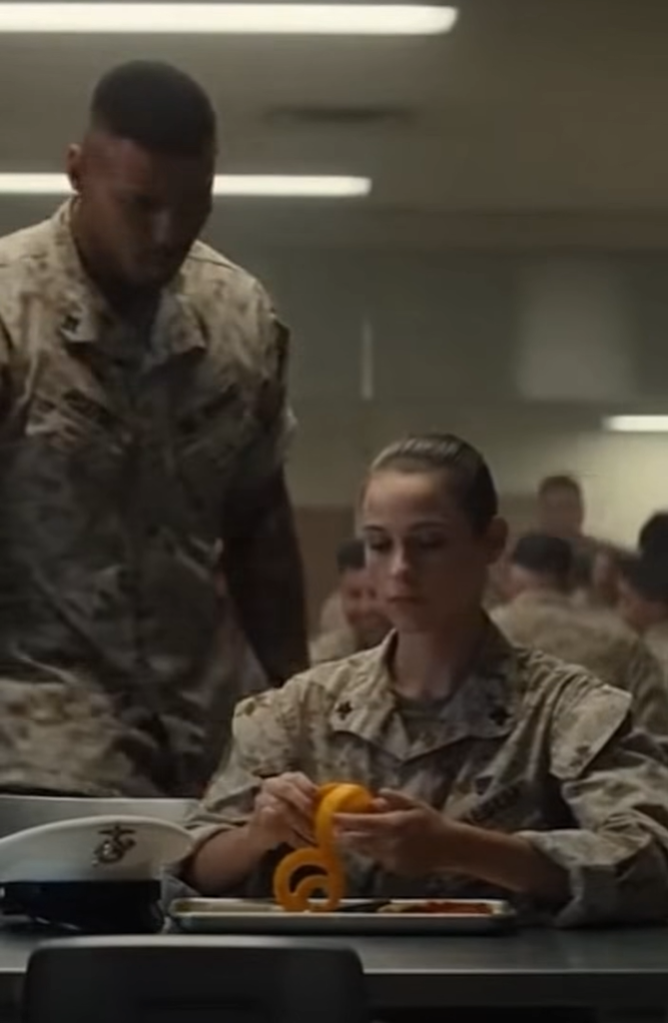
The mess hall at Camp Pendleton was never a place for the faint of heart. It smelled of burnt coffee, floor wax, and the thick, suffocating ego of a thousand young men trained for war.
Sergeant Caleb “Hawk” Donovan thought he owned the place. He was 220 pounds of tattooed muscle and bad attitude.
When he saw a “new girl” sitting at the corner table – the table his squad had claimed for three years – he didn’t see a soldier. He saw a target.
“Hey, Sweetheart,” he barked, leaning over her. “You’re in the wrong zip code. Move it.”
The woman didn’t look up. She was small, maybe 5’6″, wearing a standard tactical jacket with no visible rank insignia.
She was peeling an orange with the precision of a surgeon.
“I’m eating, Sergeant,” she said. Her voice was quiet. Level.
It should have been a warning.
Hawk’s buddies snickered at the next table. Tracy, the redhead from logistics, whispered, “Caleb, just leave her alone.”
But Hawk had an audience now. And audiences demanded blood.
He slammed his palm down on her tray. The orange rolled.
“Did I stutter, princess? I said MOVE.”
She finally looked up. Her eyes were the color of wet steel.
No fear. No anger. Just a flat, bottomless calm that made the hair on the back of Tracy’s neck stand straight up.
“Sergeant Donovan,” she said, reading his name tape. “I’m going to give you one chance to walk away. Take it.”
The mess hall went quiet. Forks froze halfway to mouths.
Someone in the back whispered, “Oh no.”
Hawk laughed. A big, ugly laugh.
Then he reached down and grabbed her ponytail.
What happened next took less than ten seconds. Witnesses would later disagree on the exact sequence—some said she moved like water, others said she didn’t move at all, that the room itself rearranged around her.
But everyone agreed on the sound.
The wet, gristly pop of Hawk’s shoulder leaving its socket.
He was on his knees. His face was pressed into the linoleum.
Her thumb was doing something to a nerve cluster behind his ear that made grown men weep, and Hawk—Hawk who’d done two tours in Fallujah—was weeping.
“Please,” he gasped. “Please, ma’am, please—”
The double doors at the end of the mess hall flew open.
General Marcus Whitfield, four stars on his collar, walked in flanked by two men in black suits with earpieces.
The entire hall snapped to attention so fast it sounded like a rifle volley.
The General didn’t look at the men standing. He looked at the woman holding Sergeant Donovan like a broken doll.
He saluted her.
Tracy’s coffee cup slipped from her fingers and shattered on the floor.
Because the woman at table seven wasn’t a new recruit. And the patch she pulled from her inside pocket—the one she dropped onto Hawk’s trembling back—wasn’t any insignia anyone in that room had ever been cleared to see.
It was a coiled viper, fangs bared, wrapped around a single black star.
And when Hawk saw what was stitched beneath it, he stopped breathing entirely.
The words were embroidered in silver thread, stark against the black fabric.
SPECTRE ONE.
The words meant nothing to ninety-nine percent of the people in the room. But to General Whitfield, they meant everything.
To Hawk, pinned and broken, they meant the end of his world.
“On your feet, Sergeant,” the General’s voice was a low rumble that cut through the silence. It wasn’t a request.
The woman, Spectre One, removed her thumb. The blinding pain in Hawk’s ear subsided to a dull, throbbing roar.
She stepped back with an almost eerie grace, pocketing the patch as if it were a grocery receipt.
Hawk struggled to his feet, clutching his dislocated shoulder. His vision swam. The faces around him were a blur of shock and morbid curiosity.
The General took a step forward, his gaze fixed on Hawk. His eyes were colder than a winter ocean.
“Sergeant Donovan, you have just assaulted a ranking officer of a branch you are not cleared to know exists.”
Hawk tried to speak, to explain, but his throat was a desert. “Sir, I… I didn’t know…”
“And that,” the General cut in sharply, “is the entire point.”
He turned his head slightly toward Spectre One. “Is your assessment complete?”
She gave a single, almost imperceptible nod. “The vulnerability is confirmed, General. Discipline is lax. Command presence is based on intimidation, not respect.”
Her voice, still quiet, carried across the silent room like a thrown knife. Every word landed.
“This weakness could compromise an entire operation,” she continued, her steel-colored eyes now scanning the room. “An enemy doesn’t care about your squad’s favorite table.”
The General’s jaw tightened. “The Sergeant’s squad is confined to barracks. Full review of your unit, effective immediately. Consider your leave cancelled.”
A collective groan went unheard. Fear had replaced all other emotions.
Then the General turned back to Hawk. “As for you, Donovan. You are relieved of your command.”
Hawk’s world tilted. “Sir?”
“You will report to Corporal Henderson in the mess hall kitchen at 0400 tomorrow. Your new duties will include peeling potatoes, scrubbing floors, and anything else he deems appropriate.”
It was a fate worse than a dishonorable discharge. It was public, unrelenting humiliation.
“You will stay there until I decide what to do with you,” the General finished. “Am I clear?”
“Yes, General,” Hawk whispered, the words tasting like ash.
The General and his entourage began to walk away. Spectre One fell into step behind them, melting back into the shadows.
Just before she passed through the doors, she glanced back.
Her eyes met Tracy’s for a fraction of a second. There was no victory in them. No malice. Just a quiet, profound exhaustion.
Then she was gone.
The mess hall erupted in frantic whispers. Hawk stood alone in the center of the room, cradling his arm, more broken than he had ever been on any battlefield.
The next weeks were a blur of misery for Caleb Donovan.
His nickname, “Hawk,” was a bitter joke now. The men who once feared him now openly snickered as he hauled trash bags and scrubbed grease traps.
His squad, the men he’d bled with, now looked right through him. He was a ghost.
The physical pain in his shoulder was nothing compared to the gnawing shame that ate at him day and night.
Only one person didn’t treat him like a leper. Tracy.
She’d bring him an extra cup of coffee in the mornings, setting it down on the prep table without a word.
One day, she found him staring at a mountain of potatoes, his peeler still.
“You okay, Caleb?” she asked softly.
He flinched at the use of his real name. No one had called him that in years.
“Just peachy,” he grunted, not looking at her.
She sighed and leaned against the stainless-steel counter. “You know, my dad was a bully.”
That got his attention. He looked up.
“He wasn’t a bad man,” she continued, looking at a spot on the wall. “He was just… scared. Scared of not being strong enough. So he made everyone else feel small instead.”
The words hit Hawk harder than any punch.
He put the peeler down. “I have a sister,” he said, the words coming out rough. “Sarah.”
He told Tracy about her. About the rare genetic disorder that kept her in and out of hospitals.
He told her how the Marine Corps’ top-tier health insurance was the only reason she was still alive.
“All I could think,” he admitted, his voice thick with emotion, “was that I had to be the strongest. The toughest. So no one could ever take this away from me. From her.”
He looked at his hands, raw from scrubbing chemicals. “I became the one thing I hated.”
Tracy didn’t say anything. She just put a comforting hand on his shoulder—his good one—and left him with his thoughts.
The conversation changed something in him. The anger was still there, but it wasn’t directed at the world anymore. It was directed at himself.
Then he got the call.
It was his mother, her voice frantic and choked with tears. Sarah had taken a turn for the worse.
A specialist in Germany had developed a new experimental gene therapy. It was her only hope.
But it wasn’t covered. Not by the military, not by anyone. The cost was astronomical.
Hawk felt a despair so deep it was like drowning. He had built his entire identity on being strong enough to protect his family, and now, when it mattered most, he was utterly powerless.
That night, he was on his hands and knees scrubbing the floor in the administration wing. It was late, the building mostly empty.
He was outside General Whitfield’s office when he heard voices from inside.
“The asset is in a politically unstable region. Extraction is… complicated.” It was one of the men in black suits.
Then he heard her voice. Spectre One. “Complications are my specialty. Send me the coordinates.”
Hawk froze. He knew he shouldn’t be listening, but he couldn’t move.
A few minutes later, the door opened. Spectre One walked out, followed by the General.
She stopped when she saw him. Her eyes, those same steel-gray eyes, took in the sight of him—the bucket, the mop, the utter defeat in his posture.
He expected her to walk right by. To ignore him like everyone else.
But she didn’t. She just stood there, waiting.
In that moment, a switch flipped in Caleb’s brain. He had nothing left to lose. His pride was already shattered into a million pieces.
He scrambled to his feet. “Ma’am,” he said, his voice cracking.
General Whitfield took a protective step forward. “Sergeant, that is enough.”
But Spectre One held up a hand, silencing the General. She turned her full attention to Hawk.
“I need help,” he blurted out, the words tumbling out in a desperate rush. “Not for me. For my sister.”
He fumbled in his pocket and pulled out a crumpled piece of paper—the German doctor’s information his mother had sent him.
“She’s sick. Really sick. There’s a treatment, but I can’t… I don’t know what to do. I’m not asking you to fight for me. I deserve this. But she doesn’t.”
He held out the paper, his hand shaking. “I just thought… you know how to get things done. Maybe you could just… point me to the right person to ask. A form to fill out.”
He looked at her, his eyes pleading. The bully was gone. The Sergeant was gone. All that was left was a terrified older brother.
She looked at the paper in his hand, then back at his face. For a long moment, the only sound was the hum of the fluorescent lights.
He expected her to scoff. To tell him it wasn’t her problem.
Instead, she gently took the paper from his hand. She folded it once and slid it into her pocket.
“Get back to your duties, Sergeant,” she said, her voice betraying no emotion.
And then she was gone, disappearing down the hallway as silently as she had appeared.
Hawk stood there, a strange mix of hope and renewed despair washing over him. He had no idea if he had just made things better or a thousand times worse.
A week passed. A week of agonizing silence.
Hawk went through the motions. Potatoes, floors, trash. The call from the hospital never came. His mother’s texts became more and more distraught.
Hope curdled into resignation. Of course she didn’t help. Why would she? He was the man who had humiliated himself by assaulting her.
He was scrubbing the same spot on the floor for the tenth time when his personal cell phone, tucked away in a locker, started vibrating.
It was his mother. He braced himself for the worst.
“Caleb?” she said, but her voice wasn’t tearful. It was filled with a bewildered joy.
“Mom? What is it? What’s wrong?”
“Nothing’s wrong!” she cried. “Everything’s right! A transport just landed. A private medical jet. They’re taking Sarah to a clinic in Switzerland, not even Germany! They say it’s the best in the world.”
Hawk leaned against the wall, his knees weak. “What? Who sent it? How are we paying for it?”
“We’re not!” his mother sobbed happily. “They said it was all taken care of by an anonymous benefactor. An anonymous military benefactor! Can you believe it?”
Hawk believed it. He knew.
He hung up the phone and walked out of the kitchen, leaving the mop and bucket where they were. He had to find her.
He found her at a remote firing range, a place few ever used. She stood in the firing lane, weapon drawn, the picture of perfect, deadly calm.
He didn’t approach. He didn’t speak. He just stood at a respectful distance and waited.
She fired a final, perfect shot, lowered her weapon, and made it safe. Then, without turning, she spoke.
“Good news, I take it?”
“How did you know?” he asked, his voice hoarse.
She finally turned to face him. “Your posture is different. You’re standing up straight.”
He took a step closer. “I… I don’t know what to say. ‘Thank you’ isn’t enough.” Tears welled in his eyes, but he wasn’t ashamed of them.
“Then don’t say it,” she replied.
“Why?” he asked, the single word holding all the confusion and gratitude in his heart. “Why would you do this for me?”
She holstered her weapon and looked him square in the eye.
“Strength isn’t about how hard you can hit, Sergeant. It’s about why you fight.”
Her words echoed what Tracy had said in the kitchen.
“You lost your ‘why,’” she continued. “You were fighting for your ego, for a table in a mess hall. You forgot what it felt like to fight for someone you love.”
She gestured back toward the main base. “The Marine Corps doesn’t need bullies, Donovan. But it desperately needs men who understand what it means to protect others.”
A small, almost imperceptible smile touched her lips. “You remembered who you’re really fighting for. That’s a man worth saving.”
She paused. “Don’t waste this second chance.”
The next day, Sergeant Caleb Donovan was ordered to report to General Whitfield’s office. He was wearing his clean, pressed uniform for the first time in a month.
He was reinstated. Not to his old squad, but to a new position as a training instructor for new recruits.
The old Hawk was gone. In his place was a quieter, more thoughtful man.
He taught his recruits about firepower and tactics, but he also taught them about humility. He taught them that the strongest person in the room is often the one who doesn’t need to prove it.
He never saw Spectre One again. She was a ghost, a whisper, a lesson learned in the hardest way possible.
Months later, a letter arrived at the base for him. It was a postcard from Switzerland.
On the front was a picture of a breathtaking mountain range. On the back, in his sister’s handwriting, were just a few words.
“The view is amazing. I can walk for a whole mile now. Love, Sarah.”
Caleb held the postcard, a real, genuine smile spreading across his face. He had finally found his purpose again, not by being the toughest marine, but by being the man his sister needed him to be.
True strength isn’t found in a clenched fist, but in an open hand. It’s not about the power you hold over others, but the power you have to lift them up. Sometimes, the path to redemption begins at the very moment you hit the floor.



