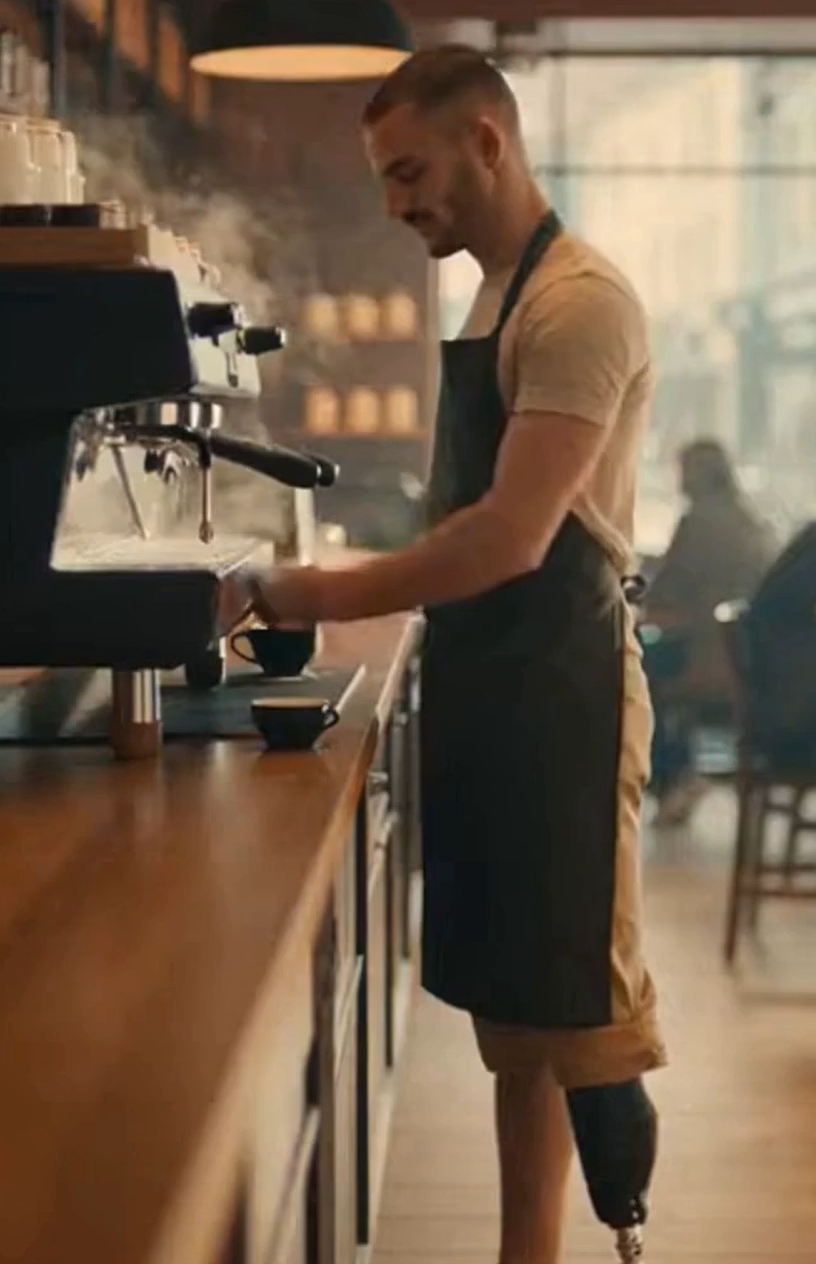
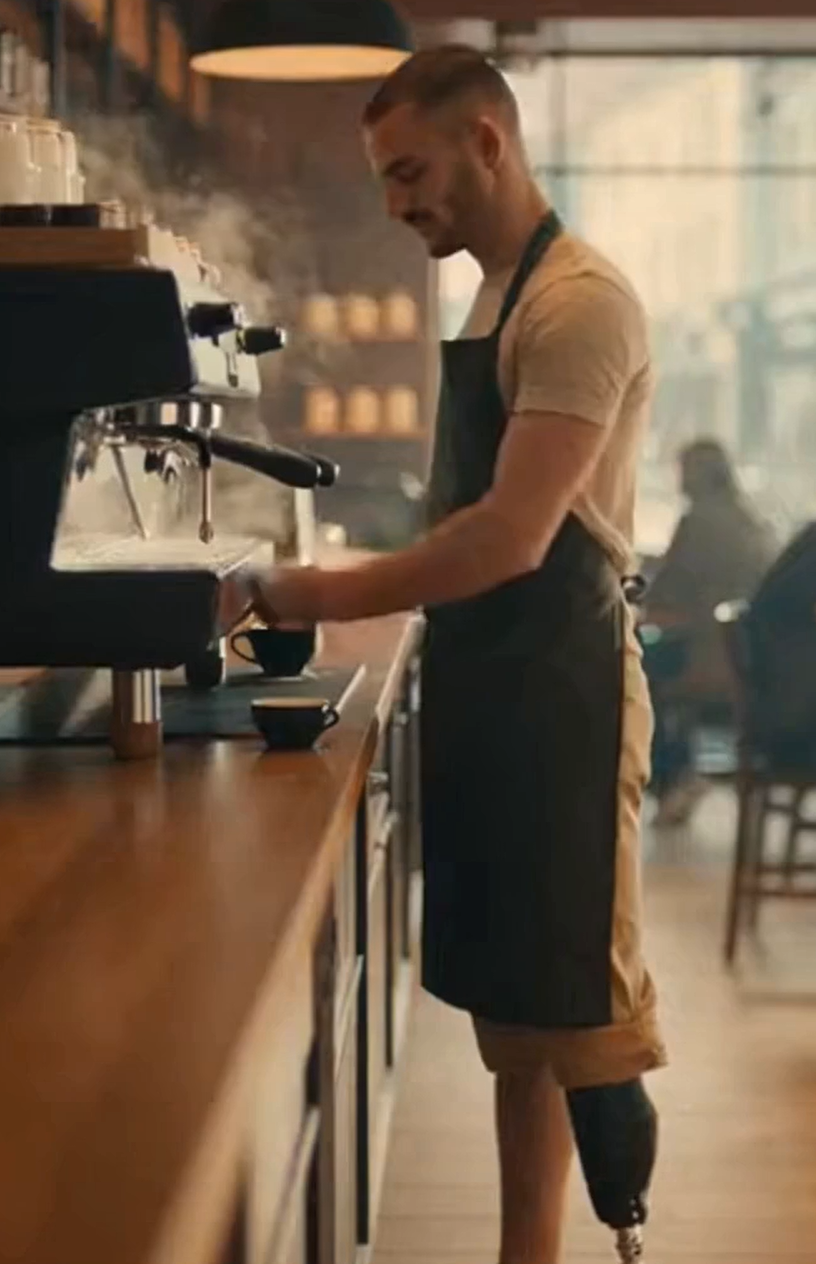
Marcus had served two tours in Afghanistan. His left leg ended just below the knee, replaced by a prosthetic he’d learned to walk on with barely a limp.
He worked the morning shift at Riverside Coffee, starting at 5 a.m., prepping espresso machines before the rush.
He was good at his job. Quiet. Efficient.
He didn’t talk much about the military, and nobody asked.
The incident happened on a Thursday at 7:45 a.m., during the breakfast crush. Marcus was taking orders at the counter when a man in a three-piece suit – expensive watch, manicured nails – stepped up with his phone already in his face.
“Just a black coffee,” the man said without looking at him. “And don’t take forever. I have a 9 a.m.”
“Coming right up,” Marcus said.
Sixty seconds later, Marcus set the cup down. The man glanced at it, took one sip, and pushed it back.
“This is garbage,” he snapped. “Cold. Bitter. Did you even try, or did you just – “
He stopped, his eyes dropping to Marcus’s leg, visible where his work pants ended above the prosthetic. A slow smile crossed his face.
“Oh. That explains it. Can’t expect much from someone who can’t even stand right.”
The coffee shop froze.
A woman in line gasped. A teenager recording TikToks looked up from her phone.
The barista in the back stopped moving.
Marcus’s jaw tightened. He didn’t argue.
Didn’t raise his voice. He just started to turn away, reaching for another cup.
“Wait,” the man called, louder now, for the room. “What’s your name? I want to report you to the manager.”
“Or does your—” he gestured mockingly at Marcus’s leg, “—condition prevent you from doing that too?”
The phone girl was recording now. So was someone by the sugar station.
Marcus could feel it. The heat of stares. The weight of judgment.
Then the back door opened.
The manager didn’t walk out. The owner did. Patricia Valdez, who’d opened Riverside fifteen years ago, who came in on Thursdays to check inventory and count receipts.
She walked straight to the counter and stopped next to Marcus.
“That coffee was perfect,” she said quietly to the man. “I’ve been watching.”
“You’ve been here seventeen times in the last three weeks. You complained about temperature fourteen of those times. We check our thermometers daily.”
She paused. “You’re a taster. You work for Henderson’s Roastery down the street, trying to sabotage competitors.”
The man’s face went white.
Patricia turned to Marcus and placed her hand on his shoulder. “This is Marcus Rivera. Sergeant. 82nd Airborne.”
“He worked security details for me for two years after he got out—unpaid—because the VA was slow with his benefits. He trained every person behind this counter on our standards.”
She looked back at the man. “He did this morning’s cupping. He’s my head of quality control.”
“His leg doesn’t affect his palate or his character.”
The man started backing toward the door. His polished shoes scuffed on the floor.
“I’m calling Henderson’s,” Patricia said, her voice firm but not shouting. “They’re going to know exactly what you’ve been doing.”
The phone girl kept recording. The woman in line was on her own phone now. Someone was already texting.
Marcus felt Patricia squeeze his shoulder once more. When she looked at him, her eyes were steady.
“Thank you for being here,” she said. “For being who you are.”
The man pushed through the door and disappeared into the morning.
But Marcus stood there, seeing his reflection in the espresso machine—seeing it differently now—while dozens of phones had captured everything.
The silence broke. A customer started clapping.
Then another joined in, and another, until the whole shop was filled with applause.
Marcus felt a flush of heat rise up his neck. This was worse than the insult.
He wasn’t a hero. He was just a guy trying to get through the day.
The teenager who had been recording, a girl with bright pink hair, walked up to the counter. She looked about sixteen.
“I’m so sorry,” she said, her voice genuine. “That guy was a total jerk. I got it all on video.”
“I’m posting it,” she added, as if it were the most natural thing in the world. “People need to see this.”
Marcus just nodded, unable to find the words. He wanted the floor to swallow him whole.
Patricia handled the rest. She gave everyone in the shop their coffee on the house, her calm demeanor settling the room back into a gentle hum.
By noon, Marcus’s phone was buzzing nonstop. Friends from his old unit were texting him links.
The video was everywhere. It had a name: “Coffee Shop Justice.”
He watched it once. He saw the flicker of pain in his own eyes before the mask of indifference slid back into place.
He saw the man’s cruel smirk. He saw Patricia’s quiet, unshakeable strength.
He hated it. He hated being seen like that—as a victim, as a symbol.
The next day, a news van was parked outside Riverside. Marcus called in sick.
Patricia didn’t question it. “Take the day, Marcus. Take tomorrow too if you need it.”
He spent the day in his small apartment, the blinds drawn, ignoring the world.
He thought about not going back. Maybe he could find another job, somewhere even quieter, more anonymous.
But then he thought of Patricia. She had stood up for him when he wouldn’t stand up for himself.
He owed her more than that.
On Saturday, he went in for his shift. The shop was busier than he’d ever seen it.
People came in not just for coffee, but to shake his hand. To thank him for his service.
It was awkward and overwhelming. He just wanted to pour espresso and steam milk.
Around 10 a.m., an older man in a simple but well-tailored suit walked in. He looked out of place, nervous.
He walked past the line and came straight to the counter where Marcus was working.
“Are you Marcus Rivera?” the man asked. His voice was raspy, tired.
Marcus braced himself. “I am.”
“My name is George Henderson,” the man said. “I own Henderson’s Roastery.”
Marcus’s hands stopped moving. The whole shop seemed to go quiet again.
“I am here,” Mr. Henderson continued, looking Marcus directly in the eye, “to offer my most profound and sincere apology.”
“What Arthur Vance did was despicable. It does not represent my company or my values.”
He looked around the bustling shop. “He was fired yesterday morning. Effective immediately.”
Marcus didn’t know what to say. He just nodded.
“That’s not enough, though,” Mr. Henderson said. “An action like that… it leaves a stain.”
Patricia came over from the back office, sensing the shift in the atmosphere. She stood beside Marcus again, a silent pillar of support.
“Mr. Henderson,” she said, her tone neutral.
“Patricia,” he acknowledged with a sad nod. “I am so sorry for what my employee put your business through. And what he put your friend through.”
He turned back to Marcus. “I understand you’re the head of quality control here. That your palate is second to none.”
Marcus felt a little uncomfortable with the praise. “I just know good coffee.”
“As do I,” Mr. Henderson said. “And I know that what Arthur did wasn’t just about being a bully.”
This was the first twist. The story was bigger than one awful man.
“He was a senior VP,” Mr. Henderson explained, his voice low. “He was pushing a very aggressive growth strategy.”
“A strategy that involved identifying successful independent shops, undermining their reputation, and then pressuring them into a buyout at a low price.”
Patricia’s eyes widened slightly. She had suspected competition, but not a predatory attack.
“He was trying to ruin you,” Mr. Henderson said bluntly to her. “So he could buy you for pennies on the dollar.”
“His behavior toward you, Sergeant Rivera, was part of that. Create a public scene, file false complaints, damage the brand.”
The pieces clicked into place for Marcus. The man’s arrogance. His deliberate, theatrical cruelty.
It wasn’t just a moment of spontaneous nastiness. It was a calculated tactic.
“I started this roastery thirty years ago with my father,” Mr. Henderson went on, his gaze distant. “We believed in community. In lifting each other up.”
“Somewhere along the way, I let people like Arthur convince me that business had to be… ruthless. I almost lost my company’s soul.”
He looked from Patricia to Marcus. “That video… it was a wake-up call for me. It wasn’t just about one man’s bigotry. It was about the culture I had allowed to fester.”
He took a deep breath. “I want to make it right. Not with a check, but with a partnership.”
Patricia folded her arms. “A partnership?”
“I have a new coffee bean I’ve been developing. A single-origin from a small cooperative in Colombia. It’s exceptional.”
“I want to offer it to you. Exclusively. For the first year, at my cost. No profit for me.”
It was an incredible offer. A bean like that could put Riverside on the map, far beyond their local fame.
“Why?” Marcus asked, finally finding his voice.
“Because it’s the right thing to do,” Mr. Henderson said simply. “And because I have another idea.”
He looked at Marcus, and for the first time, a small, hopeful smile touched his lips.
“I’ve read about your service. I know the transition to civilian life can be difficult. Finding a purpose.”
“I want to fund a program, to be run right here, out of Riverside. A training program for veterans.”
“We’ll teach them everything. Roasting, cupping, sourcing, machine maintenance, business management. We’ll call it the ‘Sergeant’s Blend Program’.”
Marcus was floored. Him? Run a program? Teach people?
He was a quiet guy who liked the predictable rhythm of a morning shift. He wasn’t a leader anymore.
“I… I don’t know,” Marcus stammered. “I’m not a teacher.”
“You trained everyone on my staff,” Patricia reminded him gently. “You taught them to care about the details.”
“You led men in combat, son,” Mr. Henderson added softly. “I think you can teach a few folks how to pour a latte.”
The offer hung in the air, heavy with possibility.
Over the next week, Marcus wrestled with it. The idea terrified him.
It meant being visible. It meant being responsible for other people’s hopes.
He visited the local VA center, a place he usually avoided. He saw the young men and women there, their eyes a little lost, just like his had been.
He saw them struggling to connect, to find their footing in a world that no longer operated on missions and clear objectives.
He talked to his old platoon sergeant on the phone, a man named Frank who now ran a small hardware store in Texas.
“You’re telling me some rich guy wants to pay you to drink coffee and talk to vets?” Frank had laughed. “What’s the problem?”
“I’m not that guy anymore, Frank,” Marcus confessed. “The guy who led patrols. I’m… quieter now.”
“Quiet isn’t the same as weak, Marcus,” Frank said. “You think those kids at the VA need a drill sergeant yelling at them? No.”
“They need someone who gets it. Someone who knows what it’s like to feel like a part of you is missing, and not just the part a doctor can see.”
Frank’s words stuck with him.
He met with Patricia and Mr. Henderson again. They laid out the plan.
A new training space would be built in the back of Riverside, funded by Henderson’s.
Veterans would be paid during their training. They would be guaranteed job interviews at Henderson’s, Riverside, and other local cafes they would partner with.
Marcus’s role would be to design the curriculum and be the lead instructor.
He stood in the back room, a dusty storage area, and tried to picture it. He tried to picture himself at the front of a room, teaching, mentoring.
He thought about the man in the suit, Arthur Vance. He thought about how small and powerless the man’s insult had made him feel.
But then he thought about Patricia’s response. And Mr. Henderson’s.
Their actions weren’t about revenge. They were about building something better in the wake of something ugly.
“I’ll do it,” Marcus said, his voice steadier than he expected. “I’ll do it.”
The next six months were a blur of activity. Construction crews transformed the back room into a state-of-the-art training lab.
Mr. Henderson was true to his word, providing the best equipment. He was at the shop often, not as a corporate titan, but as a partner, asking Marcus for his opinion on everything.
The girl with the pink hair, whose name was Maya, became a regular. She was studying graphic design and marketing.
She designed a logo for the Sergeant’s Blend Program pro bono. A coffee cup with a single chevron stripe. Simple. Strong.
The story of the partnership spread, a tale of redemption and community that people were hungry for.
Riverside Coffee became a landmark. Not just a place for a good brew, but a place that stood for something.
The day the first class of six veterans started, Marcus felt that old familiar anxiety.
But as they filed in—three men, three women, all with the same wary, hopeful look in their eyes—he felt something else, too.
A sense of purpose. A mission.
He started simply. “My name is Marcus,” he said. “And the first thing we’re going to learn is that good coffee is about respect.”
“Respect for the bean, for the machine, and for the person you’re serving.”
He found his rhythm. He taught them how his prosthetic didn’t stop him from bracing himself for a perfect espresso pull.
He used his military discipline to explain the precision of temperatures and measurements. He used his experience as a leader to encourage them when they got frustrated.
He wasn’t the sergeant from Afghanistan anymore. But he wasn’t just the quiet barista, either.
He was a bridge between those two worlds.
One afternoon, months into the program, he was watching a young Marine veteran named Celia expertly steam milk, her focus absolute.
She had been the quietest of the group, struggling with anxiety since her discharge. Now, she was a natural.
Marcus caught his reflection in the glass of the training room door. He saw himself standing tall, a genuine smile on his face.
He saw the students behind him, focused and engaged. He saw a community they had all built together.
He no longer saw a broken soldier staring back at him. He saw a man who had taken the ugliest moment of his new life and, with the help of good people, had turned it into his finest hour.
The incident at the coffee shop had not defined him by his wound. Instead, it had revealed his strength.
Sometimes, life’s cruelest moments aren’t the end of the story. They are the unexpected beginning of a new chapter, one where our deepest scars become the source of our greatest purpose.