
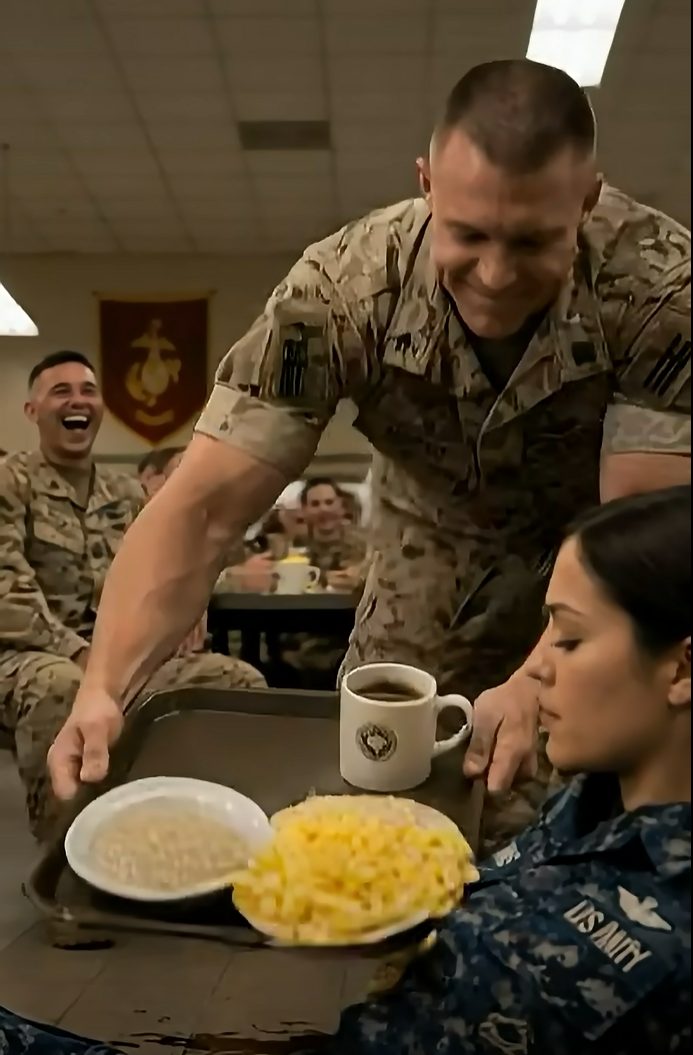
The Day an Arrogant Marine Knocked My Lunch to the Floor
He thought he was putting a “weak” Navy woman in her place. I stayed silent, took the insult, and watched him dig his own grave – because when my real record finally came out, the whole base learned how dangerous it is to mock the wrong person.
—
My name is Rachel Voss, and the first time Gunnery Sergeant Derek Mercer humiliated me, he did it in front of half the mess hall at Camp Barrett.
He came through the line loud, broad-shouldered, and wrapped in the kind of confidence young Marines wear like body armor. I was carrying a tray – coffee, scrambled eggs, toast, a bowl of oatmeal I barely had time to eat before reporting to the admin building. I kept my eyes down, not because I was afraid, but because I had learned a long time ago that silence reveals more than anger ever will.
Mercer stepped sideways at the last second and drove his shoulder into my tray.
Coffee splashed across my sleeve. The bowl hit the floor and rang out against the tile. A few people laughed. He looked down at the mess, then up at the rank on my chest, and let a grin spread across his face that told everyone in the room exactly how sorry he wasn’t.
“My bad, Petty Officer,” he said. “Didn’t see you there. Guess desk people should stay near their desks.”
The lance corporal behind him laughed harder than the moment deserved. Mercer leaned in just close enough for the people nearest to us to hear.
“This is a Marine base. Don’t act like you belong in our way.”
I bent down and picked up the tray. As I straightened, I felt the old scar on my left forearm pull tight beneath my sleeve – crescent-shaped, pale, and permanent. A breaching charge in Helmand Province had left it there, detonating half a second off timing while I was still too close to the door frame. Mercer didn’t know that. Nobody in that mess hall did. On paper, I was attached to interservice logistics support. On paper, I had no business being anywhere near field evaluations, urban assault planning, or casualty extraction drills.
On paper, I was exactly what he thought I was.
I set the tray on the nearest table, picked up what hadn’t shattered, and walked back through the line without a word. I didn’t look at Mercer. I didn’t look at the lance corporal still smirking behind his hand. I got a fresh cup of coffee, found a seat near the window, and ate what was left of my breakfast while the noise of the mess hall settled back around me like nothing had happened.
Because for me, nothing had. I had been in rooms where the wrong word got people killed. I had held a tourniquet on a man’s thigh for forty minutes in a drainage ditch outside Sangin while we waited for extraction and he told me about his daughter’s name. I had been the only woman in a six-person team that the official record still describes as a “research and assessment unit,” because that’s what the official record is allowed to say.
A man mocking my rank in a cafeteria was not a problem. It was barely an inconvenience.
What it was, though, was a data point.
—
Mercer had been at Camp Barrett for eleven months when I arrived. He ran PT like a performance, loud and theatrical, the kind of sergeant who needed an audience to feel effective. He was good – I’ll give him that. Strong, technically sound, respected by his junior Marines in the way that men who project certainty always get respected before anyone has had time to test them.
He had also, I would learn, made a habit of making life uncomfortable for anyone he decided didn’t belong. Two female Navy corpsmen had requested reassignment in the six months before I got there. A quiet Army captain attached to a joint planning cell had simply stopped eating in the mess hall altogether. Nobody had filed anything formal. Nobody ever does, when the person making things difficult is loud enough and connected enough and good enough at his actual job that the path of least resistance is just to move around him.
I was not going to move around him.
But I was also not going to confront him. Not yet. Not directly. Because I had learned – in places I’m still not fully at liberty to describe – that the most effective response to someone who underestimates you is to let them keep doing it, right up until the moment it costs them something they can’t get back.
So I watched.
I watched how he talked to his Marines when he thought no one senior was paying attention. I watched how he handled the joint planning sessions I was technically only there to observe. I watched the way he performed competence differently depending on who was in the room – sharper and more careful when the brass was present, sloppy and dismissive when it was just the working-level people grinding through logistics.
I took notes. Not in a notebook. In my head, the way you learn to do when you’ve spent enough time in environments where a notebook is a liability.
And I waited.
—
The evaluation came six weeks after the mess hall incident.
It wasn’t my evaluation. It was a joint readiness assessment – a tabletop exercise followed by a field component, designed to stress-test the interoperability between the Marine units at Barrett and the various attached personnel from other branches. My role, officially, was administrative support for the Navy side of the assessment team.
Mercer’s role was to lead the Marine element through the field component.
The scenario involved a simulated hostage extraction from a fortified structure, with a secondary objective of identifying and neutralizing a mock IED cache before the extraction team made entry. It was the kind of problem I had run variations of more times than I could count, in conditions considerably less comfortable than a training range in Virginia.
The colonel running the assessment was a man named Hargrove. I had met him once before, briefly, in a context I wasn’t going to bring up unless I had to. He didn’t recognize me, which was fine. That happened sometimes, with people who had only seen me in kit, in low light, under a different name attached to a different unit designation.
Mercer ran his element hard and fast and made three critical errors in the first forty minutes.
He bypassed the secondary IED indicators because his timeline was tight and he was confident in his read of the structure. He stacked his entry team on the wrong side of the breach point, which in a live scenario would have funneled them directly into the most likely field of fire from the interior. And when the simulated casualty event was introduced – a role-player going down with a mock sucking chest wound thirty meters from the objective – he left the assessment of that casualty to a lance corporal who hadn’t completed his combat lifesaver recertification.
I watched all of it from the observation position I had been assigned, clipboard in hand, saying nothing.
After the field component ended and the debrief began, Hargrove went around the room asking for observations. He got to me last, almost as an afterthought, the way people get to the administrative support person when they’ve already covered everything they think matters.
“Petty Officer Voss,” he said. “Anything to add?”
I looked at my clipboard, then at Mercer, then at Hargrove.
“Three things,” I said.
—
I didn’t humiliate him. I want to be clear about that, because humiliation wasn’t the point and it wasn’t something I was interested in. I laid out what I had observed, specifically and without editorializing, in the same flat tone I would have used writing an after-action report in a forward operating base with sand in my teeth and no sleep for thirty hours.
The IED indicators he had bypassed. The entry stack position and what it would have meant for the first two men through the breach. The casualty assessment gap and the certification status of the Marine he had assigned to cover it.
The room got quiet in a particular way. Not the quiet of people who are surprised, but the quiet of people who are recalibrating.
Mercer stared at me. I could see him trying to reconcile the woman he had shoulder-checked in the mess hall with the woman currently walking his colonel through the tactical failures of his field element with the calm specificity of someone who had done this before. Many times. In places where the failures weren’t simulated.
Hargrove asked me two follow-up questions. I answered them. He made notes.
Then he looked at Mercer and said, very quietly, “Is there anything you want to walk back from your initial assessment of the secondary approach?”
There wasn’t. There couldn’t be. The record was the record.
—
What happened after that unfolded the way these things do – not dramatically, not with any single moment of public reckoning, but in the slow and thorough way that institutions process information when the information matters.
Hargrove, it turned out, had made some calls after the debrief. He had looked into who I actually was, which required a few calls that went through channels most people at Camp Barrett didn’t have access to. What came back was not my full file – most of my full file doesn’t come back when people make those calls – but enough. Enough to explain why a Navy petty officer attached to logistics support knew what angle of entry minimized exposure to interior fire from a fortified structure, and why she had an opinion about IED indicator protocols that was worth hearing.
I don’t know exactly what was said. I wasn’t in those conversations. But within two weeks, three things had changed.
Mercer had been assigned a remedial review of his field assessment protocols, mandatory and documented. The joint planning cell had a new standing policy requiring all attached personnel – regardless of branch or apparent role – to be included in full debrief sessions rather than treated as observers. And I had received a quiet, private visit from Hargrove himself, who sat across from me in a small office near the admin building and looked at me for a long moment before he spoke.
“I owe you an apology,” he said. “Not for anything I did directly. But for the environment.”
“It’s a common environment,” I said.
“That’s not a defense.”
“No,” I agreed. “It isn’t.”
He asked me, carefully, whether I wanted to pursue anything formal regarding the mess hall incident. I told him I didn’t. Not because it hadn’t mattered, but because what had happened in the debrief room had mattered more, and in a more lasting way, and that was enough.
He nodded like he understood. I think he did.
—
Mercer found me three days later.
Not in the mess hall. In the corridor outside the planning cell, late in the afternoon when most people had already cleared out. He stopped when he saw me, and for a moment I thought he was going to say something sharp, something defensive, the way men sometimes do when they’ve been embarrassed and haven’t finished processing it yet.
Instead he stood there for a few seconds, and then he said: “Helmand?”
He must have heard something. Not everything – you never hear everything – but something.
“Among other places,” I said.
He nodded slowly. He looked like a man doing math he didn’t enjoy.
“I didn’t know,” he said.
“I know you didn’t.”
“That’s not – ” He stopped. Started again. “That’s not actually an excuse.”
I looked at him for a moment. He was right. It wasn’t. And the fact that he knew it was right, and said it anyway, was the first thing he had done since I arrived at Camp Barrett that I respected.
“No,” I said. “It isn’t. But it’s a start.”
I walked past him down the corridor. I didn’t look back. I had a report to finish and an early PT session the next morning, and the scar on my forearm had stopped pulling tight weeks ago, the way scars do when the weather settles and the body remembers it has already survived the thing that made them.
I had survived considerably worse than Gunnery Sergeant Derek Mercer.
The difference was, now he knew it too.
If you want to read more stories about people who got what was coming to them, check out how a K9 locked eyes on a drunk soldier who got in a K9 handler’s face, or the towel-clad fighter who brought down a Marine. And for another dose of cafeteria drama, don’t miss the confrontation that uncovered Staff Sergeant Benson’s hidden truth.



