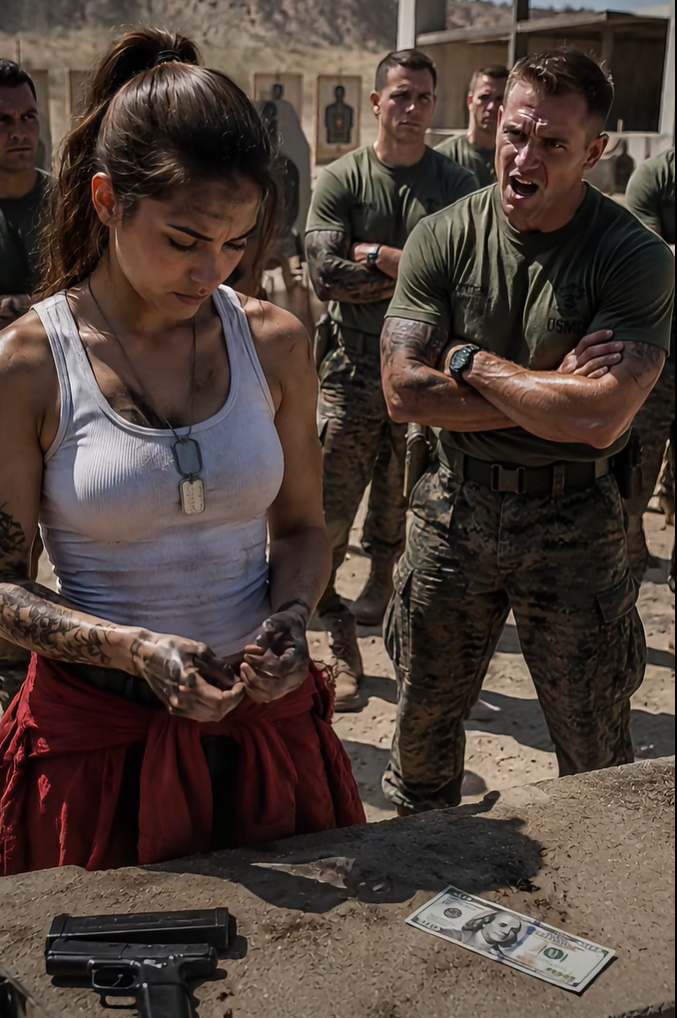
The Arizona sun hammered down on Fort Ironwood like divine judgment. Dust hung suspended in the air. Every soldier on the firing range had frozen in place. Even the wind refused to move.
Major General Wendell Hargrove stared at the tattoo across my bare back as if the devil himself had clawed his way out of hell.
“That’s… not possible,” he whispered, voice breaking.
I turned slowly, letting the full symbol face him: a raven locked inside a deadly sniper crosshair – the mark of Wraith Unit Seven.
A unit the Army had officially buried eight years ago.
Including me.
The young lieutenant behind the general let out a nervous laugh. “Sir… you know this guy?”
Hargrove didn’t answer. His eyes remained locked on mine, desperately searching for the ghost he thought he’d put in the ground.
“Rowan…” he breathed.
My real name sounded foreign after eight silent years.
Rifles lowered across the range. Conversations died. Hundreds of soldiers now stared openly.
I picked up the rifle receiver at my feet and calmly brushed the dust from the metal.
“You still recognize your dead men, General,” I said, voice cold and steady. “How reassuring.”
A colonel stepped forward. “Sir, what the hell is this?”
Hargrove’s jaw clenched like iron. “You were declared KIA.”
“No,” I replied, locking eyes with him. “I was betrayed and abandoned.”
The silence that followed was heavier than artillery fire.
Hargrove took one careful step closer. “You don’t understand what happened that night.”
A bitter smile cut across my face.
“Oh, I understand perfectly, sir.” I reached into my back pocket and pulled out a folded piece of paper, yellowed at theedges, stained dark in one corner. “I’ve been carrying this for eight years. Waiting for the day I could hand it back to the man who signed it.”
I held it up so the colonel could see.
Hargrove’s face drained of every drop of color. His knees actually buckled for a second before he caught himself on the lieutenant’s shoulder.
“Where did you get that,” he whispered. It wasn’t a question. It was a prayer that the answer would be a lie.
“From the body of the man you sent to finish the job,” I said. “He talked a lot before the end. Especially about who gave the order. Especially about the other four names on this list.”
The colonel snatched the paper out of my hand before Hargrove could move. He unfolded it. Read it. Read it again.
Then he slowly turned and looked at the General – not like a subordinate looks at a commanding officer.
Like a cop looks at a suspect.
“Sir,” the colonel said quietly, his hand drifting toward his sidearm, “I’m going to need you to come with me.”
But Hargrove wasn’t listening. He was staring past all of us now, toward the front gate of the base, where a black SUV had just rolled to a stop.
The back door opened.
And the woman who stepped out into the Arizona sun was someone every single man on that range had attended the funeral of.
Sergeant Isabella Garcia. The best damn spotter Wraith Seven ever had.
She pulled a pair of aviator sunglasses from her face, her eyes scanning the bizarre tableau on the firing range. Her gaze passed over the shocked soldiers, over the stunned colonel, over me. It landed squarely on the crumbling form of General Hargrove.
A strange, weary softness entered her expression. It was not the look of a vengeful ghost.
Then she spoke, her voice clear and carrying in the sudden stillness. “Rowan,” she said, her eyes now finding mine. “Stand down.”
My whole body tensed. Stand down? After eight years of running, of hiding, of fueling myself with this single moment of confrontation?
“Izzy, what are you doing here?” I asked, my voice rough with confusion.
She took a few steps forward, her boots crunching on the dusty ground. She ignored my question, her focus still on the general who was now visibly shaking.
“It’s over, Wendell,” she said, her voice surprisingly gentle. “You can let it go.”
At the sound of his first name, used with such familiarity, General Hargrove finally broke. His shoulders sagged, the iron rod of his military bearing dissolving into dust. He fell to his knees, his hands covering his face as a ragged sob escaped his throat.
The entire base watched a two-star general weep in the dirt.
The colonel, a man I’d now come to know as Colonel Matthews, looked utterly bewildered. He glanced from me, to the crying general, to the woman who was supposed to be dead.
“Can someone please tell me what is going on?” Matthews demanded, his voice fraying at the edges.
Izzy walked right up to me, her eyes boring into mine. For a moment, I saw the ghost of the woman I once knew, the one who could read my thoughts from two klicks away through a sniper scope.
“You think he betrayed us,” she said. It wasn’t a question.
“He signed the order,” I ground out, gesturing with my chin toward the paper in Matthews’ hand. “He sent a cleaner. I was there.”
“You were there, and you were wrong,” she countered, her voice firm. “You saw what you were meant to see. You reacted how they knew you would react.”
My world, which had been so starkly black and white for 2,922 days, suddenly fractured into a million shades of gray.
“I don’t understand,” I finally managed to say.
General Hargrove slowly got to his feet, wiping his face with the back of his hand, leaving a smear of dirt across his cheek. His eyes were red-rimmed but clear, as if a great pressure had finally been released.
“He’s right to be confused, Sergeant Garcia,” Hargrove said, his voice hoarse. “I’m the one who made him a ghost.”
He looked at Colonel Matthews. “Colonel, I need a secure room. Now. No questions, no reports. Just you, me, and the members of Wraith Unit Seven.”
Matthews hesitated for only a second before giving a curt nod. “This way.”
We walked past rows of stunned soldiers, a living ghost, a dead-again spotter, a disgraced general, and a very confused colonel. We ended up in a small, windowless briefing room in the base command center. The second the door was sealed, the oppressive silence returned.
Hargrove slumped into a chair, looking decades older than he had on the range.
“Eight years ago,” he began, his voice barely a whisper. “Wraith Seven was on a covert mission in the Hindu Kush. Your objective was to retrieve intel from a warlord’s compound.”
“Intel we got,” I said, the memory still sharp as broken glass.
“Yes, you did,” Hargrove nodded. “You got a ledger. A ledger that detailed off-the-books payments from a U.S. defense contractor to fund terrorist activities, making certain regions unstable to justify weapons contracts.”
Izzy picked up the story. “The operation was a setup. The contractor, a man named Alistair Finch, had someone powerful on his payroll. Someone in Washington.”
“Senator Thompson,” Hargrove said, the name dropping into the room like a grenade. “He was chair of the Armed Services Committee. When he found out you had the ledger, that you were flying out with it, he initiated a contingency plan.”
My blood ran cold. “The ambush at the extraction point.”
“It wasn’t an ambush, Rowan,” Hargrove said, leaning forward. “It was a kill order. A direct order from Thompson, using back channels, to have a Reaper drone strike your position and attribute it to enemy fire. He was going to wipe the slate clean.”
I stared at him, my mind reeling. “But the strike never came.”
“Because I stopped it,” Hargrove said, his eyes pleading with me to understand. “I got a tip from a source in the Pentagon, minutes before the launch. I couldn’t officially abort the strike without revealing my source and getting us both buried. So I did the only thing I could.”
He paused, taking a deep, shuddering breath.
“I logged a catastrophic system failure on the drone. I grounded the Reaper. And I declared all six members of Wraith Unit Seven killed in action in a tragic helicopter crash.”
The room was silent. I looked at Izzy, who was watching me, her expression unreadable.
“I buried you to save you, Rowan,” the general whispered. “Thompson couldn’t hunt ghosts. Declaring you dead was the only way to get his eyes off you.”
My throat was tight. The anger that had been my fuel for eight years was sputtering, dying.
“The man you sent,” I said, my voice cracking. “The one I… the one who died. The paper.”
Hargrove closed his eyes. “That was Master Sergeant Phillips. My most trusted man. He wasn’t a cleaner. He was an extractor. His job was to find each of you, to give you a new identity, a new life, and the resources to stay hidden.”
I felt nauseous. I remembered the fight in that filthy European alley. The desperation in Phillips’ eyes. He wasn’t trying to kill me. He was trying to talk to me, to give me something, but I was a cornered animal. I saw a weapon, a threat, and I reacted.
“The paper,” I croaked, pointing at the document Matthews was still holding like it was a live bomb.
Matthews unfolded it and placed it on the table.
“That’s not a kill order, Rowan,” Izzy said softly, her hand resting on my forearm. “Turn it over.”
I reached out with a trembling hand and flipped the faded paper. On the back, in faint, handwritten script, were six addresses. Six new names. Six sets of bank account numbers.
The list wasn’t for the undertaker. It was for us. The four other members of our team, me, and her.
The dark stain on the corner wasn’t ink. It was Phillips’ blood.
“He was trying to give it to you,” Hargrove said, his voice thick with grief. “He was trying to save you. And you killed him.”
The weight of it hit me like a physical blow. The man I had celebrated killing, the man who represented my enemy, was a hero who died trying to help me. The foundation of my entire existence for nearly a decade was a lie, a tragic, bloody misunderstanding.
“After you disappeared with the list,” Izzy continued, “Hargrove couldn’t risk sending anyone else. He had to assume the other four members of the team were either dead or too deep in hiding. He found me a year later, living in a small town in Oregon. He told me everything.”
“You knew?” I asked, looking at her in disbelief. “You knew, and you let me go on thinking…”
“He couldn’t find you, Rowan!” she shot back, a flash of the old Izzy fire in her eyes. “You’re a ghost. You’re what he trained you to be. We had no idea where you were, or even if you were alive, until your fingerprints popped up on an employment screening for a civilian contractor position here. At Fort Ironwood.”
It was my plan for the perfect revenge. Get a job on the General’s own base, get close to him, and expose him in the most public way possible. I thought it was genius. It was just foolish.
“I have spent eight years trying to bring Senator Thompson down,” Hargrove said, his voice now full of steel. “Every move I made, every promotion I took, was to get into a position where I could finally make him pay for what he did to my soldiers. The original ledger was destroyed in the chaos, but I have been building a new case. All I needed was proof. I needed one of you to come back from the dead.”
He looked at me. “Your arrival, as theatrical and painful as it was, might be the very thing that saves us all.”
Just then, Colonel Matthews’ phone buzzed. He answered it, listened for a moment, and his face went pale.
“Sir,” he said to Hargrove. “There’s a team of federal agents at the front gate. They have a warrant for the arrest of two domestic terrorists. They have names, sir. Rowan Calloway. And Isabella Garcia.”
Thompson was moving. He knew we were here. He was shutting it down, just like he tried to do eight years ago.
Hargrove stood up, his transformation complete. The weeping man was gone. Major General Wendell Hargrove, commander of Fort Ironwood, was back in charge.
“Colonel, lock this base down. No one gets in or out without my direct authority. Tell the gate guards those men are not federal agents. They are private military contractors working for Alistair Finch. They are to be considered hostile.”
Matthews nodded sharply. “Yes, sir.”
“Izzy,” Hargrove commanded. “I need you in the comms center. Coordinate with Matthews. I want eyes on every corner of this base.”
“And me?” I asked, standing up. The confusion was gone, replaced by a cold, familiar clarity.
Hargrove looked at me, a glimmer of the old pride in his eyes. “You, Sergeant, are going to do what you do best. You’re going to hunt.”
The next hour was a whirlwind. Izzy became a conductor of chaos, her voice calm and steady over the base-wide radio, directing units to cut off access points. Matthews, fully believing us now, mobilized his military police with an efficiency that was both terrifying and beautiful.
I wasn’t a ghost anymore. I was a weapon, unshackled. With a rifle I “borrowed” from the arms room and a map of the base from Hargrove, I moved through the shadows of the place I had planned to burn to the ground.
Finch’s men were professionals, but this was our turf. I used the ventilation systems, the maintenance tunnels, the very infrastructure of the base against them. One by one, using non-lethal force, I helped Matthews’ MPs neutralize the strike team.
The final two were in the main administration building, heading for the command center. Heading for Hargrove.
I got there first. They came around the corner, and I was just a shadow in a hallway. They never saw me. Two swift, silent take-downs, and it was over.
As the MPs cuffed the last of Finch’s men, General Hargrove walked out of his office. He looked at the chaos, then at me.
“Senator Thompson and Alistair Finch were taken into custody by federal marshals in Washington not ten minutes ago,” he said. “The evidence from Phillips’ bodycam footage, which we thought was lost, was auto-uploaded to a secure server. My source finally decrypted it this morning. It shows the whole thing. The order from Thompson, the plan, all of it.”
He looked at me, then at Izzy, who had just joined us.
“It’s over,” he said, the words heavy with finality.
In the weeks that followed, the story became national news. A corrupt senator, a criminal defense contractor, and the heroic ghosts of Wraith Unit Seven. We were exonerated, our names cleared and our records reinstated with full honors.
One evening, Izzy and I stood on a small hill overlooking Fort Ironwood as the sun set, painting the sky in shades of orange and purple. We had both been offered new positions, high-level instructor roles at the special warfare school.
“Are you going to take it?” she asked me.
I looked at the base, at the place that held so many ghosts and so much pain. But for the first time, it didn’t feel like a prison. It felt like home.
“I don’t know,” I admitted. “For eight years, all I had was a mission. Revenge. Now that it’s done… I don’t know who I am without it.”
Izzy put her hand on my arm, the same way she had in that briefing room. “You’re Rowan. That’s enough.”
General Hargrove chose to retire. He said the price of his choices had been too high, and he needed to carry that weight in private. Before he left, he handed me Master Sergeant Phillips’ posthumous Medal of Honor. “He died saving my best soldier,” Hargrove had said. “It belongs with you.”
I held that medal now, its weight a constant reminder. A reminder that the world is not simple. That good people can make terrible choices for the right reasons. That a man can salute your grave with a heavy heart, not because he put you in it, but because he couldn’t protect you any other way. The real enemy isn’t always the one you’re pointing your rifle at; sometimes, it’s the misunderstanding that pulls the trigger.
Looking at Izzy, with a future that was a complete blank slate for the first time in my adult life, I realized my mission was never about revenge. It was about finding my way back home. And I finally had.