The tattoo wasn’t pretty.
It wasn’t a butterfly or a quote or a flower like the other girls had hidden under their socks. It was small. Black. Crude. Three jagged lines crossing through a number.
A number Jackson Trent recognized.
A number that should have been impossible for me to have.
“Ross…” he whispered, and his voice didn’t sound like the bully who’d terrorized me for six weeks. It sounded like a little boy who’d just seen a ghost. “Ross, that’s not… that can’t be real.”
Chloe stepped closer, her wet hair dripping onto the tile. “Elena, what is that?”
I didn’t answer her.
I was watching Jackson.
Watching the way his hands shook. The way his knees buckled slightly against the stall door. The way the color kept draining from his face until he looked almost gray under the fluorescent lights.
“My brother had that same tattoo,” I said quietly. “Same spot. Same lines. Same number.”
Jackson made a sound. Half a word. Half a sob.
“Your brother,” he repeated. “Staff Sergeant. David. Ross.”
It wasn’t a question.
The other recruits looked between us, confused, sensing something massive was happening but unable to name it.
I stood up slowly, the ruined boot still dripping in my hand.
“You knew him,” I said.
Jackson’s lip trembled. “Knew him?”
He slid down the stall until he was sitting on the floor. A Colonel’s son. A legacy soldier. The untouchable golden boy of Fort Jackson. Sitting in a puddle on a barracks bathroom floor.
He looked up at me, and his eyes were wet.
“Ross… your brother didn’t just die over there.”
The room held its breath.
“Your brother died saving – “
Footsteps pounded down the hallway. Heavy. Fast. The kind of footsteps that made every recruit snap to attention on instinct.
The bathroom door slammed open.
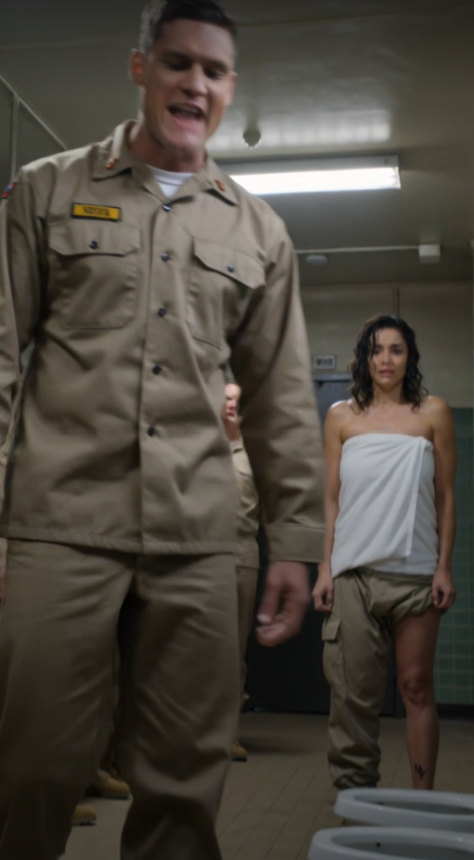
Drill Sergeant Hayes stood in the doorway, chest heaving, eyes scanning the room. But he wasn’t looking at the destroyed boots. He wasn’t looking at Jackson on the floor.
He was looking at my ankle.
And behind him, stepping into the doorway in a uniform covered in more ribbons than I’d ever seen on one chest, was a man I’d only ever seen in a single photograph my brother kept in his footlocker.
He looked at me.
His eyes filled.
And then he said the four words that brought the entire barracks to its knees.
“Your brother saved my son.”
The high-ranking officer’s voice was thick with emotion, but it carried the authority of a lifetime of command. He was a General. General Wallace. The man from the photo.
My mind raced, trying to connect the dots. His son?
My eyes darted from the decorated General to the broken man on the floor. To Jackson Trent.
The General’s son.
The pieces clicked into place with a sickening thud. The bully. The legacy kid. The boy my brother died for.
Drill Sergeant Hayes clapped his hands. “Alright, show’s over! Everybody out! Now!”
The other recruits, wide-eyed and silent, scurried out of the bathroom, leaving the four of us in a vortex of unspoken history.
General Wallace took a step forward, his gaze never leaving mine. “I’m sorry, Private Ross. This is not how I wanted to meet you.”
He looked at Jackson, his expression a painful mix of disappointment and love. “Get up, son.”
Jackson stumbled to his feet, refusing to look at me, refusing to look at his father. He just stared at the grimy tile, a statue of shame.
“My office. All of you,” Hayes barked, his usual ferocity softened by a tension I’d never heard in his voice before.
The walk across the compound was the longest of my life. The world outside the bathroom hadn’t changed, but mine had been turned inside out. The usual sounds of drills and marching were just background noise to the screaming in my head.
General Wallace’s office was sparse but intimidating. A large oak desk, flags standing in the corners, and a single framed photo on the wall. It was a picture of a much younger Jackson, smiling, arm-in-arm with my brother, David. They were both in fatigues, dust on their faces, looking young and invincible.
Seeing them together, as friends, felt like a punch to the gut.
“Sit down, Private,” General Wallace said gently.
I sat. Jackson remained standing by the door, as if ready to flee. Hayes stood at parade rest in the corner, a silent observer.
The General sat behind his desk and folded his hands. He looked old. Tired.
“I tried to contact your family after… after it happened,” he began. “They wouldn’t take my calls. I don’t blame them.”
I said nothing. My parents had been swallowed by their grief. They barely spoke to me, let alone a stranger connected to their son’s death.
“David was a hero,” the General continued. “He was the best soldier I ever had the privilege of knowing. He was my son’s best friend.”
He glanced at Jackson. “And he died because my son froze.”
The words hung in the air, clinical and brutal.
Jackson flinched as if he’d been struck. “Dad…”
“It’s the truth, Jackson. We have to speak the truth now.” He turned his weary eyes back to me. “There was an ambush. An IED. Jackson hesitated. David… David didn’t. He pushed Jackson out of the way. And he took the blast that was meant for him.”
I felt my hands clench into fists in my lap. I had the official report memorized. “Died heroically in the line of duty.” Vague. Clean. Honorable.
This was not clean. This was messy and human and awful.
“The tattoo,” I said, my voice barely a whisper. “What is it?”
“It was their unit,” the General explained. “A small recon team. They called themselves the ‘Phantoms.’ Unofficially, of course. They all got the same tattoo. The three lines for Faith, Family, and Fortitude. The number was the last four digits of their service ID.”
He sighed deeply. “There are only two of them left now.”
My eyes shot to Jackson. He was one of them. He had the same tattoo. He was part of my brother’s tribe, his brotherhood. And he’d spent the last six weeks making my life a living hell.
The question clawed its way out of my throat. “Why?” I asked, looking directly at Jackson for the first time. “Why have you been doing this to me? Ruining my gear? Reporting me for things I didn’t do? Trying to get me kicked out?”
Jackson finally looked at me. His face was a mask of agony.
“Because you don’t belong here,” he choked out.
Rage, hot and pure, surged through me. “I don’t belong here? My brother gave his life for this uniform! My family has served for three generations! You think you get to decide who belongs?”
“No!” he said, his voice cracking. He took a staggering step forward. “That’s not what I mean.”
He ran a hand through his hair, frantic. “When I saw your name on the enlistment roster… Ross. I couldn’t believe it. I thought it had to be a coincidence.”
“Then I saw you on the first day,” he continued, his words tumbling out in a torrent of confession. “And you have his eyes. You have David’s eyes.”
He looked at his father, then back at me. “I couldn’t handle it. Seeing you here. In this place. Knowing what it can do. What it did.”
The hidden twist in his cruelty began to reveal itself, and it was more painful than simple hatred.
“I couldn’t stand the thought of David’s sister… of you… getting hurt. Or worse. Because of this uniform. Because of this life. A life that took him.”
My anger began to flicker, replaced by a bewildering confusion.
“So you tried to get me thrown out?” I asked, incredulous. “You decided to bully me, to break me, until I quit? You thought that was protecting me?”
“Yes,” he whispered, shame bowing his head. “It was stupid. It was wrong. But I just… I thought if you washed out, you’d be safe. You’d go home. You wouldn’t end up like him. I owed him that. I owed him keeping his little sister safe.”
He was trying to protect me by destroying me. It was the most twisted, broken logic I had ever heard.
“You owed him?” I stood up, my chair scraping against the floor. “You owed him to honor his memory! You owed him to be the kind of man he died for! Not this… this coward who tortures his sister out of some misplaced guilt!”
The word “coward” hit him like a physical blow. He recoiled, silent.
General Wallace intervened. “Elena. He is paying for his mistake. Every single day.”
“It’s not enough,” I shot back, tears finally stinging my eyes. My hero brother didn’t die for a coward. He just didn’t.
“Then what is?” the General asked quietly. “What would be enough?”
I didn’t have an answer. I turned and walked out of the office, leaving the General, his broken son, and the ghost of my brother behind me.
The next few weeks were a new kind of difficult. The bullying stopped, replaced by a heavy, suffocating silence. Jackson avoided me at all costs. If we were in the same mess hall, he would leave. If we were assigned to the same detail, he would trade with someone.
Part of me was relieved. Another part was furious. He didn’t even have the courage to face me.
But I started to see things differently. I saw the way Jackson would stay late to help a struggling recruit with their rifle drills. I saw him give his dessert to a kid who was having a bad day. He was quiet, but he was present. He was trying.
I also saw the pain. The way he would sometimes just stop in the middle of the training yard, a distant look in his eye. I knew where he was. He was back in that ambush, watching my brother make a choice.
Our final test before graduation was “The Forge,” a grueling multi-day field exercise designed to push us to our absolute limit. It was miles of marching, obstacle courses, and mock-combat scenarios, all on little to no sleep.
On the final day, we had to summit a steep, muddy hill known as “The Reaper.” It was the last major obstacle before the end.
I was exhausted. My muscles screamed. My pack felt like it was filled with lead. Halfway up the slick incline, my foot slipped. I went down hard, my ankle twisting under me with a sickening pop.
Pain exploded up my leg. White-hot and blinding. I tried to stand, but the moment I put weight on it, I collapsed back into the mud with a cry.
I was done. After everything, I was going to fail, right at the finish line. Tears of frustration and pain streamed down my face.
Recruits streamed past me, offering a quick “You got this, Ross!” but no one could stop. The drill sergeants were screaming. Stopping meant failing the whole team.
Then, a figure stopped beside me.
It was Jackson.
He looked down at me, then at the summit. He could have kept going. He could have left me behind and graduated with honors.
“No,” I grunted through gritted teeth. “Go. Don’t you fail because of me.”
He ignored me. He shrugged off his own pack, letting it slide into the mud. “Give me yours,” he said.
“Trent, what are you doing?” I snapped. “You’ll be recycled! You’ll have to do this all over again!”
“My father told me what you said,” he said, his voice steady as he hoisted my pack onto one shoulder, balancing it with his own. “That I should be the kind of man your brother died for.”
He looked me straight in the eye, and for the first time, I didn’t see a bully or a coward. I saw a soldier.
“David wouldn’t have left a soldier behind,” he said simply. “Neither will I.”
He offered me his hand. “Now, get up, Ross. We’re finishing this.”
I took his hand. He pulled me to my feet, and I leaned on him, my arm slung over his shoulder. He bore my weight without complaint.
Step by painful step, we made our way up that hill. He didn’t just carry me. He talked to me. He told me stories about David. Funny things. The dumb jokes David told. The way he could disarm any tense situation with a stupid grin.
He painted a picture of my brother that I had never known. Not just the hero son, but the friend. The man.
By the time we reached the summit, mud-caked and exhausted, every other recruit was long gone. We collapsed at the top together, two soldiers who had finally found their way.
“Thank you, Jackson,” I whispered, my throat tight.
“He was my brother, too, Elena,” he replied.
We didn’t just pass The Forge. We defined it. Drill Sergeant Hayes was waiting for us at the bottom of the hill. He looked at my ankle, at Jackson supporting me, and a rare, small smile touched his lips. He just nodded and handed us both a water bottle.
At graduation, General Wallace was the one who presented us with our diplomas. When he got to me, he shook my hand firmly. “Your brother would be so proud of you,” he said, his voice thick.
Then he moved to Jackson. He put a hand on his son’s shoulder. “And you,” he said, his voice full of pride. “You finally learned the lesson he taught you.”
Jackson didn’t return to a combat role. He found a different way to serve, a different way to honor David. He applied for and was accepted into the Drill Sergeant Academy. He wanted to be the one to help the next generation of scared recruits, to teach them that courage wasn’t about never being afraid, but about what you do when you are.
The day before he left, he found me by the barracks.
“I wanted you to have this,” he said, handing me a small, worn photograph. It was the same one from his father’s office. David and Jackson, smiling.
“He thought the world of you,” Jackson said quietly. “He talked about his little sister all the time. Said you were tougher than any ten recruits he’d ever met. He was right.”
I held the picture, my thumb tracing my brother’s smiling face. The anger was gone. The hurt was still there, a dull ache where a sharp pain used to be, but it was overshadowed by something else. Understanding.
My brother’s sacrifice wasn’t just about saving one life in a single moment. It was a ripple in a pond. It gave a guilt-ridden boy a second chance to become a good man. It gave a grieving sister a reason to push forward and a deeper understanding of what her brother truly stood for.
David didn’t just die saving a friend. He died creating a legacy of redemption, a lesson passed from one soldier to another. And we, the living, had the honor of carrying it for him.