
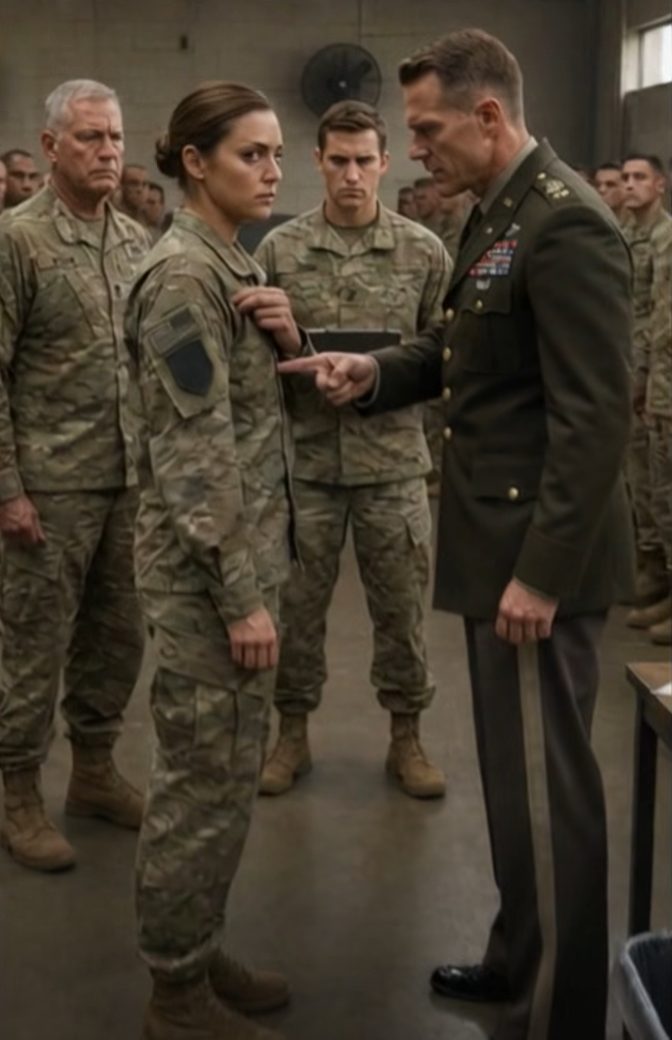
“They Laughed At Her Faded Uniform And Shamed Her In Front Of The Entire Base, Demanding She Rip Off A ‘Fake’ Patch. They Never Knew It Belonged To The Classified Unit That Brought 43 Americans Home Alive – And She Was The Only One Who Survived.
The wool of the uniform coat always held a faint odor of old dust and worn starch, no matter how many times it had been pushed through the industrial washers at Fort Liberty.
Staff Sergeant Maya Vance stood perfectly still in the third row of the logistics support company, her eyes locked on a small, useless crack in the cinder block wall thirty feet ahead of her.
The North Carolina heat had already started pressing down inside the briefing bay like a heavy, wet blanket, drawing sweat from the men and women standing rigidly at attention.
Maya didn’t move even a finger to brush away the bead of sweat tracing its slow line down her temple.
She understood waiting in the dark. She understood silence. She understood places far more dangerous than a damp morning on a stateside military base.
But today, the air was different. It felt narrow, tight, loaded with the kind of petty authority that only grows in rooms far removed from actual front lines.
Along the row of soldiers, the sharp, even clack of polished leather boots signaled the arrival of the inspection team.
Major Bradley Ross headed the walkthrough, his uniform pressed so crisply that the creases looked sharp enough to cut paper.
Ross was a career bureaucrat, a man who had risen through the ranks by mastering logistics systems and ensuring his boots always caught the reflection of the fluorescent lights overhead.
Beside him walked Captain Miller, a younger officer gripping a digital tablet like a shield, his eyes darting from one soldier to the next in search of the smallest violation.
“Keep those heels together, Specialist,” Ross murmured as he passed a young soldier two places down from Maya. “The uniform represents the standards of the United States Army. If you can’t handle your boot laces, how am I supposed to trust you with a supply chain worth millions of dollars?”
The specialist swallowed hard, eyes fixed forward. “Yes, Major.”
Maya continued staring at the crack in the wall.
She knew men like Ross. They flourished in peacetime. They memorized every sentence of Army Regulation 670-1 and wielded the rulebook like a blade to cover the fact that they had never heard gunfire aimed at them.
To Ross, war meant paperwork, inventory sheets, and properly filed documentation. To Maya, war was something that waited behind her eyelids every night she tried to sleep.
The boots stopped directly in front of her.
Maya caught the scent of Ross’s cologne – costly, sterile, and completely wrong inside a motor pool briefing bay.
She felt his eyes travel over her, from her scuffed boots to her carefully pinned hair.
Then the silence stretched out. It lasted just long enough for the soldiers beside Maya to shift their weight almost invisibly, already sensing trouble.
“Staff Sergeant Vance,” Ross said, dropping his voice into a dramatic tone meant to echo through the concrete room.
“Major,” Maya answered, her voice steady, flat, and empty of emotion.
“Captain Miller, read me Staff Sergeant Vance’s current deployment status for the left shoulder,” Ross ordered, never looking away from her.
Miller tapped quickly across the tablet. “Sir, Staff Sergeant Vance is currently assigned to the 4th Logistics Support Battalion. Her uniform should display the standard Support Command insignia.”
Ross bent closer, his face only inches from Maya’s left sleeve.
On her shoulder sat a patch that looked completely out of place among the bright, clean insignia worn by everyone else in the unit.
It was a darkened, muted piece of cloth. Its edges were badly frayed, the green and black threads worn down into a dull, ghostlike gray.
The shape looked like an uneven shield, and if someone stared closely enough, they could barely see the outline of a downward-pointing sword wrapped in a broken chain.
It looked as though it had been pulled through fire, buried under mud, and sewn back together by hands working in the dark.
“What is this, Sergeant?” Ross asked, pointing one carefully groomed finger at the fabric.
“It’s a unit patch, sir,” Maya replied.
“A unit patch?” Ross scoffed, a narrow, mocking smile spreading across his face. “I’ve served fourteen years, Vance. I know every division, every brigade, every detached group from here to Germany. This looks like some garbage you picked up from an airsoft surplus shop to make yourself look like a Hollywood operator.”
Several younger officers behind Ross let out quiet, uneasy laughs.
Maya didn’t blink. Her jaw remained locked.
“It is a non-standard deployment patch, Major,” she said softly.
“Do not lie to me in my own bay,” Ross snapped, his voice turning hard. “Look at the state of this thing. It’s unreadable. It’s fraying. It looks like it belongs in the trash. Look around you. Every soldier in this formation is wearing a clean, regulation insignia. And you show up to my inspection looking like you just crawled out of a trench on a film set.”
“The patch remains on the uniform, sir,” Maya said, her voice sinking lower.
The air in the room seemed to drop ten degrees.
No one spoke to Major Ross that way. Not an enlisted soldier, and certainly not a staff sergeant who had been transferred into a quiet logistics role six months earlier with a personnel file that was mostly blacked out.
“Excuse me?” Ross stepped back, his eyes narrowing. “Captain Miller, does AR 670-1 permit the wear of unidentified, damaged, or unauthorized tactical insignia during a formal base inspection?”
“No, sir,” Miller replied at once, eyes on his screen. “All patches must be clearly legible, approved by the Institute of Heraldry, and represent an active or historically recognized command unit.”
Ross turned toward Maya again, his expression filled with a cruel kind of satisfaction.
“You heard that, Vance? You are not special. You don’t get to create your own dress code because you want to look tough in front of the logistics clerks. This is not a game. This is a professional organization.”
From the back of the bay, an older man stepped forward.
Master Sergeant Marcus “Chief” Evans, a veteran with twenty-six years in uniform and grease permanently darkened beneath his fingernails, cleared his throat.
Evans was the man who truly kept the battalion running, a gruff, broad NCO who spent his days in the grease pits and his nights looking after the lower-enlisted soldiers.
“Major,” Evans said, his voice rough like stones scraping together. “If I may say something, sir. Sergeant Vance’s transfer packet came through a specific command channel. Her file is… restricted. There may be an administrative explanation for the gear.”
Ross spun toward the old master sergeant, glaring. “I don’t care if her paperwork came down from the Pope himself, Chief. I conduct inspections in this battalion. If a soldier is wearing a non-regulation piece of cloth that looks like a scorched dish rag, it comes off. I will not let this unit’s appearance be damaged by an enlisted soldier pretending to be a commando.”
Ross turned back to Maya, stepping close enough that she could see the tiny veins in his eyes.
“Take it off,” Ross ordered. “Right now. Tear it from your sleeve and put it in Captain Miller’s hand.”
The Thing About That Patch
Maya looked at him for the first time.
Not the wall. Not some fixed point in the middle distance. Him. Directly.
Ross didn’t flinch, but something shifted behind his expression. Something small, like a door closing in a room he didn’t know he had.
“No, sir,” Maya said.
The word landed flat and final and without drama. No trembling chin, no clenched fists, no performance of defiance. Just a fact she was stating.
Ross went red from his collar up.
“That is a direct order from a superior officer, Staff Sergeant. You will remove that patch from your uniform or I will have you escorted off this formation and written up before lunch.”
Maya didn’t answer right away. She let the silence sit there between them, and it was the kind of silence that made the younger soldiers in the formation stop breathing.
Evans, in the back, had his eyes fixed on the floor. His jaw was working like he was chewing something.
“Sir,” Maya said, “you are welcome to contact SOCOM J2 at Fort Bragg. Ask for Colonel Dennis Harwick. He will explain the authorization for the insignia. I can wait while you make that call.”
Ross blinked. “I don’t need to call anyone. I need you to – “
“Or you can contact the Office of the Under Secretary of Defense for Intelligence. They have a liaison at the Pentagon. Extension 47-dash-Bravo-9. They’ll also explain it.”
The room was so quiet now that someone could have heard the sweat hitting the concrete floor.
Captain Miller had stopped typing.
What Nobody In That Room Knew
The patch had been sewn onto that coat in a forward operating base that didn’t officially exist, in a province of Afghanistan that most maps didn’t label correctly, by a woman named Sergeant First Class Denise Pruitt who was sitting on an ammo crate and using a needle she’d borrowed from a medic kit.
Pruitt had said, while she was sewing, that the thread she was using was the wrong color and that it was going to look ugly.
Maya had told her it didn’t matter.
Pruitt had said it mattered to her. She’d said she wanted it to look right.
She finished the stitching at 0340 on a Thursday morning in October, four years and two months before Major Ross’s inspection. She handed the coat back to Maya, looked at the patch, and said it still looked ugly but at least it was on there.
Pruitt was dead by Friday.
So were six other members of Task Force Ridgeline.
The task force had operated under a compartmented access program with a name that has never appeared in any public document, any congressional briefing, or any after-action report filed through standard channels. Fourteen soldiers went in. Forty-three American personnel, a mix of intelligence contractors, downed aircrew, and two captured advisors, came out alive because of what those fourteen soldiers did across eleven days in terrain that had no roads and no air support and no resupply.
Seven of the fourteen didn’t walk out.
Maya walked out.
She walked out carrying Pruitt’s dog tags in her left breast pocket, a broken radius she hadn’t reported until they were back across the border, and a coat with a patch sewn on it in the wrong color thread.
She’d worn that coat to every inspection since.
Ross Pushed Again
“I don’t know what kind of game you think you’re playing,” Ross said. His voice had gone quiet, which was worse than when it was loud. “But I will have you in front of a board before the end of the week. I will have that patch documented as a uniform violation and I will have it on your record that you refused a direct order in front of a full formation.”
“Yes, sir,” Maya said.
“You think that’s funny?”
“No, sir.”
Evans took one step forward. “Major, I really think we should – “
“Chief, stand down.” Ross didn’t look at him. “Vance, last chance. Take the patch off or I will take it off for you.”
He reached for her sleeve.
His fingers got within about four inches of the fabric.
The door at the back of the bay opened.
The Door
The sound was wrong for a morning inspection. Too hard. Too deliberate. The kind of push that makes a metal door hit its frame and ring.
Everyone turned.
Two men in civilian clothes walked in. One was in his fifties, gray-haired, with the kind of posture that doesn’t go away after you leave uniform. The other was younger, holding a folder with a red border and a classification header that Captain Miller, standing closest to him, later said he’d never seen on a physical document before.
The older man looked at Ross the way a contractor looks at a wall that’s been painted the wrong color.
“Major Ross,” he said. It wasn’t a question.
Ross straightened. “That’s correct. And you are – “
“Colonel Dennis Harwick, SOCOM J2. This is Mr. Teller from the OSD intelligence liaison office.” He didn’t look at Maya. Not yet. “We were already in the area for an unrelated matter when we got a flag on a personnel inquiry. Your name came up.”
Ross’s face went through several colors.
“I wasn’t – I didn’t make any inquiry, sir. I was conducting a routine – “
“The flag wasn’t from you.” Harwick finally looked at Maya. Something passed across his face. Not warmth exactly. More like recognition, the way you look at someone you served with at a funeral. “Staff Sergeant Vance’s personnel file has a monitoring protocol attached to it. Any attempt to access, modify, or interfere with her assigned equipment or insignia generates an automatic notification.”
Miller’s tablet slipped in his hands. He caught it.
“Interfere,” Ross repeated.
“That patch,” Harwick said, “is not a costume. It is not a surplus purchase. It is a permanently authorized combat service insignia attached to a compartmented program that I am not going to discuss in this room.” He paused. “What I will tell you, Major, is that the soldiers who wore that patch were operating in conditions that I am not able to describe to you, doing work that I am not able to explain to you, and most of them are not alive to tell you about it themselves.”
The bay was so still that the fluorescent light above Maya’s head, the one that had been buzzing faintly all morning, sounded like it was screaming.
“Staff Sergeant Vance is the last living member of her element,” Harwick said. “She has been given permanent authorization to wear that insignia for the remainder of her service. That authorization comes from a level above my pay grade, and frankly above yours. If you’d like the documentation, Mr. Teller has it.”
Teller held out the folder.
Ross didn’t take it immediately. His hand moved toward it and then stopped, like he needed a second to remember how his arm worked.
He took it.
He opened it.
He read what was on the first page, and whatever was written there made him go very still.
What Ross Said After
He closed the folder.
He handed it back to Teller.
He looked at Maya, and for a moment he looked like he was going to say something that might have actually cost him something to say.
He didn’t.
“Carry on, Staff Sergeant,” he said.
He turned and walked to the door. Miller followed, tablet pressed against his chest like a wound. The younger officers behind them moved in a quiet, formless group, no one looking at anyone else.
The door closed.
Harwick stood in the bay for a moment. He looked at Maya again, that same look.
“You doing alright, Vance?” he asked.
“Yes, sir,” she said.
He nodded once. He and Teller left without another word.
The formation held for about four seconds after the door closed.
Then Evans let out a long breath through his nose and said, to no one in particular, “Alright. Dismissed.”
The soldiers broke. Quietly. Nobody talked much. A few of them looked at Maya as they filed out. Not the way they’d looked at her before, like she was someone’s problem. Different than that.
Maya stayed where she was for a moment after the room emptied.
She looked down at the patch on her sleeve. The frayed edges. The ghost of the sword and the broken chain, barely there, worn down by years and washers and the kind of handling that comes from a coat that gets taken out and put back on more mornings than most people will ever have.
She put two fingers on it. Just for a second.
Then she picked up her cover from the bench behind her, put it on, and walked out into the North Carolina heat.
—
If this one got to you, pass it along to someone who’d understand why she kept wearing it.
For more incredible stories about overcoming judgment and proving yourself, check out She Heard the Bet Being Placed Before the Whistle Blew, My Family Called Me a Dropout for Twenty Years. Then a Four-Star Stopped Mid-Ceremony to Salute Me., and My Sister Called My Military Career “Government Camp” in Front of Her Friends.



