Chief Petty Officer Lauren Hayes arrived at Stonewall Combatives Center just after sunrise with a duffel bag, a weathered clipboard, and the kind of posture that drew attention without asking for it. She wore plain training gear, no dramatic insignia, no visible attempt to announce herself. That was deliberate. Lauren had spent too many years in Naval Special Warfare support environments to confuse appearance with authority. The people who mattered could read competence without a speech.
Stonewall belonged to the Marines.
At least that was how the people inside talked about it. The training compound sat on the edge of a larger installation, half gym, half proving ground, known across multiple commands for producing hard fighters and harder egos. On the surface, Lauren’s orders were straightforward: evaluate safety, discipline, and instructional standards in the close-combat training program. In reality, headquarters had sent her because rumors kept surfacing about injuries, ignored tap-outs, and a culture that confused cruelty with realism.
Lauren knew the type before she even crossed the mats.
Inside, the air smelled of sweat, tape, canvas, and disinfectant. Heavy bags lined one wall. Belt ranks and unit awards covered another. Fighters warmed up in clusters, throwing sharp combinations and harder glances. Nobody offered her a handshake. Nobody asked about her operational background. Within minutes, whispers began.
“Who’s that?”
“Some admin inspector.”
“Looks like she brought a pen to a fight.”
Lauren sat at the edge of the mat and began writing.
She watched everything. The instructors who taught clean technique and controlled pressure. The senior fighters who escalated once junior Marines started tiring. The late taps that should have ended exchanges sooner. The performative aggression that existed more for status than skill. She marked times, names, drill structure, and patterns.
By day three, the disrespect had become open.
The center of it was Staff Sergeant Ryan Kessler, the unofficial king of Stonewall, a black belt with a reputation for dominance and a habit of treating the mat like private property. With him were his two favorites: Corporal Mason Reed, broad, disciplined, undefeated in unit-level challenge rounds, and Lance Corporal Tyler Vance, faster, sloppier, and always hunting an audience.
They started calling Lauren “the karate clerk.”
They laughed when she declined to roll with trainees during scheduled hours.
They decided, as men like that often do, that restraint meant fear.
Late on the third night, while finishing notes near the equipment cage, Lauren overheard Kessler in the locker corridor.
“Tomorrow. Open mat,” he said. “No instructors in the way. Let’s see if the clipboard knows what a real floor feels like.”
The others laughed.
Lauren closed her notebook without expression.
She did not sleep much that night, not because she was afraid, but because she had reached the point where silence risked becoming permission. She had already documented misconduct. What she had not yet decided was whether to expose it through a report alone or let the men running it reveal themselves in public.
The next evening, the mat lights stayed on after normal hours.
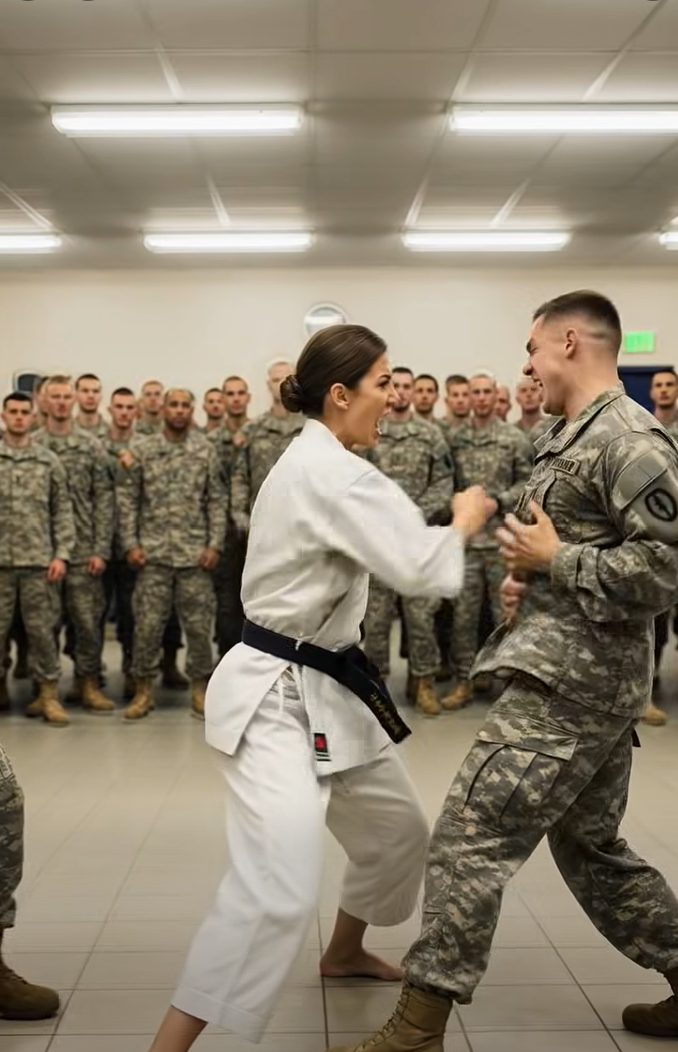
Fighters gathered in a loose ring around the open floor, energy sharp and predatory. Kessler stood at the center with Reed and Vance beside him, smiling for the room. Lauren stepped to the edge of the mat, calm as always, hands loose at her sides.
Kessler smirked. “You can still stay on the wall,” he said loudly. “That’s what observers do.”
Before Lauren answered, another voice cut through the gym.
“Not tonight,” it said.
Every head turned.
Standing at the entrance was Colonel Daniel Ruiz, installation commander.
He looked from Kessler to Lauren, then at the ring of Marines pretending this was harmless.
“If there’s going to be a demonstration,” Ruiz said, “it happens under supervision. And it happens by my order.”
The room went silent.
Because the quiet woman they had mocked for three days now had official permission to step onto their mat – and within minutes, Stonewall’s hardest men were about to learn they had not been baiting a timid evaluator at all.
They had been provoking a Navy SEAL-qualified combat instructor with a fourth-degree black belt in Okinawan karate.
But when the first Marine charged, would Lauren Hayes just win – or would she expose something so humiliating and undeniable that Stonewall Combatives would never operate the same way again?
What Nobody in That Room Knew About Her
Lauren had picked up her first gi at nine years old in Okinawa, where her father, a Navy corpsman named Gerald Hayes, was stationed at Camp Foster. Her first instructor, a retired schoolteacher named Nakamura who charged twelve dollars a month and didn’t care if you cried, had put her through four years of basics so grinding she still dreamed about horse stance on bad nights.
She kept training through high school in Norfolk. Through her enlistment. Through two deployments where she was the only woman in her advisory cell and the only person in the room who could put a 220-pound man on the floor in under four seconds without raising her heart rate.
She’d earned her fourth dan from a board in Naha that didn’t hand them out for participation.
She was also, for what it’s worth, forty-one years old and built like someone who had spent three decades making her body an argument.
None of that was on her clipboard.
None of it was on her uniform, because she wasn’t wearing one that week.
Ruiz knew. He’d read her file before she arrived, actually read it, not just the summary page. He’d been the one to request her specifically when the complaints started landing on his desk. Two hospitalized trainees in six months. A corporal with a torn labrum who said the instructor kept going after the tap. An anonymous letter that described the open-mat sessions as hazing with a training wrapper around it.
He hadn’t told Lauren about the anonymous letter. He hadn’t needed to. She’d found the patterns herself inside of seventy-two hours.
What he hadn’t anticipated was Kessler engineering a public confrontation before her evaluation was finished.
So he’d driven back from a command dinner in his service uniform, still buttoned, and walked into a gym full of Marines who suddenly had very complicated expressions on their faces.
The Order of Things
Ruiz set the terms himself, standing at the edge of the mat with his arms crossed.
Three rounds. Voluntary. Supervised. Anyone who stepped on that mat did it by choice. Anyone who tried to ignore a tap would answer to him personally.
Kessler’s smile stayed, but it had changed shape.
Vance went first. His choice. He was twenty-three and cocky the way young men get when nothing has beaten it out of them yet. He rolled his neck, got his hands up, and came at Lauren like he expected her to backpedal.
She didn’t move.
He threw a jab. She slipped it so slightly it looked like a mistake, her head just offline, and then she had his wrist, and then he was on the mat, face-down, her knee in the space between his shoulder blades, her weight distributed the way Nakamura had taught her thirty-two years ago.
Four seconds. Maybe five.
She released him and stepped back before he finished processing what had happened.
The room was very quiet.
Vance got up. He had the decency, or maybe the shock, to give her a nod. She returned it. No words. She picked up nothing from the floor because she hadn’t dropped anything.
Reed was next. He was different. Methodical. He’d watched Vance go down and he wasn’t going to make the same mistake. He circled. He tested. He kept his base low and his hands up and he was genuinely good, better than most of what Lauren had seen at Stonewall all week.
She let him work for ninety seconds. She wanted the room to see that she wasn’t just catching sloppiness.
Then he shot for a takedown and she caught the angle wrong on purpose, let him think he had her, and when his weight committed she redirected it so precisely that he didn’t fall so much as arrive on the mat without understanding how he got there. She had a rear collar tie before he could reset, and she walked him through the mechanics of the choke she could have applied, step by step, out loud, so everyone watching could hear exactly what she was doing and why.
That was the part nobody expected.
She wasn’t just submitting them. She was teaching.
The Part Kessler Didn’t See Coming
He came on the mat last. He’d had time to recalibrate, which was both an advantage and a problem. He was good. Legitimately. The black belt wasn’t decorative. He had power, timing, and enough ring experience to not panic when things went sideways.
He was also angry in the specific way that men get when their authority is being disproved in front of an audience.
Angry fighters make decisions. Decisions have patterns. Patterns have answers.
Lauren had spent the last four days cataloguing his patterns.
She knew he liked to work the body early. She knew he defaulted to a right-side clinch when he wanted to punish someone. She knew that when he felt a scramble going against him, he went for the neck, which was fine in competition and dangerous in a training environment with junior Marines who didn’t have the experience to protect themselves properly.
That last part was going in the report regardless of what happened on the mat tonight.
They moved for almost three minutes. He landed two clean shots to her shoulder that she absorbed without expression. She gave him enough to feel like he was in the fight. And then, when he went for the clinch she’d been waiting for, she changed levels, got underneath, and took him down with a trip that used his own forward pressure against him.
She took his back.
She locked in the position.
And then she stopped.
She didn’t finish. She just held it. Perfect control. His arm was right there. The choke was right there. She had three different options and she used none of them.
She held the position for four full seconds, long enough for every person in that room to understand what they were looking at, and then she released him and stood up and stepped back.
Kessler got to his feet slowly.
His face had done something complicated. Not broken. Not quite. But something had shifted in it that wasn’t going to shift back.
What the Report Said
Lauren spent Friday morning in the installation’s conference room with Ruiz and his XO, a quiet lieutenant colonel named Patricia Voss who took her own notes and asked better questions than most.
The report had twenty-nine pages. It cited eleven specific incidents over the past eight months. It named instructors. It named dates. It recommended suspension of open-mat sessions pending revised safety protocols, mandatory review of tap-out enforcement standards, and a complete restructuring of the senior instructor evaluation process.
It also noted, in section four, that several junior Marines had shown genuine technical promise that was being actively suppressed by a culture that valued dominance over development.
Ruiz read it straight through without interrupting.
When he finished, he set it down and looked at the window for a moment.
“Kessler’s been here six years,” he said.
“I know,” Lauren said.
“He built a lot of what’s in that gym.”
“He also broke a corporal’s shoulder and kept going for eleven seconds after the tap.”
Ruiz nodded. He already knew. That was why she was there.
The restructuring took four months. Kessler was reassigned, not discharged, which Lauren considered the right call. Reed stayed and ended up running the revised program with a co-instructor from the Navy’s combatives school. Vance, to his credit, had been in her office twice by the time she left, asking technical questions about the redirect she’d used against him.
She answered both times.
After
Lauren drove off the installation on a Saturday, duffel in the back, clipboard on the passenger seat. The report was filed. The recommendations were being implemented. There was a debrief in two weeks and then, probably, another assignment somewhere else with a different name and the same general problem.
She stopped for coffee at a gas station just outside the gate. Bad coffee. The kind that had been sitting since early morning and tasted like it knew.
She drank it anyway, standing next to her car in the thin November light, watching a hawk work the field across the road.
She didn’t feel satisfied, exactly. She never did. Satisfied implied a cleanliness that the work didn’t have. What she felt was the specific, low-grade relief of having done the job correctly.
The clipboard was still there on the seat when she got back in.
She picked it up, checked that the last page was secured under the clip, and set it back down.
Then she drove.
—
If this one landed with you, pass it along to someone who’d get it.
For more tales of quiet competence making a big impact, read about when I Keyed My Radio on That Runway and the SEALs Fifty Yards Away Stopped Moving All at Once, or discover how The Dog Rolled Over for Her. The Paper She Slipped Me Destroyed Everything I Knew. And you won’t want to miss how The General Saluted Her. Bulldog Had No Idea Who He’d Been Mocking.