A Rough Welcome in the K9 Yard
“Hope you can run fast, sweetheart,” Bradley said with a smirk, swinging the chain-link gate shut so hard the metal sang. The harsh sound shook the nerves right out of me.
My stomach drew tight. I knew this mean little ritual, and I hated seeing it play out. It always felt small, and it always felt wrong.
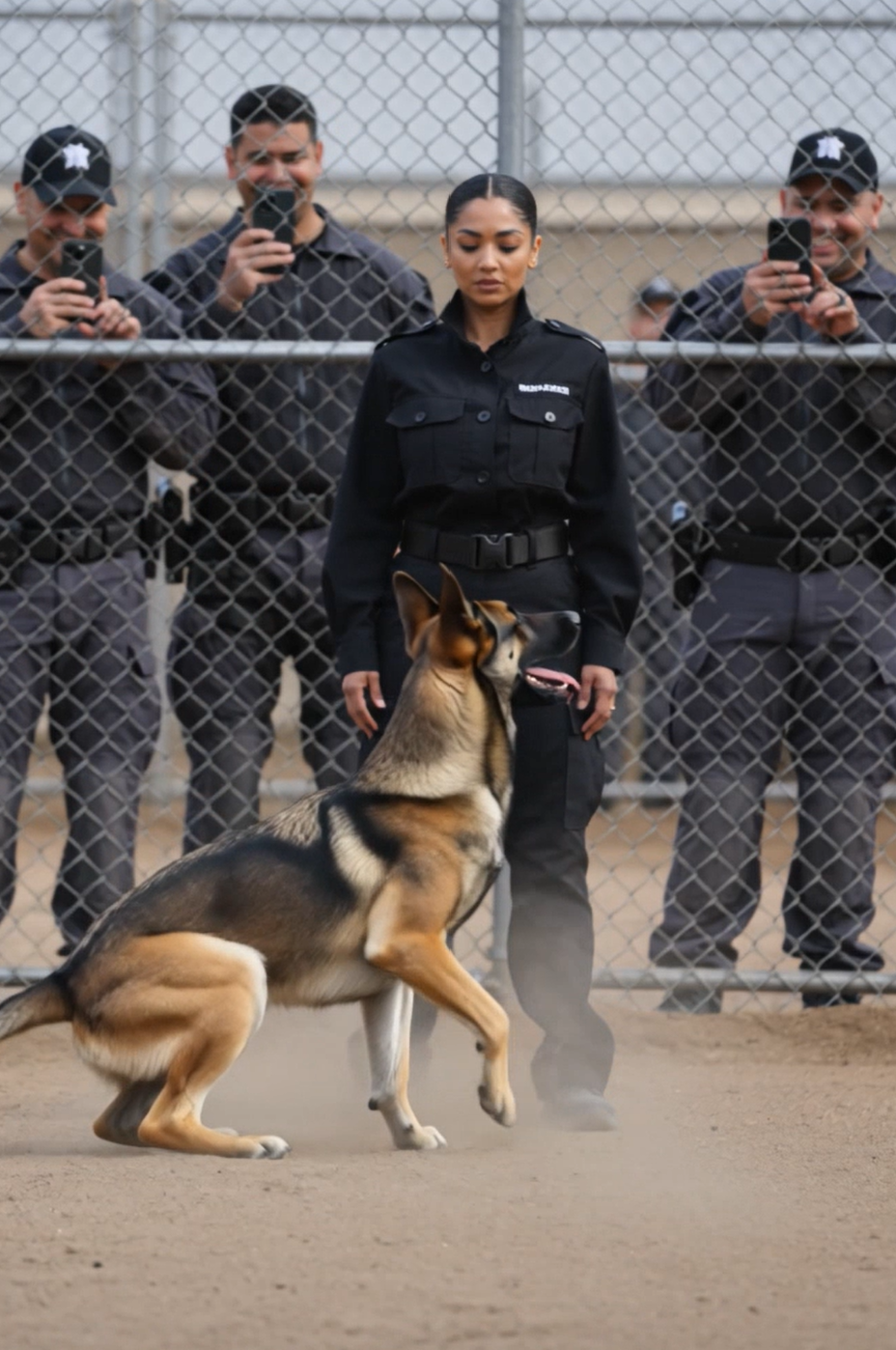
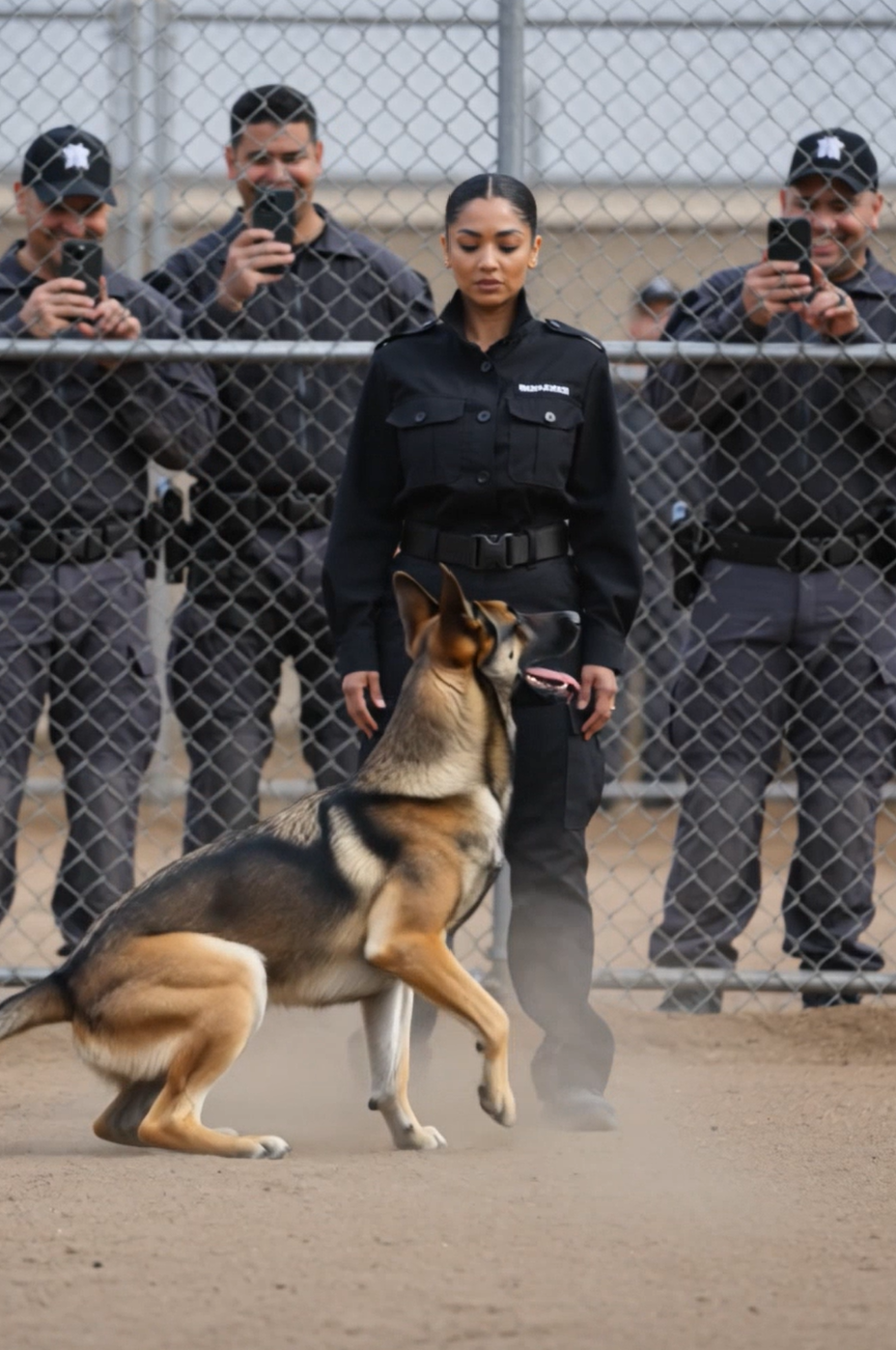
Some of the old hands liked to scare new civilian hires by tossing them into the training pen with the “problem” dog. Today it was Titan, a big Belgian Malinois who moved like a sprinter and stared like a searchlight. He’d been labeled aggressive and a washout from the K9 program. He’d also missed a meal the day before. People who work with these dogs know better than anyone that they are brilliant, intense animals designed to focus and serve. In clumsy hands, they unravel. In patient hands, they shine.


Across the fence, a half-ring of officers leaned in, phones out, hoping to catch a jump and a shriek they could pass around later for a laugh. The sight turned my stomach. A dog was being used like a stage prop, and a person was being treated like a cheap joke.
Titan lowered his head and rumbled, a deep warning from his chest. Then he launched forward, all muscle and hot breath and white teeth.
The woman in the pen—supposedly the greenest recruit we had—did not run. She did not flinch.
She made the smallest sound with her tongue. A quick, soft click.
Titan scraped to a halt so fast dust lifted around his paws. The growl thinned, then stopped. Around me, the chuckles dried up. The air itself seemed to hold still.
“What in the world?” Bradley muttered, some of the color draining from his face.
Titan tucked his tail, crept in, and touched his nose to the toe of her boot. He let out a thin, aching whimper—one of those sounds dogs make when they want help but don’t know how to ask for it.
She eased down on one knee and breathed a single, private word meant only for him. The big, so-called vicious dog slowly tipped onto his back, paws folded in the air like a puppy making himself small, offering trust.
She looked up, calm and steady. “You call him Titan,” she said, massaging the old scar behind his ear. “But that isn’t his name.” She rose, still quiet and entirely in charge. “And I’m not a rookie.”
The door to the yard banged open and the Chief of Police stormed in, fury written across his face. He marched straight to Bradley.
“You just locked Captain Vance in a cage,” he said, voice cracking like thunder. “The woman who wrote the handling manual you’re supposed to know by heart.”
Bradley turned the color of paper.
Captain Vance stepped out of the pen with the dog heeling at her side as if they’d trained together for years. She stopped in front of me and, with a small, practiced motion, slipped a folded sheet of paper into my hand so quietly no one else noticed.
“Leave this on Bradley’s desk,” she said in a voice that didn’t travel far. “Let him find it.” Then she walked away as if the matter were already finished.
I waited until she was gone before I looked. I expected a formal complaint, maybe a suspension notice, possibly a record of charges that would end a career.
It was none of those things. It was a DNA report—two columns of names and numbers, and a bold percentage at the bottom.
The Paper That Changed Everything
My hands began to shake before my thoughts caught up. The name on the left wasn’t Bradley’s son. The name on the right wasn’t mine.
I read the page again, slower. Down at the bottom was a line I had skimmed too quickly the first time. A name I knew deep in that private place where grief hums—the name on a headstone I visited every Sunday for six long years.
Robert Thorne.
The report showed a 99.9% parent–child match between a “classified sample – R. Thorne” and “Sarah Vance.” Captain Vance.
I felt the world tilt. The boy who had been behind the wheel on the rainy night my wife, Anna, was killed had been listed among the dead from the same crash. I had read the report. I had stood at his grave and tried to carry more than one person should have to hold—anger, sorrow, and a reach for forgiveness that never quite connected.
Yet the paper in my hand tied that boy to the woman who had just coaxed a frightened dog into peace with a whisper. It struck me that she hadn’t stepped into that yard to embarrass Bradley, not really. She had come for me.
Out in the lot, Captain Vance loaded the big dog into a black SUV. The Chief had Bradley pinned down with the kind of lecture you don’t forget, so no one else noticed me. I took a quick, clear photo of the report to make sure I wasn’t imagining things. Then I did what she asked. Bradley’s desk was a mess of coffee cups and good intentions gone missing. I set the folded paper right on his keyboard.
I tried to walk away. I couldn’t. The truth rattled in my chest like loose change. I needed to hear the rest from her mouth.
Down the street, I spotted the black SUV across from a small diner. It felt less like following and more like stepping onto a path someone had laid out. She knew I would come.
Through the window I saw her in a booth. The big dog—Titan to the unit, someone else to her—lay curled at her feet, calm and content. I stepped inside. The bell over the door chimed in that easy way bells do on regular days. This wasn’t a regular day.
She looked up with a steady, unreadable face and gestured for me to sit. I slid into the booth opposite her. A waitress set down two fresh coffees and left us to it.
Coffee, A Dog Named Ghost, and the Truth
“His real name is Ghost,” she said gently, nodding toward the dog. “He came to me with a past. A lot of fear. A lot of history.”
My voice didn’t trust me yet, so I nodded. My thoughts clawed at that DNA report, the headstone, the Sundays, the empty chair at my table.
“You’re here about the paper,” she said. It wasn’t a question.
I nodded again.
“Robert Thorne is my son,” she said. Her voice stayed even, but her eyes told the truth about the roads she had walked.
“He’s dead,” I said. The words tasted like dust.
She took a small sip of coffee, set the cup back down, and said, “No.”
The ground seemed to drop away again. “But the report…the crash…”
“The official story said what I needed it to say,” she replied, tone turning professional. “I had to protect him. The car he was driving that night wasn’t his. It belonged to the son of a dangerous man. That sort of man doesn’t accept ‘a mistake’ for an answer. If my son had survived in the open, prison was one risk. Retaliation was another. Possibly both.”
She held my eyes so I could not look away. “My boy wasn’t drunk. The other two were. They ran. They left him. When the call came, he was in the ICU with no ID, not expected to make it until morning.”
“But the identification,” I said, trying to organize stubborn facts with a shake of my head.
“A coroner I trusted identified a different unclaimed body as my son,” she said, careful and soft. “That body was buried. The world mourned Robert Thorne. Meanwhile, the living boy—broken body, broken heart—was moved in a midnight ambulance to a private facility under guard, under another name.”
She laid out the rest without drama. Surgeries too many to count. Months relearning how to sit, stand, and walk. After that, a new identity, a new town, and a life as quiet as we could make it, far from the place where rain on pavement still whispered danger.
“For six years he has lived with the shadow of what happened,” she said. “With the memory of your wife, Anna. He has wanted to say to you what I cannot say for him. He is afraid.”
I warmed my hands on the coffee cup and tried to relearn how to breathe. “Why tell me now?”
“Because of you,” she said simply. “I read your file. I know you visit that grave every Sunday. I’ve watched you in the kennel. Too many of them treat dogs like trophies or tools. You treat them like living partners. You took the time to read Titan’s old notes—Ghost’s notes—and tried to understand him instead of overpowering him. I needed to see who you were when things got difficult. Today told me a lot.”
Setting Things Right with Bradley
I thought about the paper I had placed on Bradley’s keyboard. “Why leave that DNA report for him?” I asked. “What were you expecting?”
“That one wasn’t for him,” she said. “It was for you.” She reached into her bag and set another folded page beside my cup. “This is his.”
I opened it. Another DNA analysis—but for a dog. Bradley’s prized German Shepherd. He bragged about that dog and showed him off at competitions for ribbons and side money. The report told the long story short. The bloodline wasn’t what he claimed. Not purebred. A fine animal, yes, just not the pedigree he’d been swearing to, certifying, and profiting from.
“You deal with bullies using facts, not fists,” she said. “He’ll face suspension for conduct unbecoming and an investigation for fraud. That ends the showboating and keeps the dogs safer. No shouting match required. The lesson holds longer this way.”
I slid the paper back and looked at the first report again in my mind. “And you gave me the truth about your son,” I said, quieter now.
“I did,” she said. “I know what that asks of you. You can take it to the press or the district attorney. You have every right. Or—” here her voice softened without pressing me “—you can agree to meet him. Just meet him. See him. Listen.”
Hope is a small word for a big feeling. Outside, the world kept moving as if hearts didn’t break and mend on weekdays. “Where is he?” I asked.
Choosing to Hear Him Out
A week later I stood in front of a shelter three hours from home, hand on the door handle as if it might answer the questions I couldn’t. Captain Vance had given me the address and told me he would be expecting me. He worked there under the name Michael.
Twice on the drive, and twice again in the parking lot, I talked myself out of walking in. I wondered what I would do if he shrugged. If he made excuses. If he wanted sympathy I did not have.
Inside, the first things that met me were the clean scent of disinfectant, the busy sound of dogs, and the simple rhythm of a place trying to help. A young man knelt inside a kennel, coaxing a trembling terrier out from under a cot with a patience that felt hard-earned. He limped, and a long scar ran from his temple to his cheek.
He looked up and knew me. I saw the recognition land in his eyes. He stood, careful and slow, as if each movement had to be paid for.
“I’m so sorry,” he said, the words breaking as tears found the old path of the scar. “There isn’t a day or an hour I don’t think about her. About you. About what I took.”
He didn’t mention the other boys. He didn’t ask for a pass because of what the accident had done to him. He didn’t list what he’d lost or what he had to rebuild. He stood there and shouldered what he had done without handing any of it to me.
In that moment, the heavy mountain I had carried for six years—anger, blame, the ache that wakes you at three in the morning—began to loosen. He wasn’t a monster. He was a man who had made a terrible mistake and had a mother who moved heaven and earth to keep him alive. Now he was using his days to help frightened, abandoned creatures.
None of it was fair. Anna was still gone. The brightest light in my life had gone out. But I finally understood what Captain Vance had been trying to say. The anger was poisoning me, not protecting Anna’s memory. Holding on to it didn’t keep her close. It kept me locked up.
Anna had a way of looking at people that found the sliver of good. She believed in second chances the way some folks believe in spring. Standing there, I could almost hear her asking me to leave a window open for grace.
I nodded toward the small terrier under the cot. “Tell me about her,” I said.
He blinked, surprised, then glanced back. “Her name is Penny,” he said. “She’s afraid of everything.”
“I know a little about scared dogs,” I said. It wasn’t forgiveness, not yet. It was a first plank laid between us.
A Year of Better Work
Over the next year, my life found a new rhythm. With Captain Vance nudging doors I wouldn’t have tried on my own, I moved into the K9 handler program. They partnered me with Ghost—the same dog everyone else had misread, the one who had been mislabeled and mishandled until he didn’t know where to put his big heart.
Ghost turned out to be the partner I needed. Sharp as a spark. Loyal in a way you can feel down to your bones. He wanted to work and to be understood. We matched. We both had histories that called for patience and a steady hand. We both needed a fair chance to do something good.
On weekends I started driving out to the shelter. Michael—because that’s who he was now in my mind—mended gates, walked the nervous dogs, and kept his sleeves rolled up for whatever job came next. We worked side by side without many words. We scrubbed runs, patched wire, set posts for a new yard where the bigger dogs could stretch and remember what a good breeze feels like. Penny found a quiet home with a couple who understood that some healing can’t be rushed.
We did not retell that night on the road. We did not weigh the grief or guilt out loud. His apology stood between us like a candle left on a table—always there, always lit, not asking for attention. We filled the rest of the space with useful work and the kind of understanding that grows when two people are trying to do better than the worst day of their lives.
What Forgiveness Feels Like
One warm afternoon, we were fighting a stubborn gate that never wanted to swing true. The dogs were dozing in small squares of sun. Without planning to, I heard myself say, “I forgive you.”
The wrench slipped from his hand and clanged on the concrete. He bowed his head and sobbed—big, shaking sobs, the kind you hear when a person has been holding their breath for years. Ghost leaned against my leg, solid and warm, and the thing I felt was not drama or fireworks. It was relief. A weight set down where it could no longer grind me down.
For six years I believed I had been trapped by what someone else had done. The cage, it turns out, wasn’t made of chain-link. It was built from anger and sorrow. Forgiveness didn’t open a door for him so much as it opened one for me. It let me step into a life where Anna’s memory isn’t a raw wound but a light I get to carry forward.
Life rarely hands over tidy endings. Sometimes it hands you a wreck. Then you stand there, hands shaking, and decide if you are going to sift through the pieces. If you are brave enough to look, you can find what’s still strong and build something new around it. That day in the K9 yard, a bully tried to make a show out of fear. A mother showed us how quiet strength works. A frightened dog reminded us how quickly trust can grow when someone finally speaks your real name with care.
As for me, I learned that strength is not how tightly you can clutch a grudge. It is how willing you are to set it down and choose a different road. Not because the past disappears, but because peace needs space to take root. Ghost curls at my feet now when I write reports. We work calls together, shoulder to shoulder, with a kind of calm that only comes from being truly seen and understood. Some weekends, I still drive those few hours to mend a fence and toss a ball for dogs who haven’t learned yet that tomorrow can be kinder than yesterday. That’s what forgiveness gave me room for—a steadier step, a lighter chest, and a life big enough to hold both memory and hope.