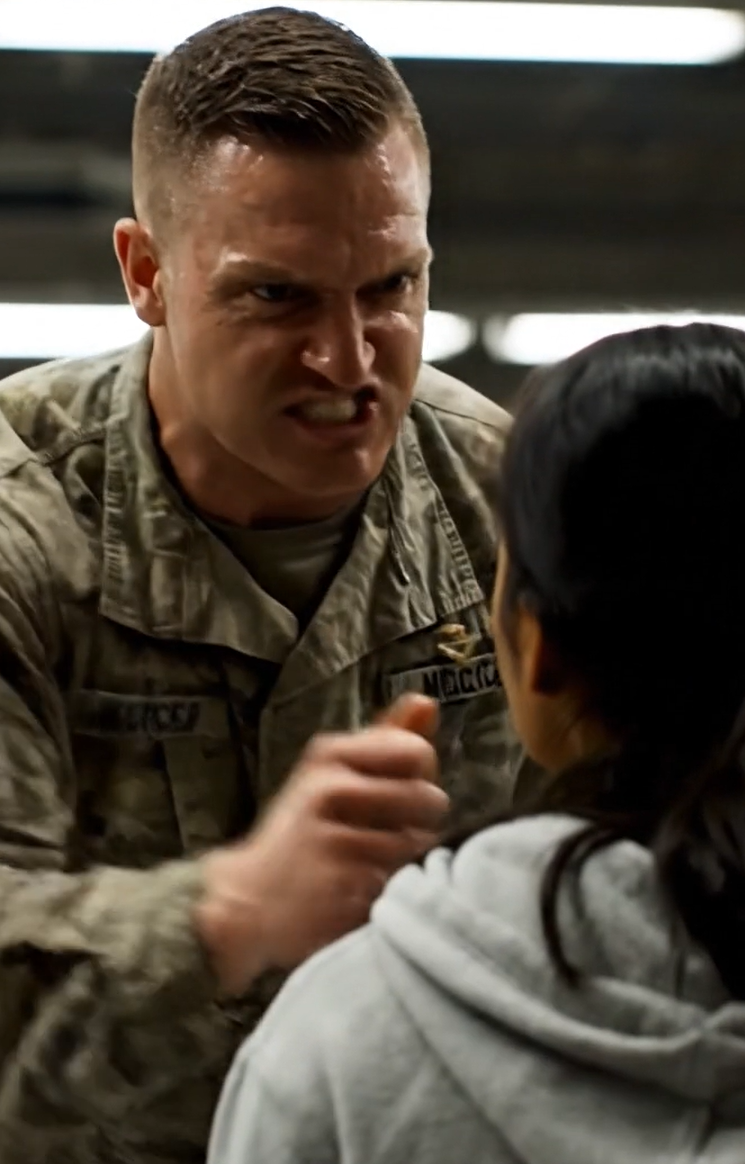
The lunch rush at Camp Redstone always sounded the same – until Staff Sergeant Wayne Mercer walked in.
Mercer was the base’s golden boy. Twenty years of service. Commendations on his office wall. But unofficially, people whispered about how authority followed him into closed rooms and left with someone else looking shaken.
Across the aisle sat a woman nobody recognized. Jeans. Faded gray hoodie. Hair tied back. She was eating alone, a folder with red stamped lettering sitting beside her tray.
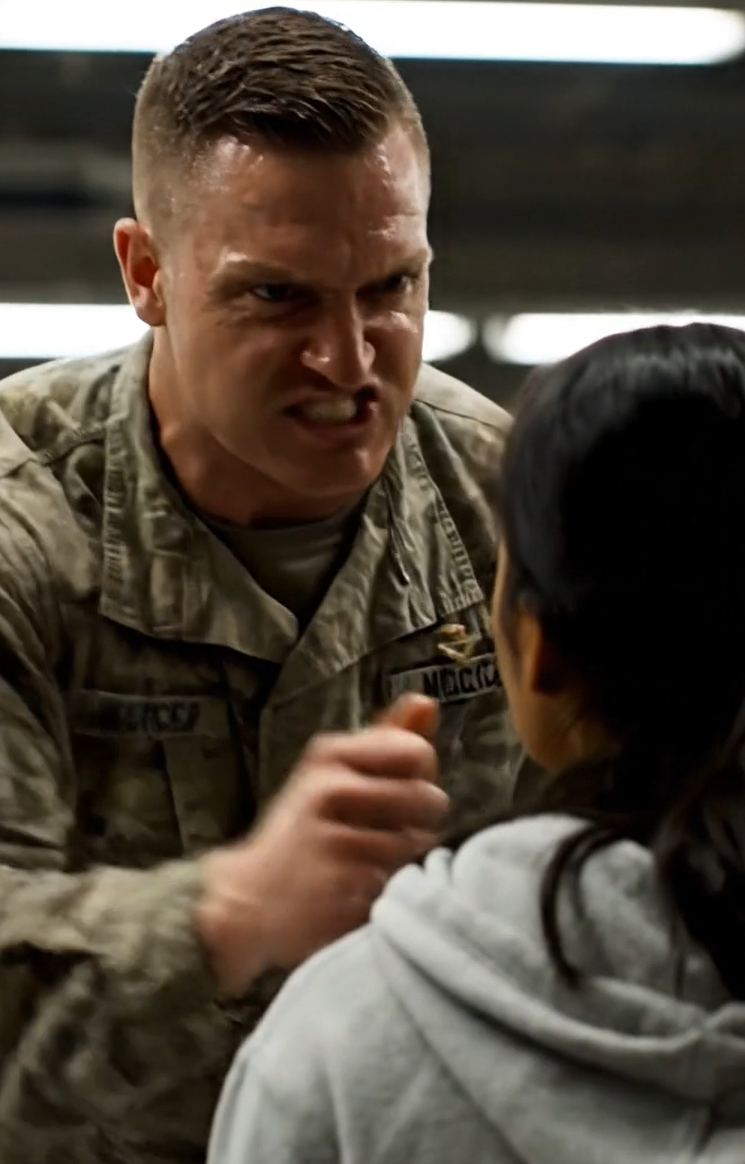
Mercer stopped at her table and stared down with open contempt. “That seat’s for Marines,” he snapped.
She looked up calmly. “There aren’t any signs.”
“I don’t need signs to tell you where you belong.” He grabbed her shoulder. Not hard enough to leave a mark. Hard enough that everyone around them froze.
The mess hall went quiet. Soldiers kept their eyes on their food. Nobody moved. Nobody wanted to be next.
“You need to leave,” Mercer said.
She set down her fork. “Actually, I’m not finished.”
That’s when Mercer’s hand moved to her arm. He pulled her up from the chair in one fluid motion. A few Marines at the next table watched but didn’t intervene. Mercer had a reputation for writing up people who questioned him.
The woman didn’t resist. She just let herself be moved toward the exit.
But as she passed the doorway, she turned back. “You just assaulted a federal investigator in front of forty witnesses.”
Mercer’s face went white.
She held up the red folder. Her other hand was already pulling out a phone. “My name is Inspector Catherine Wells. I’m with the Office of Inspector General, and I’m here investigating allegations of misconduct in your chain of command.”
“I didn’t – ” Mercer started.
“Yes. You did.” She turned to the soldiers still frozen at their tables. “I need statements from all of you. Everyone saw what just happened. Everyone is a witness.”
Mercer’s hands were shaking. His jaw worked silently.
Catherine Wells took a step closer, her voice steady and low. “Twenty-three complaints in six years, Staff Sergeant. Twenty-three people too afraid to come forward because of exactly what I just saw. Intimidation. Power abuse. And today, you just gave me documentation.”
She held up the phone, showing the recording app still running.
Mercer looked around the mess hall. Every eye was on him now. Not with the deference he was used to. With fear. Recognition. The realization that the man they’d been protecting was about to fall.
“You have the right to remain silent,” Catherine said, nodding to the base’s military police officer who had just entered the doorway. “But I’d recommend you use your right to counsel instead.”
The MP stepped forward. Mercer’s hands moved behind his back before he was even asked.
As they walked him past the tables, Catherine picked up her tray and sat back down.
She took another bite of her sandwich.
The mess hall remained completely silent.
Then, from the back table, one of the younger Marines whispered something to his friend. Within seconds, more whispers rippled through the room. Not fear this time.
Relief.
Catherine finished her lunch methodically, occasionally glancing at the red folder. Inside were the names of everyone who had filed complaints. Everyone Mercer had silenced.
By the time she stood to leave, soldiers were already lining up to speak with the MP – offering statements, sharing stories that had been buried for years.
Catherine walked toward the door, pausing only when the base commander appeared at the far end of the mess hall, his face the color of ash.
She held up the folder one more time.
“We have forty-three witnesses now, Colonel. All of them watching when your ‘untouchable’ sergeant just proved exactly how touchable he is.”
Colonel Albright straightened his uniform jacket, a purely instinctual gesture of a man trying to regain control.
“Inspector,” he began, his voice a low rumble. “My office. Now.”
Catherine gave him a small, unreadable smile. “Your office it is, Colonel. But they come first.”
She gestured to the line of soldiers forming behind the MP. Men and women, young and old, their faces a mix of anxiety and newfound courage.
The Colonel’s jaw tightened, but he nodded. He knew a losing battle when he saw one.
For the next four hours, Catherine sat in a small, sterile interview room. One by one, they came in.
A young Private, barely nineteen, spoke about how Mercer had “lost” his leave papers right before his sister’s wedding.
A Corporal explained how Mercer made him redo a training exercise in the blistering sun for hours because he’d asked a question Mercer deemed “stupid.” He’d ended up with heatstroke.
A female Sergeant described the constant, cutting remarks Mercer made, always just quiet enough that only she and a few others could hear. She’d stopped speaking up in meetings altogether.
Each story was a small cut, a single thread in a larger, darker tapestry.
The last person she interviewed that day was a Private named Daniel. He was one of the original twenty-three complainants.
He sat rigidly in the chair, his hands clasped so tightly his knuckles were white.
“He told me I was worthless,” Daniel said, his voice barely a whisper. “Said my father would be ashamed of me. He found my file, saw my dad was a decorated officer.”
Daniel looked down at his boots. “My dad passed away when I was ten. Mercer knew that.”
Catherine just listened, her expression calm. She didn’t offer fake sympathy. She offered a silent, solid presence.
“Why did you finally file a report?” she asked gently.
He looked up, a flicker of defiance in his eyes. “Because he said it to another kid. A new recruit. And I saw the same look on his face that I must’ve had.”
Daniel took a deep breath. “I just figured, if I’m going to feel worthless, I might as well do it for a good reason.”
Catherine made a note. This wasn’t just about Mercer’s cruelty. It was about the ripple effect of one person’s courage.
Later that evening, she finally walked into Colonel Albright’s office. The base was quiet now, the energy of the mess hall long since faded.
Albright was standing by the window, looking out at the perfectly manicured grounds.
“You’ve caused quite a storm, Inspector,” he said without turning around.
“Storms clear the air, Colonel,” Catherine replied, taking a seat.
He finally faced her, his expression weary. “Wayne Mercer is one of my best NCOs. He gets results. His platoons have the highest readiness scores in the entire division.”
“At what cost?” Catherine asked, leaning forward. “Sir, I have statements detailing blackmail, psychological abuse, and now, physical assault.”
“He’s old school,” Albright argued, though his voice lacked conviction. “He pushes them hard because the world outside this base is harder.”
“There’s a line between ‘hard’ and ‘criminal’,” she said. “He didn’t just cross it. He built a house on the other side.”
She opened the red folder, sliding a summary sheet across the polished desk. “These are just the official complaints. The ones people were brave enough to sign their names to.”
The Colonel looked at the list, his face grim. “I heard whispers. I told him to tone it down.”
“You told a wolf to stop hunting,” Catherine countered. “You didn’t put him in a cage.”
Albright sank into his chair, the weight of his command suddenly visible on his shoulders. “What do you want, Wells?”
“The truth,” she said simply. “And a court-martial.”
He was silent for a long moment. “He has connections. Friends in high places. This will get messy.”
“I’m not afraid of messes,” Catherine said, standing up. “You shouldn’t be either. Your people are watching you, Colonel. They’re waiting to see if the man at the top is any different from the man in the middle.”
She left him there, alone with the folder and the silence of his office.
The next day, Catherine interviewed Mercer.
He was in a holding cell on base, stripped of his rank insignias. He looked smaller without his uniform, less imposing.
He sat across from her with a smug look, his lawyer by his side.
“This is a misunderstanding,” Mercer started. “I was maintaining discipline. The woman was a civilian in a restricted area.”
“The mess hall is not a restricted area, and I am a federal officer,” Catherine stated flatly. “But we’re not here to talk about me. We’re here to talk about Private Daniel.”
Mercer’s smirk faltered for a fraction of a second.
“And Corporal Evans. And Sergeant Miller.” She continued, listing name after name. “And the forty-three other witnesses who watched you assault me yesterday.”
She slid a photo across the table. It was a still from her phone’s video, clear as day, showing his hand gripping her arm.
“You seem to think your commendations make you fireproof, Sergeant. They don’t. They just make the fall hotter.”
His lawyer cleared his throat. “My client will not be answering any more questions.”
“He doesn’t have to,” Catherine said, gathering her papers. “His actions in the mess hall were his confession.”
As she walked away, Mercer’s voice followed her. “You think you’ve won? You have no idea how this works. People like me are necessary.”
Catherine didn’t look back. “People like you are a liability.”
Over the next week, the case grew stronger. More soldiers came forward. The dam of fear had broken, and a flood of truth was pouring out.
But something still bothered Catherine.
The original tip that launched her investigation had been anonymous. It was well-written, detailed, and knew things only an insider could know. Yet none of the twenty-three official complainants had written it. Their reports were emotional, raw. This one was different. It was cold, precise.
Late one night, in her temporary office, she pulled up the original email. It had been sent from a proxy server, but the OIG’s tech team had managed to trace it back to a single IP address.
The address belonged to a public library. In a small town twenty miles from Camp Redstone.
It was a long shot, but she had a hunch. She ran the town’s name against Mercer’s personnel file.
His home address was listed there. A quiet suburban street just two blocks from that very library.
She felt a knot tighten in her stomach. It wasn’t a soldier. It was someone who lived with him. Someone who saw the monster not just in uniform, but at the dinner table.
She cross-referenced public records. Mercer had a wife and a sixteen-year-old son, Thomas.
Catherine found Thomas’s social media profile. It was mostly about video games and school projects. But one post from two months ago stood out. It was a photo of an essay for his civics class.
The title was “The Responsibility of Power: When Silence Becomes Complicity.”
The writing style was familiar. The sentence structure. The precise, almost detached way it laid out its arguments.
It was the same voice from the anonymous tip.
The truth hit her with the force of a physical blow. The person who had the courage to start all of this wasn’t a hardened Marine.
It was a child. A boy who saw the injustice his father was causing and decided to do something no one else would.
He had used his father’s own computer to look up the right channels, learned about the Inspector General, then biked to the library to send the email, covering his tracks like a seasoned operative.
Catherine closed her laptop, a profound sense of respect settling over her. This case wasn’t just about a bully in uniform. It was about the quiet, immense courage of a boy trying to stop his own father.
She knew she could never reveal his identity. It would put him in an impossible, dangerous position. His contribution had to remain a secret.
But it changed everything. It reframed her mission. She wasn’t just getting justice for the Marines. She was validating the faith of a brave kid who believed the system could still work.
The day of the court-martial arrived. The base courtroom was packed.
Mercer stood tall, defiant to the end. His defense argued that he was a victim of a “culture of sensitivity,” that his methods were necessary for national security.
But then the witnesses began to speak. Private Daniel took the stand, his voice shaking but clear. He told the court what Mercer had said about his late father.
A hush fell over the room.
One by one, they shared their stories. The weight of their combined testimony was crushing.
The final piece of evidence was Catherine’s video. The whole room watched the silent footage of Mercer grabbing her arm, his face contorted in a mask of arrogant authority.
It was undeniable.
The verdict came quickly. Guilty. On all charges.
He was sentenced to two years in military prison and a dishonorable discharge. The career he’d built on fear and intimidation was over.
As Mercer was led away, his face was no longer arrogant. It was just empty.
Outside the courtroom, Colonel Albright approached Catherine.
“You were right,” he said, his voice heavy with humility. “I was a coward. I let it happen. That ends today.”
He told her about the new anonymous reporting system he was implementing, mandatory leadership training focused on ethics, and a zero-tolerance policy that he would personally oversee.
“You didn’t just remove a bad apple, Inspector,” he said. “You forced us to check the whole tree.”
Catherine nodded. That was the best she could hope for.
As she was packing her car to leave Camp Redstone, she saw Private Daniel walking by. He wasn’t hunched over anymore. He walked with his head held high.
“Inspector Wells,” he called out, jogging over.
“Daniel,” she said with a smile.
“I just wanted to say thank you,” he said. “You gave us our voices back.”
“You already had them,” she replied. “You just needed to know someone was listening.”
He saluted her. It was a gesture of profound respect, one she returned with a nod.
Driving away from the base, Catherine thought about the case. She thought about the soldiers, about Colonel Albright, and about Mercer.
But most of all, she thought about a sixteen-year-old boy in a public library, typing an email that would change everything.
True strength, she realized, isn’t about how loud you can shout or how hard you can push. It has nothing to do with the uniform you wear or the rank on your collar.
It’s about the quiet decision to do what is right, even when the whole world is telling you to stay silent. It’s the courage to plant a seed of truth, and then trust that it will grow.