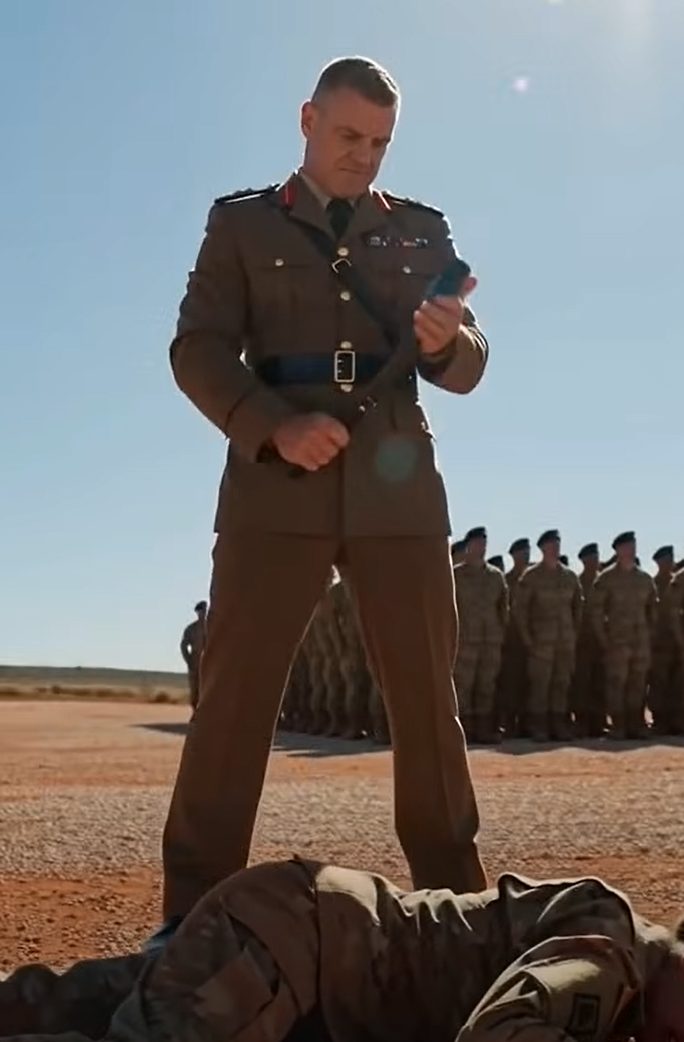
When a cruel Major brutally struck a female soldier with his belt and forced her to scream “I am nothing,” he thought he was untouchable – completely unaware that the quiet woman watching from across the field was the Secretary of the Army.
The heavy leather of Major Thomas Garrett’s uniform belt cracked against the small of my back, a sharp, blinding explosion of pain that sent me driving face-first into the red Georgia dirt.
The grit filled my mouth, mixing with the metallic taste of blood where I had bitten my tongue to keep from screaming. The heat of the midday sun at Fort Bradley was already suffocating, a thick, ninety-eight-degree blanket of humidity that made every breath feel like inhaling wet wool. But the heat of the gravel against my raw, scraped palms was nothing compared to the burning humiliation radiating through my spine.
“Get up, Specialist,” Garrett’s voice boomed above me, dripping with a cold, sadistic pleasure that he hid behind the mask of military discipline. “I didn’t give you permission to rest. Front-leaning rest position. Move!”
My arms shook violently as I pushed my upper body off the ground. My standard-issue OCP uniform was soaked through with sweat, stained dark with the unforgiving red clay of the parade grounds. Every muscle in my shoulders screamed in protest. I had been out here for three hours. Three hours of a systematic, illegal “smoke session” disguised as corrective training.
“Say it,” Garrett hissed, stepping closer. I could see the polished tips of his combat boots just inches from my face. They were immaculate. Not a single speck of dust touched them, while I was drowning in it. “Let the whole cantonment hear you, Vance. Say the words.”
I swallowed the dry lump of pride in my throat. The sun glared down, blinding me as I stared at the shimmering horizon of the empty airfield. “I am nothing, sir,” I whispered, my voice cracking, barely audible over the distant hum of tactical vehicles near the motor pool.
The belt cracked down again, this time striking the back of my thighs. The nylon-reinforced material stung like a whip, biting through the thick fabric of my trousers. I collapsed again, my chest slamming into the dirt, the wind knocked completely out of my lungs.
“I didn’t hear you!” Garrett roared, leaning down so close I could smell the stale black coffee and wintergreen tobacco on his breath. “You are a stain on this battalion, Vance. You are a broken cog in my machine. You will repeat it until I believe you mean it, or we will stay out here until the sun goes down and the MPs have to carry your corpse to the clinic. Speak!”
“I am nothing, sir!” I screamed it this time. The words tore at my throat, burning worse than the physical pain.
Twenty yards away, standing near the shadow of the brick battalion headquarters, Sergeant First Class Marcus Brody stood stiffly at attention, his eyes locked straight ahead, staring into nothingness. He was my direct supervisor, a fifteen-year veteran with three combat tours in America’s forgotten sands. He was a good man, a man who had taught me how to properly calibrate the night-vision optics on our reconnaissance vehicles, a man who had always checked on his soldiers’ mental health after long field rotations.
But right now, Brody was a ghost. His jaw was clenched so tightly that the muscles in his cheeks twitched, but his lips remained sealed. He was terrified. He had a wife, three kids in elementary school, and was only two years away from securing his twenty-year retirement pension. Major Garrett held Brody’s entire future in his hands; one unfavorable evaluation from Garrett could wipe out a lifetime of honorable service and leave Brody’s family stranded. So, Brody looked away. He let the dust consume his honor, choosing survival over his soldier.
Up on the second-floor balcony of the barracks, the blinds of Room 204 twitched. I knew who was behind them. Private First Class Chloe Jenkins, my battle buddy. Chloe was barely twenty years old, a small-town girl from Ohio who cried when she saw a stray dog on the perimeter fence. She had watched Garrett target me for weeks, ever since I had accidentally discovered the massive logistical discrepancies in the battalion’s supply ledger – discrepancies that showed thousands of dollars of tactical gear missing under Garrett’s direct authorization.
Chloe had begged me to delete the file. “Please, Maya,” she had whispered in the dark of our shared room just three nights ago, her voice trembling. “He will destroy you. People like Major Garrett don’t get caught. They just bury the people who look too closely.”
I hadn’t listened. I believed in the uniform. I believed in the values we wore on our chests: Loyalty, Duty, Respect, Selfless Service, Honor, Integrity, Personal Courage. I thought those words actually meant something to the men who wore the gold oak leaves of a major.
I was wrong.
“Again,” Garrett demanded, his shadow blocking out the harsh glare of the sun. “Say it like you understand your place in this world, Specialist Vance.”
“I am nothing, sir,” I repeated, my tears finally breaking free, cutting clean tracks through the thick red dust caked onto my face. I hated myself for crying. I hated myself for breaking.
My mind flashed back to my father, Chief Warrant Officer 4 David Vance. He had spent thirty years flying Black Hawks, his body battered by hard landings and his mind scarred by the ghosts of Mogadishu and Kandahar. He had died of cancer two years ago, his last words to me whispered from a sterile VA hospital bed: “Keep your chin up, Maya. The Army is a family. It will take care of you if you take care of it.”
I wished he could see his family now. I wished he could see his daughter being broken like an animal on a patch of neglected gravel behind a secondary logistics building, all because she wouldn’t help a corrupt officer falsify a federal audit.
“Louder!” Garrett barked, swinging the belt against his own palm with a sickening, rhythmic thwack. “You think because your daddy had a few ribbons you’re special? You’re a bug on my windshield, Vance. And I am about to turn on the wipers.”
I braced myself to push up again, my arms trembling so violently that my elbows threatened to buckle. My breath came in short, ragged gasps. The physical exhaustion was total, but the psychological fracturing was worse. When you are stripped of your dignity, when the people who are supposed to protect you turn their backs, the world shrinks down to a very dark, very cold point.
Then, through the haze of heat waves rising off the asphalt, I saw a vehicle pull up.
It wasn’t a standard green military humvee or a white government sedan. It was a single, unmarked black Chevy Suburban with dark tinted windows. It didn’t park in the designated VIP spots near the front entrance of the battalion headquarters. Instead, it pulled up quietly along the gravel perimeter road that bordered the parade field, right next to the chain-link fence where the weeds grew tall and ignored.
The back door opened, and a woman stepped out.
She didn’t look like anyone important from a distance. She wasn’t wearing a uniform. She wore a tailored, slate-grey pantsuit that looked crisp despite the oppressive Georgia humidity. Her dark hair was pulled back into a neat, professional low bun. She wore a pair of simple black sunglasses that masked her eyes, and she didn’t carry a purse – only a small, leather-bound notebook in her left hand.
Two men in dark suits stepped out of the front doors of the vehicle, their hands casually resting near their jackets, their eyes scanning the treeline with a practiced, predatory alertness. Secret Service. Or Pentagon executive protection.
Major Garrett didn’t see them at first. He was too focused on his theater of cruelty, too intoxicated by the absolute authority he wielded over a twenty-three-year-old specialist who couldn’t fight back without facing a military prison sentence.
“Down on your knees, Vance,” Garrett ordered, his voice taking on a lower, more malicious tone. “Since you can’t hold a proper push-up, you can stay on your knees and repeat it. Ten times. If you stop, I start using the buckle.”
My heart stopped. The buckle. It was a heavy, solid brass military buckle with sharp, squared edges. If that hit my skin at full force, it would split the flesh down to the bone.
“Sir, please,” I whispered, the last remnants of my pride dissolving into pure survival instinct. “I’ll do the push-ups. I’ll do them.”
“I said on your knees!” Garrett roared, his face turning a deep, venomous purple. He raised the belt high above his shoulder, his chest heaving with unhinged rage.
“Major,” a voice called out.
The voice wasn’t loud. It wasn’t a military bark. It didn’t carry the artificial gravel of a drill sergeant or the forced authority of a base commander. It was calm. It was quiet. It was completely steady, cutting through the heavy, suffocating air like a razor blade through silk.
Garrett paused, his arm still raised, the leather belt dangling like a dead snake. He blinked, turning his head slowly toward the source of the interruption. His expression shifted from rage to sheer irritation. He was an officer who loathed being interrupted, especially on his own turf, especially by a civilian.
The woman in the grey suit was walking across the parade field.
She didn’t hurry. Her strides were measured, purposeful, and remarkably smooth as her low heels clicked against the hard-packed dirt and gravel. The two security men followed a few paces behind her, their eyes locked onto Garrett with a cold, unblinking intensity that would have made any rational man uncomfortable.
But Major Garrett was not a rational man; he was a bully who believed his rank made him a god within the geographic boundaries of Fort Bradley.
“Who the hell are you?” Garrett shouted, not lowering the belt. “This is a restricted training area. This field is closed to civilian personnel. Turn around and go back to the visitor center before I have the military police put you in flex-cuffs.”
The woman didn’t stop. She kept walking, her gaze fixed entirely on me. Even through her sunglasses, I could feel the immense weight of her attention. She looked at my torn uniform, the blood on my chin, the red dirt caked into my hair, and the raw, bleeding skin on my palms.
Sergeant Brody, still standing near the building, turned his head slightly. His eyes widened as the woman drew closer. I watched his face turn a ghostly, translucent white. His hands, which had been loosely cupped at his sides, snapped into rigid, trembling fists against the seams of his trousers. He knew. He recognized her. But he was too paralyzed by shock to speak.
“I asked you a question, lady,” Garrett barked, taking three aggressive steps toward her, his chest puffed out, the gold oak leaves on his collar catching the sunlight. “Are you deaf? I am the executive officer of this battalion, and you are trespassing on a military installation. Identify yourself right now, or you’re going to have a very long, very uncomfortable afternoon.”
The woman stopped exactly five feet from him. She didn’t flinch at his aggressive posture. She didn’t step back. She slowly raised her right hand and removed her sunglasses, revealing eyes that were a piercing, stormy steel blue. They were the eyes of someone who had sat in rooms where the fates of nations were decided, eyes that had looked into the faces of generals and presidents without blinking.
“My name,” she said, her voice dropping an octave, carrying a terrifying, quiet resonance that seemed to make the very air around us grow cold, “is Evelyn Cole. And I suggest you lower that belt, Major, before I have the United States Marshals dismantle your life piece by piece.”
Garrett scoffed, a ugly, arrogant laugh escaping his lips. He hadn’t connected the name yet. To him, she was just an upper-middle-class civilian woman who had somehow gotten past the front gate with a couple of high-end private security guards.
“Evelyn Cole?” Garrett sneered, tossing the belt casually over his shoulder as if it were a toy. “I don’t care if you’re the Governor’s wife, ma’am. You don’t walk onto my field and interrupt my disciplinary actions. This soldier committed a severe infraction of UCMJ regulations, and she is receiving corrective training. Now, clear out. This is Army business.”
“This is not Army business,” Evelyn Cole said softly. She took one step closer to him, her stature smaller than his bulky, armored frame, yet she completely dominated the space between them. “This is a criminal assault under color of authority. And as for ‘Army business’…”
She paused, turning her head slightly toward Sergeant Brody, who was now sweating so profusely he looked like he had been dipped in water.
“Sergeant First Class Brody,” she called out, her voice sharp as a whip.
“Y-yes, ma’am!” Brody choked out, his voice cracking like a teenager’s. He threw his hand to his brow in the most rigid, desperate salute I had ever seen in my life. His entire body was shaking so violently his medals clinked together.
“Who am I, Sergeant?” she asked calmly.
Brody swallowed hard, his eyes wide with a terror that surpassed anything he had faced in combat. “You are… you are the Honorable Evelyn Cole, ma’am. The Secretary of the Army.”
The silence that followed was absolute.
The distant hum of the motor pool seemed to vanish. The wind stopped blowing through the tall grass by the fence. The only sound was the heavy, ragged breathing coming from my own chest as I sat in the dirt, my brain struggling to process the words that had just been spoken.
The Secretary of the Army.
The civilian head of the entire United States Army. The woman who answered directly to the Secretary of Defense and the President. The woman who commanded every soldier, every tank, every base, and every major from the Pentagon down to this miserable patch of red dirt in Georgia.
I watched Major Garrett’s face.
It was a cinematic transformation. The arrogance, the cruel amusement, the absolute certainty of his own power – it all drained out of him in a single, agonizing second. His skin didn’t just turn pale; it turned a sickly, gray-green color, the color of spoiled milk. His mouth fell open slightly, his lips moving but producing no sound, like a fish gasping for air on a dry dock.
The belt slipped from his fingers. It fell to the gravel with a soft, heavy thud.
“Madam… Madam Secretary,” Garrett stammered, his voice dropping three octaves into a high-pitched, desperate whine. He tried to snap to attention, but his knees were shaking so badly his posture looked broken, deformed. “I… I didn’t realize… I was not informed of an official VIP visit today. The base commander – “
“The base commander doesn’t know I’m here, Major,” Secretary Cole interrupted, her voice devoid of any warmth, any mercy. “I don’t do announced visits when I receive three separate anonymous whistleblower reports regarding systemic physical abuse, extortion, and financial fraud within a single battalion.”
She looked down at the belt lying in the dirt between them, then looked up, her steel-blue eyes locking onto his with the finality of a guillotine.
“And it seems,” she continued, her voice dangerously quiet, “that I arrived exactly on time to see the show.”
The Notebook
She opened it.
That small, leather-bound notebook. She flipped it open with one hand, produced a pen from the breast pocket of her jacket, and began writing. Slowly. Deliberately. Like she had all the time in the world and Garrett had none of it left.
“Date,” she said aloud, not to anyone in particular. “July 14th. 1347 hours. Fort Bradley, Georgia. Parade field, secondary logistics sector.” She looked up at Garrett. “Rank and full name for the record, Major.”
Garrett’s mouth opened and closed twice before anything came out. “Major Thomas A. Garrett. Executive Officer, 3rd Battalion, 214th – “
“That’s fine.” She wrote it down. Didn’t look at him while she did it. “And the soldier on the ground?”
“Specialist Maya Vance,” I said from the dirt.
She looked at me directly then. Full attention, the kind that makes you feel like the only person in a room even when you’re kneeling in the Georgia sun with blood on your chin.
“Specialist Vance.” She wrote my name. “Can you stand?”
“Yes, ma’am.”
I stood. My legs nearly gave out on the first try. I locked my knees and held it.
She studied me for four or five seconds. The torn uniform. The abrasions on my palms, already crusting dark in the heat. The marks on the back of my thighs that I knew were going to bruise deep purple by nightfall.
Then she looked back at Garrett, and whatever was left of the man seemed to collapse inward on itself.
“I want the battalion commander, the brigade commander, and the Fort Bradley Provost Marshal on this field in fifteen minutes,” she said to the taller of her two security men. He already had a phone pressed to his ear.
Garrett made one more attempt. It was desperate, ugly, and he knew it even as the words were coming out. “Madam Secretary, I want to be very clear that this soldier has been under investigation for conduct unbecoming – “
“Stop.”
One word. He stopped.
“I’ve read the IG file, Major. I’ve read all three of them. The one you submitted against Specialist Vance two weeks ago, the one filed against you by a supply sergeant named Dwight Pruitt in March, and the one filed against you by a Captain whose name I won’t say aloud right now because she requested anonymity and she will have it.” Cole capped her pen. “I’ve also read the supply ledger discrepancies flagged by the Defense Contract Audit Agency. The ones tied to your authorization codes.”
Garrett said nothing.
“Your attorney,” Cole said, “will want to know that number. The number of documents I’ve already reviewed. You might want to call him now, while you still have a personal cell phone to use.”
What Brody Did Next
I want to be honest about Brody.
Because I’ve thought about him a lot in the months since. I’ve thought about what he did, and what it cost him, and what it said about the man I thought I knew.
He walked across the field.
Not when Secretary Cole arrived. Not when she removed her sunglasses. Not even when Garrett’s belt hit the dirt.
He walked across the field after she told Garrett to call his attorney. That’s when Brody moved. His footsteps were slow at first, then faster, until he was almost jogging, his boots kicking up small puffs of red dust. He stopped two feet from me and stood there, not saying anything, his hands at his sides.
Then he looked at Secretary Cole.
“Ma’am,” Brody said, his voice steadier than I expected. “I witnessed the entire incident. I’ve witnessed multiple incidents. I have dates and times written in a personal log I’ve kept for eleven weeks.” He swallowed. “I’d like to give it to you.”
Cole studied him for a moment. “Why didn’t you report it through the chain of command, Sergeant?”
Brody didn’t look away. “Because the chain of command was him, ma’am.”
She wrote something in the notebook.
I didn’t say anything to Brody right then. I didn’t know what to say. He’d stood there for three hours watching Garrett work me over, and he’d done nothing, and now here he was offering up his log like it absolved the standing. Part of me wanted to tell him it didn’t.
But I was also twenty-three years old, and I was so tired I could barely feel my legs, and the truth is I was just glad someone else was finally speaking.
The Part Nobody Writes About
The brigade commander arrived in nine minutes. He came in his own vehicle, no escort, driving himself, which told me someone had communicated the situation with enough urgency that he hadn’t waited for a driver.
His name was Colonel Ray Hatch. He was fifty-one years old, built like a man who had once been athletic and had since traded it for desk weight, with a gray mustache that he kept regulation-trimmed. He stepped out of his sedan, saw Secretary Cole standing in the middle of his parade field, and went rigid.
He saluted. She returned it, briefly.
“Colonel,” she said, “your executive officer has been physically assaulting soldiers on this installation using his service belt as an instrument. I witnessed it personally. I need you to relieve him of duty, right now, in front of me.”
Hatch looked at Garrett. Something passed between them, fast and complicated, and I couldn’t read all of it. But some of it was recognition. And some of it looked like guilt.
“Yes, ma’am,” Hatch said.
That was it. That was the whole conversation.
He turned to Garrett. “Major Garrett, you are relieved of all duties pending investigation. You are to report to JAG and remain available. Your access credentials are suspended effective immediately.” Hatch’s voice was flat. Practiced. The voice of a man who had done this before and hated it.
Garrett stood there for another second. I think he was waiting for something. Some loophole to open up, some technicality to grab onto, some version of reality where his rank still meant what it had meant an hour ago.
Nothing opened.
He bent down and picked up his belt from the dirt. Reflex, I think. He looped it back through his uniform and fastened it without looking at anyone, and then he walked off the field toward the parking lot, and nobody stopped him, and nobody followed him, and I watched him go.
His boots were still immaculate.
What She Said to Me
After Hatch left to manage the Provost Marshal situation, and after Brody had been taken aside by one of the security men to begin documenting his log, Secretary Cole came and stood beside me.
We were both looking at the empty airfield. Nothing out there but heat and distance.
“How long?” she asked.
“The direct targeting? Six weeks, ma’am. Since I flagged the supply discrepancy.”
“And before that?”
I thought about it. “He was never kind. But he kept his hands to himself.”
She nodded. Wrote something. Stopped, then looked at the notebook like she was reconsidering, then closed it entirely.
“Your father was CW4 David Vance,” she said. “Black Hawk pilot. Retired 2019.”
I stared at her.
“I read personnel files before I travel,” she said simply. “His service record is exceptional. Three Meritorious Service Medals. Air Medal with V device.” She paused. “I’m sorry for your loss.”
My throat closed up. I hadn’t expected that. I hadn’t expected any of this to be personal, and it hit me somewhere behind the sternum, and I had to look back at the airfield for a second to hold it together.
“He believed in the Army,” I said, when I could.
“I know.” Cole put her sunglasses back on. “So do I. That’s why I’m here.”
The Outcome They Don’t Put in the Press Release
The courts-martial took four months.
Garrett faced charges under Article 93 of the UCMJ, maltreatment of a subordinate, along with Article 128, assault consummated by a battery, and a separate federal fraud referral tied to the supply ledger. His attorney was good. They negotiated. The fraud charges got complicated in ways I didn’t fully understand and don’t have the clearance to know.
But he was convicted on the assault charges.
Dismissed from service. Forfeiture of all pay and allowances. Eighteen months confinement at the military correctional facility in Leavenworth, Kansas.
His pension: gone.
Brody kept his. His log was entered into evidence and credited by the military judge as instrumental in establishing the pattern of conduct. He made Master Sergeant eight months later. He sent me a text when it happened. Just two words and a period. Made it.
I didn’t know what to say back. I typed and deleted four different responses. Eventually I sent him a thumbs-up emoji, which felt inadequate, and also maybe exactly right.
Chloe Jenkins transferred to a unit at Fort Campbell, Kentucky. We still talk every few weeks. She got a dog. A stray she found near the perimeter fence of her new post.
She named him Vance.
I didn’t find out about that until she sent me a photo four months after the trial. A scruffy, brown, medium-sized dog of absolutely indeterminate breed, sitting in the passenger seat of her car with his tongue out.
Named him after the bravest person I know, she texted.
I sat in my car in the parking lot of a Waffle House off I-75 and cried for about six minutes. Not the broken, grinding kind of crying I’d done face-down in the dirt. Something else. Something that didn’t have a clean name.
Then I went inside and ordered eggs and coffee and sat in a booth by myself and thought about my father and the words he’d said from that hospital bed.
The Army is a family. It will take care of you if you take care of it.
He wasn’t wrong, exactly. But he wasn’t entirely right, either. The Army is a family the way most families are, full of people who love you and people who will use you and people who will stand twenty yards away watching while something terrible happens, and very occasionally, when you’re least expecting it, a woman in a grey pantsuit steps out of an unmarked vehicle and walks across the field toward you.
And opens a notebook.
And writes your name down.
—
If this one stayed with you, pass it along to someone who needs to see it.
For more stories about jaw-dropping moments of justice, you’ll love reading about how they stopped smiling when the General read her file and when Ranger stood up, or even when the rear doors opened.