
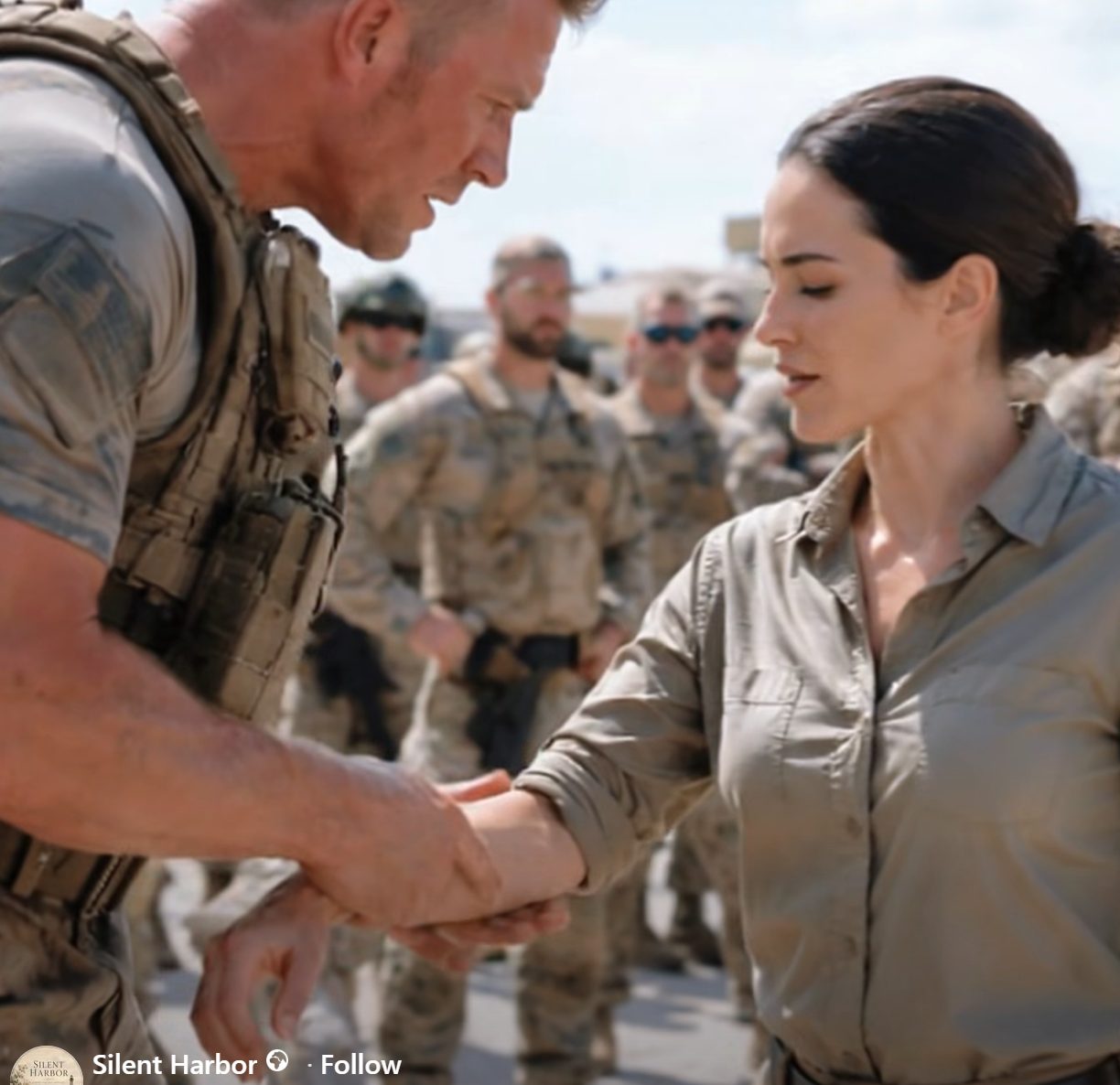
“Take your hand off me,” the woman said quietly, “or every man on this base is about to watch your pride hit the ground first.”
For one second, nobody breathed.
The parking lot at Forward Operating Base Viper went still beneath the Afghan sun. Heat bent the air above the asphalt. Dust hung over the Humvees like smoke after an explosion. Somewhere beyond the barracks, an engine coughed and died, but no one turned toward it.
They were all staring at her.
Dr. Livia Hale stood beside a black transit case, her wrist locked inside Master Chief Nolan Voss’s fist.
She did not scream.
She did not flinch.
That was the part that made the younger SEALs stop laughing.
Nolan Voss was built like a weapon and carried himself like one. Broad shoulders. Thick neck. Voice loud enough to turn humiliation into entertainment. Men knew his name before they knew his face, and he liked it that way.
On most days, his reputation moved people out of his path.
Today, it had carried him straight into a mistake.
Livia looked almost breakable beside him. Small frame. Plain field khakis. No visible rank. No sidearm. Her dark hair was pulled back with the practical severity of someone who had spent years being underestimated and had stopped correcting people unless it mattered.
At her feet, the black case sat open, rows of classified equipment sealed in foam.
She had been checking serial numbers when Voss crossed the lot.
He had seen a civilian woman kneeling near operator gear and decided the entire base needed a reminder of who belonged where.
“Move,” he had said.
Livia had not even looked up.
“This lane was cleared through logistics command.”
A few men nearby heard it.
Then a few more slowed.
Voss smiled like she had handed him a performance.
“Logistics command?” he repeated, turning just enough so the watching SEALs could hear. “That supposed to impress me?”
Livia closed the case with a precise click.
“No,” she said. “It’s supposed to inform you.”
The first laugh came from behind a transport truck.
Then another.
Not loud. Not yet. But enough.
Voss’s face changed by inches. The smile stayed, but the skin around his eyes hardened. Men like him could take pain. They could take danger. What they could not take was the sound of their own authority shrinking in public.
He stepped closer.
“You got a desk credential and a radio badge, and now you think you can talk to operators like you’re one of us?”
Livia stood.
The difference in size should have ended the conversation in his favor. He towered over her, casting a heavy shadow across her face. Sweat ran down the side of his temple. Her breathing stayed slow.
“I think,” she said, “you’re blocking a secured route.”
That was when the laughter stopped being funny.
More men turned now. More boots scraped asphalt. Four hundred operators were moving through the lot between training blocks, supply checks, and transport rotations, and a current passed through them as they realized something was happening.
Voss lowered his voice.
“You don’t know who you’re talking to.”
Livia looked at his hand before he moved it.
“I know exactly who I’m talking to.”
The words were calm.
Too calm.
That calmness offended him more than defiance would have.
His hand shot out and clamped around her wrist.
The sound was small.
Skin against skin.
But it moved through the lot like a rifle bolt sliding into place.
Livia’s eyes lifted to his.
For the first time, Voss seemed to notice there was no fear in them. Not arrogance. Not anger. Something worse.
Assessment.
Like she was no longer a woman being grabbed by a decorated SEAL.
Like he had become a problem she was deciding how gently to solve.
“Let go,” she said.
Voss leaned down, his voice thick with humiliation.
“Make me.”
Nobody moved.
Some of the younger operators exchanged looks, uncertain now. The joke had gone too far, but no one wanted to be the first man to step between a Master Chief and a civilian specialist.
Then Livia moved.
Not backward.
Into him.
It happened so cleanly that half the men watching did not understand it until Nolan Voss was already falling.
Her free hand touched his elbow – not struck it, not forced it. Guided it. Her shoulder turned beneath his line of strength. Her hips shifted a fraction. She stepped across his stance and redirected the pressure he had put into her wrist straight through the weakness of his balance.
Voss’s eyes widened.
His boots betrayed him.
For one impossible heartbeat, the biggest man in the lot looked like he had misplaced the ground.
Then Livia dropped her weight.
Voss hit the asphalt flat on his back.
Hard enough to knock the air from his lungs.
Controlled enough that everyone knew she could have done worse.
The silence afterward was terrifying.
No one laughed.
No one spoke.
A bottle of water rolled from someone’s hand and clicked once against the pavement.
Livia released his wrist and stepped back, her expression unchanged. She adjusted the cuff of her sleeve with two fingers, as if he had left dust there.
Voss coughed, one hand pressed to his chest, shock spreading across his face before rage could cover it.
Four hundred SEALs had just watched him go down.
Not in a fight.
In a lesson.
He rolled to one side, trying to push himself up, but the humiliation was heavier than his body armor.
“You – ” he rasped.
Livia looked down at him.
“Don’t.”
One word.
It pinned him harder than the throw had.
Then a shadow crossed the asphalt behind her.
Colonel Elias Grant had arrived without anyone noticing.
He stood at the edge of the crowd, sunglasses in one hand, jaw locked so tight the muscles jumped beneath his skin. He looked at Voss on the ground. Then at Livia. Then at the hand Voss had used to grab her.
Every operator in the lot straightened.
Grant’s voice did not rise.
It didn’t need to.
“You just put hands on the woman who wrote the close-combat doctrine your team trains under.”
The sentence froze the base.
Voss stopped moving.
Livia’s face remained unreadable, but something colder passed through her eyes.
Grant stepped closer, and the men parted for him without a sound.
“And that,” he said, staring down at Voss, “is not the worst part.”
Livia slowly turned her head toward him.
For the first time, her calm cracked.
Not with fear.
With warning.
Colonel Grant looked at the black transit case beside her feet.
Then he said the one thing that made every weapon-trained man in that parking lot understand this was no longer about pride.
“Open the case.”
What Was in the Case
Nobody moved for three full seconds.
Then Livia crouched.
Her fingers found the latches without looking. Two clicks. The lid came up. She turned it toward Grant, not toward the crowd, which told everyone watching that whatever was inside was not for them.
Grant looked.
His face didn’t change, but something left it. Some baseline of calm that he’d carried through two wars and a dozen operations that nobody would ever read about in any report.
“When did you know?” he said.
“Kandahar,” Livia said. “Fourteen months ago.”
Grant looked up at her. “And you’ve been carrying it since.”
“Carrying it, tracking it, waiting for the right chain of custody.” She paused. “You’re the right chain of custody.”
Voss had gotten to his feet somewhere in the middle of this. Nobody had helped him. He stood at the edge of the group now, body armor dusty, the back of his shirt dark with sweat, trying to figure out whether he was still relevant to whatever was happening.
He wasn’t.
That was the part he hadn’t caught up to yet.
Grant closed the case himself. Carefully. The kind of careful that meant the contents had weight beyond their physical mass.
“Who else knows what’s in here?”
“Three people,” Livia said. “Two of them are dead.”
The lot went very quiet again, but it was a different quiet this time. Not the stunned silence of watching a big man hit the ground. Something older. The silence that forms around information that changes the shape of a situation.
Grant looked at the case for another moment.
Then he looked at Voss.
“Get out of my sight,” he said. “We’ll deal with you in an hour.”
Voss opened his mouth.
Grant’s expression closed like a door.
Voss left.
Who Livia Hale Actually Was
She had a PhD from Georgetown, which she never mentioned. She had a second credential from a program that didn’t have a public name, which she mentioned even less. She’d spent four years embedded with special operations units across three countries before FOB Viper, mostly as a technical consultant on equipment the operators used but didn’t fully understand.
The close-combat doctrine Grant had referenced was real. Forty-seven pages. Classified. Used in training cycles at two facilities. Her name was on the cover page, though most of the men who’d been put through the program hadn’t bothered to read that far.
She was thirty-nine years old. She’d been doing this work since she was twenty-six. She’d been underestimated for roughly the same amount of time, by roughly the same category of men, and she had stopped being surprised by it around year three.
What she hadn’t stopped being was careful.
She had learned early that the worst thing you could do in her position was make someone like Voss feel small in front of his team. Not because it was wrong. Because it was expensive. Small men with wounded pride were a resource drain, and she had too much work to spend energy managing one man’s feelings about being corrected.
But he had put his hand on her.
That was different.
That was the one place she did not negotiate.
She had told him to let go.
He had not.
So she had solved the problem with the least force available to her, in the most visible way possible, because sometimes a lesson needed an audience to stick.
She did not feel good about it.
She didn’t feel bad about it either.
She just felt like she had one less hour before she needed to be somewhere else.
The Hour Before Grant’s Tent
He walked her across the base himself, which was unusual enough that men stopped and watched.
The transit case was in Grant’s hands. Livia walked beside him at a pace that suggested this was a meeting she had been expecting and he had not.
“Fourteen months,” he said again, not quite a question.
“I needed to verify the second set of serial numbers. That took until March. Then I needed transport clearance that wouldn’t flag the manifest, and the only window was this rotation.”
“You couldn’t have gone through Langley.”
It wasn’t a question either.
Livia said nothing, which was its own answer.
Grant processed that. She watched him do it, watched the specific kind of recalibration that happened when a man who thought he understood the full scope of a situation discovered a new floor beneath the one he’d been standing on.
“How bad?” he said.
“The equipment in that case,” she said, “was logged as destroyed in a controlled burn at Bagram in 2021.”
Grant stopped walking.
Livia took two more steps before she stopped and turned back to him.
“It wasn’t destroyed,” she said.
“I can see that.”
“The burn report was filed by someone with the access to file it and the motive to move the equipment instead. It’s been in three different countries since then. I tracked it through a procurement chain that shouldn’t exist.” She looked at the case in his hands. “What’s in there is the proof of who filed the report.”
Grant looked down at the case.
Back up at her.
“And you brought it here.”
“I brought it to you,” she said. “Specifically. Because your name isn’t on any of the paperwork.”
That landed differently than she’d expected. Something moved behind his eyes that she hadn’t seen there before.
Not gratitude exactly.
More like the recognition of a debt he hadn’t asked for.
“Voss,” he said.
“Has nothing to do with this.”
“He grabbed you.”
“He grabbed a civilian specialist in front of four hundred of his colleagues and lost the exchange,” she said. “He’ll spend the rest of his career explaining that. That’s consequence enough.”
Grant looked at her for a long moment.
“You could press charges.”
“I could,” she said. “I won’t. I need the next six hours to be very quiet and very fast, and a formal complaint creates paperwork that creates attention.”
He nodded slowly.
“And after the six hours?”
Livia looked out across the base. The lot was back to normal now, men moving between buildings, vehicles pulling in and out, the ordinary machinery of a forward operating base grinding through another afternoon. As if the last forty minutes hadn’t happened.
“After the six hours,” she said, “it’s your problem.”
What Happened in Grant’s Tent
She laid it out in forty minutes.
Documents first. Then the equipment logs. Then the photographs she had taken herself in a warehouse outside Kabul that she described only as a place she had no business being, and left it there.
Grant asked four questions total. Practical ones. He didn’t ask how she’d gotten the photographs. He didn’t ask about the two people she’d said were dead.
He was a man who understood that some information was load-bearing and some was decorative, and he had the discipline to only pick up the pieces he needed.
When she finished, he sat with it for a moment.
“The name on the burn report,” he said.
“Is in the sealed envelope at the bottom of the case.”
“You haven’t told me.”
“No.”
“Why.”
She looked at him steadily. “Because I need you to receive it officially. Not conversationally. The distinction matters.”
He understood that too.
He reached into the case and took out the envelope.
He didn’t open it in front of her. He set it on the table between them and put one hand flat on top of it, and she recognized the gesture for what it was. An acknowledgment. A formal receipt. The kind of thing that didn’t require witnesses because the man performing it didn’t need them.
“You’re leaving tonight,” he said.
“I’m leaving in two hours.”
He nodded. “I’ll have someone walk you to the airstrip.”
“I don’t need – “
“I know you don’t need it,” he said. “I’m sending someone anyway.”
She looked at him.
He looked back.
“Fourteen months is a long time to carry something alone,” he said.
She didn’t answer that.
She picked up her empty transit case, turned it once in her hands to check the latches out of habit, and set it back down.
“There’s a copy,” she said. “If the envelope disappears.”
“I assumed.”
“Good.”
She stood. He stood. They did not shake hands.
She walked out of the tent into the late afternoon, the sun lower now, the heat still thick but starting to lose its edge. Somewhere across the lot, she could hear men in a training block running drills. Shouted counts. The flat crack of bodies hitting mats.
She thought, briefly, of Nolan Voss.
She wondered if he was in there. Working it out of his system the only way men like him knew how.
She hoped, in a small and not entirely generous way, that he was.
Then she stopped thinking about him, because she had a flight to catch and two hours to sleep on the plane and a meeting in three days that she needed to be sharp for.
The case swung light in her hand.
Empty now.
Done.
—
If this one got you, pass it on to someone who’d appreciate it.
For more insights into your body’s subtle signals, check out these reads on 9 alarming warning signs of swollen feet you should never ignore, 7 Signs You Have A B12 Deficiency, and The Solar Anchor: 7 Signs of a Vitamin D Drought and a Gentle Path Back to Steadier Strength.



