
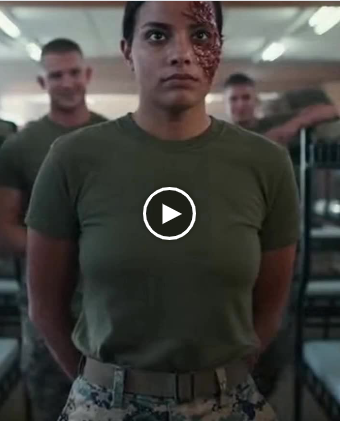
When the Room Fell Silent
The air in the briefing room felt tight, as if everyone had been holding their breath for just a bit too long. A few recruits traded knowing looks. There were smirks, the kind people wear when they think they’ve already seen the end of the story. They expected a scolding. Maybe even a dismissal. After all, they had noticed the scar. They had been whispering about it since the first day.
But then Commander Thorne stopped. He did not raise his voice. He did not make a speech. He simply lifted a hand and pointed across the room, and that small motion seemed to slice through the tension like a sharp wind.
“You,” he said, his tone low and even. “What’s your name, soldier?”
The young woman in question straightened her back and met his eyes head-on. She did not hide her face. She did not shift her weight or look down. “Private First Class Riley Hart, sir.”
He studied her for one more measured second. Then he nodded. It was a short nod, decisive and final. “Follow me.”
The whispers started the moment he turned away. She could hear all of it—guesses, jokes, and the sting of remarks made just loud enough to be heard. But she did not slow down. She matched the commander’s pace and stepped into the Colorado sun as it poured down over the base like a white-hot flood.
The Test at the Wall
They walked side by side across the tarmac, past the barracks, past the armory, until they reached the rugged edge of the obstacle course. There, at the far end, stood the brutal challenge almost no one approached without being told to: a fourteen-foot combat wall built to be climbed with no rope and no help. It was tall, plain, and unwelcoming, scarred by boots and weather and time.
Commander Thorne turned to her. “Fourteen feet. Straight up. No support,” he said. “You ever climb one of these?”
Riley kept her gaze steady. “Yes, sir.”
“You fall?”
“Once.”
Something close to a smile tugged at the corner of his mouth. It barely showed. “Don’t fall today.”
He stepped back, crossed his arms, and waited.
She did not hesitate. She took two steps to gather speed, then jumped. Her boots slammed against the wood as her fingers found the first hold. Her arms lit with heat. Her side pulled in protest. The scar on her face prickled, as if the skin remembered the day it formed. But she set her jaw and pulled herself upward. She reached. She braced. She pushed again. Every inch was a decision she had to make twice—first in her mind, then with her body.
She reached the top and swung her legs over, dropping to the other side with solid footing and a steady breath. Commander Thorne was already nodding when she turned back to face him.
“Again,” he said.
She climbed the wall two more times. By the third run, sweat ran from her chin and her hands trembled. She said nothing. She explained nothing. When she landed for the final time, he walked up close and lowered his voice so only she would hear.
A Name from Long Ago
“Your father’s name was Eli Hart?” he asked.
Riley’s breath caught. “Yes, sir.”
“I served with him. Afghanistan, 2007. He was the one who ran into a burning Humvee to pull a kid out when the rest of us thought it was too late. Took shrapnel to the neck. Didn’t flinch.”
Riley swallowed hard. “He told me that story. He said the kid lived.”
Thorne’s eyes softened for a heartbeat. “He did. I was that kid.”
The quiet that followed weighed more than any rucksack. It was not awkward. It was full. It held respect, and surprise, and the kind of gratitude that never finds enough words.
Thorne looked at her scar. “That fire of yours,” he said carefully. “Was it your house?”
Riley nodded. “Yes, sir. My little brother was trapped upstairs.”
Thorne’s jaw clenched. “And you went back in.”
“I did,” she said, her eyes burning for a reason that had nothing to do with smoke now.
He turned away for a moment, as if steadying a thought that had waited years to be spoken. When he faced her again, there was iron in his voice.
“They may laugh now,” he said, so she alone carried the first hearing, “but soldiers like you are the reason the rest of them even get to wear the uniform.”
Then he raised his voice so the words carried across the field, to the furthest formation and the last skeptic.
“Private Hart is reassigned to advanced combat training under my personal supervision. If anyone has a problem, they can take it up with me.”
He did not wait for applause. There was none. There was just the sound of the wind, and the hum of the base, and a new understanding settling in where rumors had been living.
From Whispers to Nods
Back at the barracks, the tone changed. No laughter. No comments made behind cupped hands. Just quiet glances that lasted a little longer than usual, followed by slow nods that asked for nothing and gave something simple in return—respect. Not pity. Not apology. Respect for what she had already lived through, long before she put on the uniform.
Riley did not need their approval. That had never been the point. She had come to serve, to learn, and to carry more than just her own weight. She had made peace with the scar a long time ago. Now she was ready to see who she could become with it, not in spite of it.
Learning to Lead
The weeks that followed were not easy. Commander Thorne pushed hard. Dawn came early, and often it came before she closed her eyes. There were drills that punished hesitation, exercises that demanded focus, and tactical simulations where one wrong step reset the whole day. When they moved to live-fire practice, there was no room for guesswork. Safety and speed had to live in the same breath.
Riley did not complain. She listened. She adjusted. When she missed a mark, she learned. When she hit it, she hit it again. Thorne did not heap praise. He did not have to. He set a standard and kept it there, and she rose to meet it because she was finished with just surviving. She was learning to lead—steadily, quietly, with the kind of confidence that comes from knowing you have been through the worst and kept moving anyway.
Her scar stopped stinging. It did not harden into something cold or hidden. It became a reminder she wore the way a veteran wears a story—a simple truth on the surface of her skin.
In time, the questions from other recruits changed. They had once asked in whispers, “What happened to her?” Now they asked in an even voice, “How did you make that climb so fast?” and “How did you keep your head when the alarms went off?” She showed them the grips she used on the wall. She talked them through breathing when stress punched up the heart rate. She explained that courage usually looks quiet because it is busy paying attention.
One evening, a young trainee approached her at dusk. He had that new-boot wobble in his stance and a tremor in his voice. “I heard what you did,” he said softly. “With the fire. Your brother. That’s… brave.”
Riley met his gaze and spoke in the calm way she had learned to prefer. “Courage isn’t loud,” she said. “It doesn’t shout. Most of the time it’s just doing what has to be done when no one else will.”
He nodded and walked away a little straighter. A small thing, but not to him. Not to her either.
The Mountain Call
Just as the days began to feel like they might find a comfortable rhythm, the call came in. A training exercise in the mountains north of the base had turned into the real thing. A hostage situation. Civilians at risk. The weather was turning rough, the kind of cold that could make even simple tasks harder. Everyone moved at once.
Commander Thorne gathered his team. He did not hesitate. “Private Hart, you’re with me.”
Riley felt her heartbeat steady instead of race. She checked her gear. She checked it again. She climbed into the helicopter without a word she did not need.
The rotors cracked the air as they lifted off. The ride was short and violent, as mountain winds shouldered the aircraft and pushed back. Thorne briefed them over the headsets. The plan depended on speed and quiet, a careful approach from the east, no wasted motion, no unnecessary noise.
Boots hit the snow and the mountain told them the truth. The ground was uneven. The cold bit quick. Every breath fogged in the air as they moved in a line of shadows through the trees.
Fire in the Snow
Riley led the flank, eyes open to every angle and every shift in the wind. Her breathing fell into the same pattern she used on the wall: in for focus, out for steadiness. Then the stillness broke with a sharp crack. Gunfire split the quiet, and the world moved all at once.
She dropped behind a boulder and returned fire. Rounds cut the air so close she felt the heat pass her ear. A teammate went down with a hit to the leg. There was no time to think about it. Riley moved. She dragged him into cover, slid off her pack, and opened his vest. “You’re not dying today,” she growled through the noise, tying the tourniquet clean and tight.
“Breach in thirty,” Thorne’s voice snapped over the comms. “We need eyes inside.”
Riley did not wait for permission that could be argued later. “I’m going in,” she said.
“Negative—Hart, wait—”
But she was already gone, a quiet shadow moving low and fast through the trees. She rounded the slope and found the back of the cabin. The wall there was weaker, with boards that had not seen the same care as the front. She slipped in under a broken beam with barely a whisper of sound.
Inside, she counted three hostiles. Two civilians were tied to chairs. A third captive was slumped against a post, barely conscious. The scene snapped something into extra focus in her mind, clean and bright. Her brother’s face flashed for an instant, not to distract her but to remind her why she was there.
She moved. She took the first man down with a driving knee that crushed his wind. The second reached for a weapon. She got there first, smashed his wrist with a hard elbow, and stripped the gun from his hand. The third managed a wild shot that grazed her shoulder and burned a line through her sleeve. She did not stop. She closed the distance and dropped him fast, a sharp, final motion that left the room in ringing quiet.
By the time the team burst through the front, it was done. The hostiles were down. The civilians were breathing. The man by the post was awake and blinking at the light.
Commander Thorne took it all in at a glance. He looked at Riley. There was blood on her uniform. Her eyes were steady and bright. He did not say a word. There was nothing to add to what was already plain.
They flew back in a silence that was not empty. It was a silence that said the mission mattered more than any victory lap. It was the kind of quiet you get when everyone understands what just happened and no one needs to mark it with noise.
The Debrief and the Decision
At the base, the wounded were carried to medical with practiced urgency. The team gathered for the debrief. Thorne stood in front of them in his usual way, hands still, voice calm.
“Private Hart disobeyed a direct order tonight,” he said.
A murmur ran through the room. Not shock, exactly. More like the sound of people checking their own pulse.
Thorne waited for it to fade. “She also saved three lives, neutralized the enemy, and completed the mission.” He turned to Riley. “You still want to lead, Hart?”
Riley nodded once. “Yes, sir.”
He returned the nod. “Then lead. Starting tomorrow, you’re squad captain.”
The title landed with a soft kind of thunder. For those not familiar, a squad captain does not just shoot straight or run fast. A squad captain carries people forward and brings them home. It is responsibility more than rank. It is trust, spoken aloud.
No one argued. No one made a face. The room seemed to line up around the decision as if it had been waiting there all along.
Riley lifted her hand in a clean salute. Thorne returned it with the same measure of respect.
What They See Now
Word spread across the base, but not in the way gossip spreads. It moved slower and straighter, like news you tell with care because it deserves that. People stopped seeing the jagged line on Riley’s face as a curiosity. They started seeing it for what it truly was—a piece of living proof.
It was proof that some of the hardest battles don’t look like firefights or obstacle courses. They look like a girl running into a burning house because her little brother is upstairs. They look like a soldier climbing a fourteen-foot wall three times because a leader she has never met before told her to. They look like the choice to set fear down and pick responsibility up, over and over again, until the habit becomes the person.
Riley did not think of herself as a symbol. She thought of herself as a soldier who had learned the simple rules that get you through the worst days. Breathe in. See clearly. Move purposefully. Help the person next to you. Do the work in front of you. Trust the training. And when the moment calls for it, go.
Some nights, she still felt the faint tingle in the skin of her cheek where the scar began. When she did, she touched it lightly and remembered what it stood for. Not pain. Not embarrassment. Not something to hide. It stood for a family protected. A promise kept. A life carried forward when turning back would have been easier.
There are many kinds of strength. Some come from muscle. Some come from memory. The strength Riley carried came from both. It could climb a wall. It could ignore a smirk. It could choose the steady path through noise and doubt. It could reach into a fire and not let go.
From Surviving to Leading
In the days that followed her promotion, Riley walked the line between teaching and learning. She showed her squad how to move as one. She spoke plainly. She did not waste words. When a recruit stumbled, she turned the stumble into a lesson instead of a bruise. When someone did well, she let a simple “Good work” carry more weight than a long speech.
She respected the quiet recruits who paid attention. She guided the loud ones who needed a purpose for all that noise. She made sure every person knew the plan and knew that they mattered to it.
Commander Thorne watched without hovering. He had already said what needed saying the day at the wall. He knew better than to cover a bright flame with someone else’s shadow. He simply kept the standard high and trusted her to meet it. And she did.
People sometimes say scars fade. Some do. Some don’t. Riley’s stayed where it was, honest and unhidden. With time, it became less the first thing anyone noticed and more the last thing they forgot. It reminded the whole unit—without a single extra word—that the measure of a person is not found in polished parts. It is found in the places where life pressed hard and the person did not break.
They had once laughed at her scars. They no longer did. They had once doubted her. They no longer did that either. They followed her. Not because she demanded it. Because she had lived through enough to earn it.
In the end, what they saw on her face was not damage. It was testimony. It said, clearly and calmly, that some battles are survived long before the first shot is fired. And that is exactly the kind of leader people wait a lifetime to find.



