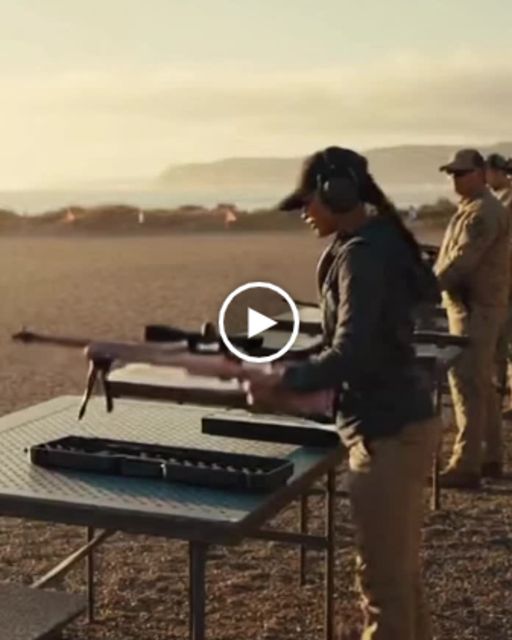
Hello, I’m Emily Carter. At 28, I generally avoid drawing attention. Yet, there I was in Southern California, feeling the salt breeze on my face and the crunch of gravel under my boots, aware that I had everyone’s attention.
My equipment landed on the steel table with a soft sound. Surrounded by tan rifles and black scopes, mine was different: a rose-pink model, with a finish that shimmered in the sunlight. Not overly flashy, but distinctive enough to catch anyone’s eye among the serious competitors getting ready for the long-distance shootout.
A man a couple of spots away chuckled. “Pink? Trying out for a Barbie sequel?”
His companion leaned in with a smirk. “Hope that’s not your lucky charm today, sweetie. Wind’s playing up.”
I didn’t engage. I calmly unzipped my case, hands steady despite the familiar shakiness I’ve learned to channel, not conceal. I’d driven three hours to get here, my notebook crammed full of wind observations and ballistic notes from countless hours spent on deserted shooting ranges.
The lead instructor barked out the guidelines: “800 yards. One shot. Hit or you’re out.” He glanced at my setup, eyebrows raised. “Fifteen minutes to prepare?”
“Exactly,” I replied simply. No explanation. No justification.
Murmurs circulated. “Fifteen? That’s beginner’s pace.” Someone whispered something about “a girl putting on a show.” Meanwhile, the senior spotter observed keenly, noting how I synchronized my breaths with the flags fluttering in the wind.
I nestled into position, cheek against the stock. The target was a blur in the distance, a mere speck. The wind played left to right, then stopped. My heart beat once, twice—timed just right.
“Clear the bay,” I instructed, my voice slicing through the murmurs.
There was a shuffle of boots. The smirks disappeared. Silence descended as I breathed out, gently squeezing the trigger.
The shot rang clear, echoing over the ocean waves.
The spotter checked it through his binoculars, lowering them slowly. “Hit. Right in the center,” he announced over the radio, quiet satisfaction in his tone.
Faces displayed shock. The man who had doubted my pink rifle looked as if he’d been hit. But it didn’t end there. The instructor stepped forward, radio in hand, connecting to range control.
That’s when the reply came through, and my heart sank—not just a confirmation, but a summons.
“Range control here. Confirmed hit. But ask shooter Carter to head to the command tent immediately. Sergeant Miller is requesting her presence.”
The mention of Sergeant Miller was a gut punch. It had been five years since I last heard the name—since the day uniformed officers came to my parents’ doorstep.
My concentration shattered. The smell of gunpowder and salt air was replaced by the memory of fold flags and empty condolences.
The instructor lowered his radio, his face inscrutable. “Carter. You heard the orders.”
The confidence I had moments ago evaporated. The line of shooters, their earlier teasing now replaced with a confused silence, watched. What was a military sergeant doing here at a civilian event? And what did he want with me?
I unmounted my rifle, my movements stiff and mechanical. The pink stock felt strangely cool against my skin. I packed it gently, like tending to a relic from my past.
The man who had joked about my “Barbie” rifle watched silently, his previous smug grin gone. I walked past without acknowledging him.
The command tent was a simple canvas shelter a short distance from the firing line. An older man stood outside, looking out over the ocean. He wore civilian clothes, yet his posture was undeniably military.
He turned as I neared. His face, weathered and marked by time, was familiar. His eyes, though aged with stress, were gentle and kind—the same eyes I recalled from my brother’s funeral.
“Sergeant Miller,” I said, my voice barely audible.
“Just Frank now, Emily,” he said softly. “It’s been a while. You’re looking well.”
It was a polite lie. I felt hollow. “What brings you here? How did you know I’d be here?”
He gestured for us to walk, leading us away from curious ears along the bluff’s edge. “I’ve kept casual tabs on you. Heard you were gaining a reputation in shooting circles.”
“I’m not,” I replied quickly. “I just…shoot. It’s what I do.”
“You shoot like him,” Frank said quietly, the weight of the words lingering. Like Daniel.
My brother Daniel, he’s the reason I’m here. He placed this rifle in my hands, taught me to read the wind, to control my breath, to feel the trigger like a heartbeat. He was a scout sniper—the best there was.
And he’s gone.
“Why are you really here, Frank?” I questioned, my voice gaining strength.
He paused, looking into my eyes. The kindness was laced with deep sorrow. “Because I lied to you, Emily. We all did.”
My heart pounded. “Lied about what?”
“About how Daniel died,” he explained. “It wasn’t just a random attack. It wasn’t happenstance.”
The world tilted. I’d rehearsed the official account countless times, a sterile account of a mission misfortune. It always felt wrong. Daniel’s final letters spoke of shadows, a partner he couldn’t trust, an ominous decision he grappled with.
Frank continued, his voice urgent. “Daniel’s unit was betrayed by his spotter, a man named Gavin Thorne.”
The name didn’t register.
“They were on overwatch duty,” Frank explained. “Thorne provided intel to the opposition. Daniel discovered the truth. Planned to report it.”
He paused, letting the gravity sink in. “Thorne ensured he never got the chance. He falsified their location, misdirected extraction, and left Daniel to fate. He reported Daniel was hit and left no body to retrieve. He got away with it.”
A long-suppressed fury ignited within me. “Why tell me now?”
“Because Thorne is here now,” Frank said, his eyes drifting towards the firing line. “He’s competing today.”
I followed his gaze, trying to pick out faces among the shooters. “Who is he?”
“He’s using a new alias. Goes by Nash. Big fellow, brown hair. He was two spots down from you,” Frank informed.
The color drained from my face. Nash—the man who mocked my rifle. The one who called me “sweetheart.” He had stood just feet away.
“He doesn’t know who you are, Emily. He sees only a woman with a pink gun. He doesn’t know Daniel had a sister,” Frank explained. “I’ve pursued him for years, but without proof…”
“What do you need from me?” I asked, the pieces of a terrifying puzzle clicking into place.
“I noticed your name on the registry,” he said. “I saw the rifle description. It could only be you. Daniel mentioned the rifle’s significance to me once. He was proud of you.”
Emotion welled up. My brother crafted the rifle for me, saying the shooting world was full of grim men. He wanted me to have something uniquely mine, something that didn’t conform yet excelled. A private joke, a statement.
“Thorne would recognize it if he knew,” Frank continued. “But he doesn’t. He only sees color. His arrogance is his downfall.”
“And arrogance is our tool,” I concluded, newfound resolve replacing old tremors. Daniel wasn’t merely a memory now—he was a cause.
Frank nodded. “The next challenge is a two-person, shooter-spotter test. I arranged for you to team with Nash.”
My breath caught. “You want me paired with the man who killed my brother?”
“I need you to provoke him,” Frank explained. “Not confront him—simply be you, Daniel’s sister. Share stories, moments. He’ll see the ghost of guilt loom over him. His conscience will tear him apart.”
It was audacious and risky. But it was our only chance.
“Alright,” I said firmly. “I’ll do it.”
When the instructor announced the final pairs, interest rippled among competitors. “Carter, you’ll be shooting. Nash, you’re spotting. Team One.”
Nash—or Thorne, I now knew—made his way over. His initial shock faded, confidence returning. “Looks like we’re a team, Barbie. Just follow my calls.”
I gave a tight smile without warmth. We moved to the firing spot, the unsaid tension palpable.
The challenge involved hitting targets between 600 and 1000 yards, with fluctuating winds. We had ten minutes. The spotter fed instructions, the shooter trusted and executed.
I arranged my mat, setting up. Thorne positioned his spotting scope nearby.
“First target, 650,” his business-like tone conveyed. “Wind seven mph, full value. Aim two-point-one up, point-three right.”
I made adjustments, following his guidance precisely. Inhaling, exhaling. Imagining Daniel’s calm guidance. The rifle felt integral to me.
“Sending,” I confirmed.
The shot struck with precision.
“Hit,” Thorne confirmed, surprise tinging his voice. “Next, 800. Winds fluctuating. Wait for a calm. Four-point-two up, point-five right.”
I obeyed, and another hit confirmed his skill—but it highlighted his betrayal. He had skills to save but betrayed Daniel instead.
We aced the third and fourth targets. With each success, Thorne’s arrogance grew, mirrored in my accuracy. Soon, he turned chatty.
“Not bad, Carter. You’re a good listener,” he remarked as I prepared for the last target at 1000 yards. This was the culmination.
Taking a deep breath, I remarked, “Thanks. My brother taught me.”
He grunted, maintaining focus. “Was he any good?”
“He was the best—Daniel Carter, a scout sniper,” I announced steadily.
Beside me, Thorne flinched—almost unnoticeably. His manner went rigid.
“Never heard of him,” he lied, voice strained.
“He hailed from Colorado, near Aspen,” I continued lightly, aligning the shot. “Learned more about wind from watching aspens than flags.”
No response. He saw a ghost no one else could.
“This rifle was his,” I added, cheek to the pink stock. “A gift for my 18th birthday. He loved its humor.”
The silence was telling. The rising wind scattered sand around us, yet Thorne didn’t budge.
“Final target,” he rasped, fear tinging his order. “1000 yards. Wind’s tricky. Nine-point-one up, one mil right.”
Through my scope, the mirage indicated a left-to-right wind. Flags affirmed it. His call was deliberately wrong—sabotage based on fear.
I ignored it.
“Daniel taught me: ‘Trust not the man, but the mirage,’” I remarked, voicing a lesson Thorne would understand too well.
His frozen posture betrayed guilt.
Using intuition honed by Daniel’s teachings, I adjusted for the truth in the wind. I anchored my aim high, into the breeze—a shot guided by legacy.
“Sending,” I stated, voice clear, resonating with resolve.
The rifle jumped back against my shoulder, the sphere of our world encompassing only the shot’s echo.
Through the lens, the target swayed, a confirmed bullseye. A flawless finish.
Thorne’s head drooped, a guttural sound escaping—one of realized guilt. He understood, not just because of the hit, but the exposure his own ability against a supposed amateur.”
Rising from my position, I observed the man broken at my feet. His face drained of color, eyes wide with a terror long overdue.
“His name was Daniel,” I repeated, voice laden with revelation. “My brother.”
That’s when Frank, accompanied by military police, arrived. No confession was needed—the truth was etched across Thorne’s stricken face. His entire existence toppled by a woman wielding a pink rifle.
As they escorted him away, the remaining shooters were hushed, understanding dawning. Their whispers now pertained not to me, but to his downfall.
Later, packing my things, the observant senior spotter approached. He stood quietly before the vibrant case.
“I’m truly sorry,” he said, regret genuine. “For myself, and all of us. We couldn’t have known.”
I accepted his sentiment. “It’s not just a novelty,” I said as I sealed the case.
“No,” he acknowledged, with a respectful nod. “It’s a tribute.”
Driving back as the sun descended over the Pacific, a profound peace enveloped me—a liberation I hadn’t felt in years. The rifle sat beside me, its weight no longer burdensome, now a cherished connection.
Justice, I realized, doesn’t always manifest in courtroom formality. Sometimes it sails quietly on the sea breeze, a reconciliation that echoes across a thousand yards.
I came not to prove myself, but to commune with my brother in our shared, silent language. In the end, his message resonated.
True strength isn’t defined by appearances or clamor. It resides in the quiet legacy we bear, skills honed in solitude, the courage to remain genuine despite onlooking skeptics. Dismissed trivialities might harbor potent stories, uncovering their worth when it matters most.