
The wind moved through the Appalachian Mountains like something with a mind of its own, not just loud but heavy, pressing against rock and trees with a steady, stubborn force. It howled through the ravines in long, hollow waves. Every time it rose, it felt like the mountain itself took a breath and held it.
In a shallow cave cut into jagged stone, six Navy SEALs sat close to the walls and said very little. Water ticked from the ceiling in slow, uneven drops. The air was wet and cold. They had been pushing past tired for hours. Nobody let himself fully settle. Not here. Not with the storm still clawing at the world outside.
On the ground between them, a GPS unit blinked a weak, steady rhythm that felt like a bad heartbeat. Searching. Losing. Trying again. The screen gave nothing you could trust, only the faint promise that it might work if the storm would just step aside for a second and let a signal pass through.
Master Chief Petty Officer Graham Callahan watched the device until his eyes stung. He didn’t like what he had to say next, but he knew the rules and he knew the weather and he knew the math. He pressed the radio key and spoke evenly, because that was his job.
“Base, this is Bravo 5 with a status update.” He paused only long enough to search for a different sentence that did not exist. “Captain Nathaniel Ashford is presumed killed in action. We have lost GPS for six hours. Hurricane Elena is preventing recovery. We will extract at first light.”
The reply came back shredded by wind and static. Copy. Understood. Mark KIA. Extract when able. Then only the roar again, the kind that makes words feel small.
Senior Chief Marcus Lindren leaned his head back against the wall and let out a slow breath he had been holding a long time. “That’s it, then,” he said, in a voice too tired to be angry. “Six hours out there. No shelter. No signal. Nobody lives through that.” He waited a moment. “Not even him.”
No one challenged it. What were they going to say? They knew storms. They knew mountains. They knew how far the human body could bend before it broke. A call like that was not made lightly. It was made because you had to draw a line somewhere and tell yourself it was the right place to stop.
Callahan picked up the GPS again and felt the familiar weight of doubt settle in his chest. “It feels wrong,” he said, half to himself.
“What does?” Lindren asked.
“Calling it on him. I know the book. But it doesn’t sit right.”
Someone at the back said, “Instinct is good. Hurricanes don’t care about instinct.” Nobody argued with that either.
Right then, the screen flickered and showed a coordinate for a breath of time, a single hard blink, then dropped it like a trick of the eye. Callahan held his breath and squinted at the display as if he could force it to behave by wanting it to.
Before he could decide what he had seen, a sharp sound cut through the wind. It was clean and distant and made everyone look the same direction at once. One precise crack. Then another. Not thunder. Not a tree splitting. Controlled fire. Single shots. Spaced just enough to be heard and recognized by anyone listening for them.
Weapons came up. Conversation ended. The gray world just outside the cave mouth felt closer than it had a second earlier. Eyes adjusted and narrowed. Fatigue fell off the men like a coat shrugged from the shoulders.
Movement showed itself through the rain, slow at first, just a difference in the way the darkness shifted. Two figures. One helping the other. Lightning stretched hard across the sky and gave one bright frame of clarity, the sort of brief gift storms sometimes hand out when they want you to know exactly what you’re looking at.
In that instant, they saw her.
What They Saw
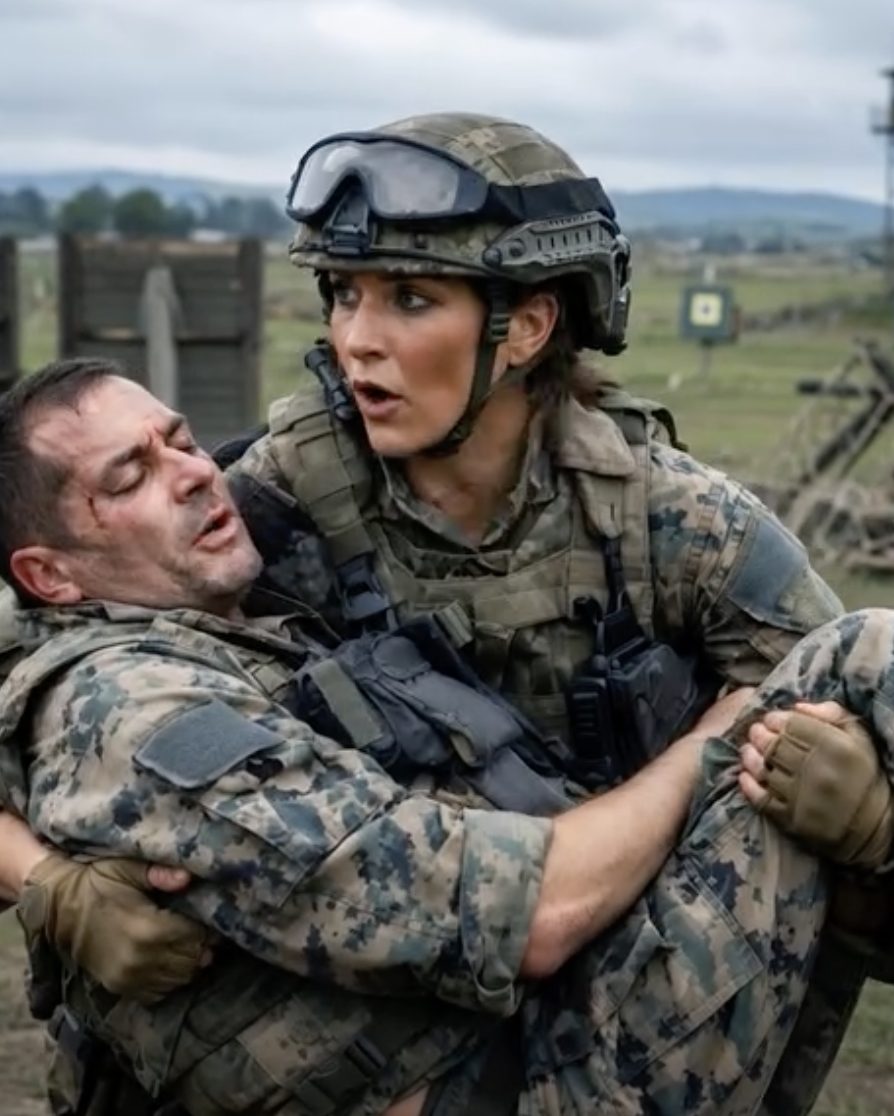
She was not rushing. She was not stumbling. She was moving with the careful, practiced pace of someone who understands that speed is not always the same as progress. Each step was placed as if the ground were a set of choices, not a path. Her body leaned forward under a heavy, living weight across her shoulders, one hand braced to keep it from slipping.
It was not a pack. It was a man. Their man.
Callahan was already stepping out into the rain before anyone else found words. The wind met him like a shove. He pushed back and raised a hand to shield his eyes and kept going until he could see her face and the man she carried.
She saw him at thirty yards and did not slow. “Bravo 5?” she called, her voice clean and certain despite the storm.
“That’s us,” he answered. “Name?”
“Staff Sergeant Dena Pruitt. JSOC augment. Assigned to your team three weeks ago.” She adjusted the weight on her shoulders with a small shift that said she had done it a hundred times already. “I have your Captain. He’s alive. Barely.”
Up close, her face was streaked with mud and rain and maybe blood. It was hard to tell. The figure across her shoulders was Captain Nathaniel Ashford, his arms looped over her like straps, his weight balanced the way you do it when you have miles to go and the only measure that matters is whether you make the next ten steps without falling. His head hung forward. One boot was gone. He was breathing, and that simple fact changed the air around all of them.
“How long?” Callahan asked, reaching to take some of the load as they moved together toward the cave.
“Carrying him about four hours,” she said. “I found him around two hours after we got separated. He went over a ravine edge. Fifty feet, maybe more. Broken arm. Likely concussion. Hypothermia coming on fast.”
“The shots?”
“I put three rounds out on purpose. Figured anyone still out here would be listening for something that sounded like order, not panic. Glad somebody heard.” She gave him a look that had a little humor in it. “Took you long enough.”
He almost smiled, and for a moment the cave ahead felt closer than it was.
The Cave
They had Ashford down on the ground within minutes, jackets off, heat packs out, hands moving with the quiet speed that comes from knowing exactly how long you can take and not a second more. The space that had felt like a last stop an hour earlier now felt like a room with a purpose.
Pruitt knelt and checked pupils with steady fingers, her voice low and even. “Right eye a little sluggish. Concussion seems likely.” She moved to his arm and ran her hands along the line of bone. “Mid-shaft radius fracture. Stable right now. He splinted it himself before he went out.”
“He was awake when you found him?” Lindren asked.
“For forty minutes or so,” she said. “Long enough to argue with me about walking. Long enough to tell me where he thought you’d head. Then he slipped out. He was already getting cold. I couldn’t wait on anyone else.”
One of the younger operators motioned toward the scrape along her cheek. “What about you?”
She touched it like she had to remind herself it was there. “Fell a couple of times. The ground is coming apart out there. I picked myself up until I couldn’t, and then I picked him up and kept going.” She shrugged, as if it wasn’t a thing that needed commentary.
Callahan watched how she moved. He had seen good people fray in kinder weather. He had seen training meet its match in much less. She was steady in a way that did not announce itself. She did not take up space with it. She just did the next right thing, and then the next, as if that were the only option available to her.
What She Left Unsaid
Later, pieces of the story found their way to Callahan like weathered driftwood washing up after a storm. Three weeks earlier, Pruitt had arrived as a sniper augment. Most of the men took it as a matter of fact. Two did not, though they never said so in a way you could neatly circle in a file. More like a door that didn’t quite open for her. A briefing question that skipped her chair. A pack moved where she wouldn’t find it easily. Silences that were not neutral.
Captain Ashford had addressed it once, cleanly and directly, with the authority he was paid to use. After that, everyone pretended the current had gone slack. You learn to live with that kind of almost-fixed thing in a unit. You should not have to, but often you do.
When Elena hit the ridgeline and the team stretched thin along wet rock and scrub, the mountain did what mountains do when you give them a chance. Visibility went to almost nothing. Footing turned unreliable. Noise bounced back at you in ways that made distances lie. Ashford disappeared over an edge in the chaos. The two men closest to him marked where it happened and called it in. They followed the line they had been taught to follow toward the rally point.
On paper, that was the right move. The storm was chewing up time and light. Protocol tells you not to risk five for one when the one is almost certainly gone. You live with that rule because it makes sense most days.
Pruitt had been four hundred meters back when she heard the sound of a body hitting rock and water. It was not a gunshot. It was not a branch snap. It was a particular hard, sick noise that does not get confused with anything else once you have heard it. She turned and moved into the storm and into the wrong direction as far as the rally point was concerned.
She found Ashford face down in a gully with runoff dragging at him like hands. She pulled him out and got him as dry as the rain would allow, then set about fixing what she could fix with sticks and paracord and a determination that made up for a lack of proper tools. He told her she was doing it wrong. She told him to let her work. He did. Then he went quiet, and the clock got louder.
So she picked him up and started walking toward the only people who could help. No map she could trust. No stars to steer by. Only the memory of the shape of this mountain under better skies and the thin thread of judgment you earn step by careful step when your life has taught you that rules are a floor and not a ceiling.
The Unspoken Part
Back at base, the debrief ran four hours and piled up more paper than anyone would honestly read twice. On the page, everything sat where it needed to. Protocol observed. Conditions extreme. Life saved. Judgment call made by Staff Sergeant Pruitt in the field. The words were neutral. They were careful. They were true as far as they went.
But some truths are shaped more by what does not get said out loud. Callahan read the report and then set it aside and let the weight of it balance out in his hands. The two who kept moving could point to the book and feel sure. Pruitt could not point to anything except the decision she had made in weather that wanted to erase people. She stepped across the tidy line because a man was breathing, and because she knew she could carry him, and because sometimes what is correct is not the same as what is right.
He turned that over for longer than he expected to. He still does sometimes. Odd, how the person who had been given the fewest reasons to go back had been the one who did.
First Light
Captain Ashford opened his eyes around 0400. It took him a minute to sort out the sound of rain from the sound of breath and to feel where his body ended and the mountain began. He looked around the cave like a man moving through rooms he once knew. When his eyes found Pruitt asleep against the wall, he did not ask the question. He only said, in the quiet way of someone fitting pieces together, “She carried me.”
“Four hours,” Callahan said.
Ashford held that in his face for a while, like light coming through a window you did not expect to be open. “Through Elena.”
“Through Elena.”
She slept hard and awkward, her head tilted against rock at a painful angle, a spare jacket across her shoulders that somebody had placed without calling attention to the gesture. She did not wake when Ashford shifted or when someone checked his splint again. The rain sounded different now, a little less sure of itself.
“How bad is it?” Ashford asked, nodding toward the arm.
“Bad enough,” Callahan said. “You’re going out on a bird as soon as we can get one in.”
“I’ll walk,” Ashford said by reflex, the way men sometimes do when the body wants a say in a conversation it is not qualified to lead.
“You won’t,” Callahan replied, and there was no room in it. Ashford let it go.
He looked at Pruitt again. “When she wakes up, I’d like to talk to her first.”
“Figured,” Callahan said, and let the quiet take the room for a while.
Beyond the cave, the storm was loosening its grip. Not gone, not tamed, but softening at the edges. Wind stepped down a notch. Rain shifted from hammer to steady drum. Somewhere behind the heavy cloud, the sun began the slow work of making gray from black and then something warmer from gray.
On the ground near the entrance, the GPS that had done them no favors suddenly showed four solid green bars. A perfect signal, a little late to be useful. Callahan watched it glow and thought about the neatness of tools and the mess of people and the way the two do and do not match in the spaces where it matters.
He turned the unit face down and waited for morning.
What Stays With You
There is a kind of memory that does not need anyone’s permission to stay. It sits in the bones more than the mind. The men in that cave would tell you the wind had a voice that night and that it tried to talk them into quitting. They would tell you about a woman who answered back with three small, controlled sounds that cut through a storm, and about the long, careful walk she made with a man on her shoulders because sometimes the shortest distance between two points is not a line but a choice.
If you were there, you would remember how quickly a room can reshape itself when hope walks in. You would remember the simple, practical kindness of a jacket across sleeping shoulders and how it can feel like a salute no one needs to perform. You would remember that rules are made by people trying to protect other people, and that now and then the best way to honor the rule is to know when to reach beyond it.
None of them would put it in a speech. They did not talk that way. But later, when anyone asked how the Captain made it home from a mountain that was swallowing men, they would point to the weather and the training and the gear and then, perhaps after a pause, they would nod toward the part of the story where a single person decided that carrying a life through a storm was a thing worth doing, even if nobody would have blamed her for choosing safer ground.
Morning came. The clouds lifted just enough to show the shape of the land again. The promise of blades on air grew from rumor to reality. The team packed to move. Ashford met Pruitt’s eyes when she woke. Whatever he said first is between the two of them. You could guess at it, but you would not need to hear it to know what it meant.
Some days, the mountain keeps who it takes. Some days, it gives a man back. On those days, most of the important work is quiet and heavy and done by hands that do not tremble. If you are lucky enough to watch it happen, you learn, or you remember, that the line between lost and found is sometimes drawn by a person who decides to walk the other way until they can carry somebody home.



