A Rainy Afternoon, a Slice of Pie, and an Ugly Surprise
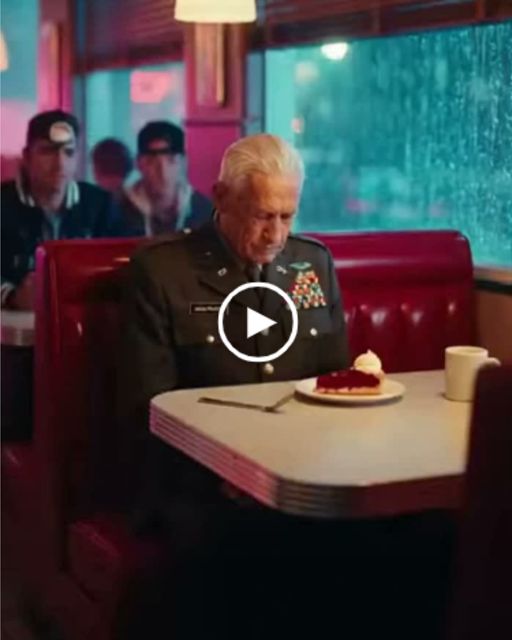
I was seventy-two and wearing my old Class A uniform, the one I kept pressed for funerals, Veterans Day, and the occasional Sunday when I felt like looking my best for no reason at all. The rain had rolled in steady and gray, so I ducked into a little diner I liked, ordered a slice of cherry pie, and planned to ride out the weather with a hot cup of coffee.
Four college boys slid into the booth behind me, smelling like a bar mat and bravado. Their laughter had that sloppy edge you get after too many cheap beers. One of them, a tall blond kid with an eager smirk, glanced at the ribbons on my chest and chuckled like they were novelty stickers. He took the pitcher off the table as if it were a prop in a play he didn’t quite understand.
“Maybe the old man needs to cool off,” he said, and the pitcher of ice water cracked against my cheek. The shock was instant. Cold slithered down my collar, and the burn of metal and cherry syrup mixed on my tongue.
The room stilled the way rooms do when everyone realizes the line has been crossed. Forks hung in the air. Chairs stopped scraping. I felt my hands tremble, not from the icy water, but from a heat that didn’t belong to this place or this year. It came from a green jungle I don’t visit anymore unless something drags me there.
When the Tablecloth Rumbled
The blond one leaned in close enough that I could trace the freckles on his nose. “What’s the matter, old man? Cat got your tongue?” His breath smelled like sour cherries and cheap whiskey. He thought I was alone. He thought wrong.
I didn’t raise my voice. I didn’t stand. I just slid my right hand beneath the long tablecloth, fingers finding what I knew was there. The small metal click was soft as a whisper. That was when the sound started—low and steady, a rumble you feel in your ribs before you make sense of it with your ears.
The boy’s eyes flicked down. The tablecloth lifted like a curtain at the end of a long intermission. Out slid a black muzzle, scarred and calm, with lips drawn back just enough to show the tools he came with. He was ninety pounds of old muscle and new teeth, and he moved with the easy quiet of something that has learned not to waste energy. His eyes stayed on the boy’s hands, reading every twitch, measuring every inch of space between them.
The cook’s spatula slapped the grill and then fell silent. The waitress froze, back to the pie case, her hand already slipping into her apron for a phone. No one breathed. The dog did not bark. He didn’t need to.
“Easy,” I said, pulling the carabiner clip free from the leg of the booth. “On me.” He flowed out from under the table, chest low, vest snug against his ribs. He pressed his nose to the boy’s beltline and stayed there, still as a statue, except for a small shift of his eyes toward mine—the look I knew so well. He had found something he wasn’t supposed to find.
The boy’s smirk wilted. He tried to step back, but the dog moved with him, quiet and assured, the way I trained him years ago in places that still don’t show up on maps.
Phones came up. Whispers fluttered along the counter like napkins in a draft. Someone choked on a breath. The dog’s metal tag tapped against the tile as he squared himself and, for the first time, everyone in the diner had a clear view of the bright yellow patch on his vest.
EXPLOSIVES DETECTION K-9.
Underneath, in smaller print, the words were plain and final. RETIRED – DO NOT PET.
The room’s silence changed. It wasn’t just surprise or fear anymore. It was recognition. They were looking at more than a dog. They were looking at a working partner who had already done more than his share.
Gunner Steps Into the Light
“He’s giving an alert,” I said, the words simple and level. I didn’t need drama. The dog did all the talking that needed doing. His name is Gunner. He spent twelve years walking rooms, checkpoints, and dusty markets, sniffing for things that turn people into names read at memorials. He does not make mistakes.
The blond boy swallowed hard. He tried to arrange his face into a shape that denied it all. “I don’t… I don’t have anything.” His voice wavered, the wobble of someone realizing the ground beneath him wasn’t as solid as he thought.
“My dog seems to think you do,” I said. Gunner did not lunge or snap. He simply held his position, nose a finger’s width from the boy’s front pocket, still and certain in a way that made the hair rise on more than one neck. When one of the boy’s friends in a gray hoodie slid toward the door, Gunner’s head turned. A single hard bark cracked off the tile like a judge’s gavel. The kid stopped with his hand on the handle and didn’t move again.
I stood then. My knees complained, but they held me. Water dripped from my chin onto the medal at my chest, the Distinguished Service Cross I never talked about and rarely wore. “I think it’s best if you and your friends take a seat over there,” I said, nodding toward the empty corner booth. They shuffled that way in a rush of elbows and excuses. Gunner eased behind them, not crowding, not threatening, just present in a way that suggested the path forward was very straightforward.
When it was done, he returned to my side and sat, pressing his shoulder to my leg. He gave a soft, checking whine, the one he saves for those moments he’s more concerned about me than anything else.
“I’m all right, old boy,” I told him, rubbing the scar behind his ear that he pretends not to like. “Just a little wet.”
The cook, a big man named Sal with sure hands and a quiet temper, came out from behind the counter and handed me a clean towel. No fuss. Just a nod that said plenty.
Blue Lights, Clear Thinking
Sirens drew close, the sound threading through the rain until it broke at the door. Two officers stepped in—one young and tight as a drum, the other older, his eyes taking stock in a thoughtful way. The younger one saw Gunner and reached for his sidearm by reflex.
“Sir, you need to control your animal,” he said, trying to find the right authority in his voice.
The older one laid a steady hand on his partner’s arm. “Hold on, Davies.” He looked at me, at my uniform, and then at Gunner’s vest. He didn’t hurry. He didn’t guess. He just collected the picture and then turned to the boys in the corner, who had gone from cocky to quiet.
“I’m Sergeant Miller,” he said to me. “What happened?” I told him, short and straight. The insults. The pitcher. The alert. No color added. No need.
He asked a single question with a professional calm. “Is your dog certified for narcotics?”
“Among other things,” I said. “Cross-trained.”
He nodded and turned to the blond kid. “Son, my officer is going to ask you to step outside.”
The boy tried to puff up again, like a frightened bird. “You can’t. You have no reason.”
Miller glanced at Gunner and back. “A certified K-9 alert constitutes probable cause,” he said evenly. “We can do this easy, or we can do this hard.”
The fight went out of the boy’s shoulders. Officer Davies patted him down and pulled a small plastic baggie from his front pocket. Dozens of blue pills caught the fluorescent light.
“Oxy,” Davies said to the sergeant, jaw tight. “A lot.” The other boys had more, and cash—too much to be pocket change. It wasn’t a prank or a dare. It was business, and not the kind any of them wanted to discuss with their parents.
Two Hours and a Long Memory
They took statements at the station. Gunner lay at my feet like a shadow that breathed, one eye always open. Sergeant Miller was courteous, professional, and clear. He told me Gunner’s alert would be central to the case. The boys weren’t just using. They were supplying pills from the city to the college, a quiet, profitable current running under the lives of kids who thought they were untouchable.
I had just finished signing the last page when the station doors opened hard enough to rattle the glass. A man in a thousand-dollar suit strode in, his frown practiced and expensive. He introduced himself as Robert Davenport, father to the blond boy, and he carried himself like a man used to his phone calls being returned in under a minute.
He saw me and pointed with a polished finger. “And I want that man arrested for setting a vicious dog on my son,” he said, voice sharp enough to cut. He talked fast, the way people do when they’re used to being obeyed.
Sergeant Miller stepped in, gentle but firm. “Mr. Davenport, your son was arrested on felony possession with intent to distribute. This gentleman and his service dog helped us make that arrest.”
Davenport laughed, the sound as cold as his cufflinks. “That old man? And that mutt? I know the mayor. I know the council. You’re finished if you think this will stand.” He turned on me. “You think you’re a hero? You’re a relic. My son made a mistake. You terrorized him.”
I met his eyes for the first time. “Your son threw a pitcher of ice water in my face because he thought my medals were funny,” I said. “He’s lucky a wet shirt is all he got.”
Gunner watched Davenport without a sound, head tilted just a fraction, the way he does when he’s cataloging a person. Davenport’s attorney arrived, gathered his client up, and steered him into a conference room. The air in the lobby warmed a few degrees after they were gone.
“Don’t worry, Mr. Collins,” Sergeant Miller said, shaking my hand with a grip as honest as his eyes. “We have this. That much evidence doesn’t bend for money.” I hoped he was right. I’ve lived long enough to know that sometimes, in the short run, money can make the road twist. But truth has a way of straightening it over time.
The Video That Spoke for Itself
By the next morning, my phone was buzzing like a beehive. Sharon, the waitress from the diner, had posted her video. It began with the taunts, the pitcher, and that awful moment when cold shocked hot, then moved to the slow lift of the tablecloth and Gunner’s patient, practiced emergence. You could see the exact second the boy’s certainty broke, and you could see Gunner’s discipline written in every quiet breath.
The clip caught fire. A million views by noon, and by dinner, we were on television screens across the country. The comments poured in, not just angry at the disrespect, but full of stories—grandfathers’ medals, mothers who’d served, uncles who came home different but still came home. People recognized Gunner for what he was and what he had given. They recognized, too, the familiar look on the face of an old man trying very hard to keep his calm.
Then came the second act. A reporter dug into Mr. Davenport’s background. He wasn’t just any attorney. His firm held the lead contract for a new Veterans Affairs building downtown. He had made a fortune from projects meant to serve men and women like me and dogs like Gunner. The headline wrote itself, and it wasn’t kind: a man who profited on veterans while his son mocked one in a diner.
The reaction was swift. Veterans groups called for a review of the contracts. The mayor, who Davenport swore was his close friend, made a public statement condemning the boy’s actions and promising transparency. The city council, suddenly allergic to Davenport’s confidence, took a large step back. Power, I’ve learned, is often borrowed, and when the lender asks for it back, the room changes.
Back to the Diner, Back to Ordinary Grace
A week later I returned to the diner for another slice of cherry pie. The rain had moved on, leaving the sky washed and bright. Gunner settled under the table, his leash looped loosely in my hand, more habit than need. Sal wiped the counter like he always did and slid a plate toward me before I could ask.
“On the house, Art,” he said, using my first name for the first time. “For you and for Gunner. From now on.” I started to protest, but he lifted a hand and shook his head. Some arguments aren’t worth having.
Sharon set a small plate near Gunner—no fuss, just a few pieces of bacon, set down with respect and space. “My brother was a Marine,” she said quietly. “Fallujah. An IED. A dog like yours found a secondary device before it could take the rest of his guys. Saved a dozen men.” She looked at Gunner with calm gratitude and then at me. “Thank you for what you did. Both of you.” My throat went tight in a way I couldn’t talk around, so I nodded instead.
Consequences Find Their Owners
The charges against Todd Davenport and his friends held. With the video and the evidence pulled from their pockets, there wasn’t much room to argue. They took a plea. Todd received five years and a mandatory rehabilitation program. It wasn’t a slap on the wrist, and it wasn’t a life sentence. It was, I thought, a chance to learn the difference between confidence and character.
As for his father, investigators started asking long-delayed questions about contracts and invoices. The man who had stormed into the station certain the world would step aside found that doors sometimes close, and when they do, they often close quietly. His influence thinned. His voice did not carry as far. That, too, was a kind of justice.
What Stays, What Matters
I finished my pie and stood to leave. As I reached the door, a man at the counter stood up. Then another. Soon, the whole diner was on its feet. No one said a word. They didn’t need to. I gave a small nod—almost nothing at all, really—and walked into the sunshine. Sometimes the most generous things people give you are the ones that don’t cost a cent.
I didn’t set out to make a point that day. I wasn’t looking for trouble or cameras or applause. I wanted a hot drink and a sweet slice and a dry place to wait out a storm. But life does not ask your permission. It hands you a moment, and you decide. Stand up, or stay seated. Speak softly, or let anger make the choice for you. I have learned, again and again, that the quieter road is often the stronger one.
True strength isn’t loud. It doesn’t throw its weight around or crush the table to make a point. It’s the steadiness in an old man’s back when the room goes silent. It’s the discipline in a dog who has known fear and fire and chooses calm anyway. It’s the patience to trust that the right thing, once set in motion, will find its way.
Gunner nudged my hand with his nose as we stepped off the curb, his breath warm and familiar. We’ve walked harder miles than this together. We have stood in louder rooms and lonelier ones. We are a little older now, a little scarred, and a lot more grateful for quiet days and good people.
We will keep standing, side by side, for as long as we can. In the end, that is the lesson that never grows old. Not the medals or the headlines or the noise, but the partnership you earn, the calm you choose, and the way you carry yourself when no one is watching and when everyone is. That is the work. That is the point.