The morning everything changed
The next day began like any other, until the rumble of heavy tires broke the quiet routine of the school’s parking lot. Big, dark SUVs rolled in and stopped with the kind of certainty that makes everyone pay attention. Men in uniforms stepped out, moving with a calm efficiency that spoke louder than any siren. Boots hit the pavement, clipped and steady. A tall man led the way, his Special Operations emblem catching the light. He carried himself like someone used to walking into hard places and making them safe. And when he said her name, the noise that usually filled the school corridors fell away like dust after a storm.
“Lily,” he called, his voice deep and measured. It echoed along the hallway that, just yesterday, had been full of whispers and sideways smiles at her expense. Today, it felt like a place holding its breath.
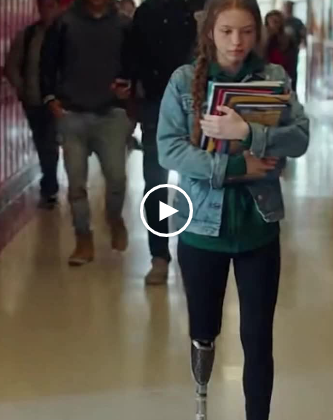
Lily stopped and turned. She hadn’t seen her father at school in years, and never like this. Her heart kicked up a little, not in fear, but in the strange sense that something long overdue was finally arriving. She traced his gaze as it moved from her face to the bruises on her arms, then down to her damaged prosthetic leg. She knew that look, the one where his jaw tightened just a fraction. Years ago it had meant he was about to carry a heavy pack for someone who couldn’t, or step into a task no one else yet understood how to handle. Now it meant something deeply personal. Now it meant her.
Behind him, his team didn’t bluster or pose. They simply did their jobs. Two headed toward the administrative wing. Others positioned themselves near the exits, polite but unmistakably firm. Students who would normally hold up their phones and laugh behind screens kept their hands still. No one wanted to be the first to break the quiet.
Near the lockers, three boys shrank against cold metal. Derek, Austin, and Blake had never looked so small. Yesterday they had taken what wasn’t theirs to take. They had pushed what they had no right to touch. They had broken what her father had made with care. Now, without a single raised voice, they understood they were in trouble far deeper than a hallway scuffle.
Her father stopped a few steps from them, his face set. “You three,” he said evenly, “come with me.”
They hesitated for only a heartbeat, which was long enough for two men to step forward and guide them along the hall. No one dragged them. No one shouted. But the message was clear as day.
Lily swallowed and tried to gather herself. Part of her wanted to hide; part of her wanted to stand taller than she ever had. Her father’s hand found her shoulder with a gentle pressure that told her he was there and that she didn’t have to do any of this alone.
“You okay, sweetheart?” he asked softly.
“They broke the leg you made me,” she said, the words quiet but steady.
He let out a slow breath through his nose. “We’ll take care of it,” he answered. “But first, I brought something.”
One of his men stepped close and handed him a long, sleek metal case. It was the kind of case that could hold delicate instruments or something carefully crafted for a specific job. He set it on a bench and opened it with care. Inside, laid against foam molded for it alone, was a prosthetic leg unlike any Lily had ever seen. Carbon fiber shimmered in a woven pattern. Small sensors glinted at the joints. Everything about it looked purposeful and strong.
“Dad,” she breathed, her eyes round, “what is it?”
“A new beginning,” he said. “It’s a prototype we designed for injured soldiers. You’re the first civilian to use one. It listens to your movement, helps you balance, and gives back a little of what the world tries to take. You won’t just walk, Lily. You’ll stride.”
Her fingertips brushed the smooth surface. It was light, cool, and beautiful in the way a finely made tool is beautiful. It promised reliability. It promised she wouldn’t have to fight her own body just to keep up.
“No,” he added with a small smile, “you’re the beautiful part. This just helps you feel the truth of that.”
He knelt, not like a man showing off, but like a father handling something priceless. He released the cracked prosthetic with the quick, careful motions of a field medic. When he fitted the new one, his hands were practiced and steady, every touch respectful. He glanced up. “Try it,” he said.
She stood. The first step was cautious, the kind you take across a creek on a slippery rock. Then the second came smoother. By the third, a new rhythm settled into her frame. She didn’t wobble. She didn’t brace herself against the lockers. She let her shoulders drop and her chin lift. She felt level, aligned, and—there was no better word for it—strong.
A hush spread wider. A few students stared openly. Some looked down, cheeks pink with a shame they hadn’t known they could feel. One girl who had snickered the day before whispered to a friend, not unkindly this time, “She looks like a superhero.”
Her father straightened and tilted his head toward the office. “Let’s go,” he said.
“Where?” Lily asked, though she already knew.
“To stop pretending this doesn’t matter,” he replied. “To make sure it changes.”
The office where silence learned to listen
In the principal’s office, three chairs held three paler-than-usual faces. Derek stared at the floor as if it might open up and swallow him. Austin, who had always found a joke, found none now. Blake breathed too fast for steady hands. The principal, Mr. Whitaker, pressed a tissue to his forehead even though the room was cool.
Colonel Jack Carter didn’t raise his voice or pound the desk. He simply stood where everyone could see him and spoke so no syllable was wasted. “I trust you understand why we’re here.”
The principal bobbed his head. “Y-yes, Colonel. We, uh, we deeply regret—”
“Regret doesn’t mend bone or confidence,” Jack said calmly. “And it doesn’t prevent the next time.”
Mr. Whitaker’s shoulders loosened, then tightened. He paused, measuring something in his own mind. “No, sir,” he admitted. “It doesn’t.”
Jack looked to Lily. “Tell them,” he said, not as a command, but as a gift of space.
She did. She told the room how the comments started as careless and turned cutting. How the teasing at first made her pretend she couldn’t hear, and then turned into a game she was tired of losing. She described the shove by the lockers, the stumble that bruised her arms, and the crack that echoed louder in her chest than from the damaged leg. Her words filled the room without shouting. She didn’t cry. She didn’t falter. She said only what was true, and the truth was powerful enough.
When she finished, the quiet in the office felt different, not brittle but attentive. Even the boys who had done the harm had to sit beside the weight of it.
Jack turned back to the principal. “Here’s what will happen. These three students will be suspended pending investigation. You will issue a formal apology to my daughter. And you will meet with the board to account for your lack of action. If you neglect your legal duty to protect students with disabilities, I will make certain this school’s federal funding is reviewed. I don’t say that lightly. I say it because someone needed to take responsibility yesterday and did not.”
Mr. Whitaker nodded, his face as pale as fresh chalk. “Yes. Absolutely. Immediately.”
Outside, word spread fast, as word always does. News vans idled at the curb, lights ready. Students filled the windows, faces pressed to the glass with a mixture of curiosity, nerves, and something like hope. When Lily and her father stepped back into the daylight, the crowd didn’t jeer. The air had changed. It felt, if not friendly, at least ready to listen.
“Miss Carter,” a reporter called, careful to keep her voice respectful, “may we ask who your father is?”
Lily smiled, small but genuine. “He’s a soldier,” she said. “And he’s my hero.”
The camera turned to Jack. He didn’t grandstand. “Protecting my daughter isn’t special,” he said simply. “It’s what fathers do.”
They started toward the car together. Before they reached it, Lily paused and turned back. For once, she didn’t shrink from the eyes on her. The new leg felt like part of her, not an object she had to carry. “For a long time,” she said, “I tried to blend into the walls. I thought if I took up less space, people would stop staring. I don’t think that anymore. If you look at me now, know this: this leg doesn’t make me less. It helps me be more. And I’m just getting started.”
The crowd made room, not in fear but in recognition. Respect is quiet when it is real. That’s what the air held then—a quiet kind of respect.
An evening of small breaths and big thoughts
That night, the sun eased itself down behind the rooftops. Lily and her father sat on the back porch with a pitcher of water between them, condensation sliding down the glass and pooling on the table. Her new leg rested on a cushion, her muscles both tired and alive. The day had moved through her like a storm that left clear air in its wake.
“I didn’t expect you to show up like you were rescuing hostages,” she teased gently, her eyes warm.
Jack smirked, a line of humor softening his features. “Sometimes a little shock and awe gets people’s attention. Sometimes it reminds them to do their jobs.”
She laughed—a full, unguarded sound that surprised even her. For a long time she had laughed quietly, as if not to draw attention to herself. Tonight there was no such worry.
“What happens now?” she asked, the day’s adrenaline wearing off, leaving behind a clear curiosity about tomorrow.
“Now,” he said, leaning back and looking at the slice of sky left between the trees, “you go back to school. Head high. You don’t pretend to be smaller than you are. And you let that leg do what we built it to do—support you, not define you.”
“And if they try something again?”
He lifted an eyebrow, a familiar spark in his gaze. “Then they’ll learn something new about you. And about the people who stand with you.”
She nodded. For the first time in a long while, she wasn’t bracing for the worst. She was picturing what was possible.
The next day, a different kind of quiet
Morning arrived with its usual rituals—breakfast, a backpack adjusted over one shoulder, a double check of homework pages. Only one thing felt unfamiliar: the lightness in her step as she crossed the kitchen. The new leg hummed softly, tuned to her pace like a thoughtful companion.
When she reached the school, the hallway did fall quiet again, but this quiet wasn’t cold. It was watchful and, strangely, courteous. She made her way to her locker with even strides. The metal door swung open with a familiar squeak. On the inside, a small square of yellow waited. A note. It said, in simple handwriting, “Sorry. You didn’t deserve that.” It had no name. It didn’t need one.
She folded it carefully and slid it into her pocket. Not forgiveness, not yet. But a step.
As she passed Derek and his friends, there were no smirks. There was no laughter. They stayed quiet, eyes fixed on their books or the floor. She didn’t glare or gloat. She simply moved forward. Power didn’t have to be loud. Sometimes it was the steady click of a confident stride.
In history class, when she reached her desk, someone pulled out the chair without making a show of it. At lunch, a table that had never noticed her before waved her over, not because of a spectacle, but because it finally felt right. She sat, she talked, she listened. The day filled with gentle, ordinary kindnesses, the kind that rebuild a person’s trust in the world one brick at a time.
When the final bell rang, she headed for the doors with the sun pouring through the glass like a kind spotlight. She didn’t hurry. She didn’t hide in the flow of the crowd. She walked the way she wanted to walk. And it felt like the building itself breathed out in relief, like it, too, was ready for a better story.
What everyone learned, even if they didn’t say it
Once, they had looked at Lily and seen only a label, as if that could hold the whole of her life. They had seen “disabled” and missed the dancer’s balance she was learning to reclaim, the student who stayed late to master the last few math problems, the daughter whose father designed a tool not just to help her get by, but to help her feel whole. They had thought the story was simple. It never was.
Now they knew better. Not because of a grand speech or a viral clip, but because the evidence stood at her locker and walked down their hall. It looked like courage that didn’t need to be perfect to be real. It sounded like a voice that refused to shake when the truth mattered. And it felt like a school beginning to understand that protecting dignity is not optional; it is the foundation of every lesson worth teaching.
As for Lily, she didn’t become someone new. She became more herself. The prosthetic was a marvel of engineering, yes, but more important than its sensors and joints was what it allowed her to remember: that she was not broken. She was resilient. She was capable. She was deserving of respect, equal treatment, and a place in the world that did not pity her for the tools she used, but appreciated her for the person she was.
Her father’s visit had been dramatic, and it made for whispers and headlines. But the truest change would come in the quiet days that followed, in the way adults enforced the rules meant to keep every child safe, in the way students spoke up when jokes turned cruel, in the way an apology note could fit in a pocket and still feel heavy with meaning.
At home, the prototype would come off at night and rest on a stand. The skin on her leg would need its own kind of care. She and her father would talk about adjustments, balance, and comfort. They would test and retune and test again, the way you do with anything designed for a person’s everyday life. It was ordinary work. It was also a quiet kind of love.
In time, Lily would find that the strongest thing about her wasn’t the carbon fiber or the precise bearings. It was the way she kept showing up. To class. To conversations. To her own future. She would discover that respect can grow in the same hallways where ridicule once lived—and that sometimes the most powerful transformation is not a single moment of shock, but a thousand small, steady choices.
They had thought she was just a disabled girl. Now, even the people who had once looked right through her would see what had always been there. Strength. Grace. A will that didn’t crack when pushed. And a stride that, at last, belonged completely to her.
And so she walked on
The story didn’t end with a headline or a handshake. It continued in simple, everyday scenes: Lily threading through the morning crowd without shrinking, her friends learning to be better friends, teachers noticing what they had missed, and a principal who finally understood the difference between regret and responsibility. Out on the back porch in the evenings, the sky would keep giving them oranges and purples to look at, and her father would keep asking the same question, always with the same deep care: “You okay, sweetheart?” She would keep answering honestly. Most days, she would say yes. On the days she couldn’t, they would work on it together.
At school, the hush that once meant mockery began to feel like room being made, a width in the air for people to be as they are. Lily’s new leg wasn’t a miracle that solved everything. It was a tool. The miracle, if there was one, was in the way she grew around it, the way courage took root in her and reached into all the corners of her life. That courage didn’t announce itself with fanfare. It revealed itself with each steady step she took toward the doors, toward the sunshine, and into the day that was waiting for her.
They thought they knew her. Now they know better. And so does she.