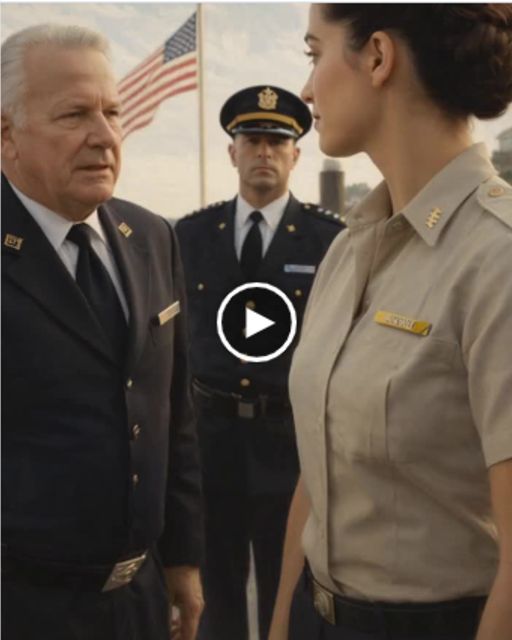
I was on duty as a security officer at the fleet week event in Pensacola. It was an occasion reserved for VIPs: senators, high-ranking officers, and the like.
Then, I noticed a woman in line who seemed out of place. She wore a faded green jacket that didn’t fit well and had boots that were quite worn. Her exhaustion was apparent.
Mrs. Higgins, the event coordinator with a fondness for her own voice, promptly approached her.
“Excuse me,” she said sharply, snapping her fingers. “The general public viewing area is further along the beach. This line is for dignitaries and veterans.”
The woman, looking down, responded softly, “I’m on the list. My name is Casey.”
Higgins didn’t bother to check her clipboard. “I doubt it. You’re holding everything up. Leave immediately, or I’ll have you arrested for pretending to be someone you’re not. You can’t just grab a jacket from a thrift shop and claim to be one of us.”
As Higgins attempted to push the woman away, Casey instinctively blocked her, causing her sleeve to slip, revealing a small scar on her wrist.
The mark was jagged, resembling a trident with one broken wing.
Suddenly, the crowd parted to make way for Admiral Henderson, a man who had not moved without assistance in a decade. Yet here he was, moving swiftly.
“Do not touch her!” he shouted, his voice thick with emotion.
Higgins looked smug. “Admiral, I’m taking care of this trespasser. She’s disgracing the uniform.”
The Admiral’s focus remained on Casey’s wrist, tears welling in his eyes. He let his cane fall on the dock—creating a loud clatter—and stood as straight as ever.
He didn’t salute her. He bowed.
Higgins gasped, “Sir? She’s nobody!”
The Admiral turned, his face ghostly pale. “You have no clue who you’re addressing,” he mumbled, pointing to the scar. “That symbol isn’t just about serving. It means she was the sole…”
He hesitated, swallowing hard, his voice choked by aged grief.
“…survivor.”
A haunting silence consumed the dock. Only the gentle waves against the pilings and a distant gull’s cry interrupted it.
Senators, captains, and every observer fixed their gaze on Casey. She stood motionless, her eyes on the weathered boards, as if wishing to vanish into them.
Mrs. Higgins went from smug satisfaction to dumbfounded confusion. “Survived what? Some training exercise?”
Admiral Henderson raised his head, the look in his eyes as intense as a brewing storm. “Be silent,” he commanded, his tone shifting to a dangerous rumble.
Approaching Casey gently, as if nearing a fragile animal, he softly held her elbow, his touch an unspoken question.
She didn’t retract. She gave a slight nod.
Turning to the assembly, he continued to hold Casey’s arm, a grounding force amid the stunned faces.
“Seven years ago,” he began, his voice carrying across the water, “an operation was launched. It’s absent from public records, classified at the utmost levels.”
He took a moment before continuing, “We called it Operation Trident’s Wing.”
Some older officers shifted uncomfortably, their expressions betraying hints of recognition, a tale passed in whispers behind closed doors.
“A team of seven Navy SEALs participated,” the Admiral recounted. “The finest men I’ve ever had the privilege to command, sent to retrieve critical intelligence from deep within hostile territory.”
“But they didn’t go alone.”
He looked down at Casey, her shoulders quivering slightly. “With them was a civilian, a cryptologist. A young woman whose brilliance defied what our best systems couldn’t achieve.”
The dock was utterly silent, the air heavy with anticipation.
“Her name is Casey Miller.”
He enunciated her name with a reverence that rippled over me. This was more than an introduction; it was an accolade.
“The mission unraveled into chaos,” he recounted, pain lacing his words. “Terribly wrong. Ambushed, outnumbered, outgunned. Communications severed.”
“We believed we lost them. For three haunting days, silence prevailed.”
The Admiral’s hold on Casey tightened, not aggressively, but protectively. “On the fourth day, a signal emitted. Short, jumbled, using a cipher obsolete for two decades. A code only a bona fide historian might know.”
“Casey.” He stated firmly. “Under fire, injured, alone, besieged. But her transmission wasn’t an S.O.S. for herself.”
“She broadcasted the enemy’s coordinates. She refused to abandon the mission.”
His voice quavered under the emotional weight, necessitating a deep breath.
“When aided forces arrived, they discovered she’d held the line, used her intelligence, their gear, and a bravery beyond description.”
“She was found holding the dog tags of every lost SEAL. She wouldn’t leave them behind.”
Addressing Casey directly, “The shrapnel that scarred your wrist…it was from the blast that killed the last of your team.”
The air around felt dense, burdened by the narrative’s gravity. Casey finally raised her head, tears creating clean lines amidst her dusty cheeks.
Then came the revelation clarifying everything—Admiral’s rapid approach, his tears, his profound bow.
“That team member,” he said, emotion cracking his voice, “the one she tried to save…was my son. Lieutenant Daniel Henderson.”
Gasps echoed among the crowd. Mrs. Higgins appeared as if struck, her hand to her mouth.
Admiral Henderson’s tears gave way as he continued. “Her last broadcast, the final effort before collapsing…conveyed personal messages for our families. She memorized every word.”
Turning back to Higgins, his face now steely, “You spoke of stolen valor. You accused a woman bearing insurmountable burdens of dishonoring the uniform.”
His finger trembled as he gestured towards Casey. “This woman, in her worn jacket and tattered boots, embodies more honor, more valor, more sacrifice than you could fathom in a lifetime.”
Higgins began faltering. “Admiral, I…I wasn’t aware. I was observing protocol…”
“Protocol?” interjected Senator Albright, a decorated veteran who witnessed everything from the front.
He advanced, visibly upset and disappointed. “Your ‘protocol’ is shameful, Mrs. Higgins. Your role is honoring service, not ranking those who served.”
He maintained his calm demeanor. “You were dismissive, discourteous, and utterly mistaken.”
Addressing both Higgins and the Admiral, the Senator said, “On behalf of my office, I apologize for this conduct from our event coordinator.”
He fixed his gaze on Higgins. “Consider your contract void. Immediately. Vacate the dock.”
It was a swift, public denunciation, and Higgins retreated, humiliated, under the cold scrutiny of onlookers.
Senator Albright then turned to Casey, his tone gentle, respectful. “Ms. Miller, it’s a true honor to have your presence.”
Casey nodded, overwhelmed by the abrupt shift in her reality. Once invisible, haunted by her past, she was now fully seen.
Admiral Henderson cleared his throat, steering back to the event’s focus. Addressing Casey, “Why come today, Casey? Why not contact me all these years?”
Her reply, whispered and private, was overheard by those close. “I couldn’t,” she admitted, torn by shame and grief. “I felt…like I failed them. Returning alone seemed undeserved.”
Looking toward the ocean, “I’ve been…not alright. Keeping on the move. But this ceremony came up. I needed to hear their names, know they aren’t forgotten.”
My heart ached for her. She came not for recognition but to connect, to share in a solitude she bore for seven years.
The Admiral’s gaze was saddened. “Oh, Casey,” he murmured. “The guilt was never yours. I signed the orders.”
He unfolded a worn paper from his pocket. “My son’s final note,” his voice heavy with emotion. “Venomous enemy discourse replaced by praises for your bravery.”
Handing it to her, “He called you their anchor.”
The paper trembled in her hands, revealing she wasn’t a surviving defeat, but a keeper of their final moments.
The master of ceremony approached, flustered. “Admiral, Senator…The wreath laying is ready.”
The Admiral raised a hand. “A change of plans.”
His gaze returned to Casey, now resolute. “The wreath will be laid by Ms. Casey Miller for Lieutenant Daniel Henderson and all of Trident’s team.”
Casey hesitated. “No, sir. I’m not…one of you.”
The Admiral’s reply was tender and firm. “Casey, you are more ‘one of us’ than anyone. You are their living testament.”
Offering his arm, “Together, let’s honor them.”
Hesitantly, she took his arm. As they proceeded to the dock’s edge, her posture transformed. The weight seemed to lift, and her gaze rose.
Hand across my heart, I saw this woman—previously dismissed—walk alongside the Admiral, boldly facing the heart of the ceremony.
Together, they held the ornate wreath at the dock’s edge, bowed in prayer, and released it gently into the sea.
The wreath, a vivid circle, floated across the ocean’s blues as a solemn trumpet played Taps, the sound gracefully carried by the wind.
There was not a dry eye among us.
Once the event concluded, I noticed the Admiral and Casey seated quietly on a distant bench, speaking softly. No longer officer and subordinate, but friends. Family.
He wasn’t extending pity, but a lifeline.
He shared about a foundation he’d begun: a resource for families of operatives who never returned, and survivors left without systems of support.
“Help is needed, Casey,” he implored. “I’m elder, requiring someone with understanding and experience of returning alone.”
Providing her a mission anew—one of healing and purpose, honoring not by memory alone but through helping others.
For the first time that day, a light flickered in Casey’s eyes. A glimpse of a future she thought lost seven years past.
“Yes,” she affirmed, softly yet determined. “Yes, I can do that.”
Respecting their moment, I turned away, eyes misted. My day began focused on order, ended with an understanding of true honor.
Amidst sharp uniforms and shining medals, we often forget the heroes in worn jackets, faces tired but spirits undeterred.
Heroism is not the fight’s glory. It’s surviving with dignity, reliving the fallen, and finding the strength to finally, truly find your way home.