I still remember the moment I saw my first white hair.
It was a Tuesday. I had just dropped Mira off at school, poured myself some tea, and glanced into the hallway mirror. At first, I thought it was dust. I leaned in closer—and there it was.
A single strand. Silver. Shining against my dark roots like a quiet truth I wasn’t ready for.
I pulled it out.
By the end of the month, there were five more.
I told myself it was stress. Motherhood. Long nights. Short mornings. Life.
But each time I looked in the mirror, all I could see was change. Change I wasn’t ready to accept.
I tried dyes. The boxed kind that promised “natural black” in ten minutes. They worked—until the color faded and the damage stayed. My scalp itched. My strands felt thinner. My hair, once long and strong, began to feel like paper in my hands.
So I stopped looking at it altogether.
I tied it up. Tucked it into scarves. Smiled through the compliments and cried in silence whenever I combed out a handful of weak, broken strands.
I had always loved my hair. It had been my comfort, my crown. But now, it felt like a quiet goodbye happening right in front of me—and I didn’t know how to stop it.
Then came the afternoon at Aunt Zarina’s.
I hadn’t planned to say anything. But when she hugged me, she pulled back and said, “What’s going on with your hair, beta?”
That question—gentle, but knowing—was enough to break whatever wall I had built. I told her everything. The greys. The thinning. The fear that I was losing more than just strands.
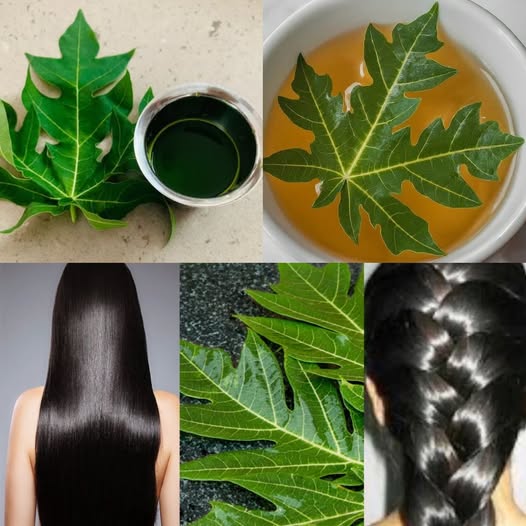
She didn’t scold or lecture. She just nodded, walked to her little garden, and plucked a handful of papaya leaves.
“These will help,” she said. “They helped me. And my mother before me.”
I was skeptical. But also tired. Tired enough to try anything.
That night, I followed her instructions.
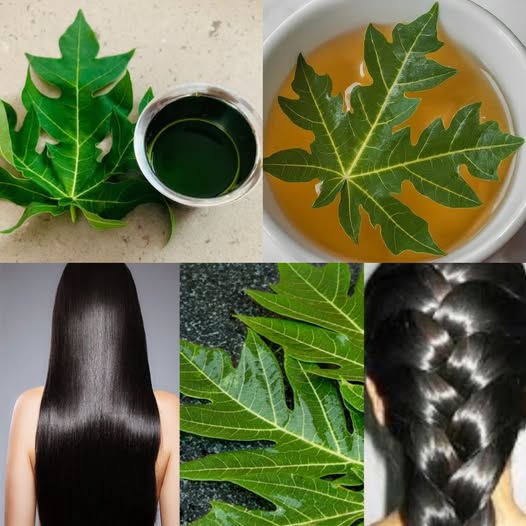
I washed the leaves. Boiled them in three cups of water until the green deepened and the kitchen smelled sharp and earthy. Then I let it cool, strained it, and poured the liquid into a spray bottle.
Before bed, I parted my hair and sprayed the water directly onto my scalp. I massaged it in, slow and steady, then wrapped a cotton scarf around my head.
I didn’t expect much. But that first night, I slept deeper than I had in weeks.
The next morning, my scalp felt refreshed. Alive. I did it again that night. And the night after. By the end of the first week, the itchiness was gone. My hair didn’t feel as dry.
It wasn’t dramatic. But it was real.
Something was waking up.
By the second week, I noticed something I hadn’t seen in a long time—shine.
The dullness was lifting. My roots, especially near my temples, looked darker. The strands felt thicker between my fingers. And my hairfall? It slowed. Not completely, but enough that I noticed.
I started making papaya leaf tea twice a week and drinking a small cup as well. Aunt Zarina said it helped from the inside. “What nourishes the scalp starts in the blood,” she’d say, tapping her temple.
I didn’t just feel changes in my hair. My energy returned. I didn’t drag through my mornings. I looked forward to my nighttime hair ritual. It became more than a remedy. It became a moment of peace.
Even Mira noticed.
“Mama, your hair looks soft again,” she said one evening as she braided it for me.
She touched the back of my head and smiled. “It smells like trees.”
I laughed. “That’s the papaya leaves.”
One day while shopping, I caught my reflection in a storefront window. My hair was loose. Shining. The grey patches at my crown had faded. And I smiled—not because my hair looked like it used to, but because I felt like me again.
A month into the routine, I went to visit my mother.
She opened the door and stared at me.
“What did you do?” she asked, brushing my hair back with her fingers. “Your hair looks like it did ten years ago.”
I told her everything. The leaves. The tea. The way it all started with one honest conversation and a quiet garden remedy passed down through love.
She teared up.
“Your nani used to use papaya leaves too. I used to help her crush them in a mortar. I never thought you’d be the one to bring it back.”
We sat for hours that day, just talking. About old recipes. Old remedies. How women have always carried healing in their hands.
Now, two months in, I still use the papaya leaf water every week.
Twice a week, I boil a fresh batch. Once for my scalp, once for tea. I’ve even started drying some to keep in a jar. And my hair? It’s darker. Thicker. Longer. Stronger.
No dyes. No chemicals. Just leaves. Just time.
One evening, I ran into an old friend who hadn’t seen me in a year.
“Did you dye your hair?” she asked, shocked.
I smiled. “Nope. Just went back to the garden.”
She stared, wide-eyed. “I need that recipe.”
So I shared it. Like Aunt Zarina did for me. Like Nani had done for my mom.
And now, I’m sharing it with you.
PAPAYA LEAF HAIR REMEDY
- Wash a handful of fresh papaya leaves
- Boil them in 3 cups of water for 15–20 minutes
- Let it cool, then strain the liquid
- Store in a spray bottle in the fridge (lasts 3–4 days)
- Spray onto scalp and hair before bed, massage gently
- Wrap hair in soft scarf or towel and sleep
- Rinse in the morning with mild shampoo
- Repeat 2–3 times a week for visible results
Optional: Drink 1 small cup of papaya leaf tea once or twice a week to nourish from the inside.
If your hair has started whispering that it’s tired—listen.
Don’t rush to cover the grey. Don’t punish the thinning. Just start small. Start with care.
Sometimes, what your roots need isn’t rescue. It’s remembrance.
And sometimes, healing begins not in a salon… but in a single green leaf and the willingness to believe you are worth growing again.
If this story gave you hope, like it.
And if someone you love is feeling lost in their reflection, share it with them.
Because every woman deserves to feel beautiful in her own roots. Naturally. Gently. Truly.