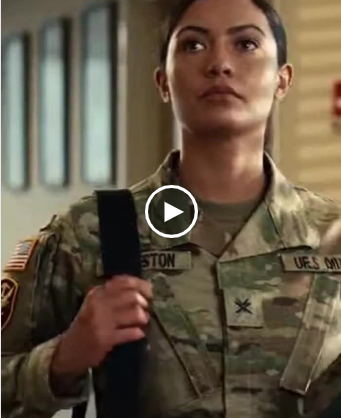
The Patch That Stopped the Room Cold
The woman beside him narrowed her eyes, trying to make sense of the small insignia on my sleeve. “That insignia — I’ve never seen it. What’s it supposed to represent?”
“It’s a specialized credential,” I said, keeping my voice steady and even.
“Specialized for what exactly?” she pressed.
“I’m afraid that’s classified, ma’am.”
The room seemed to hold its breath. Papers paused mid-rustle. A hum from the lights filled in for words no one wanted to say. Then a calm voice, the kind you don’t argue with, came from the doorway.
“Classified,” he said, “because in the last twenty years, only five officers in the United States Army have qualified to wear that patch.”
Every head turned. A three-star general stepped in as if the air itself made room for him. His uniform was crisp, medals neat and orderly, the kind of chest that told a long story without a single word spoken. His face wasn’t lined so much by age as by experience. And when his eyes found mine, they didn’t blink.
“General Carter,” someone whispered, the sound carrying more weight than volume.
I started to come to attention. He waved off the formality with a small motion of his hand, not dismissive, just focused. His boots struck the tile with a measured rhythm that sounded like memory.
He stopped beside me and studied the patch on my arm. “That insignia doesn’t represent a division or a battalion,” he said, his voice steady. “It doesn’t show up in field manuals or on briefings you can search. But make no mistake,” he added, looking around the room, “it is earned. And it is feared.”
A throat cleared somewhere in the back. No one else spoke.
“It’s not for special operations in the way you’re thinking,” Carter continued. “It’s not Delta. It’s not Rangers. It’s not psychological operations. This is Shadow Directive.”
The word moved through the room like a quiet wave.
“I thought that was a myth,” the woman colonel said, half skeptical, half uneasy.
“You’d be lucky if it were,” Carter replied, eyes still on me. “Captain Monroe is here under direct orders from the Joint Chiefs. Her mission is compartmentalized. If you’re not part of her brief, you don’t ask. And if you see that patch? You step aside.”
Silence draped itself over the room. The only sound was the buzzing lights overhead. Carter turned back to me and gave the slightest nod.
“You’re clear to proceed, Captain. Colonel Dawson will get you what you need.”
He pivoted and left. The air felt thinner without him, or maybe we were just breathing again.
Colonel Dawson stepped closer, pride a little bruised by the public directive, but duty well in charge. “Understood, Captain. You’ll have access to Alpha Channel resources and a secure node. We’ll brief you in Room 7-B.”
I picked up my bag and followed him out.
Behind the Steel Door of 7-B
The hallway narrowed the farther we went, the kind of corridor that gets quieter with each step. At the door marked 7-B, steel framed the entry like a vault. There was a retina scanner and a manual override, the kind of belt-and-suspenders security that says, even if the power goes out, we still control this space.
Dawson keyed in the code. The door hissed open.
Inside, a ring of screens wrapped around a round table. A single file waited like a loaded question. The label on the folder read OP RED SABLE. A familiar tightness hit my chest, one hard beat that shook more than it should have.
Dawson shut the door behind us and checked his watch. “You’ve got thirty minutes. Then the Joint Threat Council expects an initial sitrep.” His voice carried the abbreviation as if to reassure me he knew the language. Situation report. Short, clear, no fluff.
I sat, opened the file, and there it was: the photograph.
A convoy burned to husks in the Syrian desert. Sand charred black, metal curled back like dried leaves. That wasn’t what froze me.
What stopped me was the symbol traced in blood in the sand beside the wreckage. The crossed blades of my patch. Only inverted.
My breath hitched. My fingers tightened on the paper.
The file went on. Satellite images. Torn radio transcripts. Black box audio. Screams and static, a mix that makes your bones remember things your mind tries to forget. And then, tucked into the packet like an afterthought, a log that defied common sense.
A voice transmission recorded eight hours after the confirmed deaths of everyone in that convoy.
It was my voice.
I felt the chair beneath me. I saw the pages in front of me. But in my head, I was two years back, in Northern Yemen, crawling through the broken ribs of a fallen mosque, looking for a stolen payload that couldn’t be allowed to move another inch. Sand in my teeth. Blood in my ears. Heat thick enough to taste.
In a small inner chamber, someone had scraped a message on the wall with something sharp and desperate.
You are not who you think you are.
I closed the file a little too fast.
Dawson raised an eyebrow. “Something wrong, Captain?”
“No. Just a déjà vu,” I said. The words came easily. The truth never does.
He studied me for a beat longer than polite. “We’ve had chatter about a rogue unit. Highly trained. Off the books. No digital footprint. They’re using old Shadow Directive methods, only twisted. Like someone learned from us and bent it out of shape.”
“And you think it’s connected to me?”
“We don’t think,” he said. “We know.”
He stepped out. The room felt bigger and emptier at the same time. My reflection glimmered in one of the black screens. For the first time in a long time, I wasn’t sure I trusted the person looking back.
ACCESS GRANTED, and the Name I Didn’t Expect
I logged into the secure node. Keys tapped steady. Requesting intel on OP RED SABLE. Cross-reference: Shadow Directive. Echo Cell. Codename: Oracle.
The screen blinked.
ACCESS GRANTED.
What appeared next felt like a bruise blooming under the skin.
A decryption screen, then a roster. Operatives from the Directive, former members, most listed as KIA, which is the neat way official documents say killed in action. All flagged as gone.
Except one.
Oracle — ACTIVE — UNKNOWN LOCATION.
A small red dot pulsed on a map. Berlin. Last contact: twenty-seven hours ago. Unconfirmed sighting: Brandenburg Station.
That didn’t line up with the past I kept like a ledger. Oracle was dead. I had been there when the rubble gave him back to us in Morocco. I had given the eulogy with a voice I barely recognized as my own. I had watched the casket close.
The room grew quiet again, as if the building knew how to listen. Then I stood.
Colonel Dawson was outside, speaking in a low tone to another officer. I stepped into the hall.
“I need a transport to Andrews,” I said. “Now.”
He hesitated. “Captain, with all due—”
“This isn’t a request.”
Three seconds of matching eyes, then he turned to the young officer beside him. “Get it done.”
Gray Skies Over Berlin
Twelve hours later, clouds hung low over Berlin, the kind that can wring rain out of the air just by thinking about it. I stepped out of the airfield into an unmarked SUV. Credentials stayed sealed in a diplomatic pouch. Some things travel better when they aren’t seen.
My contact was a local intelligence source who didn’t ask for trust but always showed her work. Codename Lumen. We met at a small cafe a short walk from the station, the kind of place where the sugar packets have seen better days and the coffee never apologizes.
“He was here,” she said right away. “And he’s not alone.”
“Describe him,” I asked.
“Tall. Scar under the left eye. Right leg a little off, like an old injury that bothers him on wet days. Same man you showed me. Only…” She searched for a word and found one that made me colder than the weather. “Colder.”
“Colder?”
“Like something in him died, and what’s left doesn’t blink anymore.”
She slid a small flash drive across the table. “Security cameras. Two days’ worth. Someone tried to wipe the footage. I found a backup.”
I plugged it into my portable. Frame by frame, the station moved in grainy grays. Commuters. Tourists. Bags and umbrellas and the everyday fog of cities that never fully sleep. Then a face in a shadowed corner.
Oracle. Alive. Watching.
I sharpened the image, cleaning the smear of motion just enough. Oracle wasn’t looking at the crowd. He was looking at one person. A woman moving with purpose, a clear line from here to there.
My own face looked up from the screen.
I wasn’t in Berlin then. I hadn’t been, ever.
A twin? A double life I didn’t know about? Or a trick designed to make me doubt the one thing a field officer can’t afford to lose—my sense of self.
“Where was this?” I asked Lumen.
“Tunnel access,” she said. “Line six. It leads down into old East Berlin bunkers from the war. People forget what their city is built on.”
I nodded. Some places don’t forget us, though. They keep our footprints long after we’ve left.
Down the Stairs and Into the Past
The entrance hid under layers of spray paint, rusted scaffolding, and the kind of urban decay that makes a good secret look like simple neglect. I went alone. Some doors should only open for one set of steps at a time.
Stairs turned to tunnels. My light found concrete that remembered boots from decades ago. The air thinned and cooled. Water waited in shallow sheets and sent soft echoes ahead to mark the path.
At the lowest level I saw a glow wash over a wall. I rounded the corner and there he was.
Oracle.
He stood in front of a wall layered with maps and photographs, the board of someone who has been thinking hard for too long. Strings crossed and re-crossed the city, lines of red tying faces and locations into a net only he could untangle.
He turned slowly. “Hello, Monroe.”
I raised my weapon out of muscle memory and training, hands steady, breath even. “You died.”
He almost smiled. “I tried.”
The words scattered a dozen questions. I chose the best two. “Why fake your death? Why this?”
He took a step closer, not cautious so much as tired. “Because the mission was compromised. Shadow Directive wasn’t shut down. It was hijacked. Rewritten from the inside.”
“By who?”
“You already know.”
Pieces that had been rolling around the table in my head finally clicked together. The symbol in the sand. The inverted blades. The recording with my voice after death had closed the books on a convoy. The sightings no one could explain.
These weren’t random. They were warnings.
Oracle stepped aside and brought up a video loop on a small screen. The picture was clean enough to hold up in any room that mattered. General Carter stood in a secure room, a place you only walk into when you know where every camera is and who’s watching.
On the screen, Carter handed over Shadow Directive manuals to a man in civilian clothes. The man’s face was obscured, but his voice wasn’t.
“Welcome to the future of privatized warfare,” Carter said in the recording. “With Shadow Protocol under our control, no government red tape. No oversight. Just results.”
The floor under me didn’t move, but the world shifted anyway.
Oracle met my eyes. “They built a mirror unit. A private army trained in our doctrine, working outside the law. They call themselves Black Reign. First job on their list? Erase the originals.”
I lowered my weapon. For once, it was the lighter thing to do.
“You survived,” I said.
“So did you,” he answered. “And now they know.”
The Tunnel Fights Back
A deep rumble rolled through the concrete like thunder trapped underground.
“They found us,” Oracle said.
Explosions bit at the edges of the tunnels. The light flickered and steadied. Training took over before thinking could slow us down. We moved, fast and clean, the way you do when you learned to trust your legs before your doubts found words.
At the stairwell, gunfire cracked the air into hard edges. Black Reign agents poured in with our own tactics dressed in someone else’s patch. Familiar moves twisted to serve a different master.
We answered with what we remembered best. Not tricks. Not muscle alone. Purpose. Rhythm. The old lessons that never needed a patch in the first place.
Oracle took a round high in the shoulder and kept going, breath sharp but steady. I put two agents on the ground with non-lethal shots, a choice that wasn’t kindness. It was a message. Live to tell this story. Live to tell who stopped you.
We broke daylight with sirens rising in layers around us, the city waking to a truth it hadn’t asked for.
Truth in a Room Without Windows
Three days later, I stood before the Joint Threat Council in a room that held more power than comfort. The screens showed the footage. The documents made their slow rounds, paper whispering from hand to hand. No one spoke until the last page rested flat.
General Carter sat across from me, military police at his shoulders. He didn’t argue. He didn’t explain. He didn’t have room to.
The Council voted without grand speeches. Shadow Directive was disbanded. The official end of a unit that had never officially existed.
I left the room to find Oracle by the elevator, his arm in a clean bandage, his expression carrying a small, stubborn hope.
“Now what?” I asked.
He gave a quiet smile. “Now we rebuild. The right way.”
What the Patch Means
The elevator doors slid closed. In the quiet between floors, I touched the patch on my sleeve. Two blades crossed over a shield, a small star above them, each stitch set by hands that knew how to measure cost.
People think that symbol means secrecy. That it points to something hidden in the dark, dangerous because no one can see it. Maybe that’s part of it. But it was never the point.
The point was duty. Not to a man. Not to a single chain of command that could be bent by money or fear. Duty to the people who never walk into rooms like the one I just left. Duty to those who count on someone, somewhere, choosing what’s right over what’s easy.
Black Reign wanted to turn the lessons we learned into a product. They wanted our training without our conscience. They wanted to sell results and never pay the bill that comes due when you forget why you started.
We didn’t forget.
So we’ll start again. Quietly. Cleanly. No shadows where rot can grow. Hard rules and harder honesty. Fewer secrets, kept only when keeping them protects people who will never know our names. We will not be a myth. We will be a promise.
There are still symbols out there. Some are painted in blood to frighten the living. Some are sewn into patches to remind the wearer who they are. Some are scratched on old stone walls to warn the person who comes next. I have seen all three.
I also know this: the war didn’t end in that council room. It didn’t end in the tunnels in Berlin. It didn’t end in the desert beside an inverted set of blades. It never really ends. It only moves, changes names, puts on a different coat, and hopes you’ll be too tired to notice.
We are not too tired. Not yet.
There will be new files, each with their own neat covers and names that sound like colors and animals thrown together by a committee. There will be fresh faces walking into rooms with the kind of courage that doesn’t shout. There will be times a hallway grows quiet and a door marked with a number and a letter opens into a place where decisions weigh more than years.
When that happens, someone will ask again what a small patch means. Someone will look at crossed blades and a star and wonder who has the right to wear them. And if I am there, I will tell them.
It doesn’t mean you get to keep secrets because you like the power. It doesn’t mean you own the night. It doesn’t mean you’re above the people you serve.
It means you remember why we do any of this. You hold the line when someone tries to sell it. You walk into the rooms that most people never have to see, and you leave them a little lighter than you found them.
The patch is small. The duty is not.
And for as long as I wear it, I will keep it that simple.
Somewhere, right now, another convoy is rolling through a place so empty even echoes feel alone. Somewhere, a camera in a train station is blinking its red light, recording a truth no one expects to need. Somewhere, a file is sitting on a table, and a heartbeat is about to skip the way mine did when I saw a set of blades drawn the wrong way in the sand.
We will be there. Not because someone ordered us to be. Not because a patch grants us permission. But because there are still times when the right thing to do is quiet, difficult, and worth it.
Shadow Directive as it was is finished. The people who tried to buy it are learning the difference between owning a method and earning a mission. General Carter will face the same truth every person in uniform learns sooner or later. You can’t rent integrity. You can only live it, one choice at a time.
As for me, I keep moving forward. I will find the places where Black Reign thought they could use our playbook like a weapon and fold those pages shut. I will meet the men and women who still believe service is a promise, not a product, and together we will set a new standard. When we make a move, it will not be because we can. It will be because we should.
There are easier stories to tell. Lighter ones. I hope someone writes them. For now, I will keep this one honest. If you ever see the patch, don’t think of secrets. Think of duty. Think of people who get up when it would be simpler to lie down. Think of the work that continues, even when the world is gray and the tunnels beneath a city remember footsteps better than names.
We will rebuild. The right way.
And until the day comes when no one needs to ask what that patch means, I will be ready to answer.