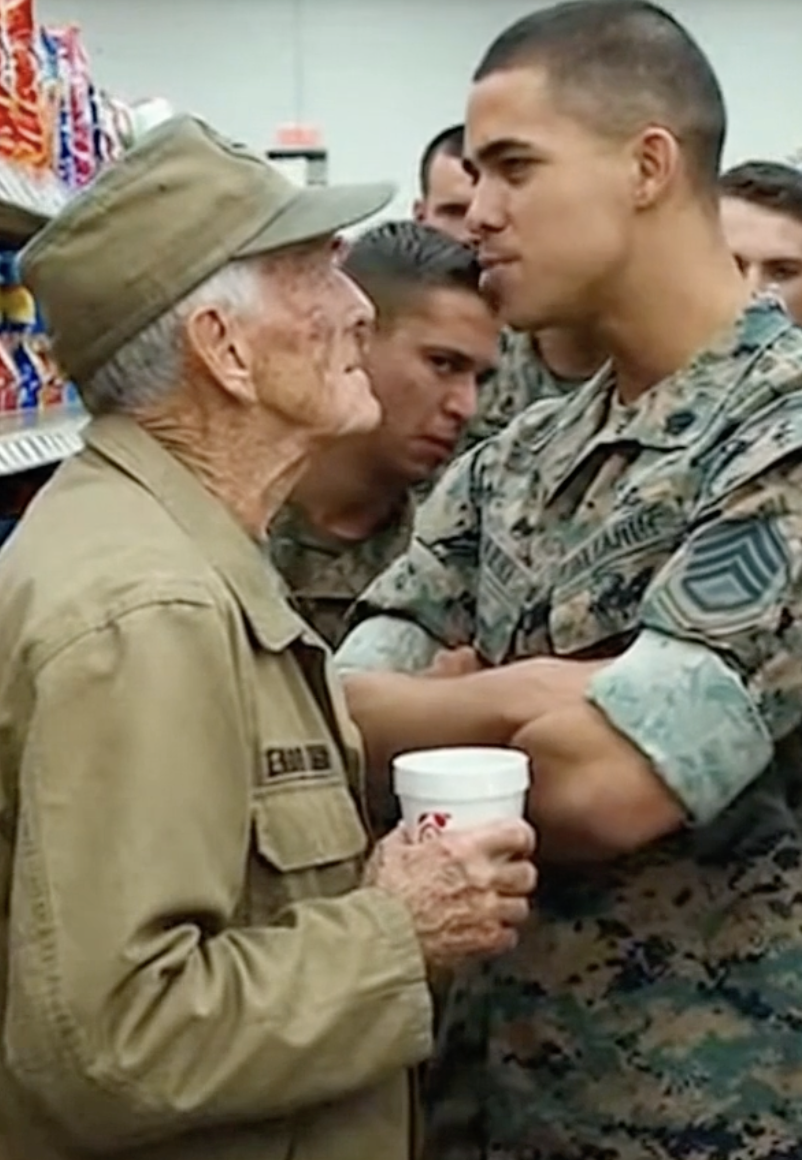
“Is today special, sir? Or do your hands always tremble like that?”
Corporal Mallerie’s voice was not a whisper; it was loud and clear, echoing through the Exchange for everyone to hear, causing a ripple of humiliation.
In the midst of browsing the snack aisle, a bottle of water paused halfway to my mouth, I felt a sudden shift as silence fell, thick and uncomfortable. Everyone turned to witness what was happening.
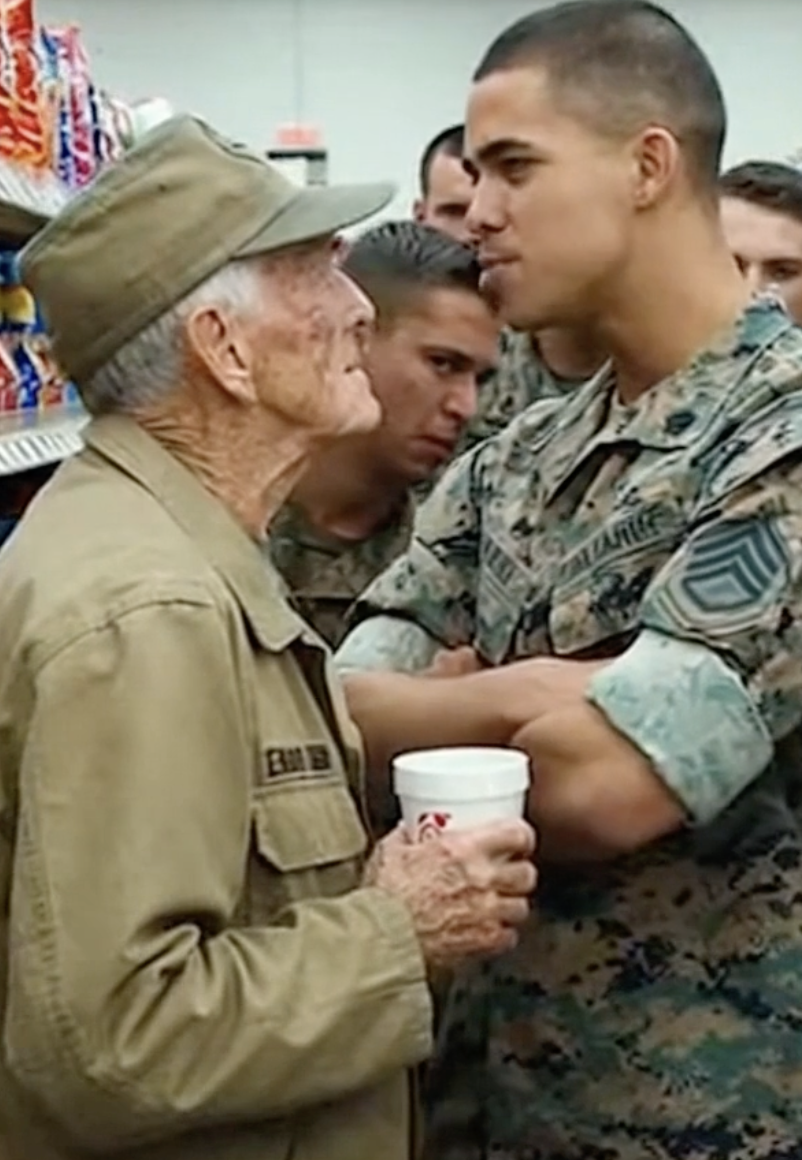
The elderly gentleman at the register displayed no sign of faltering under the scrutiny. Although frail, barely managing the coffee cup in his grasp, there was an unmistakable air of quiet authority about him—a veteran’s dignity that hinted at a time when he stood tall and proud.
Mallerie, however, seemed intoxicated by newfound power. His stance was confident: boots planted firmly, arms crossed, chin defiantly raised. Evidently, his recent promotion had misled him into conflating rank with respect.
He moved in closer, pressing his misconduct further.
“Did you earn those medals, or are they eBay specials, Grandpa?”
Yet no one intervened. Not a single person stopped him.
A sense of responsibility weighed on me, Lieutenant Harris, as indecision held me back—not fear exactly, for I had seniority over the brazen fool. Rather, it was as if something sacred surrounded the old man that I dared not disrupt.
Mallerie’s next words crossed an unseen threshold.
“Impersonating a Marine is a felony, you know. Should I make the call?”
At that moment, I noticed the battered canteen clipped to the gentleman’s belt. Its scuffs obscured all but one word: COLE.
My heart sank as my fingers quickly searched for confirmation of what I feared. The results that appeared before me were almost unbelievable.
Master Sergeant Everett Cole, a name touched by legend.
I remembered hearing about him once during Officer Candidate School—a tale of incredible valor, a man who had faced down fire to save lives.
Grabbing my phone, I dialed hastily.
“Sir,” I murmured into the receiver, turning away from the glass, “you need to get down to the Exchange.”
The voice on the other end, initially curt with busyness, paused. “Harris, I’m in the middle of—”
“Sir. The canteen says Cole.”
Silence answered, broken by the sound of a chair dragging across the floor.
“Do not let him leave.”
I turned back to find Mallerie making a move toward the veteran’s chest.
“Let’s see if these medals are plastic—”
“Corporal!” I shouted, stepping forward hastily.
But it was not my intervention that halted him.
It was the sound of the front doors clanging open.
The Base Commander, Colonel Briggs, charged into the room.
Without pause or hesitation, he made his way directly to the elder gentleman, stopped, and kneeled with the reverence one might show a flag.
“Master Sergeant Cole, sir. It’s an honor. Welcome home.”
The atmosphere shifted palpably, almost like gravity had been altered.
Mallerie, aghast and paling, could only stammer as his earlier bravado evaporated into silence.
Calmly, without triumph or anger, Cole regarded Briggs kindly.
“Please stand, Colonel. You’re causing a scene.”
Briggs obeyed, the moisture in his eyes betraying the profound emotion restrained within.
“Yes, sir,” he replied gently.
Mallerie made perhaps the most foolish choice yet, offering a derisive scoff.
“Just an old guy, huh? How could this trembling man be a legend?”
Briggs swiftly turned, his gaze sharp.
“You’re dismissed, Corporal.”
Confusion and protest left Mallerie’s lips, but Briggs’s tone required no amplification.
“Corporal, leave now, or I will arrange for an escort in cuffs.”
Reluctantly, Mallerie departed, departing under the collective weight of disappointment from those who watched, a form of rebuke more cutting than anger.
Approaching gingerly, uncertainty tinged my voice.
“Master Sergeant Cole,” I began, striving not to sound as nervous as I felt, “I… I’m sorry.”
His gaze met mine, softened by a lifetime of understanding.
“Son, never apologize for another’s ignorance. Just don’t emulate them.”
Those words struck deeper than any chastisement could.
At the register, Cole’s hands still shook as he retrieved a ten-dollar bill, while the cashier trembled more intensely than he did.
Stepping in, Briggs offered his assistance.
“Allow me, sir.”
With a faint smile, Cole declined. “Colonel, I believe I can still manage a cup of coffee.”
“That’s not it,” reiterated Briggs, his voice laden with respect. “Today, you don’t pay here.”
As they departed together, a silent understanding grew between them—an understanding that cleared a path through the crowd without the need for words.
I watched them go, contemplating the magnitude of what had just occurred. I’d encountered generals who didn’t command the same respect.
A young private nearby finally voiced the question lingering in the air.
“Who was that man?”
I turned, prepared to respond, but someone from amidst the bystanders had already begun to speak.
A woman, appearing in her fifties, approached from the back, her steely gaze following Cole’s departure closely. Her civilian attire belied a posture honed by military discipline.
“That was my father,” she softly informed us, “and he wanted his presence here to pass unnoticed.”
With attention fixated on her, she addressed us with a gentle, yet authoritative warning in her tone.
“He’s here for a funeral,” she explained. “His last surviving squadmate, now resting in the cemetery near our old training grounds.”
Quiet engulfed the room again.
She continued, her voice unyielding, even in fond remembrance.
“Attention like this wasn’t to his liking—not even for the Silver Star pinned on him, not when he saved lives amid chaos, nor when he ran miles under fire despite his injuries.”
A low whistle arose from someone in the crowd.
She turned to me with a knowing affirmation.
“You did right, Lieutenant.”
My confession followed: “I hesitated.”
“But you noticed. You acted. And that’s significant.”
A slight nod marked her acknowledgment as she turned to leave.
At the threshold, she added a final reflection.
“As for that Corporal, perhaps temper judgment with understanding. My father often said that those who shout the loudest are sometimes the most afraid.”
With her departure, a poignant silence returned.
Later that day, a summons brought me to Briggs in his office, the weight of the day etched across his features.
“He’s staying on base tonight,” Briggs informed me. “In the officer guest quarters.” I nodded. “Understood.”
“And he asked for you at dinner.”
In surprise, I reiterated, “Sir?”
Briggs confirmed it.
That evening, I found myself seated across from a man whose life-filled history books, yet nothing in his demeanor would betray that to a passerby.
He spoke slowly, savoring each bite as he shared stories missing from the records.
Tales of selflessness—a week without his own rations to help a young recruit send money home; months spent safeguarding a letter for a soldier no longer able to send it.
Even amid recounting heroic deeds, he reflected on the haunting memories.
Medals couldn’t quiet the past; they didn’t resurrect lost companions.
Yet, he wore them—not for his sake, but for those unable to wear theirs.
Questioning why he hadn’t corrected Mallerie, Cole simply offered, “I used to be a corporal, too—thought I was invincible then.”
A chuckle from me met with his solemn reply.
“Sometimes allowing folly is the gentlest teacher.”
His wisdom lingered.
Following dinner, as he rose, hands yet trembling, he honored me with a salute.
“You’ll make a fine officer, Harris,” he commended, “Just remember why you wear that uniform.”
Swallowing past emotions, I returned the gesture.
“Thank you, Master Sergeant.”
Time passed, spreading the narrative across the base, but Cole departed quietly, much as he had arrived.
Mallerie found himself transferred—not dismissed or demoted—but reassigned to a veteran’s rehab unit, assisting in physical therapy.
A penalty, it seemed—a gentle correction instead.
One day at the gym, I found Mallerie aiding a fellow Marine, carefully tending to a prosthetic. An unexpected gentleness marked his demeanor.
Upon noticing me, he came over sheepishly.
“I owe you an apology,” he admitted. “I was wrong.”
I nodded, acknowledging his path of realization.
“I wrote to him,” Mallerie admitted. “Uncertain if he’ll read it, but it felt necessary.”
“That’s good.”
He began to retrace his steps but hesitated.
“Thank you for handling it well.”
I responded with a shrug, “That was never my intention.”
Months drifted by peacefully until an unexpected package arrived on my desk.
Absent of a sender, save for a simple inscription: Cole.
Enclosed, a faded photograph surfaced—a troupe of soldiers merrily posed before a makeshift tent, bearing dust and exhaustion, yet vibrantly alive.
In practiced handwriting on the reverse:
“Only one remains. Pass the story on.”
An accompanying note read:
Lieutenant Harris,
In seeing what others might overlook, you arose. This significance shouldn’t falter.
Reflect the kindness you received—let them question if you’ve earned your place. Smile thoughtfully and continue earning it anyway.
— E.C.
Placing that photograph upon my wall became a symbol.
Not as a mere accolade, but as a profound reminder.
Respect isn’t bestowed by default; it is earned, day by day. It’s evident in our dialogues, our attentions, our perceptions.
Despite never raising his voice, Master Sergeant Cole taught invaluable lessons. Lacking ranks, he radiated an aura of honor.
As for Corporal Mallerie? Transformation awaited him. Pursuing studies in physical therapy, he aimed to aid those, once fragmented, in regaining wholeness.
How a singular moment, an unsteady hand, unlocked transformation within us all.
If this tale resonated, share it. Let its truth ripple forth.
Because amidst the myriad reminders of life lies one irrefutable truth:
Respect transcends medals, age, and titles. It’s conveyed in our character—whether seen or unseen.