
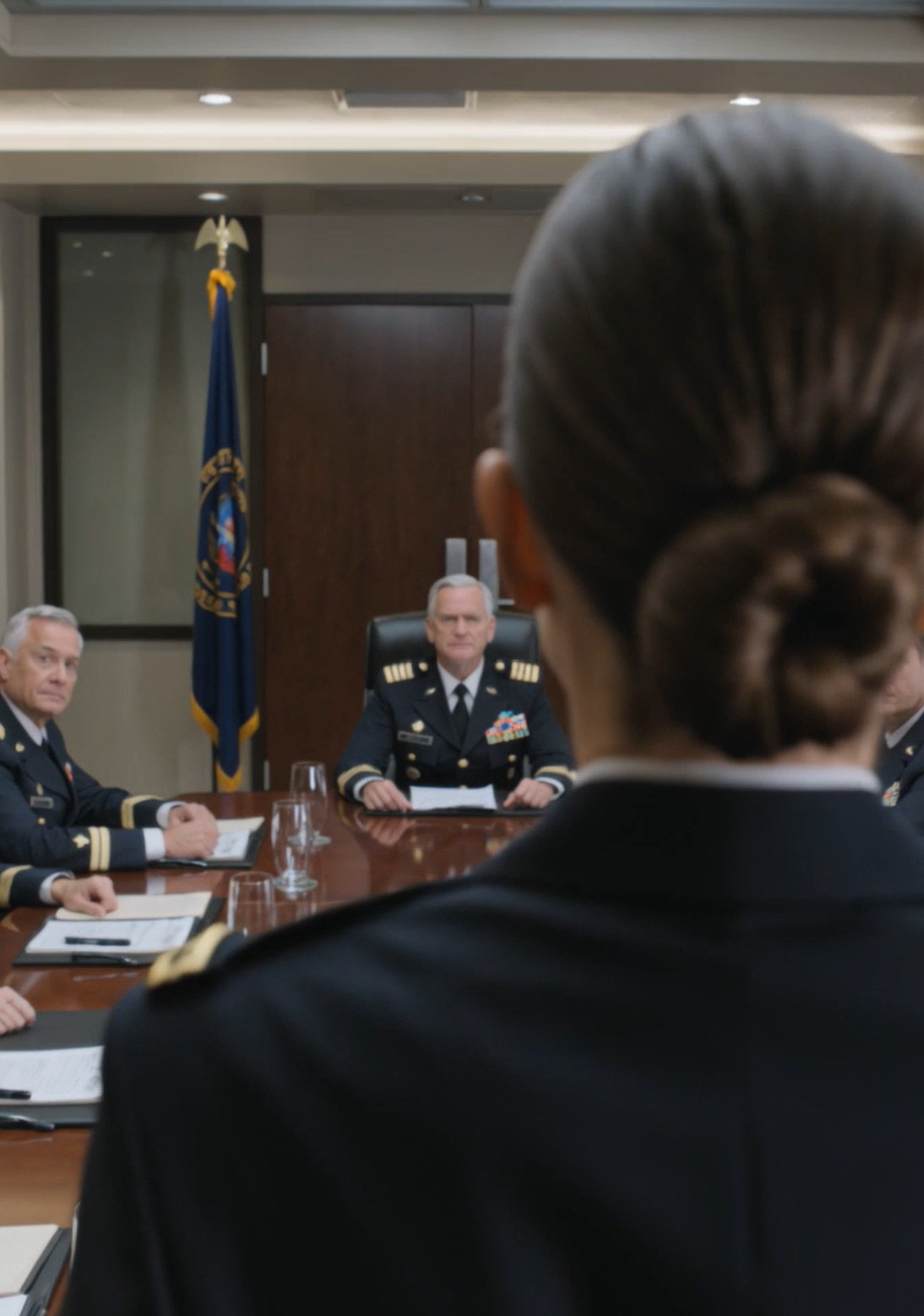
Captain Wendy Dawson walked into a room full of four-star generals who had already made up their minds. Too young. Too small. Too green to lead a mission this dangerous.
She could feel it. The way they didn’t look up when she entered. The way one colonel actually scoffed into his coffee.
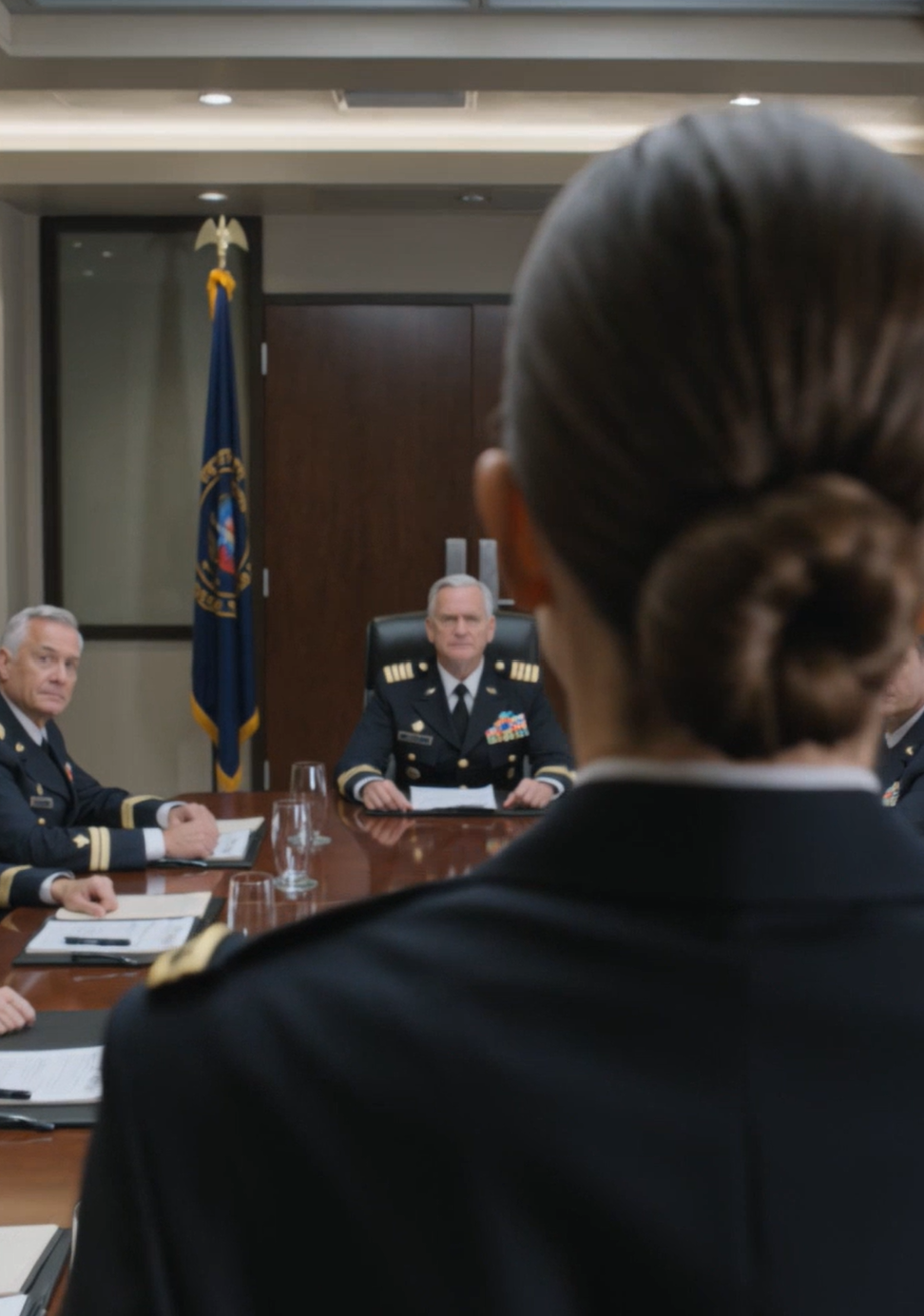
General Harding didn’t even let her sit down.
“Captain Dawson. Your call sign.”
She didn’t blink.
“Specter Six.”
The room froze.
No whispers. No shuffling papers. The colonel slowly set his coffee down without taking a sip.
Because every man in that room had read the classified reports. The Kandahar extraction nobody survived – except they did. The Damascus job that officially never happened. The name “Specter Six” lived in black-ink files locked in drawers most of these generals couldn’t even access.
And she was standing there in a uniform two sizes too crisp, looking like somebody’s daughter.
General Harding finally spoke. “Sit down, Captain.”
The mission was a nightmare. A rogue paramilitary group had gotten their hands on enough chemical weapons to wipe out a city. Northern Afghanistan. Twelve operators. No air support. No backup. If anything went wrong, the U.S. government would deny they ever existed.
Forty-eight hours later, Wendy and her team were crawling through the dark toward a compound that shouldn’t have existed on any map.
They cut the fence.
Killed the cameras.
Slipped past two patrols.
She was the first one through the door of the storage facility.
That’s when her stomach dropped.
The intel was wrong. Catastrophically wrong. There weren’t six guards inside. There were dozens. And the crates stacked against the wall – they weren’t chemical weapons.
They were something worse.
Then she heard the footsteps coming down the hallway behind her. Heavy. Confident. Not running.
And when the man stepped into the doorway and the moonlight hit his face, Wendy lowered her rifle. Because the man standing there was supposed to have been buried six years ago – and he was wearing her father’s dog tags.
The metal of her rifle felt cold and heavy as it sagged in her hands. The world seemed to shrink, compressing into the space between her and the ghost in the doorway.
“Dad?” The word was a breath, a prayer she didn’t know she was holding.
Colonel Marcus Dawson, a man she had mourned with a folded flag and a 21-gun salute, stood before her. He was older, his face etched with lines she didn’t recognize, his hair now streaked with gray. But the eyes were the same. The ones that had taught her how to ride a bike and how to aim a rifle.
He gave a small, pained nod. “Hello, Wendy-girl.”
The pet name, a relic from a childhood long gone, shattered the soldier and left only the daughter. Her team, filtering in behind her, saw her weapon pointed at the floor and froze, confused.
“Captain? Who is this?” her second-in-command, Barnes, asked, his own rifle still trained on Marcus.
Wendy couldn’t answer. Her mind was a whirlwind of questions and a deep, aching sense of betrayal. Her father raised a hand, not in surrender, but as a plea for calm.
“Tell your man to stand down, Wendy. We don’t have much time.”
She found her voice, though it was ragged. “You were dead. We buried you.”
“A box of sand and memories, I’m afraid,” he said, his voice laced with a sadness that felt ancient. “It was the only way.”
“The only way for what?” The anger was rising now, hot and sharp, pushing past the shock. “To lead a rogue army in the middle of nowhere?”
He looked past her, at the crates that had so confused her just moments ago. “It’s not what you think. Nothing is.”
The crates weren’t filled with munitions. They were refrigerated storage units, humming softly in the cold desert night. She could see condensation beading on their metal sides.
“I need you to listen to me,” her father said, his gaze locking with hers. “The intel you were given was a lie. A very specific lie, designed to bring a team like yours here.”
“A team that’s deniable,” Wendy finished, the pieces clicking into place with a horrifying sound. “A kill squad.”
“Exactly,” he confirmed. “They couldn’t send a conventional force. Too many questions would be asked. But Specter Six? You clean up messes and disappear. Nobody asks questions about ghosts.”
Barnes shifted his weight. “Captain, we have a mission. We need to secure the assets and deal with the hostiles.” He gestured toward Marcus.
Wendy ignored him, her entire world focused on the man she thought she’d lost forever. “What’s in the crates, Dad?”
He walked slowly toward one of the large containers and unlatched a small viewing window. A soft, blue light emanated from within.
“Not weapons,” he said softly. “A miracle.”
Wendy moved closer, her boots crunching on the dusty concrete floor. She peered through the window. Inside, nestled in cooled racks, were thousands of small glass vials containing a clear liquid.
“This is the work of Dr. Aris Thorne,” her father explained. “He was a biologist, a genius. He developed a universal vaccine platform. Not for one disease, but a way to rapidly create cures for almost any viral agent.”
The scope of it was staggering. It was the end of pandemics. The end of so much suffering.
“Why is it here?” Wendy asked, her voice hushed.
“Because Dr. Thorne worked for a private defense contractor, which was acquired by a much larger, more powerful corporation. When they realized what he’d created, they didn’t see a gift to humanity. They saw a weapon.”
He let the silence hang in the air for a moment.
“Imagine you control the cure to a plague you can also release,” he continued. “You control the world. Thorne knew what they planned. He came to me. He knew my reputation.”
Six years ago, Colonel Dawson had been a legend in Special Operations Command. A man of unwavering principle.
“We tried to go through channels,” Marcus said, the memory visibly paining him. “We were shut down at every level. The corporation’s influence reached all the way to the top. To Undersecretary of Defense Peterson.”
The name sent a chill through Wendy. Peterson was a political player, known for his aggressive foreign policy and his deep ties to the military-industrial complex.
“Thorne and I knew they would try to silence us. To take the research. So we disappeared.”
“You faked your death,” Wendy said, the accusation still raw.
“I did,” he admitted. “And it was the hardest thing I’ve ever done. Leaving you and your mother behind… it almost broke me. But it was the only way to protect this. To protect you. If they knew I was alive, they would have used you to get to me.”
He explained how he and Thorne, along with a handful of other soldiers and scientists who believed in their cause, formed this ‘rogue’ unit. They’d been on the run ever since, moving the research from one secret location to another, trying to find a way to get it into the hands of the World Health Organization without it being intercepted.
“They finally tracked us here,” Marcus concluded. “But they couldn’t risk a direct assault. So they created a story. Chemical weapons. A dangerous paramilitary group. And they sent the best deniable team they had, knowing you would follow your orders without question.”
He looked at her, his eyes pleading. “They sent you to kill your own father and destroy the last, best hope for millions of people.”
The truth landed with the force of a physical blow. Her entire career, her sense of duty, was built on a foundation that had just crumbled into dust.
“Captain,” Barnes said again, his voice harder this time. “This is a fantastic story. But our orders are clear. We neutralize the threat and secure the packages.”
Wendy turned to face him and her team. She saw the conflict in their eyes. They were trained to follow her, but this situation was outside any parameter they had ever prepared for.
“Barnes is right,” she said, her voice steadying as the officer took over from the daughter. “Our orders are clear.”
A flicker of disappointment crossed her father’s face.
“But the orders,” Wendy continued, her eyes scanning her team, “were based on a lie. We’re not assassins. We’re soldiers.”
She turned back to her father. “What’s your plan?”
Relief washed over Marcus’s face. “The same plan as always. Get this to people who will use it to save lives. There’s a transport plane coming in two hours to move us to a new location. But I suspect we’re not the only ones with a transportation plan.”
As if on cue, the distant sound of helicopter rotors began to chop through the night air. It wasn’t the heavy, lumbering sound of the transport her father was expecting. It was the sleek, predatory whine of attack helicopters.
“That’s them,” Wendy said grimly. “The clean-up crew. They never expected us to talk. They just expected us to shoot, then they’d come in and wipe out whoever was left standing.”
“Barnes, Rivera, Mac,” Wendy barked, her command presence snapping back into place. “Forget the old mission. New mission: We protect the asset. We’re with them.” She gestured toward her father and his men, who were already grabbing weapons and moving into defensive positions.
Rivera and Mac nodded, their loyalty to Wendy overriding everything else. They began setting up firing positions near the door.
But Barnes didn’t move. He just stood there, his rifle now aimed vaguely in the space between Wendy and her father.
“I can’t do that, Captain,” he said, his voice flat.
“What did you say, Sergeant?” Wendy asked, stepping toward him.
“My orders come from Undersecretary Peterson,” Barnes stated, his eyes cold and empty. “My real mission was to ensure the target was neutralized. And if Specter Six showed any hesitation, to neutralize them, too.”
The betrayal was a fresh, deep wound. Barnes was her rock, the one she’d trusted in a dozen impossible situations.
“Barnes, don’t do this,” she pleaded. “You hear what this is. It’s a cure.”
“It’s a job, Captain,” he replied. “And you’re making it complicated.”
He raised his rifle, no longer aiming vaguely. But before he could fire, a single, muffled shot echoed in the warehouse. Barnes crumpled to the ground, a look of surprise on his face.
Standing behind where he had been, holding a smoking sidearm, was Mac, the quiet heavy weapons specialist.
“He was always talking too much,” Mac grunted, holstering his pistol. “Never trusted a man who talked that much.”
There was no time for relief or recriminations. The helicopters were nearly overhead. Bright searchlights sliced through the darkness outside, pinning the compound.
“They’ll be rappelling onto the roof!” Marcus yelled over the noise. “We need to move the vials to the underground tunnel. Now!”
What followed was a controlled chaos. Wendy’s training kicked in, and she seamlessly integrated her small team with her father’s men. They were no longer two separate units; they were one, fighting for a common cause.
They formed a perimeter, laying down suppressing fire as the clean-up crew, clad in all-black tactical gear, descended on them. Rivera, the tech specialist, was a whirlwind, disabling the enemy’s comms and feeding Wendy real-time tactical data on her display.
“Four on the roof! Two coming in from the east wall!” Rivera called out.
Wendy and her father fought back-to-back, a terrifying and beautiful synchronicity. It was as if no time had passed at all. The lessons he had taught her in the backyard with a pellet gun were now being used to save his life.
“You’ve gotten better,” Marcus shouted over the gunfire, taking down an enemy operative with two precise shots.
“I had a good teacher,” she shouted back, returning fire.
They managed to hold them off long enough to move the most critical samples into a service tunnel beneath the warehouse. It was a desperate, fighting retreat. Just as the last crate was being lowered, a rocket-propelled grenade hit the main entrance, collapsing the doorway and trapping them.
The air filled with dust and the smell of cordite.
“We’re stuck!” Mac yelled. “The transport will be here any minute, but we can’t get to the airfield!”
Panic began to set in. They were trapped, with a superior force closing in and their only escape route about to arrive at an airfield they couldn’t reach.
But Marcus Dawson smiled. “Who said we were going to the airfield?”
He led them down the dark, damp tunnel. After a few hundred yards, they came to a steel door. He opened it, revealing not the desert, but a massive, underground hangar carved out of the rock.
Sitting in the middle of it was a C-130 Hercules, its cargo bay open and ready.
“You can’t hide a compound,” he said, a twinkle in his eye. “But you can hide an airfield. Or in this case, a runway inside a mountain.”
This was the final piece of the puzzle. Her father hadn’t just been hiding. He had been preparing. The ‘rogue’ group was a highly organized, well-funded operation dedicated to one thing only: protecting this cure.
As his team loaded the last of the crates onto the plane, Marcus turned to Wendy.
“Come with us,” he said, his voice quiet but firm. “We could use a mind like yours. A heart like yours.”
She looked at her remaining team. Mac and Rivera. They were U.S. soldiers. Going with her father meant desertion. It meant becoming fugitives.
She took a deep breath. “Our fight isn’t out here in the shadows, Dad. It’s back there. In the light.”
She pulled a satellite phone from her pack. “Rivera, I need you to dump every piece of data you have. The mission specs, Barnes’s last transmission, everything, to a secure server. I’m calling General Harding.”
Her father looked concerned. “You can’t trust him. He’s part of the system.”
“I don’t think so,” Wendy said. “He looked me in the eye. He wanted to know my call sign. He knew what Specter Six meant. He wasn’t sending a killer. He was sending a surgeon. He just didn’t know the disease was in the command staff.”
She made the call. She didn’t know if Harding would pick up. Or if he would believe her. But she had to try.
General Harding answered on the second ring. Wendy laid out the entire situation in sixty seconds: the fake intel, her father, the cure, Undersecretary Peterson’s treason, the firefight.
There was a long silence on the other end of the line.
“Hold your position, Captain,” Harding finally said, his voice like cold steel. “And tell your father he owes me a bottle of the good stuff.”
Before Wendy could ask what he meant, Harding continued. “I never believed Marcus Dawson went down in that crash. I sponsored his nomination to lead this black-op six years ago. When he ‘died’, and Peterson shut down all inquiry, I got suspicious. Sending you was a gamble. A long shot. I was hoping the best of him would recognize the best in you.”
It was the final twist. Harding had been playing his own game, using Wendy as a scalpel to cut out the cancer he suspected but couldn’t prove.
Within the hour, the “clean-up crew” was ordered to stand down, arrested by a U.S. Marshal unit that seemed to appear out of nowhere, acting on Harding’s authority.
The C-130 took off, not into the shadows, but with a full diplomatic escort. Colonel Marcus Dawson was no longer a ghost; he was a living witness to a crime against humanity.
Months later, Wendy stood on the tarmac, not in her combat gear, but in her dress uniform. Undersecretary Peterson was facing a tribunal. The corporation was dismantled by sanctions. The vaccine was being distributed globally by the WHO, free of charge.
Her father walked up beside her, wearing a civilian suit that didn’t quite fit his frame. He looked relaxed. Younger.
“It’s a big world to save,” he said, watching a transport plane take off with a fresh shipment of the cure.
“We didn’t save it,” Wendy replied, looking at him. “We just gave it a chance to save itself.”
They stood there for a long time, father and daughter, no longer a ghost and a soldier, but a family finally reunited. The path to doing the right thing isn’t always clear or easy. Sometimes, it demands that you go against your orders, against your training, and even against the life you thought you were meant to live. True duty isn’t about blind loyalty to a flag, but unwavering loyalty to what that flag is supposed to stand for: justice, truth, and the protection of human life.



