When the room held its breath
It happened in a grand hall where every footstep seemed to echo and every glance carried weight. The music had faded. The ceremony had paused. And in that stillness, my father finally realized something that should have been simple all along — he did not truly know who his daughter was.
The quiet did not feel peaceful. It was the kind of silence that makes the air feel heavy, as if the room itself is waiting to see what comes next. Faces turned toward the front, toward me, toward my father. No one shifted in their seats. No one cleared a throat. The quiet stretched out until it demanded an answer.
Across from us stood Admiral Thomas Davis. He did not need to lift his voice; he never did. His presence carried a steady authority that reassured rather than overwhelmed. You could feel the room adjust around him, not out of fear, but out of respect.
Authority that did not need to shout
The Admiral looked at me first, not as a headline, not as a controversy, and not as a surprise. He looked at me the way a leader looks at a teammate — directly, fairly, with a memory of shared work and what it cost. Then he turned his attention to my father.
“Sir,” he said in a voice so even it could have been measured with a ruler, “you are standing in a hall filled with men and women who have gone into danger beside her. They have trusted her judgment when the margins were razor thin. Some are alive because when retreat would have been easier, she chose to advance.”
He did not dress the moment in big words or dramatic flair. His sentences were careful and exact, each one landing with quiet certainty. They were not meant to humiliate. They were meant to correct.
My father’s jaw tightened. He searched the room, eyes moving from uniform to uniform, looking for agreement, for outrage that matched his own. No nods came. No one stepped forward to echo his anger. The room stayed steady.
A wall of quiet support
Behind me, four hundred operators stood in formation. Shoulders squared. Faces set. Some carried scars that would outlast their years. Some had buried friends whose names were now carved in cold stone. Every one of them understood that service carries a price tag no one can pay for you. They stood without fanfare, and their stillness said what words could not.
They were not there to intimidate my father. They were there to acknowledge me. They stood because they had seen the same things I had seen, and they knew what it took to walk back from those places ready to do it again.
“She manipulated you,” my father said, his voice not booming now but unsteady. “She’s dramatic. She likes attention.” He reached for an old story about me — a story where I was reckless, exaggerated, hungry for eyes on me. It had worked before. It did not work now.
Once, that accusation would have burned. This time it did not. I was no longer a child waiting to be measured and approved.
When records tell the story
The Admiral did not flinch. He studied my father the way you study a problem that can still be solved, not with heat but with care. “With respect,” he said, “your daughter completed three classified rotations that require psychological screening most candidates never clear. She led an extraction under hostile fire. She carried a teammate two hundred meters under incoming rounds.” He let the image sit there, unadorned, just long enough for the room to feel its weight.
“She did not come here asking for applause,” he continued. “She asked to keep deploying.” The truth was not loud. It did not need to be. It simply stood upright in the center of that ornate hall.
My father’s stare softened at the edges. For the first time, I saw uncertainty where anger had lived. He was weighing the story he had told himself against the facts placed gently but firmly before him.
Speaking for myself
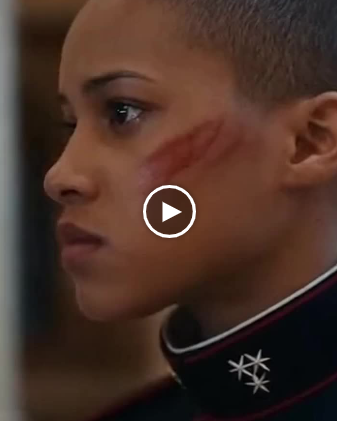
I stepped forward because some sentences cannot be spoken for you, no matter how kind the voice that tries. “You told me I did not belong,” I said quietly. “You told me I was pretending. That I was chasing something I had not earned.” The side of my face still remembered his hand, but I let that memory pass like a wave that does not pull you under.
“Do you know what belonging feels like?” I asked. “It feels like standing in a storm beside people who trust you without looking over their shoulders. It feels like hearing your call sign and knowing someone out there believes you will bring them home.”
The room did not move. Cameras lowered. Phones disappeared. The moment narrowed until it held only a father, a daughter, and a truth that had been waiting years to be said aloud.
Words that travel farther than sound
“You never asked what I did,” I said, my voice steady. “You only told me what I was not.” The words were soft, but they carried. They crossed the distance between us and settled where defensiveness had lived.
Behind me, two operators stepped forward by a fraction. Then a third. Not to threaten. To affirm. A quiet show of witness from people whose testimony was their presence.
Admiral Davis spoke again, the strength in his tone now laced with gentleness. “She earned her place long before today,” he said. “The only question is whether you can allow yourself to see it.”
Seeing past a cherished tradition
My father had anchored his life to lineage — to the firm idea that honor moved in a straight line from father to son. I never fit that picture for him, no matter how hard I tried. It was a narrow frame, polished and proud. And now, in a public room where every sound echoed, that frame did not fit the photograph in front of him.
He looked at me — really looked — as if history could be edited without erasing what came before. He was not angry now. He was searching.
“I tried to protect you,” he said, the fight gone from his voice. It arrived like an offering, rough around the edges but true.
What protection meant to him
“From what?” I asked, because it mattered to hear him say it.
“From becoming hard,” he said. “From becoming someone who has to live with all of this.” His hand moved toward the formation behind me and came to rest in midair, as if the weight of those years was too much to point at directly.
I nodded. “I did become hard,” I said. “But not in the way you fear.” The hard that came to me was not cruelty or coldness. It was the firm kindness of someone who shows up no matter what. It was a backbone, not a shield.
The lessons he gave me, carried forward
“You taught me to be disciplined,” I told him. “You taught me to be loyal. You taught me that quitting is a luxury we cannot afford.” I paused. “I took those lessons and used them in a place you had not planned for. That does not make them wrong. It only means they found a different home.” There was no sharpness in my voice. Only recognition.
The four hundred behind me did not need to move to be felt. Their steadiness made the room feel less like a stage and more like a living room where a family finally chooses honesty. This was not spectacle anymore. It was acknowledgment.
“I did not want to lose you,” my father said, barely above a whisper. He was not a man given to confessions. The words came out like something he had carried for too long.
What it costs to say the hardest thing
“You lost me when you stopped believing in me,” I said. It was the hardest sentence I have ever spoken, and I said it without anger because I wanted it to land where it needed to, not explode and scatter.
The Admiral stepped back to give us space. Ceremony could wait. Rank could wait. Even applause could wait. What mattered was small and immediate — the kind of moment that repairs a bridge you were not sure could be saved.
The hall went quiet again, but this time the silence did not accuse. It listened.
The breath before a choice
My father drew in a long breath. He looked at the operators, at the senior officers, and then at me, as if gathering courage from each face in turn. The anger that had introduced him to the moment had run out of road. What remained was choice.
“I was wrong,” he said. No fanfare. No hedging. Just three simple words that felt heavier than all the polished brass in the room.
The Admiral offered a single nod, a small salute to humility. In this community, where lives depend on clarity and character, admitting you are wrong is not weakness. It is leadership.
When the music returns
“Then let’s proceed,” the Admiral said. The orchestra found its place again, softer now, respectful. The ceremony resumed, but the ground under our feet had shifted. A door had opened where a wall used to be.
When they called my name, I stepped forward without the familiar tightness in my chest. I could feel the presence of those who stood behind me, not as a prop but as a promise. I was not alone against doubt anymore.
I glanced toward the audience. My father was standing at attention. Not because a manual required it, but because respect did. His posture said, I see you. It said, I am late, but I am here.
Applause that does not rush
The clapping that followed did not crash like thunder. It flowed, steady and sure, like a river that has carved its bed over years. It was not the noise of excitement. It was the sound of recognition. It did not need to be loud to be true.
In that moment I understood with a clarity I had been chasing for years: Belonging is not something family grants you by bloodline. It is something you prove by showing up, by doing the work, by standing your ground when storms try to move you. It is earned, in quiet and in fire.
Sometimes, victory does not look like conquering a distant enemy. Sometimes it looks like standing still long enough for the truth to catch up to someone who loves you, and to change both of you in the process.
Later, when the room emptied
After the music faded and the handshakes slowed, there were small moments that meant more than the ceremony itself. A shared cup of coffee. A breath taken together near a doorway where the night air felt clean. My father’s voice, trying out a new truth and finding it fit. None of it made the past disappear. But it made the future possible.
I do not pretend our story became simple overnight. Respect is not a medal you pin once and forget. It is a practice you return to, especially on the days when pride tries to speak first. We promised each other something modest but real: to ask before assuming, to explain without dramatizing, and to grant each other the same patience we had demanded from strangers.
What we carry home
Service leaves marks you cannot see. Behind the neat rows of ribbons are nights spent awake, holidays missed, and the ache of names that echo when rooms go quiet. Families carry their own weight too — worry that does not clock out, pride that is safer left unspoken, fear that sometimes sounds like anger.
My father had thought protection meant steering me away from anything that might harden me. He did not realize that real protection, the kind that helps someone grow, often looks like trust. It looks like listening. It looks like letting an adult child build a life that makes sense to them, even if it complicates your tidy picture of legacy.
I had my own lesson to learn. I thought my record alone would speak for me. It turns out that while actions matter more than speeches, sometimes the people who love you need you to put your courage into words they can hold. Not to defend yourself, but to invite them closer to what is true.
For anyone standing in a hall of your own
If you have ever stood in your living room, a kitchen, a driveway — any place that suddenly felt like a stage — and faced a loved one who could not yet see who you had become, know this: calm truth travels farther than shouted proof. Respect does not erase disagreement, but it leaves the door cracked open for understanding to walk through.
If you are a parent afraid of losing a child to a path you do not recognize, consider that fear can masquerade as control. It pushes away the very person you are trying to keep close. Listen for the person behind the choice. Ask what their days really look like. Ask what they need you to know. You might not agree with every answer. Agreement is not the only way to love someone well.
Two kinds of courage
There is courage in pulling a teammate to safety with rounds snapping at your heels. There is also courage in turning toward your daughter and saying, “I was wrong.” Both save something precious. One saves a life. The other saves a relationship that might have slipped away without either of you noticing until it was gone.
That afternoon, my father did something I have always appreciated in the best leaders I have served under. He let go of being right to be honest. He laid down a piece of ego to pick up a piece of truth. The room understood what that cost. So did I.
The bridge we crossed together
When the last notes of the orchestra thinned into the rafters, my father and I did not make a grand speech to each other. We did not need to. We shook hands longer than protocol required. He held my eyes steady. I felt us both changing by an inch or two in the right direction, the kind of change you can build a future on.
He released a story that had never fit me. I released a tightness I had carried like armor. Between us, a bridge appeared — not finished, but strong enough to step onto without fear it would give way.
What belonging finally meant
Belonging, I learned, is not granted by blood or taken by force. It is recognized. It is named. It is confirmed by the people who have watched you do the work and still choose to stand behind you, not out of obligation but out of respect.
I will remember the applause from that day for the rest of my life, not because it was loud but because it was steady. It felt like a room full of people saying, We see you. It felt like a father learning to say the same thing, even if the words came late.
I did not need to win an argument. I needed to be seen. And he needed to know that seeing me would not undo him. In the end, we both kept more than we feared we would lose. That is a kind of victory worth standing still for.
Moving forward, quietly and sure
Since that day, the work has not changed much. The hours are long. The calls still come at inconvenient times. The risks are the same. What has changed is the ground I stand on. It is firmer because the person who once stood against me now stands beside me. We do not agree on everything. We do not have to.
What we have now is a simple agreement to keep showing up — to speak plainly, to listen fully, and to let respect do the slow, patient work that applause can never finish. That is how you build a belonging that lasts. Not with a single moment in a shining hall, but with a hundred small choices after the music ends.
So when I look back at that afternoon, I do not see a war won. I see a truth finally allowed to stand on its own legs. And I see a father who chose to recognize the person in front of him, even when doing so meant rewriting a story he once thought was permanent. That is enough. That is more than enough.