
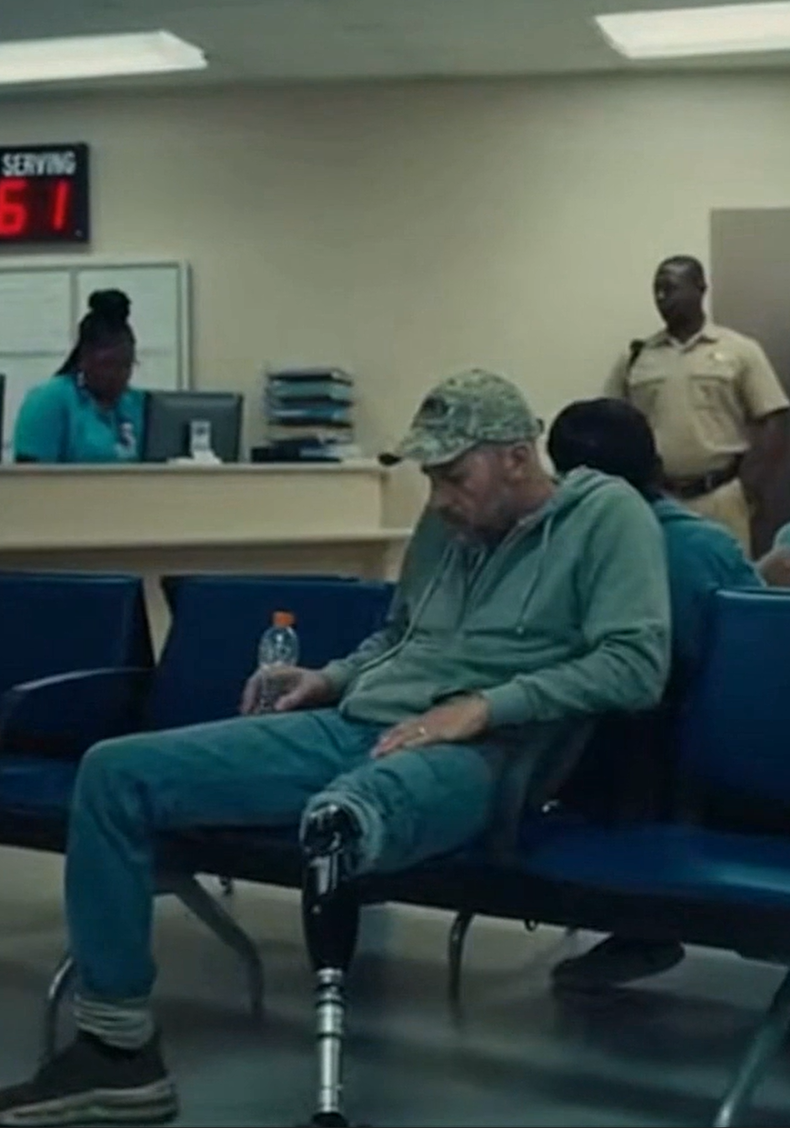
The fluorescent lights in the VA clinic waiting room buzzed like they always did. That low, endless hum that made everything feel slower, heavier, like the building itself was tired.
Robert Dawson sat in the hard plastic chair, his prosthetic leg aching where it met what was left of his right knee. He’d been there since 7 AM. It was now past 1 in the afternoon. His ticket number was 84. The screen above the front desk still read 61.
He hadn’t eaten. His water bottle was empty. The vending machine in the corner had a handwritten “OUT OF ORDER” sign taped over it with surgical tape.
“Excuse me,” Robert said to the front desk clerk for the third time. “I just need someone to look at my prescription. It expired two days ago and I haven’t slept since – “
“Sir, I told you. You have to wait your turn like everyone else.” The woman didn’t look up from her computer.
“I understand, but the pain medication – “
“Sir. Sit down.”
A security guard near the entrance shifted his weight, watching Robert the way you watch something you might need to handle. Robert held up his hands. “Okay. Okay, I’m sitting.”
He lowered himself back into the chair. His hands were shaking. Not from anger. From withdrawal. Three days without the nerve pain medication and his body was screaming at him in a language only he could hear.
An hour passed.
Then another.
The lobby was packed. Old men in faded baseball caps with unit patches. Young guys with thousand-yard stares scrolling through phones. A woman in a wheelchair with an oxygen tank humming softly beside her.
Nobody talked to each other. Everyone just waited.
At 2:47 PM, Robert’s vision blurred. His skin turned the color of wet cement. He grabbed the armrest and tried to steady himself, but his body had already made the decision for him.
He slid out of the chair and hit the linoleum floor with a sound that made the whole room flinch.
“Someone help him!” a man in a Korean War cap shouted.
The front desk clerk stood up, looked over the counter, and picked up her phone. “I’m calling someone,” she said. Then she sat back down.
Nobody came.
Thirty seconds. A minute. Robert lay on the floor, conscious but barely. His chest rose and fell in shallow, uneven waves. People around him stood but didn’t know what to do. The security guard spoke into his radio. Static came back.
Then Marcus Green, the night-shift janitor who’d come in early to cover for someone, rounded the corner with his mop cart. He saw the man on the floor. He saw the people standing around him. He saw the clerk typing.
Marcus dropped the mop.
He crossed the lobby in four strides, knelt beside Robert, and checked his pulse. His fingers moved with a precision that didn’t match the gray jumpsuit or the name patch stitched above his chest pocket.
“Sir, can you hear me? I need you to squeeze my hand.”
Robert squeezed.
Marcus looked up at the clerk. “Get Dr. Patel. Now.”
“Sir, you can’t – “
“I said get Dr. Patel. NOW.”
His voice hit the walls and came back hard. The room went dead silent. The clerk stared at him. Then she picked up the phone.
Marcus elevated Robert’s legs using a folded jacket. He loosened his collar. He timed his breathing with his watch – a battered military-issue watch with a worn leather band. The same model issued to Army combat medics.
The old man in the Korean War cap noticed it first. His eyes locked on the watch, then moved to Marcus’s hands, then to a faded scar running from his left wrist to his elbow.
“Son,” the old man said quietly. “You served.”
Marcus didn’t answer. He just kept his fingers on Robert’s pulse.
Dr. Patel finally rushed in four minutes later. She froze when she saw Marcus on the floor, his hands steady, Robert stabilized and breathing evenly.
“Who triaged this patient?” she asked.
The clerk pointed at Marcus.
Dr. Patel looked at him for a long time. Then she looked at the chart she’d been handed, and her face changed.
“Marcus Green,” she read aloud. Then she flipped to the second page and her hand went to her mouth.
The entire waiting room was watching now. Every single person.
She lowered the file and stared at him. “You were a—”
“Ma’am,” Marcus said quietly, not looking up. “Just help him. Please.”
But Dr. Patel was already reading the next line, and the paper in her hands began to tremble.
“You were a trauma surgeon,” she whispered, her voice cracking. “At Walter Reed.”
A ripple of shock went through the waiting room. A surgeon? Mopping floors?
The old man in the Korean War cap took a step forward. “He was a what?”
Dr. Patel looked from the file to the man on the floor, a man in a janitor’s uniform who held a veteran’s life in his hands with the practiced calm of a seasoned professional. “He was Major Marcus Green. Chief of Surgical Trauma, Kandahar Airfield. Awarded the Bronze Star for valor.”
She looked at Marcus, her eyes filled with a new kind of awe and a deep, unsettling confusion. “What are you doing here?”
Marcus finally looked up. His eyes were tired, ancient. “What needed to be done.”
Two orderlies arrived with a gurney, breaking the spell. They worked with Dr. Patel to carefully lift Robert onto it. As they wheeled him away, Robert’s eyes fluttered open and met Marcus’s. He tried to speak, but only a hoarse whisper came out. “Thank you.”
Marcus just nodded, the single, simple gesture carrying the weight of a shared, unspoken understanding.
The waiting room, once a silent collection of strangers, was now a community bound by a single moment. They all stared at Marcus, who slowly stood up, his knees cracking. He looked out of place, a hero in a janitor’s jumpsuit. He walked over to his cart, picked up his mop, and turned to head back down the hallway he came from.
“Hold on there, son,” the old man called out. His name was Arthur.
Marcus stopped but didn’t turn around.
“We ain’t done here,” Arthur said. Everyone in the room murmured in agreement.
The front desk clerk, whose name tag read ‘Brenda,’ looked pale. She had seen the same file Dr. Patel had. She had processed Marcus’s employment paperwork. She knew. And she had told him to sit down.
In a small office down the hall, Dr. Patel found Marcus rinsing his mop head in a utility sink.
“Major Green,” she began.
“It’s just Marcus,” he said, not turning around. “I’m not a Major anymore. I’m not a doctor anymore.”
“I don’t understand,” she said, her voice soft. “You were one of the best. I remember reading your papers. You pioneered a technique for vascular shunting in the field. You saved hundreds of lives.”
He finally turned off the water and faced her. The fluorescent light of the closet was harsh, highlighting the lines of exhaustion carved into his face.
“I lost one,” he said. His voice was flat, hollowed out. “It’s always the one you lose that you remember.”
He told her about a young private, no older than nineteen. An IED. Marcus had worked on him for eighteen hours straight, in a tent with failing generators and the constant thud of mortars in the distance. He had done everything right. Every procedure, every stitch, was perfect.
But the boy died anyway.
“His name was Samuel,” Marcus said, staring at the gray water in the bucket. “He had a sister getting married. He showed me a picture.”
After that, his hands started to shake. Not all the time. Just when he held a scalpel. He’d see that kid’s face. He couldn’t do it anymore. The Army honorably discharged him. He came home, a decorated hero who felt like a complete failure.
“The pressure… the responsibility of holding a life in your hands…” He trailed off. “I couldn’t. Not again.”
So he vanished. He took a job where the only responsibility was a clean floor. No life or death. Just dirt. You see the dirt, you clean the dirt. The result is always the same. It was simple. It was quiet. It was a way to serve without the risk of breaking.
“You don’t belong here, Marcus,” Dr. Patel said gently.
“Maybe this is the only place I do belong,” he replied. “Close enough to help, but far enough away not to hurt anyone.”
Their conversation was interrupted by a sharp knock on the door. A man in an expensive suit and a crisp tie stood there, his face a mask of bureaucratic annoyance. This was Mr. Henderson, the hospital administrator.
“Is this the man?” Henderson asked, pointing a pen at Marcus. “The janitor who interfered with a patient?”
Brenda, the desk clerk, stood behind him, looking terrified. She had been forced to report the incident, protocol being protocol.
“He didn’t interfere, Mr. Henderson,” Dr. Patel said firmly. “He saved that man’s life. He provided critical aid when no one else was.”
“He is not a licensed physician at this facility,” Henderson said, his voice cold and devoid of emotion. “He touched a patient. He gave medical advice. That is a violation of half a dozen regulations. It’s a lawsuit waiting to happen.”
“It’s a life that was saved,” Dr. Patel countered, her anger rising.
“He’s a liability,” Henderson snapped. “Green, you’re terminated. Clean out your locker. Security will escort you from the premises.”
Marcus just stared at him, his face impassive. It was what he expected. It was easier this way. Disappearing again.
But this time, he wasn’t allowed to.
“Like hell he is.”
The voice came from the doorway. It was Arthur, the old veteran from the lobby. Behind him stood a dozen other veterans. Young and old, men and women. They had been listening. They had heard everything.
“That man is a hero,” Arthur said, stepping into the small room. “He did for one of our own what this place failed to do for six hours. And you’re going to fire him?”
Henderson’s face hardened. “This is an internal staffing matter. It does not concern you. Now, I suggest you all return to the waiting room.”
“We are the waiting room,” a young woman with a prosthetic arm said. “And we’re not going anywhere. Not until you reinstate this man.”
The veterans formed a silent, unmovable wall in the hallway. They weren’t yelling. They weren’t being aggressive. They were just standing there, a testament to shared experience and unwavering loyalty.
Henderson scoffed. “This is absurd. I’m calling security.”
“They’re already here,” Arthur said, gesturing to the guard by the entrance. “And last I checked, Frank served in the 101st. He knows a brother when he sees one.”
The security guard, Frank, just gave a slight, almost imperceptible nod. He wasn’t moving.
The standoff was broken by the sound of a wheelchair. An orderly was pushing Robert Dawson down the hall. He was pale and hooked to an IV drip, but his eyes were clear and burning with purpose. He had his prescription. And he had a story to tell.
“Stop,” Robert said to the orderly. He wheeled himself to the front of the group. He looked at Henderson.
And then he froze.
A flicker of recognition crossed his face, followed by a wave of cold anger. He stared at Henderson, not as a patient to an administrator, but as a soldier to an officer.
“Henderson?” Robert said, his voice low and dangerous. “Captain Henderson?”
The administrator’s composure finally cracked. A flash of panic appeared in his eyes. “I… I don’t know what you’re talking about.”
“Oh, you know,” Robert said, his voice gaining strength. “I’d never forget the face of the man who called in an air strike on the wrong grid coordinate.”
The hallway went utterly silent. Even the buzzing of the lights seemed to stop.
“You were the FSO in the Korengal Valley, 2009,” Robert continued, his words like hammer blows. “You got a report of enemy movement. You didn’t wait for visual confirmation. You just wanted the glory. You called it in.”
Henderson was white as a sheet. “That’s a classified—”
“It was my unit you called it in on,” Robert said, his voice thick with emotion. “Friendly fire. We lost four men that day. I lost this leg.” He slapped his hand on his prosthesis. “Because you were more concerned with protocol and quick results than with the lives of your men.”
The truth hung in the air, heavy and suffocating. Henderson, the man of rules and regulations, had broken the ultimate rule. He had failed his men.
“You were moved to an administrative post after that,” Robert said, connecting the dots. “They buried it. Swept you under the rug. And here you are. Doing the exact same thing. Hiding behind rules instead of doing what’s right.”
Henderson looked around at the faces staring at him. They weren’t just patients anymore. They were judges. A jury of his peers, draped in the invisible scars of service he had managed to avoid. His authority was gone, evaporated in the face of his exposed past.
He turned, without a word, and walked back to his office, the door clicking shut behind him with a sound of finality.
The veterans didn’t cheer. There was no victory in this. Just a sad, profound justice.
Dr. Patel knelt beside Robert’s wheelchair. “Are you alright?”
“I am now,” he said. He looked over at Marcus, who was still standing by the utility sink, looking stunned. “He’s the one we need to worry about.”
Later that afternoon, the waiting room was still full. But the atmosphere had changed. People were talking. Sharing stories. Arthur was buying coffee for everyone from the now-magically-fixed vending machine.
Dr. Patel approached Marcus, who was sitting quietly in a corner.
“Mr. Henderson has taken an ‘indefinite leave of absence’,” she said with a small smile. “And his last official act, per my very strong recommendation, was to reverse your termination.”
Marcus nodded slowly. “So I can go back to mopping?”
“No,” she said. “We have something else in mind.”
She explained her idea. A new position. A Patient Advocate. Someone who wasn’t a doctor or a nurse, but who understood the system and, more importantly, understood the people it served. Someone to walk the waiting room, to talk to the veterans, to triage not just their medical needs, but their human needs. To be the person who listens when no one else will.
“You wouldn’t be making life-or-death decisions,” she said. “You’d be making sure people get to the person who does. You’d be guiding them. Helping them.”
Marcus looked out at the room full of veterans. He saw the faces, the tired lines, the hopeful eyes. He saw Robert, now sitting with Arthur, laughing about something. He saw the community that had formed in the last few hours, a community that had stood up for him.
He thought of the young private, Samuel. He had failed to save his life. But maybe… maybe he could honor his memory by helping the hundreds of others who came home, still fighting battles long after the war was over.
It wasn’t a scalpel. It was a kind word. It wasn’t an operating room. It was a waiting room. But it was still a way to serve. A way to heal.
“Okay,” Marcus said, a flicker of his old self returning to his eyes. “I’ll do it.”
A week later, Marcus Green walked through the VA lobby. He wasn’t wearing a gray jumpsuit anymore. He was in a simple polo shirt and slacks, with a new name tag that read, “Marcus Green, Veteran Advocate.”
He stopped by a young man who was bouncing his leg nervously, his ticket number clutched in his hand.
“First time here?” Marcus asked gently.
The young man nodded. “It’s a lot.”
“I know,” Marcus said, pulling up a chair. “Tell me your story. We’ve got time.”
The fluorescent lights still buzzed with that same, tired hum. But today, for the first time in a long time, it sounded a little like a song of hope.
Heroes are not always found on the battlefield or in the operating room. Sometimes, they are found in the quiet corners of a hospital, holding a mop or a steady hand. They are defined not by the rank on their shoulder or the title on their door, but by the compassion in their heart and the courage to act when someone is in need. True service is about seeing the person, not the number, and reminding them that they are not forgotten.



