
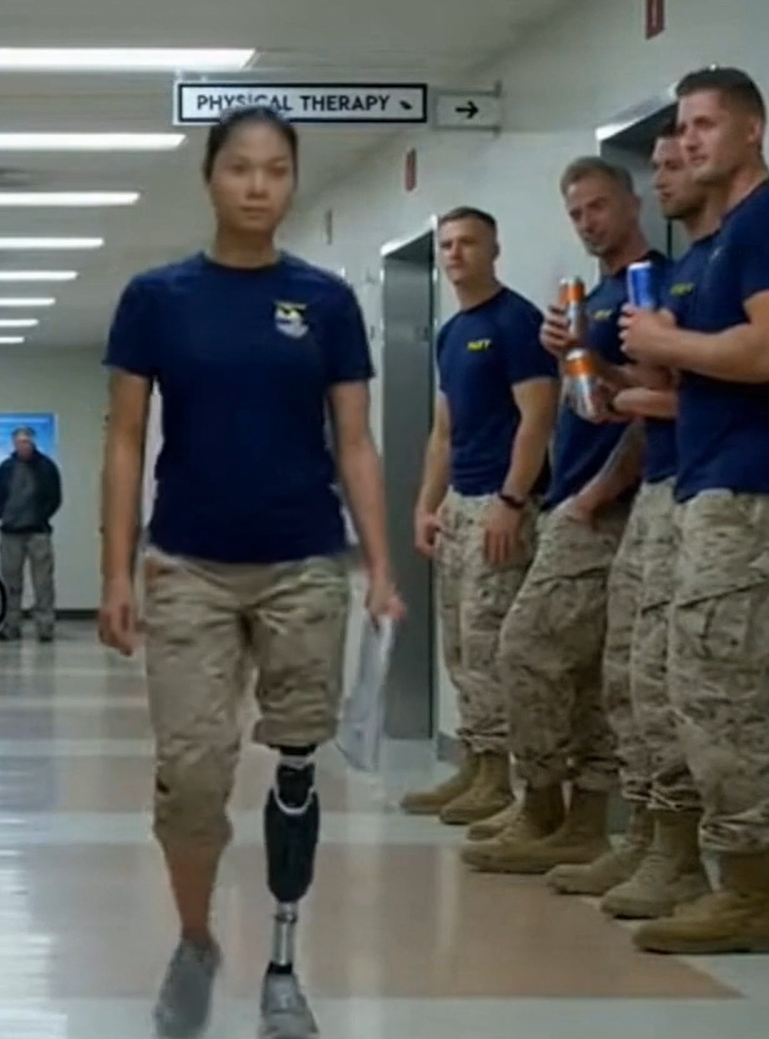
The San Diego VA Medical Center hallway smelled like disinfectant and burnt coffee. Lieutenant Sarah Chen, 29, walked slowly toward the physical therapy wing, her prosthetic leg clicking with each step. The titanium and carbon fiber contraption replaced what she’d lost to an IED in Kandahar three years ago.
“Jesus, look at her limp,” one of the SEALs muttered. There were five of them, all in their late twenties, fresh from BUD/S training. They leaned against the wall near the elevator, drinking energy drinks.
Sarah kept walking. She’d learned to ignore comments. Her physical therapist always said the same thing: “Keep your head up, focus on the goal.”
“Bet she was a desk jockey,” another one said, louder this time. “Admin types always cry about their ‘injuries.’”
Sarah’s face burned. Her hands clenched. She’d been a helicopter pilot. She’d flown seventeen combat missions. She’d pulled three wounded Marines out of a hot zone with hydraulics failing.
But she kept walking.
“Ma’am, you need help?” The tallest one stepped in front of her, blocking her path. He wore a smirk. “Maybe you should use the wheelchair entrance. You’re holding up traffic.”
Behind them, other vets in the hallway had stopped. An elderly man with a walker. A young guy with burn scars. A woman pushing an empty wheelchair. All watching.
“I’m fine,” Sarah said quietly. Her throat felt tight.
“Doesn’t look fine.” He glanced back at his buddies. “Looks like someone got a medical discharge for a boo-boo and now wants sympathy points.”
“Move,” Sarah said.
“Or what?” He leaned closer. “You gonna run after me?”
That’s when the elevator dinged.
Everyone turned.
General Marcus Webb stepped out. Four stars on his collar. Seventy-two years old, with steel-gray hair and a ramrod-straight back. He’d commanded JSOC. He’d overseen operations in three wars. Every servicemember in that hallway recognized him instantly.
The SEALs straightened. The smirk vanished from the tall one’s face.
“Attention,” someone whispered.
General Webb walked straight toward them. His eyes locked on the SEAL blocking Sarah’s path. The hallway went completely silent. Even the intercom seemed to stop crackling.
“Name,” the General said. His voice was quiet. Cold.
“S-Staff Sergeant Miller, sir. SEAL Team Three.”
“SEAL Team Three,” the General repeated. “You just graduated BUD/S?”
“Yes, sir.”
“Then you don’t know shit yet.” The General stepped past him and stood next to Sarah. “Lieutenant Chen here flew CH-47s. She evacuated forty-three wounded in twelve months. She lost her leg pulling a bird out of a firefight when most pilots would’ve bailed.”
Sarah’s eyes stung. She hadn’t expected this.
“But that’s not why I’m here,” the General continued. He turned to face all five SEALs now. The elderly vet with the walker had moved closer. More people were gathering. “I’m here for my appointment. Same one I’ve had every Tuesday for six years.”
The General reached down.
His fingers found the hem of his right pant leg.
He rolled it up slowly, revealing what nobody in that hallway had ever seen.
A prosthetic leg. Older model than Sarah’s. More scarred. The kind they gave out in the nineties.
“Lost it in Mogadishu,” he said. “1993. I commanded the Rangers there. Got hit in the firefight. Spent two years learning to walk again.”
Sarah’s breath caught.
Staff Sergeant Miller’s face had gone white.
“Every person in this hallway,” the General continued, his voice carrying now, “has earned their place here. Every. Single. One.” He looked at Sarah, then back at the SEALs. “And if I ever hear about any of you disrespecting a wounded servicemember again, you’ll find yourself – “
The General stopped mid-sentence.
His eyes had shifted to something on Sarah’s uniform. A small pin she wore above her ribbons. A memorial pin.
His hand moved to his own chest, where an identical pin sat.
“Where did you get that?” His voice had changed. Softer now. Almost shaking.
Sarah touched the pin. “It was my co-pilot’s. Emily Webb. She didn’t make it out of the crash. I promised her – “
The General’s hand was trembling now.
“Emily was my daughter.”
The hallway felt like all the air had been sucked out.
Sarah’s vision blurred. “Sir, I… I tried to pull her out. The fuel line was – “
“I know.” The General’s voice cracked. “I read the report. Fifteen times. You stayed with her. You held her hand while the fire—”
He stopped.
Tears ran down his weathered face.
Everyone in that hallway stood frozen.
The General reached into his pocket. Pulled out a folded piece of paper. His hands shook as he unfolded it.
“This is what she wrote,” he whispered. “Her last letter. She mailed it two days before the mission.”
He began to read aloud, and Sarah recognized Emily’s handwriting, Emily’s words:
“Dad, if anything happens to me, find Sarah Chen. She’s the best pilot I know. The best person I know. Tell her…”
His voice caught on the last two words. He took a shaky breath and continued.
“Tell her it wasn’t her fault.”
A sob escaped Sarah’s lips. It was a sound she’d held inside for three long years. The guilt had been a constant companion, heavier than any piece of metal strapped to her body.
“Tell her to live,” the General read on, his voice gaining a fragile strength. “Live for both of us. Tell her I said to finish our project. The one we talked about under the stars in Bagram. She’ll know what I mean.”
The paper trembled in his hand. He looked up from the letter, his eyes finding Sarah’s through a film of tears. The crowd of onlookers, the shamed SEALs, the sterile hallway—it all faded away.
There were only two people, bound by a ghost.
“I didn’t know,” Staff Sergeant Miller whispered. The words were barely audible, a crackle of static in the profound silence. His arrogance had shattered, leaving a young man looking utterly lost.
General Webb slowly folded the letter. He placed a hand on Sarah’s shoulder, a gesture that was both grounding and paternal.
“Come with me, Lieutenant,” he said softly. “Let’s get out of this hallway.”
He turned to the SEALs. He didn’t yell. He didn’t threaten a court-martial. His voice was something far worse; it was heavy with disappointment.
“You are dismissed,” he said to Miller. “Go back to your team. And think. Think about what it means to serve. Think about the people who serve next to you. And think about the ones who can’t anymore.”
They didn’t move for a long moment. Then, as one, they turned and walked away, their confident strides gone, replaced by the heavy-footed shame of men who had just learned a lesson they would never forget.
The General guided Sarah toward a small, quiet waiting area down the hall. He sat her down in a vinyl chair and took the one opposite her.
For a while, neither of them spoke.
The unspoken weight of Emily Webb filled the space between them.
“I tried to contact you,” the General finally said, his voice raspy. “After… after it happened. They told me you were in Germany, in critical condition. Then stateside. I didn’t want to intrude on your recovery.”
“I wouldn’t have minded, sir,” Sarah replied, her own voice weak.
“Call me Marcus,” he insisted. “We’re past that now.”
He leaned forward, his elbows on his knees. “Tell me about her. Not the report version. Tell me about my daughter.”
So Sarah did.
She told him about how Emily hummed off-key when she was nervous during pre-flight checks. She told him how Emily kept a stash of terrible gas station candy in her flight bag and shared it with everyone.
She told him about the night they talked about “the project.” They had been sitting on the ramp of their Chinook, looking up at a sky so full of stars it felt like you could fall into it. Emily had been sketching in a small notebook.
“What’s that?” Sarah had asked.
“A dream,” Emily had answered. “A retreat. For vets who are… broken. Not just their bodies, but their minds. A place with horses and mountains and silence. A place to learn how to be a person again, not just a soldier.”
As Sarah spoke, a sense of peace began to settle over Marcus Webb’s face. He was seeing his daughter not as a fallen hero on a memorial wall, but as a vibrant, living person.
He shared his own stories. He told Sarah about a stubborn six-year-old Emily who insisted on learning to ride a bike without training wheels, resulting in a week of scraped knees and a triumphant, toothy grin. He told her about Emily’s terrible prom dress, which she’d loved with all her heart.
They laughed. They cried. In a small, forgotten corner of the VA hospital, a father and a friend mourned together, and in doing so, they began to heal.
“The project,” Marcus said, his eyes clearing. “We should do it. For her.”
A purpose ignited in Sarah’s chest, something she hadn’t felt since she last sat in a cockpit. “Yes,” she said. “We should.”
Six months passed.
The “Emily’s Haven” project was underway. With General Webb’s connections and Sarah’s relentless drive, they had secured a plot of land in the mountains east of San Diego. Donations poured in. Volunteers signed up.
Sarah was at the VA three times a week, but not just for her own physical therapy. She had become a mentor, a peer support specialist. She sought out the new arrivals, the ones with the same haunted look she once wore.
She taught them the little tricks: how to navigate a shower, how to drive with hand controls, how to answer the inevitable questions from strangers without bitterness.
Most importantly, she taught them how to keep their heads up and focus on the goal.
One afternoon, in the bustling physical therapy gym, she saw a familiar face.
He was sitting on a therapy table, his head hung low. His leg was in a massive cast, propped up on a pillow. It was Staff Sergeant Miller.
Sarah felt a flicker of the old anger, but it was quickly replaced by something else. Empathy. She knew that look of defeat all too well.
She walked over, her own prosthetic making its familiar, rhythmic click on the linoleum floor.
“Training accident?” she asked quietly.
Miller looked up, startled. His face flushed with shame when he recognized her.
“Yeah,” he mumbled. “Fast-roping exercise. Came down wrong. Shattered my ankle. Compound fracture.”
“Nasty,” Sarah said, nodding. “Docs say you’ll get back to it?”
He shook his head, looking down at his hands. “They’re not sure. Said the nerve damage might be permanent. I might not be able to run. Might not be able to stay on the team.”
His voice, once so full of cocky assurance, was now just a whisper.
“The guys who made it through BUD/S,” he said, “we think we’re invincible. We think nothing can touch us.” He looked at her, his eyes filled with a new, raw understanding. “We’re idiots.”
Sarah pulled up a stool and sat next to him.
“No, you’re not,” she said. “You’re just human. And sometimes, humans break.”
She looked him in the eye. “My therapist always told me the same thing: ‘Keep your head up, focus on the goal.’ So, what’s your goal, Staff Sergeant?”
He was quiet for a long time. “To walk again,” he finally said. “Properly.”
“Okay,” Sarah said with a small smile. “That’s a good goal. Let’s start there.”
From that day on, Sarah became Miller’s most unlikely ally. She was there for his agonizing physical therapy sessions. She pushed him when he wanted to quit. She shared her own frustrations, her own dark days, letting him know he wasn’t alone.
He saw the grit behind her limp. He saw the sheer, stubborn will it took for her to get up every single morning and strap on a piece of metal just to be able to walk.
His four teammates started visiting him. At first, they were awkward around Sarah, unsure of what to say. But they saw how she was helping their friend. They saw the change in him.
One Saturday, they showed up at the Emily’s Haven build site. They didn’t say much. They just picked up hammers and saws and got to work. They came back every weekend after that.
The day Miller finally took his first steps without crutches, Sarah and his team were there, cheering him on. He walked, slowly and painfully, across the gym floor, his eyes locked on Sarah.
“Thank you,” he said, his voice thick with emotion.
“You did the work,” she replied. “I just reminded you that you could.”
A year later, Emily’s Haven opened.
It was a beautiful, sprawling ranch nestled in a valley, with horse stables, hiking trails, and quiet cabins. It was a place of peace.
The opening ceremony was a small, private affair. General Webb stood at a podium, looking out at the crowd of veterans, volunteers, and supporters.
Sarah stood beside him. Staff Sergeant Miller, now fully recovered and recently promoted to Chief Petty Officer, stood in the front row with his team. He was a different man now—quieter, more thoughtful, a leader forged not just by fire, but by humility.
“Strength,” General Webb said, his voice echoing across the valley, “is not the absence of weakness. It is not about never falling. True strength is what we do after we’ve been broken. It’s about reaching out a hand to help someone else up, even when you’re still unsteady on your own feet.”
He looked at Sarah, and then his gaze settled on Miller.
“It’s about learning that the deepest wounds are the ones we can’t see, and the greatest honor is not in the medals we wear, but in the compassion we show to our brothers and sisters in arms.”
He finished his speech, and the valley filled with applause.
Later, as the sun began to set behind the mountains, Sarah stood on the porch of the main lodge, looking out at the land her friend had dreamed of.
Miller walked up and stood beside her.
“She would have loved this,” he said softly.
“Yeah,” Sarah agreed, a sad smile on her face. “She would have.”
They stood in comfortable silence for a moment.
“I’m a better man because of you, Sarah,” Miller said. “And because of her.”
A life is not measured only by its length, but by the ripples it leaves behind. Emily Webb’s life was cut short, but her ripples had changed the course of so many others. They had healed a grieving father, given a new mission to her best friend, and taught a group of arrogant young warriors the true meaning of strength.
The greatest lessons are not always learned on the battlefield, but in the quiet hallways of a hospital, in the shared stories of loss, and in the simple, profound act of helping another person learn to walk again.



