The Arrival
The vineyard’s parking lot was already busy when she pulled in, neat rows of shiny sedans and luxury SUVs catching the afternoon light. It looked like a showroom of the things her brother prized most—gloss, polish, and the right kind of impression.
She shut off the engine and rested her hands on the steering wheel. She wasn’t stalling out of nerves. She was letting the noise of the day settle so she could enter on her own terms.
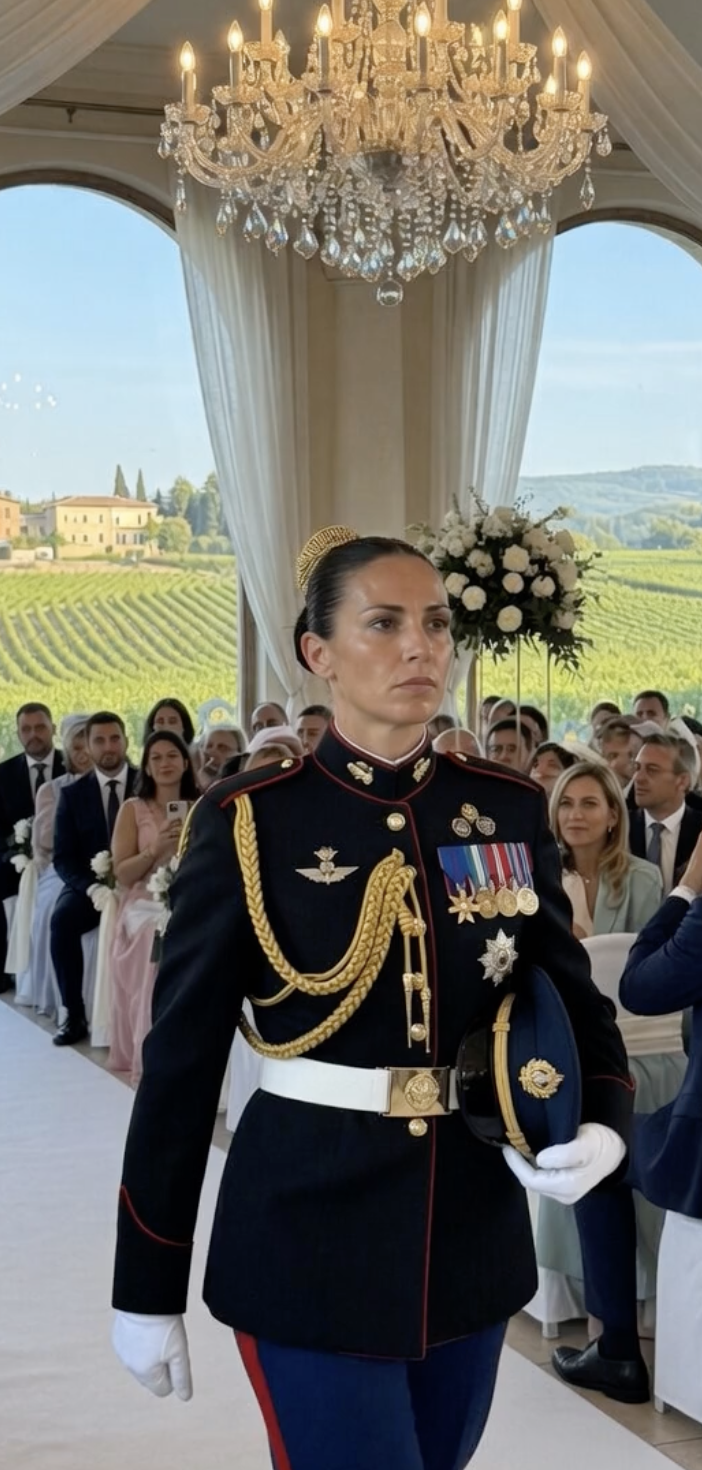
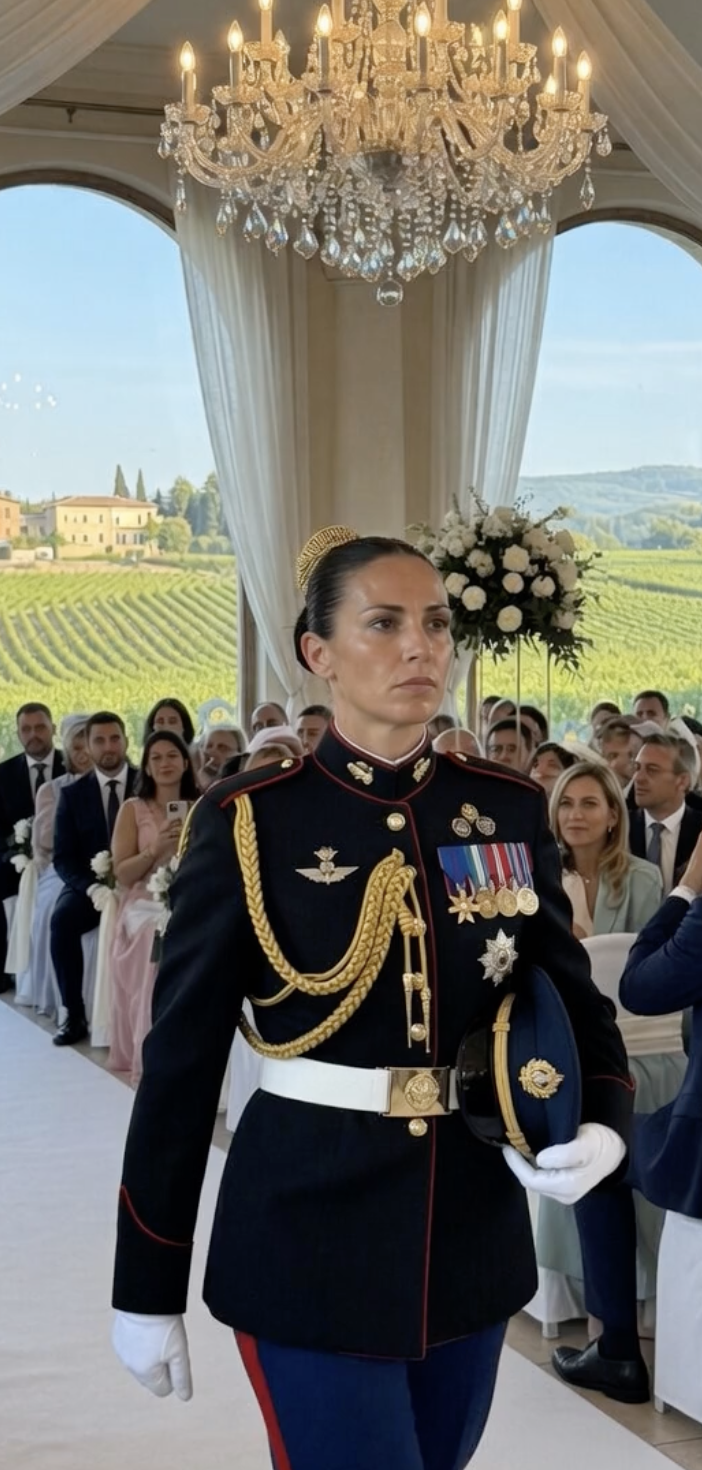
When she stepped out, the gravel gave a soft crunch under her dress shoes. Sunlight flashed across the two silver stars on her shoulders. To most people, they were a pretty detail. To anyone who had ever worn a uniform, they meant something else entirely.
Walking In On Her Terms
From the edge of the lot, she could hear the reception before she saw it. Glasses chimed. Laughter, bright and practiced, threaded the air. Conversations hummed with the particular energy of people who had worked hard at looking relaxed.
She crossed the terrace entrance with the same posture she used everywhere, the one that said she belonged without asking anyone’s permission. She didn’t hurry. She didn’t pause. She simply chose her pace and kept it.
A cousin spotted her first. They hadn’t seen each other in years. The cousin’s smile came and went in a blink, replaced by a careful look, the kind people put on when they aren’t sure how to feel. “Oh,” the cousin said, glancing at the uniform. “You actually wore it.”
She kept walking.
The First Confrontation
Conversations didn’t stop, not at once. They thinned. Words fell away like leaves until a hush, delicate and uneven, drifted across the terrace. Heads turned in sequence, interest rippling through the crowd.
Her brother, Daniel, saw her from across the space. His jaw set. He placed his drink on a table as if it were part of a rehearsed routine, then started toward her. His new bride’s hand slipped from his arm.
He lowered his voice, calm in the way of a man who thought shaping appearances could reshape reality. “I asked Mom to speak to you,” he said. “You couldn’t do this one thing.”
She met his eyes. She didn’t need to raise her voice. She almost never did. “You asked me not to arrive as myself,” she said. “I thought about it. And I decided I’ve spent enough years making other people comfortable.”
Color rose in his face. He opened his mouth to answer—
And three chairs scraped the stone behind them.
Twenty Salutes
She turned in the direction of the sound. At a table toward the back, a man in his sixties stood. His suit was dark and formal, but the small pin on his lapel—the Eagle, Globe, and Anchor—told a longer story. His gaze fixed on the stars at her shoulders. His right hand rose to his brow.
Another guest stood. Younger. At a different table. The same pin. Then a woman three rows over. A man near the bar. Two more by the railing that overlooked the vines.
One by one, they rose. Twenty of them. Marines, retired and still serving, scattered among the guests from both families. Some carried decades of time in their posture. Some looked too young to have seen what their eyes revealed.
They did not speak. They didn’t need to. They saluted and held it, a line of silent respect cutting through the three hundred people who weren’t quite sure what they were seeing.
Daniel’s face drained. The bride’s father—a silver-haired man at the head table who had spent cocktail hour talking about investments—stood among the twenty. He held his hand at his temple, eyes bright with emotion, and stared at her as if he were seeing something sacred.
The silence lasted only a dozen seconds, but it seemed to stretch out, time suspended between those raised hands and the woman standing still at the center of it.
She returned the salute. Precise. Clean. The kind of movement you learn through years and responsibility, through the weight of decisions that shape other people’s lives.
Hands fell. The bride’s father walked directly to her. Not to his new son-in-law. Not to his daughter. To her. He took her hand in both of his. His voice was rough around the edges. “Major General Caldwell,” he said. “My son served under you in Helmand. He came home because of you.”
The hush deepened. Even the wind seemed to soften as it moved through the vines.
Daniel stood a few paces away and watched as the man he’d tried so hard to impress all evening held his sister’s hand with reverence.
Their mother sat at the family table, both hands covering her mouth, eyes closed. Whether it was pride or shame, no one could tell from the outside.
She looked at her brother once more but left the words unsaid. The room had spoken for her.
She turned back to the bride’s father and, in a gentle voice, offered two simple words that broke him open right there in front of everyone.
“He remembered you.”
What Those Words Meant
Later, he would tell me he knew she had to have been there to know what she said. It wasn’t a line from a speech. It was a detail about his son that only someone who had shared the same ground would understand.
But it wasn’t those hushed twelve seconds that changed everything. It was what happened three hours later, after the cake and the toasts and the long line of Marines who filed past her table to nod, shake her hand, and call her “Ma’am.”
Near the oak barrels behind the hall, beneath the smell of damp earth and fermenting grapes, Daniel pulled her aside. His voice trembled. “I need you to tell me something,” he said, clutching at words the way a person clutches at a ledge. “Did Dad ever know what you really—”
She lifted a hand, rested it on his shoulder, and whispered something that made him fold down onto the ground right there in his rented tuxedo and stay there a long time.
The Long Evening
Until that moment, the reception had carried on around her like a river parting around a rock. She sat at her table, quiet and steady. The bride, Sarah, drifted over first, her dress whispering as it moved. She didn’t apologize for Daniel. She simply looked at the woman in uniform with a kind face and said, “My dad hasn’t stood that straight in twenty years. Thank you.”
There wasn’t much to add. A nod was enough.
Others followed, not to talk about firefights or medals but about something older and simpler. They spoke about leadership. About how respect moves silently from person to person. A woman from the logistics corps in the nineties. A young man not long back from deployment. They didn’t compare wounds. They compared the weight of responsibility.
Each handshake and quiet greeting placed a small stone on the scale, balancing years of Daniel’s polite distance and their mother’s anxious quiet.
Daniel did what was expected of a groom. He smiled for the photographs. He danced. He made the rounds. But his eyes kept finding the sister he thought he understood. He saw people he admired lean toward her with gratitude, and confusion settled into him like a deep ache. His world of impressions and status, built with such care, had been cracked open by something he hadn’t accounted for: a life lived in service, seen and acknowledged by strangers.
The bride’s father, Mr. Harrison, spent nearly an hour at her side. He spoke slowly about his son, Kevin. He described how Kevin had talked about her, not as a distant commander, but as someone who knew the names of spouses and kids and who checked in on a soldier’s father with a bad heart. He said Kevin had once described her as a leader who noticed the small things people carried and lightened them when she could.
“He said you remembered me,” Mr. Harrison murmured, emotion thick in his voice. “He told you about my hardware store struggling. About how I used to take him fishing.”
Her answer was simple and warm. She said Kevin talked about it all the time, about coming home to fix the leaky roof on the little bait shop. The older man’s face moved through grief and gratitude, and for a moment, it was as if Kevin had stepped into the room between them.
By The Barrels, A Hard Truth
When the music finally faded and the guests thinned out, Daniel found her by the old barrels. His energy was gone, replaced by something raw and empty. “How did you know all those people?” he asked, eyes on the ground.
“I don’t,” she said with calm clarity. “They knew the uniform.”
He shook his head. “No. They knew you. Sarah’s dad looks at you like you put the stars in the sky. He barely looked at me all night.” The words came out sharp with long-held resentment he couldn’t name until then.
He swallowed, then asked what had been pressing on his chest for years. “Did Dad know what you really did?” He needed her to say no. He needed to believe their father had seen the world the way he did.
She studied her brother—handsome, successful, dressed in a tux that suddenly felt flimsy under her palm. Then she gave him the truth that would change him.
“He tried to enlist,” she whispered. “The day after I shipped out to Parris Island. He was forty-eight.”
Daniel flinched. She explained, softly and plainly, that the recruiter turned him away because of his blood pressure, that he told no one except her. And with that, Daniel’s careful composure broke. He didn’t ease down; he collapsed, tuxedo trousers soaking up the evening dew, shoulders shaking with quiet sobs. She let him be. Sometimes you have to meet the truth where it puts you.
She walked to her car alone, the same way she had come.
The Morning After
At sunrise, she saw him from her hotel window. His car straddled two parking spaces. He sat on the hood with his tie undone and his face gray with a sleepless night. In his lap rested a folded American flag and an old envelope, yellowed at the edges.
She went down in her sweatpants and a t-shirt. He didn’t speak. He slid off the hood and handed her the flag and the letter with steady hands, the storm inside him spent.
She recognized the flag the second she felt its weight. It was their grandfather’s. She opened the envelope and saw their father’s neat handwriting. The first line reached straight through the years.
“To my bravest child — the one I was too afraid to follow.”
The letter, written the night before she left for boot camp, read like an unburdening. He wrote that he had spent his life telling Daniel that success meant safety, a tidy life measured in offices and portfolios. He admitted it wasn’t the whole truth. It had been his way of keeping fear at bay. He spoke of his own father, a hero in the family’s memory, and how he had chosen comfort instead of courage and then dressed that choice up as responsibility.
He confessed that when she enlisted, he felt two strong things at once: a fear so bright it made his heart race and a jealousy that tasted like shame. The day after she left, he’d walked into a recruiter’s office, hoping it wasn’t too late to follow her path. They turned him away. Middle-aged. High blood pressure. A body that could no longer cash the checks his courage wanted to write.
After that, he wrote, he tried to protect the only way he knew how. He pressed Daniel toward a safe life, not because it was the best life, but because his fear demanded it. He needed to believe one child would be untouched by risk, and in that need, he mistook safety for happiness.
He explained the flag. It had been his father’s, and he had promised to pass it to the child who most clearly carried the spirit of service. That child was her. He admitted he had asked Daniel to hold it because he hadn’t been brave enough to say these words out loud while he lived. He told her not to be angry with her brother. Daniel was the son he had molded, and the fault was his own, not Daniel’s.
The letter closed with a simple truth: live your life the way you were made to live it. Be brave. Know that, in his silent way, he had always been proud—prouder than he could ever show.
Her eyes blurred as she folded the paper. She looked at the flag and then at her brother. “He gave this to me after the funeral,” Daniel said, voice rough. “Told me to keep it safe for you. I thought he meant something else. I thought he was disappointed in you.” He lifted his gaze, and she saw something new there. “I was wrong. About him. About you. About a lot.”
She took a slow breath. “He was trying to protect you,” she said gently.
“He was trying to protect himself,” Daniel answered, a tired wisdom settling in his voice. “He didn’t want me to see he was disappointed in himself. So he let me think he was disappointed in you.”
They stood quietly as the early light warmed the asphalt. For the first time in a long time, they weren’t the General and the Businessman. They were simply a sister and a brother, looking at the same truth and, finally, seeing it together.
The Brunch
“There’s a brunch,” Daniel said at last. “Sarah’s family will be there. Mr. Harrison too.” He hesitated. “He asked if you would come. I think he just wants to be near you.”
She studied her brother’s rumpled tux and his honest, tired eyes. “I’ll go,” she said. “But you’re introducing me.”
He managed a small smile. It was the first one she had trusted from him in years. “Okay,” he said. “I can do that.”
An hour later, they walked into the vineyard’s restaurant side by side. The twenty Marines had gathered again. So had Mr. Harrison. Conversations quieted without anyone asking. Daniel placed his hand lightly on her shoulder—the one without the stars—and spoke in a clear, steady voice.
“Everyone,” he said, “I’d like to properly introduce my sister, Major General Avery Caldwell.”
She looked around the room. She didn’t focus on the uniforms or the fine suits, but on the faces. Respect. Gratitude. Relief. And in her brother’s eyes, for the very first time, she saw something she had been denied for many years—a reflection of the pride their father had carried, silently and awkwardly, inside his heart.
What We Carry Forward
It is easy to misread the quiet chapters in our families. We fill in the blanks with our own worries. We decide silence means disapproval, that fear equals shame. But sometimes, love shows itself in a harder, braver way. It shows up when someone walks into a room as their true self, even when asked not to. It shows up when a father writes the words he could not say, and a brother listens to the truth he never wanted to hear.
That day at the vineyard did not end a story. It began one. It began with a sister choosing to arrive as herself, with strangers standing in respect, with a folded flag and a late confession that untied a lifetime of knots. It continued with a brother choosing to see his sister clearly, to introduce her—not as an inconvenience, not as a problem to manage—but as the woman she had become through years of service.
We are all, in one way or another, trying to find our way back to the bravest version of ourselves. Sometimes we arrive there gently. Sometimes we get there by sitting on the ground in a tuxedo, dust on the knees, breathing through a truth that knocks the wind out of us. Either way, we arrive by telling the truth, receiving it with grace, and then walking into the next room together.
And when we do, the people who matter will stand—quietly, without fanfare—and meet us where we are, hand to brow, hand to heart, steady as a salute held just long enough to change a life.