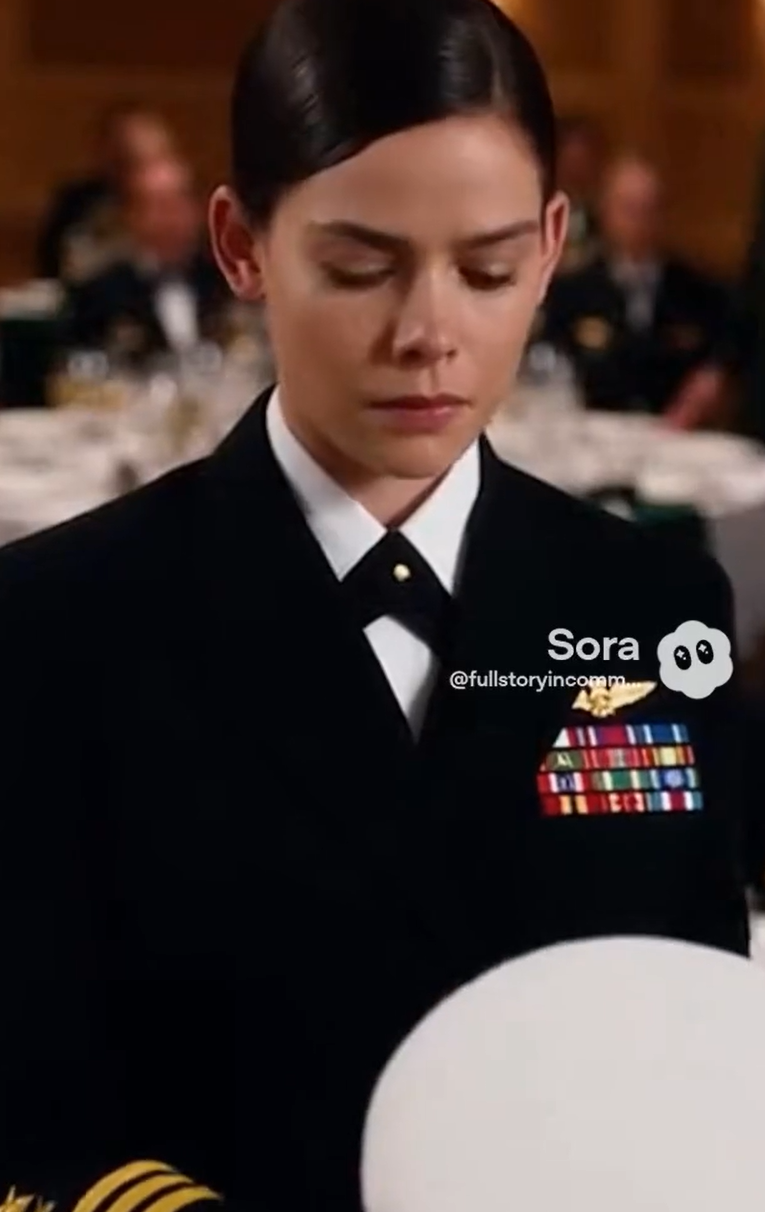
The Military Ball ballroom glittered with medals and polished brass, but all I could see was my father’s face turning crimson. His dress uniform, decorated with three decades of service, seemed to swell with rage as he looked at Marcus beside me.
Marcus wore a leather jacket over his dress shirt. His motorcycle boots, polished to a mirror shine, caught the chandelier light. What my father saw was a biker. What I saw was the man who’d saved my life.
“Dad, please – ” I started, but he cut me off with a gesture so sharp it silenced the surrounding tables.
“Colonel Davidson’s daughter,” he said, his voice carrying across the ballroom like a command. “Throwing away her family name for some drifter.”
Marcus’s jaw tightened. I felt his hand squeeze mine – not angry, just steady. He’d warned me this might happen. His father had been a military man too, before the accident. Before Marcus had to drop out of the Naval Academy to care for him.
“Sir,” Marcus said quietly, “I respect your service. I respect – “
“I don’t give a damn what you respect,” my father snapped. He stood, his chair scraping loud against the marble floor. Heads turned. Phones came out. “Get this trash out of my sight. This event is for heroes, not for filthy bikers.”
The words hung in the sudden silence like a slap. My mother covered her mouth. My sister stared at her plate. Around us, officers and their families watched, uncertain whether to look away or lean in.
My face burned. My hands shook. This was the moment I’d dreaded since Marcus asked me to come. This was exactly why I’d almost said no.
Then the ballroom doors opened.
Commander Patricia Chen, the event’s commanding officer, walked straight toward our table. Her uniform was immaculate, her face unreadable. Behind her came two younger officers I didn’t recognize, both moving with urgent purpose.
My father straightened, snapping into parade rest. “Commander Chen. I apologize for the disturbance—”
“Not to me,” she said coolly. She turned to Marcus. “Marcus Whitmore?”
His hand released mine. “Yes, ma’am.”
“I need to speak with you. Privately. Now.”
The room was silent enough to hear the ice in champagne glasses settling. My father’s face had gone pale. “What is this about, Commander?”
Commander Chen didn’t look at him. Her eyes stayed on Marcus as she waited for him to stand.
As he moved toward her, she finally glanced at my father. The look she gave him lasted maybe two seconds, but it contained the weight of every command decision she’d ever made, every soldier she’d led.
“Your daughter showed remarkable courage tonight, Colonel,” she said quietly. “It’s a trait I value.”
Then she walked Marcus toward the side exit, the two officers flanking them both.
My father sat down slowly. His hands trembled as he reached for his drink. My mother stared at me with questions in her eyes I couldn’t answer.
Five minutes later, a general—an actual three-star general—appeared in the ballroom doorway, scanning the crowd. When his eyes found my father, he walked directly to our table.
“Colonel Davidson,” the general said. “We need to talk about the scholarship fund you’re administering.”
My father’s face went white.
The general glanced at me, then back at my father. “Apparently, someone nominated Marcus Whitmore for the Naval Community Heroes Award three months ago. Did some remarkable work coordinating disaster relief in the Midwest on his own time. Motorcycle club and all.”
My father couldn’t speak.
“Funny thing,” the general continued, “the nomination was anonymous. But the work was documented. Verified. The boy’s been doing more for his community in two years than most officers do in a career.”
The general paused. Let that land.
“He’ll be receiving the award tonight. I expect you’ll want to apologize to him before the ceremony.”
Then he was gone, leaving my father sitting in the wreckage of his certainty.
I watched my father’s hands shake as he reached for his drink. Watched the officers around us lean their heads together. Watched my mother’s expression shift from shock to something like understanding.
Marcus appeared in the doorway again, Commander Chen beside him, both of them looking directly at our table.
When our eyes met across the ballroom, he smiled.
That smile broke the spell. It was the same one he’d given me the day we met, when my car had spun out on a patch of ice and he’d been the first one to pull over. It was a smile that said everything was going to be okay.
I stood up. My chair made a soft scrape, a pale echo of the noise my father’s had made.
“Where are you going?” my father asked, his voice a low rasp.
I didn’t answer him. I couldn’t. I just looked at my mother. Her eyes, which had been filled with confusion, now held a glint of something I hadn’t seen in years. Pride. She gave me the slightest of nods.
That was all the permission I needed.
I walked toward Marcus. The journey across the marble floor felt like a mile. Every eye in the room was on me, a thousand tiny spotlights. The whispers followed me, a wave of sound that I refused to let pull me under.
I saw the wives of my father’s colleagues, their faces a mixture of pity and morbid curiosity. I saw junior officers, their expressions carefully neutral. This was a lesson for them, too.
When I reached Marcus, I didn’t say a word. I just threw my arms around him.
He held me tight. I could feel the steady beat of his heart against my ear. “You okay?” he murmured, his voice for me alone.
“Are you?” I asked, pulling back to look at him.
He shrugged, that easy way he had of dismissing things that would cripple anyone else. “Been called worse. Just never at a party this fancy.”
Commander Chen stood a few feet away, a ghost of a smile on her face. “Miss Davidson,” she said, her voice softer now. “I think you chose well.”
I felt a blush creep up my neck. “Thank you, ma’am.”
“The ceremony will begin in fifteen minutes,” she said, before turning and striding away, her job here seemingly done.
I took Marcus’s hand. “What did they say to you?”
“They apologized,” he said simply. “For your father’s behavior. And then they told me about the award. I thought it was a prank at first.”
“It’s not a prank, Marcus. It’s the truth.”
“Yeah,” he said, looking over my shoulder at my family’s table. “The truth has a funny way of coming out.”
My father was still sitting there, a statue carved from humiliation. The General was back, standing beside him now, speaking in a low, intense voice that didn’t carry across the room. My father wasn’t looking at him. He was just staring into his glass of water as if it held all the answers he’d gotten wrong.
“What about the scholarship fund?” I asked. “What did he mean by that?”
Marcus’s expression tightened for the first time. “I don’t know all the details. But the General mentioned that my nomination packet had been… misplaced. Buried at the bottom of a pile. It was only found when the anonymous nominator followed up directly with the General’s office last week.”
My blood ran cold. Misplaced. I knew my father. Things were never ‘misplaced’ in his world. They were deliberately put where he wanted them to be.
“He found it,” I whispered. “He found your name and he buried it because of who you are.”
Marcus squeezed my hand. “Let’s not jump to conclusions.”
But I already had. I had jumped, and I had landed on a cold, hard certainty. This wasn’t just about my father’s prejudice. It was about his abuse of power.
The lights in the ballroom dimmed, and a master of ceremonies stepped up to the podium. It was time.
They seated Marcus at the head table, next to the General. They offered me a seat beside him, but I shook my head and walked back to my family. I sat down in my original chair, the space next to me now empty.
The air at our table was thick and suffocating. My sister wouldn’t look at me. My mother kept patting my hand, her touch both a comfort and a plea for calm.
My father was a hollowed-out version of the man who had stood up an hour ago. His uniform seemed too big for him now. His eyes were glassy.
“They think I’m a cheat,” he said to no one in particular. “After thirty years.”
“Did you cheat, Robert?” my mother asked, her voice quiet but firm. It was the first time she’d spoken directly to him since it all began.
My father flinched. He looked at her, truly looked at her, and the anger in his face crumbled into something that looked like fear. “It wasn’t a worthy application. A bunch of bikers handing out blankets. That’s not what the fund is for. It’s for future leaders. For men of character.”
“And Marcus isn’t a man of character?” I asked, my own voice trembling with a rage I didn’t know I had. “The man who pulled my unconscious body from a wrecked car while others just drove by? The man who gave up his own dream of being a naval officer to nurse his dying father for three years?”
Tears were streaming down my face now. “The man whose ‘biker friends’ rebuilt the entire roof of the town’s community center after the storm last spring, for free, because they knew the town’s budget was shot?”
My father had no answer. He just stared at me, his mouth slightly open.
My mother took a deep, shaky breath. “I was the one who nominated him, Robert.”
The world stopped.
My father turned his head slowly to face her. My sister gasped. I just stared, trying to process what she’d said.
“You what?” my father breathed.
“I nominated him,” she repeated, her voice gaining strength. “I saw the story about the community center roof in the local paper. They didn’t mention him by name, just ‘a group of local motorcyclists.’ But I saw his bike in the picture. I knew it was him.”
She continued, her words clear and precise, like a weapon she had been sharpening for years. “I put the packet together myself. I got testimonials from the mayor, from the head of the relief agency he worked with after the floods. I sent it in anonymously because I knew. I knew you would do exactly what you did.”
She looked at him, not with anger, but with a profound and bottomless sorrow. “I just never thought you’d get caught.”
My father sagged in his chair as if his strings had been cut. The Colonel was gone. In his place was just a man, a flawed and broken man, stripped bare in front of his family.
At the podium, they were announcing the Naval Community Heroes Award. They spoke of selfless service, of leadership outside the conventional chain of command. They spoke of character.
Then they called Marcus Whitmore’s name.
The room erupted in applause. It was genuine, thunderous. Everyone here had witnessed the drama, and now they were a part of the resolution. They were applauding the man, not the uniform.
Marcus walked to the stage. He didn’t look like a biker in a borrowed jacket anymore. He looked like a leader.
He took the award, a heavy glass sculpture, and stepped to the microphone. The room fell silent.
“Thank you,” he began, his voice steady. “I’m… not used to this. My friends and I, we don’t do what we do for awards. We do it because the work needs doing. When a flood hits, the water doesn’t care if you’re a colonel or a mechanic. It just rises.”
He looked out at the crowd. “There’s a lot of talk about service. I learned about service from my father. He wore a uniform with pride. He taught me that service isn’t about what you wear, or what table you sit at. It’s about what you do when no one is looking.”
His eyes found mine in the crowd. “It’s about showing up. For your family. For your community. For a stranger stranded on the side of the road.”
He then looked toward our table. His gaze didn’t hold malice, only a kind of sad understanding as it rested on my father for a moment.
“I believe everyone has the capacity for heroism,” he said. “Sometimes, it just gets buried under other things. Pride. Fear. Sometimes, you just need someone to remind you what’s important.” He raised the award slightly. “Thank you for the reminder.”
He walked off the stage to another standing ovation.
We didn’t stay for the rest of the ball. We left as a family, a shattered, silent group. The ride home was the quietest I’ve ever experienced.
The next few weeks were a blur of hushed conversations and closed doors. My father was quietly relieved of his duty administering the fund. He wasn’t formally disciplined, but his career was over. The shame was a punishment far worse than any official reprimand. He put in his retirement papers a month later.
He and my mother started talking. Really talking. Their conversations weren’t loud, but they were long. They were unearthing thirty years of things left unsaid.
One Saturday afternoon, I found my father in the garage, staring at his old tool chest.
“I was wrong,” he said, without turning around. The words sounded rusty, like they hadn’t been used in a long time.
“I know, Dad,” I said softly.
He finally faced me. His eyes were red. “I dishonored my uniform. I dishonored your mother. I dishonored you.” He took a shaky breath. “And I dishonored a good man.”
It was the apology the General had demanded, but it wasn’t for public consumption. It was just for me. And it was enough.
A few months after that, Marcus’s disaster relief group got an anonymous donation. It was a large one, enough to buy a new mobile command vehicle and outfit it with communications gear.
The donation was traced back to a newly created trust, funded by the sale of a prized collection of military antiques. My father’s collection.
The next weekend, Marcus was organizing a volunteer day to sort a mountain of donated supplies for families hit by a recent tornado. I was there, taping up boxes, when a familiar car pulled into the warehouse parking lot.
My father got out. He wasn’t wearing a uniform or a suit. He was wearing old jeans and a work shirt. He looked uncertain, standing by his car, a man without a rank for the first time in his adult life.
Marcus saw him. He wiped his hands on a rag and walked over. I held my breath.
They stood there for a moment, not speaking.
Then, my father extended his hand. “I hear you might need some help with logistics,” he said, his voice quiet but clear. “I have some experience in that area.”
Marcus looked at his hand, then at my father’s face. He smiled that same, steady smile.
He shook my father’s hand. “We can always use a good man,” he said. “Welcome to the team.”
I watched them from the loading bay door, my father and the man he had once called trash, standing together. They were just two men, defined not by the clothes they wore or the tables they sat at, but by their choice to show up on a Saturday morning to do work that needed doing.
True honor, I realized, isn’t something that’s pinned to your chest. It’s a quiet, sturdy thing you build inside yourself, one right action at a time. It’s not about belonging to the right group, but about doing the right thing, especially when no one is watching.