
A Quiet Hurt in a Loud Room
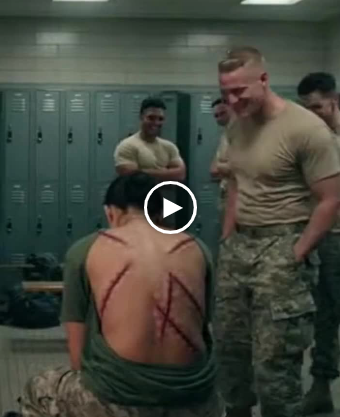
Emily eased herself onto the wooden bench, trying to make her hands be still. They would not listen. They shook in tiny ripples, like leaves in a small wind, and she stared at them because it was easier than staring at the faces around her. She could hear the laughter. Not the easy kind shared after a long day, but the sharp kind that looks for a target and finds one. She felt her throat tighten, felt the old heat rise to her cheeks, and yet she made no sound. She would not give them that. She kept her eyes down and tried to breathe.
Someone let a joke fly, something about her back, something about the line of scars that crossed her shoulder blades like a map no one asked to carry. There was a comment about a lawn mower, and the laughter got louder. Emily did what she had learned to do: she kept quiet. She wrapped her arms around herself and tried to make the moment pass.
Then the locker room door slammed open. The noise cut clean through the room and dropped everything into silence. Colonel Jackson stepped in, the commanding officer whose presence could settle even a crowded drill yard. The air changed. Shoes scuffed. Breaths held. The Colonel scanned the room, taking in each face, steady and slow.
The Door Swings Open
He looked at Emily first. He didn’t ask her a question. He didn’t tell her to speak. He only saw her, truly saw her, and then shifted his gaze to the men who had been laughing. When he spoke, it was not loud, but the room carried each word as if the floor itself wanted to hear.
“Do you even know who you’re mocking?” he asked, his voice low and controlled.
No one answered. A boot tapped once and then stopped. Even the fluorescent lights seemed to hum more quietly.
The Colonel took three steps forward, boots striking the tile with a crisp, even rhythm. He stopped in front of Staff Sergeant Mitchell—the one whose grin had been a little too wide, whose joke had started the chorus. The Colonel’s jaw was tight. The tendons in his neck stood out. His eyes never left Mitchell’s face.
“You think those scars are funny?” he asked, calm in a way that made the words feel heavy. “You think they’re a punchline?”
Mitchell opened his mouth and closed it again. He finally managed, “Sir, I—”
“Enough,” the Colonel said, sharp as a snapped salute. He turned his head slightly toward Emily without taking his eyes off Mitchell. “You need to hear something about Private Carter.”
The Story Behind the Scars
Emily had not moved from the bench. She sat still as a statue, except for her hands. Her face was pale, but there was a steadiness in her eyes when they lifted to meet the Colonel’s. Somewhere under the hurt, there was something else—something she carried that no one in that room could take away.
“She did not get those scars from a fight with an old boyfriend or a stumble on a trail,” Colonel Jackson said, his voice leveling out to something measured, something instructive. “She earned them pulling three soldiers out of a burning convoy in Kandahar.”
There was a small sound, a single inhale drawn across the room, as if the air itself had been holding back.
“She was with the 173rd on patrol,” he continued. “The Humvee hit an IED. The world turned into fire and shrapnel and shouting. Others ran to cover. Carter—she ran the other way. She ran into the fire.”
The room didn’t move. The Colonel let the words hang there for a beat, allowing them to land where they needed to land.
“The blast blew the door clean off,” he said, his voice quieter now, as if replaying it. “She tore her gloves off—bare hands—so she could get a grip on Corporal James, who was already burning. She dragged him out. Then she went back in and pulled Specialist Lopez into the dirt, rolled him until the flames went out. Then Sergeant Danner. He was trapped. She wedged her shoulder under a twisted axle and lifted until there was just enough room to haul him free.”
He paused long enough that the smallest tremor touched his voice. It was there and gone, like a bird that flits by a window and vanishes into the trees.
“She spent seven weeks in intensive care,” he said. “Skin grafts. Physical therapy. They told her a lot of things she might never do again—carry a pack, shoot a rifle, climb a wall. She took every one of those doubts and did not let a single one of them be the last word.”
He turned to face the room head-on. “She trained harder than any of you,” he said, and this time his voice rose not in anger, but in certainty. “She asked to come back to active duty. And now she stands here, among you, while you look at the marks of her courage and treat them like a joke. You will not do that again.”
A Different Kind of Silence
No one met his eyes. The room felt still, but something in it had shifted. A few glanced toward Emily, and this time the looks were not curious or cruel. They were seeing, maybe for the first time, the person they had been talking about as if she didn’t exist.
Emily sat as she had at the start, but the tears that lifted to the surface now were not from shame. They were something like relief. She had not asked for a defense. She had not asked for a story to be told. But it had been told anyway, and the truth had weight.
Colonel Jackson took a step back, his expression unreadable. “You will apologize,” he said evenly. “All of you. Now.”
Mitchell swallowed. “Sir, we didn’t—”
“Now,” the Colonel said, without waiting for anything more. Then he turned and left the room, the door closing softly behind him. The loudest part of his entrance had been the first sound; the quietest part of his exit left the heaviest echo.
Making Amends
For a long breath, no one moved. Then there was a shuffle. One by one, the men approached. Not grand speeches, not excuses. A murmur here, a nod there. “I’m sorry, Private,” Mitchell said, voice low, the bravado hollowed out of it. “We didn’t know.”
Emily stood slowly. Her voice, when it came, was not sharp. It was steady. “It doesn’t matter if you knew,” she said. “You do now.”
There was no reply to that. There didn’t need to be. She lifted her chin and walked out, not faster than usual, not slower. Just herself, carrying herself the way she had learned to.
Back on the Track
That afternoon brought physical training. The sun sat a little low in the sky, the track throwing long shadows in thin stripes. Emily was already there. Boots laced, stretches done, breath easy. She moved through her warm-ups the same as always, as if the morning had been any other morning. Inside, her heart still held the tremor of the locker room, but she had practice keeping her pace even.
When the others arrived, there was no whispering. No sideways snickers. They took their places beside her. Not a show, not a parade—just a quiet adjustment that meant everything. Mitchell jogged up after a moment. He kept his voice low.
“Mind if I pace with you?” he asked.
Emily looked at him, and a corner of her mouth lifted for the first time in days. “If you can keep up,” she said.
They started to run. The track turned beneath their feet, steady and familiar. No one shouldered her aside. No one questioned whether she belonged there. At the obstacle course, she moved with practiced confidence—over the wall, across the balance beam, hand over hand on the rope, landing with both feet and a grunt. She didn’t make it look easy; she made it look possible.
Her squad watched. Some clapped. Some called her name. The cheers were not loud, but they were warm, and for the first time that week, she heard approval where there had been doubt.
Across a Mess Hall Table
That night in the mess hall, the scrape and clatter of trays sounded like any other evening. Emily found a seat near the end of a table, content to eat and be quiet. A tray slid onto the table beside hers. She looked up and met eyes she recognized even though she had not seen them in a long time.
Sergeant Danner sat down with a careful motion, his leg still stiff from old injury. He nodded once before he spoke, as if greeting an old truth.
“I heard what happened,” he said softly. “Didn’t know you were back in rotation. I owe you my life.”
Emily’s fork stopped, held above her tray. She set it down before she answered. “You don’t owe me anything,” she said. “Pay it forward when you can.”
Danner looked at her a long moment and then nodded again. He did not move away. He stayed and ate with her, the quiet between them comfortable, like the hush that sometimes settles over a camp just before dawn.
Respect Becomes Routine
The next morning came and the locker room felt different. No smirks bounced off the tiled walls. Only the ordinary sounds of a unit beginning its day filled the space—zippers, laces, soft talk about assignments and weather and who had pulled early watch. The room had not grown kinder overnight by magic. People had simply remembered who they were supposed to be.
Mitchell lingered after most had gone. He shifted his weight and rubbed the back of his neck. It was not an easy posture for a man used to certainty.
“Hey,” he said, voice tentative. “I was out of line. Really out of line.”
Emily lifted an eyebrow. “You think?” she said, and let the faintest smile show that the sting had not robbed her of humor.
He gave a small, sheepish laugh. “I’m not great at this. I’ve never served with a woman before.”
She crossed her arms loosely. “You’ve served with soldiers, though. Right?”
Mitchell nodded once, then again, slower. “Yeah,” he said. “You’re right.”
He held out a hand. “Truce?”
Emily looked at it, weighing the moment. Then she reached out and took his hand in a firm shake. “Truce,” she said.
Miles to Go, Together
In the weeks that followed, the shift held. It was not dramatic. It was better than that. It was steady. Emily was not only tolerated, not only left alone—she was included. Someone waved her over during marksmanship drills. Someone else asked her thoughts on a team formation change. At week’s end, when a card game formed and chips clacked on a battered table, a chair opened beside the pile and a voice called, “You in?”
No one softened the work because she stood there. She did not want them to. They pushed each other and expected the same from her. She gave it back.
On a long field run one morning, the trail chewed into ankles and lungs. A young recruit, new and eager, misjudged a rut and twisted his ankle hard. The line moved on, breathing the steady music of exertion. Emily dropped back without being told. She set the recruit’s arm over her shoulders and took his weight as if he were another pack to carry. She paced him across two slow miles, not scolding, not comforting, simply sharing the load until the finish line came into view.
At the endpoint, the group gathered, drawing down breaths and sweat. Colonel Jackson stood by the timing board, eyes tracking faces as they arrived. When Emily and the recruit came in together, he gave one single nod.
“Good work, Carter,” he said, and there was nothing more to add.
Emily nodded back. “Part of the job, sir,” she replied, still catching her breath.
What Scars Can Mean
That night, lights glowed across the barracks in rectangles on the floor. Emily passed the mirror on her way to stow her gear and stopped without intending to. The reflection offered a version of herself she knew well and yet was always getting to know anew. She turned slightly, just enough to see the ridges and swirls along her back—skin that had once been smooth, now a topography of survival.
There had been a time when she had rushed to cover those marks, rushed to change clothes in the dark, rushed to keep her back turned to the wall. But looking now, the feeling was different. Not pride in the pain, not a longing for applause, but a sense of place. The scars were no longer a story of what had been taken. They had become a record of who she had chosen to be when it mattered, and who she chose to be still.
She ran her fingertips, light as breath, over the uneven lines. The touch was gentle, not to avoid pain, but to grant respect.
From the next room came a burst of laughter—ordinary, easy. Someone complained that the dealer had sticky fingers. Someone else claimed a miracle hand. The sounds were not sharp. They were welcoming, threaded with the simple comfort of people who work hard and sit down together when the whistle blows.
Emily let a smile find its way to her face. She turned from the mirror, stepped out of the dim hallway into the common room’s warmer light, and pulled up a chair. The circle opened without ceremony, the way it does for one of your own.
She was no longer the quiet figure on the bench, bearing a private storm. She was a soldier among soldiers, and even more than that, a person among people who had chosen to see her as she was—not as a rumor, not as a joke, but as a teammate who had earned her place.
Not Alone Anymore
There would be other hard days ahead. Every unit has them, every life does, too. People forget themselves and remember again. Respect requires practice the way endurance does, and everyone stumbles before they run. But the air in the barracks had changed, not because of a speech alone, but because the truth had been spoken and then lived, day after day, mile after mile, task after task.
Emily sat with her squad, a hand of cards fanned out where anyone could see, her back unhidden, her laugh unguarded. The path to this moment had wound through fire, hospital rooms, long nights, and a locker room gone quiet when a door flew open. It had led here, to a table where the past was honored and the present was shared.
Outside, the evening settled over the base in a soft veil. Inside, she felt something simple and strong settle in her chest. It was not triumph. It was not even relief. It was belonging.
And this time, as the voices rose and the game went on, she did not sit at the edge of the room. She stepped into the light.
She was not alone.



