
A quiet corner and a loud mistake
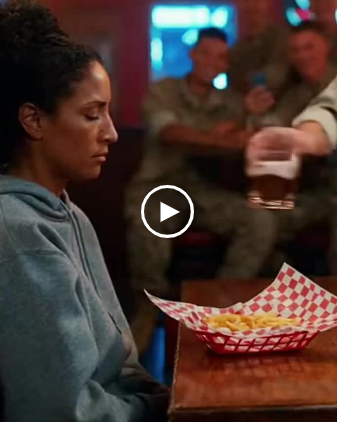
The night started simply. I chose the far corner of a small, no-frills bar not far from the base, the sort of place where the wood is worn smooth by stories and the jukebox plays the same five songs until closing. I pulled my gray hoodie tight and sat with a glass of water, content to be unnoticed. That was the plan. To be invisible. To watch and listen without taking up any space at all.
Then a cold splash cut through the music and chatter. A wave of beer spread across my table, soaking my sleeve and what had been a hot plate of fries. Someone laughed loudly and said, “Oops. Watch your step there, grandma.” The word hung in the air, not quite funny and not quite brave. I looked up slowly.
Four Marines in dusty uniforms stood at the end of my table, high on adrenaline and the kind of confidence that often comes with a Friday night. They were young, amped, and clearly celebrating something. One lifted his arms like he’d won a small parade and shouted, “We run this town tonight!”
The ringleader, a broad-shouldered kid I would later confirm as Tyler, flicked a peanut that bounced off my sleeve and rolled onto the wet tabletop. “Go home,” he said. “You’re killing the vibe.” His smile didn’t reach his eyes. It rarely does at that age when you mistake volume for power.
I didn’t answer. I dabbed up the beer with a napkin and kept my face still. I didn’t scold. I didn’t raise my voice. Once the table was dry enough to rest my hand, I signaled for the check, paid, and left without another look. As I pushed through the door into the cool night, I heard one of them mutter something about “the sad lady in the hoodie.” Laughter followed. Doors, like memories, don’t always shut quietly.
What they didn’t know was simple. I wasn’t a bystander. I wasn’t there to drink. I was there to observe, quietly and carefully, as part of the final, unannounced evaluation before an elite selection cycle. Sometimes the most important tests happen when the stopwatch is tucked away and no one thinks it counts.
The cold morning reckoning
At 0500 the next morning, the air sliced like glass. The battalion stood in formation, boots aligned, breath lifting in pale streams. Whispered guesses about the new Commanding Officer fizzled as the first light crept over the yard. I stepped out of the command tent and onto the frost-dusted gravel.
There was no hoodie now. I wore full dress uniform, the rank on my shoulders catching the dull morning light. Silence followed me down the line, the kind of silence that isn’t just quiet, but listening. I moved with purpose, eyes steady, reading the set of shoulders and the tension around eyes like you would read a map. A row of faces, some defiant, some hopeful—boys and men at the seam of who they had been and who they were trying to become.
I stopped in front of Tyler.
The shift in his face was instant. Blood drained, posture faltered. Whatever bravado he’d wrapped around himself the night before fell like a coat slipped from a hanger. I leaned in close enough that only he could hear and spoke the six words I knew would close one chapter and force open another.
Enjoy civilian life, Recruit First Class.
There was no need to raise my voice. Consequence is loud even when spoken softly. He trembled, searching the air for something that would undo what he’d done. But time only runs one way in this line of work, and respect is the only currency it accepts.
I pivoted sharply and continued down the line. No one blinked. Somewhere in the ranks, a young heart thumped faster. Somewhere else, a jaw set firm. I reached the end, turned, and faced them all.
“I don’t care where you’re from or how many pull-ups you can do,” I said evenly. “If you don’t carry discipline in your blood and respect in your bones, you will not wear this uniform in combat beside me. Understood?”
The reply rose as one: “YES, MA’AM!” It hit the concrete walls and came back a fraction tighter, as if the yard itself approved.
But a single warning is not a lesson. Lessons take time to settle in. They take quiet, too.
“Some of you believe what you do off-duty doesn’t matter,” I continued, letting my gaze settle, one by one, on the other three from the bar. “You think the person in jeans and a T-shirt is different from the person in uniform. That illusion ends today. Character is what you do when no one you recognize is watching.”
One of them—Jackson—flinched almost imperceptibly. The others held still, but their eyes revealed what their posture hid. Guilt. Shame. Fear. All useful, if you know how to work with them. Fear can teach. Shame can be turned into accountability. Guilt can be sanded into responsibility.
“Dismissed.”
Boots broke formation and moved toward the barracks, fast and crisp. Tyler didn’t move at all. He stood there like a statue someone forgot to bring in from the cold. I gave the Master Sergeant a small nod. He stepped forward and placed a steady hand on Tyler’s shoulder. There was no spectacle in the moment. No speeches. Just cause and effect.
Rumors, and what matters more
By 0700, the story ran faster than any radio transmission. You didn’t need to be inside a room to hear the words: The Colonel was the woman from the bar. The woman in the hoodie. The so-called “lonely woman.” Some said I had outplayed them. Others used words like legend. I didn’t want either label. I wanted something quieter and more stubborn. I wanted change.
Change isn’t fireworks. It’s the steady repair of a habit. It’s the way a hand goes from shoving to helping. It’s the pause before a joke at someone else’s expense, followed by the choice not to tell it. You don’t clap for change. You notice it later and realize the room feels different, and you breathe a little easier.
An honest knock at the door
In the early afternoon, while I reviewed schedules and training rotation, there was a soft knock. I called for the person to enter. Jackson stepped in, took off his cover, and stood just inside the doorway like there was a line he wasn’t sure he was allowed to cross.
“Permission to speak freely, ma’am?”
I motioned to the chair across from my desk. He sat on the edge of it, as if sitting fully might be too comfortable given the day’s events. His eyes flicked to the ribbons on my chest and then back to the floor. His voice was steady, but the humility in it was new, like a uniform just picked up from the tailor.
“What we did at the bar wasn’t right,” he said. “I knew it wasn’t right. I said nothing. That makes me guilty, too.”
I let the words rest on the desk between us. He didn’t fill the silence with excuses. He didn’t look for an easier version of the truth. He simply owned what he had done and what he had failed to do. Ownership matters. It is, more often than not, the doorway to growth.
“You are correct,” I said. “It does make you guilty.”
He swallowed, but he didn’t look away. That, at least, was a sign of backbone. I asked him the question that matters to anyone hoping to lead, on a battlefield or in a break room, at home or on a patrol.
“Do you believe you can lead with that kind of silence?”
“No, ma’am.”
“Tell me why I shouldn’t send you home with Tyler.”
He took a breath and chose his words with care. “Because I’ve learned something today. About who I was, and who I want to be. I thought this uniform would make me someone. I understand now that someone has to show up first.”
Nothing about his tone was polished. It didn’t sound like a speech. It sounded honest. I prefer honest to shiny every time.
“Very well,” I said. “You’ll report to Gunnery Sergeant Maddox for two weeks of disciplinary detail. You will research and write a report on the Code of Conduct and present it to your fellow recruits at Friday’s briefing. Understood?”
The assignment surprised him, but not because it was harsh. It surprised him because it wasn’t dismissal. A narrow road had appeared where he assumed there was only a drop-off.
“Yes, ma’am.”
“You’re dismissed, Private.”
He stood, saluted, and left quietly. When the door closed, I allowed myself one long breath. Accountability handed down. A seed planted. Now we would see if it took root.
One rope, one choice
The next morning just past dawn, the obstacle course was slick with dew. I stood beside the Drill Instructor, clipboard in hand, watching Reece—another from the bar—start the rope wall. He attacked it at first, then hesitated, and his grip began to slip. It wasn’t lack of strength on his face. It was the fog that comes when your mind is louder than your muscles.
Halfway up, he stopped. He looked down. Our eyes met. Nothing was said. He took one more breath and kept climbing.
At the top, where the view is always better and the wind is always colder, he paused just long enough to collect himself. I gave him a small nod. That was all. He descended the far side like someone who had decided the hill would not have him. He landed, stumbled, found his footing, and accelerated, chest open, eyes forward.
Beside me, the Drill Instructor spoke under his breath. “That kid’s going to make it.”
I marked a check on the page. Sometimes you don’t need a speech. You need a choice made at the top of a rope and the proof that you can keep moving afterward.
The week tightens
By Thursday, the air around the battalion felt different. Not lighter. Sharper. Eyes were a little more alert. Feet found their marks faster. There was a quiet curiosity in the rank and file, as though everyone was waiting for the next lesson. Good. The unknown, handled well, creates vigilance. Vigilance becomes survival.
Friday’s mirror
Friday’s briefing hall filled early. Seats taken, backs straight, faces turned toward the front. I sat in the first row, hands folded loosely, giving away nothing. Jackson stood at the podium, paper in hand. His palms shone with a nervous sheen that anyone who has ever stood up to say something true would recognize.
He cleared his throat and began. “The Code of Conduct isn’t just rules. It’s a mirror. Sometimes, when you look into that mirror, you won’t like what you see. I didn’t.”
He spoke plainly about honor, accountability, and the duty to speak when silence would be easier. He didn’t make excuses. He didn’t shift blame onto Tyler, though he could have. He took responsibility for his silence and for the harm it allowed. He kept his voice steady. When he finished, there was no applause. Just quiet. Not the awkward kind that asks, “What now?” but the knowing kind that says, “Something here just changed.”
I rose. “Private Jackson.”
He turned toward me, shoulders squaring by instinct.
“Your words today may save lives,” I said. “Not today. Not tomorrow. But on some future day, when someone who heard you chooses to speak up because you showed them how.”
He nodded once, not in pride, but in acceptance. Sometimes the right words lay a steady foundation you barely notice while you’re standing on it.
Reece stepped forward from the rows, quietly. “Ma’am,” he said, “I owe you an apology.”
“For what?” I asked.
“For underestimating you. For thinking respect is won by shouting the loudest or hitting the hardest. I was wrong.”
I looked at both of them—two young men who, a few nights earlier, had wandered into a bar convinced the world would bend to their voices. Now, they understood a fraction more about what it really means to stand for something.
“You have a long road ahead,” I said, keeping my voice steady. “But you’re on it. Make every step count.”
They nodded, not in unison as a performance, but together as a beginning.
Back to the bar, on purpose
That evening, I walked back into the same bar. This time, I wore my uniform. Not as a taunt. Not as theater. I wore it because I had done my job and because I wanted a quiet drink at a table that had, a few nights before, hosted a different kind of lesson.
The bartender looked up, paused, and then smiled. He poured without asking and slid the glass over, the amber catching the light. “They’re not coming back here,” he said with a small chuckle.
“Good,” I answered. “They have better places to be.”
I took a sip. Good whiskey has a way of burning just enough to remind you you’re awake. Behind me, two older Marines lifted their glasses in a small, respectful toast. “To the Colonel,” one said softly.
I didn’t turn around. I returned the nod to the empty space ahead of me and let the moment pass. It wasn’t about applause. It never is. It’s about the work. It’s about the simple promise that tomorrow will be a little better because today, someone drew a clear line and held it.
What stays and what changes
I have served long enough to know that people rarely change because you shouted at them. They change because something strikes the steel of their character in the right place and at the right time. That night in the bar, the spark was small. The next morning on the gravel, consequence met behavior and made the connection for them. In the days that followed, the spark found air—an apology offered, a rope climbed, a report delivered with the kind of honesty that humbles you before it strengthens you.
Some might say Tyler’s dismissal was the whole story. It wasn’t. It was the boundary. Boundaries are needed. They protect what is worth protecting. But the heart of the story is what happened after. Young men saw that the person they are when they believe no one is watching is the same person who stands on the line when it matters most. Once you learn that, the work only deepens. Your voice lowers. Your vision clears. You begin to understand that respect isn’t demanded; it is demonstrated, over and over, in a hundred small choices.
We talked a lot that week about discipline and respect. Simple words. Hard practice. They are not about being perfect. They are about being accountable. Accountability is not a hammer. It is a compass. It points you back when you drift. It gets you to the next ridge. It keeps you from mistaking noise for strength. In this job, and in many others, that can be the difference between chaos and order, between loss and return.
When I think back to that first moment—the beer running across the table, the peanut skipping like a stone—it would be easy to focus on the disrespect. But that night was also a doorway. It opened onto a cold morning where a uniform spoke louder than any raised voice and where six simple words did what long speeches rarely do: they told the truth, cleanly and without drama.
Enjoy civilian life, Recruit First Class.
I didn’t take pleasure in saying it. I did take responsibility. Leadership requires that. So does life, whether you’re wearing boots on a parade deck, lacing up for a long walk, or showing up for a family that needs you steady. The principle holds: who you are when no one expects much from you is who you really are. The rest is just costume.
That evening, I finished my drink and stepped back into the night. The same street. The same neon hum. Different air. Back on base, a battalion settled in, a little quieter, a little stronger. Somewhere in the barracks, a young recruit wrote the last lines of his report and felt, maybe for the first time, the satisfying weight of choosing the harder right instead of the easier wrong. Somewhere else, another recruit set his alarm and knew he would beat it to the punch because he wanted to. That is how it begins. Not with fanfare. With a better choice, then another, and then another after that.
And that is enough. For a bar on a Wednesday night. For a training yard on a freezing morning. For the kind of change that lasts.



