A Morning in Court I Will Always Remember
“Love doesn’t pay the electric bill, Your Honor.” The words came out like a sneer, smooth and sharp, as my ex-husband’s attorney waved my worn bank statements like a prize. He let them flutter for effect, as if each page were proof that I was failing at life, not just juggling bills.
I felt my hands clamp onto the edge of the table. My knuckles blanched, and I concentrated on breathing through the ache in my chest. Across the aisle, my ex, Todd, sat in a crisp charcoal suit. He had the cool look of a man who expected to win, as if this were a business deal and not a decision about our seven-year-old son, Noah.
I worked two part-time jobs to keep a roof overhead and something decent on our plates. Todd earned six figures and had filed for full custody not because he wanted more time with our son, but because I had finally found the courage to leave. His attorney spent twenty long minutes telling a neat little story about me: a desperate, broke woman who couldn’t be trusted, who bought generic cereal and had a maxed-out credit card.
The courtroom felt airless, the silence heavy enough to bend my spine. The judge’s expression softened with what looked like pity, and every bit of warmth drained from my body. I knew that look. It was the kind of gentle stare people offer just before they turn away.
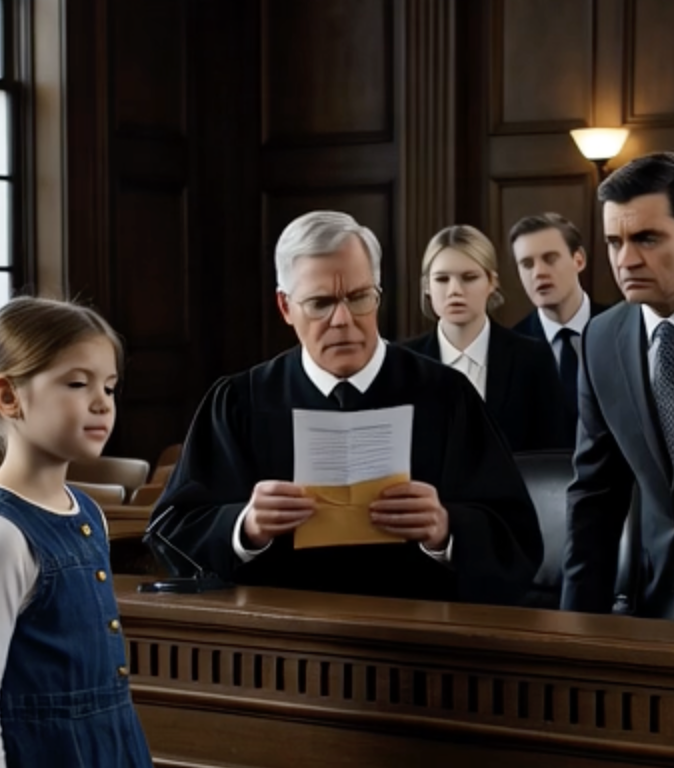
“If there is nothing else…” the judge said softly, reaching for his gavel.
“Wait!” The word rang out in a young voice, high and sure.
The Small Voice That Stopped the Room
Noah stepped out from the front row like he’d been waiting for that moment all morning. Before I could catch his hand, he moved past Todd’s attorney and stopped in front of the bench. From his backpack, he pulled a crumpled yellow envelope and set it down carefully in front of the judge, as if it were something fragile and important.
“He told me to throw it away,” Noah whispered, pointing straight at his father. “But I kept it.”
Todd’s easy smile vanished. He sprang forward a half-step before the bailiff blocked him, firm and unmovable. The room went so still you could hear the scratch of the judge’s letter opener slicing the top of the envelope.
The judge slid out the contents, and his face changed in an instant. The color drained; his jaw set. He didn’t speak for several seconds. The quiet stretched, and in that silence I heard my own heart hammering.
A Crayon Picture with a Grown-Up Message
When the judge finally held up what Noah had saved, I blinked in confusion. It was a drawing. The waxy lines and bright colors of fresh crayons made up three stick figures.
On the left stood a tall figure with brown hair in a suit, labeled “DADDY.” Next to him, another man in a suit was labeled “MR. PETERSON,” the name of Todd’s attorney. Both were grinning, their smiles wide and jagged. In each of their hands, Noah had drawn bags marked with big dollar signs.
On the right, a smaller figure stood alone, blonde hair sketched in soft strokes and blue tears falling down her face. She was labeled “MOMMY.” Hovering over the first figure was a speech bubble, carefully colored in, each letter pressed into the paper with the earnest force of a child’s hand.
Inside the bubble, Noah had written: “WE WILL WIN THE GAME AND MOMMY WILL BE ALONE.”
A murmur swept through the courtroom like wind through leaves. Mr. Peterson looked as if someone had pulled the floor out from under him. Todd’s face twisted—anger, then panic—like he could not decide which feeling to wear first.
The Second Page That Changed Everything
The judge’s gaze shifted back to the envelope. He set the drawing down with care, as if it were precious, and unfolded a single sheet of paper tucked behind it. His features hardened further as he read, and when he lifted his eyes, the disappointment there was colder than any anger.
“Mr. Peterson,” the judge said, his voice low but clear, “perhaps you can explain this.” He turned the page so the courtroom could see, though we already understood. It was a printout of an email. Even from where I sat, I recognized Todd’s name in the ‘From’ line.
The judge read out loud, his words clipped and ringing around the room. “Here’s the final draft of the financial affidavit for the court. I’ve moved the offshore funds as we discussed, so they won’t show up on any statements. The numbers I’ve provided should be enough to paint her as completely incompetent. Make sure to emphasize the part about her maxed-out credit card. That should be the nail in the coffin.”
Silence followed, heavy as thunder. You could feel the shock break over everyone at once, like a wave landing on shore.
“The date,” the judge continued, his eyes level and unwavering as he looked at Todd, “is two days ago. It was sent from your work account, Mr. Davies, to Mr. Peterson.”
My mind tried to catch up. Offshore funds. Drafted lies. A plan to make me look weak and irresponsible. This was not a man trying to be a better father. It was a calculated attempt to break me in front of the law.
“Your Honor!” Todd burst out, the polish gone from his voice. “This is a setup. It’s not real. She must have coached him, or—”
The judge raised a hand, then looked at Noah, who had drifted to stand at my side, his small fingers wrapped in the fabric of my sleeve.
“Young man,” the judge said, gentle now, “how did you get this?”
Noah stared straight ahead, brave and steady. “Daddy printed it when he was cleaning his office. He put it with my drawing and said to throw it away. But I heard him on the phone with Mr. Peterson. They were laughing. They said it was a game.” He took a breath. “It made Mommy cry. Games aren’t supposed to make people cry.”
The Judge’s Verdict
The judge exhaled once, long and slow. When he spoke again, his voice was iron. “Mr. Davies, attempting to mislead this court, hiding money, and dragging your child into your deception are among the most troubling things I have witnessed in this role.”
He turned to the attorney. “And you, Mr. Peterson. As an officer of the court, your behavior is inexcusable. Your choices reflect a serious breach of ethics and basic decency. I will be referring this matter to the state bar association immediately. You would be wise to seek counsel of your own.”
Mr. Peterson sagged into his chair, his color gone. Todd stared at the email as if it might set itself on fire and disappear.
The judge looked back at me, and for the first time that day, I felt seen. Not pitied. Seen. “Ma’am,” he said, his tone steady and kind, “it is plain to me who the stable, loving, reliable parent is.”
He did not pause. “Mr. Davies’ petition for custody is denied. His current visitation is revoked, pending a full psychological evaluation. Full legal and physical custody is awarded to the mother. This court is adjourned.”
The gavel fell with a sharp crack, and my legs went weak. Then relief came in a warm rush, filling my lungs and bringing me back into my own body. I knelt and hugged Noah, pressing my face into his hair, grateful beyond words for his courage and his clear, honest heart.
Out of the Courthouse, Into the Light
We stepped into the hallway holding hands. Todd moved toward us, anger and panic fighting for space on his face, but the bailiff cut him off with a firm arm and said nothing. I didn’t look back. I just kept walking forward, my son’s palm tucked into mine, both of us lighter than we had been in months.
The days that followed were hazy around the edges, the way mornings are when you first wake. I had lived so long braced for the next blow that it took time to recognize what had changed. The fear softened. Laughter crept back in. Nights were quiet again.
Doing the Right Thing, One Step at a Time
About a week after the hearing, the state bar association called. The woman on the line spoke gently, as if she understood that just recounting the facts would be like walking back into the courtroom. She asked me to come in and give a formal statement about Mr. Peterson and about what I knew of Todd’s actions.
I went. I sat in a plain, tidy office and told the story the way it had happened. I described the years of financial control, the constant belittling, and the way my ex-husband had used our son’s innocence as if it were just another tool in his toolbox. Saying it out loud did not break me. It steadied me. I realized that the shame had never belonged to me in the first place.
I was not a failure because I had struggled to pay bills. I was a mother who kept going. There is a difference, and it matters.
Consequences Arrive, Quiet and Certain
In the months that followed, autumn came and the trees turned from green to gold. News filtered in bit by bit. Mr. Peterson lost his license to practice law. It turned out that what he had done in my case wasn’t new. Investigators uncovered a pattern: a list of wealthy, angry clients and the same mean-spirited strategy again and again—hide the money, smear the other parent, win at any cost.
Todd’s reckoning arrived too. The email about moving funds was not just a courtroom problem; it was a tax problem. The IRS began an audit, and before long I learned he owed back taxes and penalties. The psychological evaluation the judge ordered told a story I already knew in my bones: deep, stubborn narcissism. His visits with Noah were restricted to supervised, therapeutic sessions. He had set out to take everything, and in the end, he lost more than he ever imagined.
An Envelope in the Mailbox
One afternoon, a letter arrived from a law firm I didn’t recognize. My heartbeat picked up the way it always did when anything official came in the mail. I stood at the kitchen counter and opened it with careful fingers.
The letter was from a woman named Clara. Her husband had been represented by Mr. Peterson years earlier. She wrote that she had seen a write-up of my case in a small legal journal. The article mentioned the child’s drawing and the email—the so-called playbook that had been used to turn the truth on its head.
Clara said her story was painfully similar to mine. She had been a stay-at-home mother, and in her divorce, the same tactics had been used to paint her as unfit and to strip away her security and her children’s stability. She was not the only one. A group of women had come together with their own evidence. My testimony and Noah’s saved envelope were the missing pieces that allowed them to file a class-action lawsuit against Mr. Peterson and his old firm.
They won. In the settlement, the group had set aside a portion for us. “For the woman whose child helped shine the light,” she wrote. I unfolded the check tucked behind the letter and had to sit down, my legs suddenly unsteady.
It was not life-changing money in the storybook sense, but it was enough. It was enough to pay the debts that had followed me like shadows. It was enough to move us to a small two-bedroom in a neighborhood with a pocket park and a good school. It was enough to make room for new air in our lungs.
Pepperoni, Cardboard Boxes, and a New Beginning
That night, we didn’t go out anywhere fancy. We ordered a large pizza with extra pepperoni and ate it on the living room floor among open boxes and folded blankets. It felt exactly right.
“You know, buddy,” I said, brushing a dot of sauce from Noah’s cheek, “you are my hero.”
He looked at me with serious eyes and spoke with the plain honesty that makes adults quiet. “I just didn’t want you to be alone, Mommy.”
Tears rose, but they were different this time, warm with gratitude. I remembered the lawyer’s taunt in court, the line he had rolled out as if it were wisdom. He was right in one small way. Love does not pay the electric bill all by itself.
But love is why we keep the lights on. It is the steady hand that signs the next check, the patient voice that reads one more bedtime story while you’re tired from work, the courage of a child who tells the truth even when adults are playing cruel games. Love may not be currency, but it is power—the kind that makes people braver than they thought they could be.
The Truth a Child Can Carry
I have learned that money moves quickly, and appearances can be bought. Suits can impress a judge for a moment, and lies can flood a room like smoke. But they do not hold. The truth has a way of settling in, quiet and certain. And when that truth comes from the clear heart of a child, it cuts through everything.
Noah’s drawing looked simple—three stick figures and a few bright colors. But it said the thing adults sometimes refuse to say: this isn’t a game, and a family is not a prize to be won. That single page was stronger than all the clever words and planned performances. It carried more weight than bank statements and sneers.
I think often about the judge’s face as he read. He looked not just angry, but disappointed. The kind of disappointment that says, “We can be better than this.” In that courtroom, with its pale wood and its hush, a child’s courage made us all stand a little straighter.
What We Chose to Keep
These days, our life is not grand, but it is good. Mornings start with oatmeal and a few minutes by the window watching the light move across the floor. Evenings end with library books and a puzzle on the coffee table. There are still bills, of course, and busy weeks, and moments when I feel stretched thin. But there is also peace. There is laughter. There is the ordinary comfort of knowing that home is a safe place again.
I think of all the things we almost lost, and then I think of what we kept. We kept our time together. We kept our sense of right and wrong. We kept a space where a small boy can draw pictures with bright crayons and know he is heard.
We have found a kind of wealth that doesn’t live in a bank ledger. It is in the calm of our new rooms, the echo of Noah’s laugh in the hallway, and the deep relief that comes from looking fear in the face and walking past it. We came through something hard, and we came through together, and that will always be enough.
Closing the Door on the Old Story
Sometimes I think back to the moment the judge lifted the gavel, to the way the sound cracked in the room and then faded into silence. It felt like an ending, but it was also a beginning. Not the kind you shout about, but the quiet kind, where you pack a box, label it “kitchen,” and decide that tomorrow you’ll make pancakes in a new place.
When I talk about those days now, I choose simple words. A lawyer mocked me, and a judge almost believed him. A child told the truth, and the truth changed everything. The men who played games with our lives faced the consequences, not because I had power or money, but because right still matters and because decent people still do their jobs.
As for me, I learned to stop mistaking struggle for failure. I learned that dignity doesn’t come from the size of a paycheck. It comes from showing up, from telling the truth, and from loving your child more than you fear a courtroom.
There will always be people who think life is a scoreboard and other people are pieces to move around. There will also be children who draw with crayons and mothers who hold their ground. In the long run, I believe the second group wins. Not because the world is easy, but because truth lasts. Because kindness echoes. Because family, however small, is stronger than a lie whispered into a phone and printed on a page.
Our story did not end with a flourish. It ended with a deep breath, a set of new keys, and a pizza on the floor between two people who love each other more than any game. That is the kind of victory you carry, quiet and steady, for the rest of your life.