
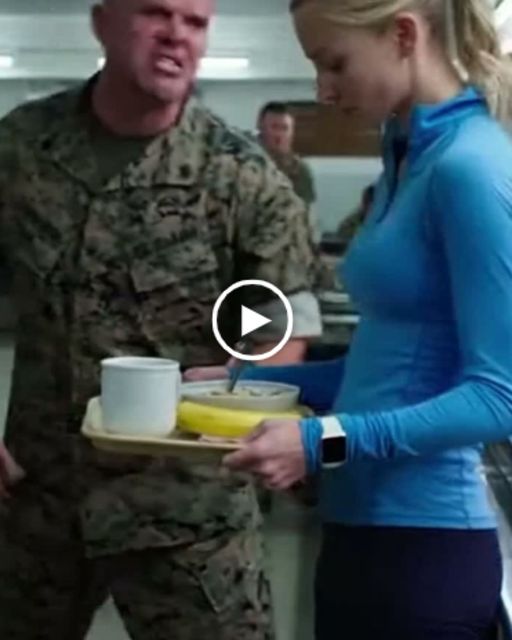
A Tense Morning in the Chow Hall
The room was noisy in the easy way a base chow hall gets during breakfast, full of clinking utensils and the quiet rhythm of early conversations. I had just taken a sip of coffee when a voice cracked through the air like a snapped branch. Conversations froze. Heads turned. Even the line ahead of the serving station went still.
Step out of line, sweetheart. This chow halls for Marinesnot girls playing soldier.

What came next made my stomach drop. The sergeant who had barked the insult leaned in and shoved her. It wasnt playful. It wasnt a misunderstanding. It was a hard, deliberate push meant to move her and make a point.
Her tray tilted. Coffee sloshed to the rim. A spoon jittered and clattered onto the plastic, loud enough to turn a few more heads. Somehow, she caught the rail with one hand and steadied herself. She didnt yell. She didnt flinch again. She straightened slowly, drew a long breath, and turned to face him with a calm that didnt match the moment.
She wore a faded blue running top, her hair pulled into a messy ponytail. If you didnt know better, you might have assumed she was a civilian out of place, someones spouse who wandered into the wrong line. That was clearly what he had decided she was. Two younger Marines just behind him smirked like they were watching a show, already expecting her to back away in embarrassment.
This place is for Marines, he said louder, making sure everyone could hear. Not for dependents who think they can cut the line just because they married into a uniform. A couple of uneasy chuckles bubbled up from nearby tables, the kind of laughter that isnt really laughter at all.
She met his eyes and held them. After a beat, she said, very simply, Im here to eat.
That should have been enough. It wasnt. The sergeants face colored a deep, angry red. He stepped in too close and reached for her arm. I said move, little lady. I felt my own chair scrape backward as I started to standand thats when the double doors swung open.
When the Colonel Stepped In
Base Commander Colonel Hayes walked in with the kind of presence that tightens a room. You could almost feel the temperature change. The sergeant snapped to attention, his expression flipping into something smug, as if he had just been handed a prize.
Just handling a trespassing dependent, sir! he announced. She refused to leave the line!
The Colonel did not look at him. He didnt speak to him. He strode right past the sergeant and stopped in front of the woman in the running top. His face, usually steady as stone, lost a little color as he drew himself to full height.
In the silence, he gave a salute so crisp you could have heard the seams of his sleeve creak. And then he greeted her with a title that hit the room like a thunderclap.
Major Sharma. Its an honor to have you back on base, maam.
The word maam echoed. The sergeants jaw unhinged, his eyes blinking in a kind of stunned panic. The womanMajor Sharmareturned the salute with quiet precision, a motion at odds with her casual clothes. Good to be back, Colonel. Just trying to grab some breakfast before my briefing.
Only then did the Colonel take in the details around her tray. The cooled ring of spilled coffee. The fallen spoon. The trembling posture of the sergeant who had just made a very public mistake.
He finally turned to him. The Colonel didnt raise his voice. He didnt have to. Sergeant Miller.
Sir, the sergeant croaked.
You will secure this Marines tray. You will escort her to my table. You will bring her a fresh cup of coffee. Then you will wait for me outside my office.
Each sentence landed with unmistakable finality. Is that understood, Sergeant?
Yes, sir, he mumbled, almost as pale as the tabletop. He reached for the tray, hands shaking so much he nearly upset it again. He couldnt bring himself to look her in the eye. Major Sharma gave him a small nod and two quiet words that carried more weight than anger ever could.
Thank you, Sergeant.
The Name Everyone Needed to Hear
The room slowly exhaled. Conversations resumed in whispers, every voice lower than before. Curiosity pulsed at every table. Who was she? I heard the question bounce around us in different forms, some with embarrassment, some with disbelief.
My friend Sam, a Corporal who believed the phone in his pocket could answer anything, was already searching. The Colonel guided the Major toward the officers section with the quiet deference of a man who knew exactly who she was and what she had done.
A few minutes later, Miller returned with a steaming cup and placed it on the Colonels table like it was a sacred offering. He muttered something that might have been an apology before hustling out, shoulders hunched, the bravado gone.
Sams eyes widened as his screen lit up. Youre not going to believe this, he whispered, turning it so I could see. A headline from about a decade earlier glowed back at us: Navy Cross Awarded to Angel of Sangin for Extraordinary Heroism.
The photo below showed a much younger woman, face streaked with dust, surgical scrubs under body armor, eyes steady and fierce. It was her. Major Anya Sharma.
The article described combat medicine in terms that made you feel the ground shake: Forward Surgical Team, Afghanistan. Mortars walking in. Wounded pouring through the flaps of a makeshift operating tent. And herthis same calm, focused womanworking through chaos with unflinching resolve.
One detail stole the air from my lungs. During a brutal ambush when the field hospital took direct fire, she shielded a Marine with her own body while finishing a complicated operation. She saved him. The write-up called her a legend. The Marines who had been there had called her something else. The Angel of Sangin.
She wasnt just an officer. She was a decorated combat surgeon, one of the most honored women to serve during that conflict. And minutes earlier, a sergeant had shoved her and sneered that she was a girl playing soldier.
The shame that rolled through the chow hall wasnt abstract. It was thick and present, pressing on the ribs. It wasnt only his mistake. Some of us had sat there and let it happen. A few had even smirked. We had judged a book by a messy ponytail and a running top.
The Weight of What We Dont Know
Word spread across the base before lunchtime. As it turned out, Major Sharma had retired from the Corps and become Dr. Sharma, a leading trauma consultant. She was visiting to help design a new, more realistic combat medic training program. In other words, she was back to help save the next generation of Marines before they ever saw a battlefield.
That afternoon I passed by the Colonels office with some routine paperwork. The door was closed, but his voice carried through, quiet and heavy. He wasnt shouting. Something far harder lived in his tone: deep disappointment.
You didnt just disrespect an officer, Sergeant Miller, he said. You disrespected a war hero. You disrespected every Marine who ever bled on a battlefield and prayed for someone like her to show up. There was a silence that seemed to stretch a mile.
You judged her by her appearance, he continued, voice level but edged. You assumed weakness. You assumed she didnt belong. Thats not leadership. Thats ego and prejudice talking.
Another pause. Paper rustled. Look at your file, Sergeant. Page six. Helmand Province. June 2011.
I could almost see the scene through the wood grain. Your patrol hit an IED. Two killed. Four wounded, the Colonel said, voice softening, as if even the memory deserved gentleness. Your squad leader, Gunnery Sergeant Peters, took the worst of it. The report said he had no chance.
There was a choked sound from inside the office, a sound a grown man makes when the past knocks the wind from him.
But he lived, the Colonel said, almost a whisper now. He made it home. He held his newborn daughter. Today hes training shooters in Virginia. Do you know why?
Silence. Then the answer the room could feel coming. Because the surgeon on duty wouldnt give up. She operated for twelve hours while rockets fell close enough to rattle the lights. When his heart stopped, she pumped it with her hands for eight minutes. That surgeon was Major Anya Sharma.
I leaned against the hallway wall and closed my eyes. There was a hard, humbling justice in it. The man who had shoved her had once unknowingly counted on her kind of courage to bring a brother back from the edge.
An Apology That Needed Saying
The next morning, I spotted Sergeant Miller outside the medical simulation center, out of uniform in a plain t-shirt and jeans. He looked smaller somehow, like the weight of what hed done had reshaped him. He waited. And waited.
When Dr. Sharma stepped out, tablet in hand, talking with two officers, she noticed him. She sent the others along and walked over. She didnt look angry. She looked tired in a human way you recognize if youve seen people carry heavy memories.
He straightened, but his chin stayed low. Maam… Dr. Sharma. I His voice broke. He swallowed and tried again. I didnt know. About Gunny Peters. I didnt know it was you.
She listened without interrupting.
Im sorry, he said, words finally spilling out. Not just for yesterday. For my assumptions. For what I said. For what I did. Theres no excuse. He lifted his eyes and let the truth of it show. Thank you for saving him.
For a moment, she said nothing. Then a faint warmth reached her eyes. Look at me, Sergeant, she said gently. He did.
The uniform comes off. The rank fades. The medals end up in a box. But the service lives here, she said, touching a hand to her chest. Its who we are. Clothes dont make that true or false.
She took a half-step closer. Dont thank me. Honor what your Gunny got back by being the kind of leader hed be proud of. Teach your young Marines to see the person first. Not the rank. Not the gender. Not the uniform. The person.
He nodded, unable to find words. She finished softly. We all carry scars. Some on the skin. Most underneath. Be kinder. Thats the only order Ill give you. Then she turned and walked away, leaving a man who was not the same as he had been a day earlier.
Consequences That Built Something Better
Sergeant Miller was not thrown out of the Corps. The Colonel understood that punishment alone doesnt always teach the lesson that needs learning. Instead, Miller was reassigned as the lead instructor for the bases integration program, the first stop for brand-new Marines fresh from boot camp.
On day one, he gave them a story. He never used names, not hers and not his. But everyone whod been around knew exactly which morning he described. He told them how easy it is to mistake noise for strength. How simple it is to judge a stranger by a haircut, a shirt, or a voice that doesnt carry like yours. He told them how wrong he had been.
Most of all, he told them what respect really means. Not the kind you demand because of a stripe or a chevron, but the kind you offer because the person standing in front of you has a whole unseen history you know nothing about. And sometimes, that history holds a kind of courage your eyes cant spot at a glance.
A Lesson for Any Generation
Over the years, some lessons earn a permanent place in your bones. This was one of them. Watching that scene unfold was a reminder that humility is not weakness. Its wisdom. The people around us dont wear signs that list their battles, losses, and victories. A quiet mother in a grocery line may have once commanded a team under fire. A gray-haired neighbor might carry a medal tucked in a drawer and a memory he doesnt talk about. A woman in a worn running top can be the reason a Marine made it home to hold his child.
When I think back to that morning, what lingers most is not the shove or even the Colonels ice-cold tone, though both were unforgettable. What stays with me is the stillness on Majornow Dr.Sharmas face. Not indifference. Not intimidation. Just steadiness. The steadiness of someone who has stood inside chaos and learned to be a shelter.
In the months that followed, the training program she helped design changed how our medics learned. It felt more real, more urgent. We heard stories of exercises where young corpsmen stepped into mock scenarios and felt their hearts race, not because someone shouted at them, but because the training made them care about the life in front of them. That was her touch. Make it human first. The skill follows.
What We Carry Forward
I sometimes think about that sergeant in the years since. Not the red-faced man who shoved a stranger in a line, but the quieter version who waited in jeans outside a doorway with a knot in his throat. He made a terrible mistake in public, and he learned a bigger truth in the same unforgiving light. It didnt erase what happened. But it did rewrite what came next.
There was a time not long after when I saw him teaching a new squad, and I caught the start of his familiar story. He paused and tapped his chest, just as she had done. The recruits leaned in. They were listening, really listening. And I realized that maybe the best use of a failure is to build a bridge someone else wont have to fall from.
So here is the lesson the chow hall taught us the hard way. You never truly know the battles another person has fought, the losses theyve absorbed, or the quiet heroism they carry like a hidden medal. A quick glance can get it all wrong. A sharp word can cut into a scar you cant see. And sometimes, the person you are tempted to dismiss is the very one who once saved the world for somebody else.
If we start from respect, we waste less time correcting ourselves. If we begin with humility, we leave room to be surprised in the best possible way. And if we lead with kindness, we may not learn who someone really is right awaybut well never be the ones who push a hero aside to find out.
That morning ended with a fresh cup of coffee placed at the right table, a salute given where it was earned, and a hard truth set down like a stone in the center of the room for all of us to walk around and remember. The uniforms, the rank, the medalsthey matter. But what matters most is the service that stays in the heart when all the rest is put away.
And that, more than anything, is what I carry forward from the chow halls stunned silence to the life that came after. Be slower to judge. Be quicker to honor. See the person first. The rest will come into focus on its own.



