
The Whisper That Started It All
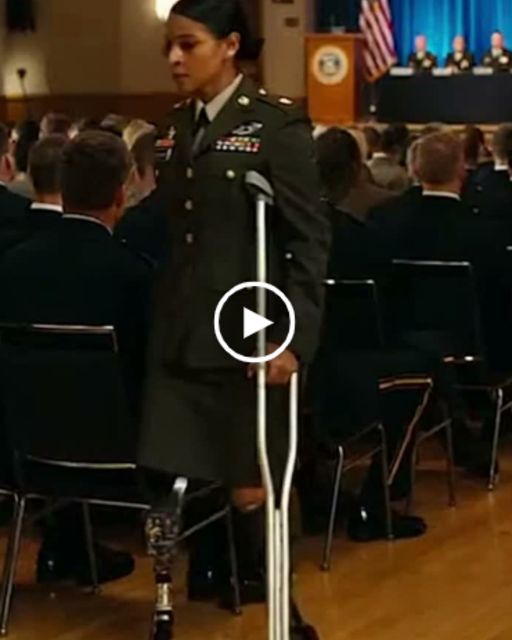
The military conference hall buzzed with small talk and the clink of coffee cups when a sharp whisper cut through the noise. “Look at that. Ranger Barbie needs a crutch.” The words weren’t loud, but they aimed to sting. Captain Taryn Mendes heard them. She didn’t slow, didn’t turn, didn’t give the speaker the satisfaction of a reaction. She adjusted her grip on the cool aluminum of her crutch, her prosthetic left leg clicking softly against the tile as she made her way down the aisle.
Taryn had earned two Bronze Stars. She had led soldiers in hard places and kept people alive under fire. But to a handful of young Navy SEALs gathered up front, she looked like a joke. A target. The kind of target that feels safe when you don’t know what you’re looking at.

“Guess combat was too much for her,” one of them muttered with a sneer. His name was Todd. He lounged back as if the room belonged to him. “If you can’t run, you don’t belong here.”
There was a time when Taryn might have fired back. Not anymore. She had learned that silence can be its own kind of armor. She kept her eyes forward and moved toward her seat, calm and steady, exactly as she had trained herself to be when the heat was on.
When the Room Stood Still
The heavy doors at the back of the hall swung open and conversation died in an instant. Lieutenant General Warren Hale stepped in, three silver stars on his shoulders catching the light. Everyone stood. The rustle of uniforms snapped into a crisp hush.
The General walked straight down the center aisle, heading for the stage. But he didn’t climb the steps. He stopped beside the first row—right in front of Todd and the few who had been laughing with him. Their grins drained away.
For a long beat, no one moved. The General’s gaze settled on them, steady and unblinking. Then he reached down with deliberate care, loosened the side of his dress trousers, and pulled the fabric up.
A sound rippled through the hall like a wave. It wasn’t flesh and bone beneath that uniform. It was metal—titanium, scuffed and strong. A prosthetic. Just like Captain Mendes’s.
“If you believe a missing limb makes a warrior weak,” he said quietly, “you’ve learned nothing that matters.” His words were not loud. They didn’t need to be.
He let the trouser leg fall back into place and set his hand on Taryn’s shoulder, steady and sure. When he spoke again, his voice softened, but the power in it only grew.
“You’re mocking this woman,” he told the young men, “and you have no idea she is the reason I am alive.”
The Day Everything Changed
The entire room seemed to lean forward, drawn to the story that was about to unfold. The General kept his hand on Taryn’s shoulder as if tethering the past to the present, as if to say, We were there together. We still are.
“Five years ago,” he began, “our convoy was moving through the Kunar Province. It was a bright day. The kind of day that looks more peaceful than it is. An IED took out the lead vehicle, and then mine.” He paused, collecting the memory with care, almost as if he could still smell the burned rubber and dust.
“I came to in the dirt. My leg was a ruin. I knew enough to know I was running out of time. The medic was down. The radios were useless. And the fire from the ridge above had us pinned to the ground.”
Taryn listened, face calm, eyes forward. She didn’t need to relive it out loud. She had carried that day with her through every appointment, every night that came too quiet, every morning she laced her life back on at the knee.
“I was the senior officer,” Hale continued. “I ordered my people to leave me and form a perimeter. It was the right order. It was also a death sentence, and everyone knew it.” He looked across the room, letting that settle, the way a hard truth has to.
“One person would not leave.” His voice thinned, threaded with feeling. “A young lieutenant named Taryn Mendes.”
He turned, and the glance he shared with her carried a whole conversation. She had refused to let him die. He had never forgotten it.
“She crawled to me on her elbows with a medical kit, while the dirt around us jumped with incoming rounds. She put a tourniquet high on my thigh and cranked it down until I saw stars. But the bleeding was too high for that to fix.”
In the front row, Todd swallowed. His face had lost all color. The room had slowed to the pace of the story.
“She looked me straight in the eye,” the General said, “and told me she was going to have to do something drastic to keep me here. I nodded because there was no other choice.”
There were no theatrics in his telling, only simple facts. “With nothing more than a standard field blade and a calm that I have rarely seen in any soldier, she did what had to be done. Quick. Clean. Focused. She saved my life in the dirt, under fire, while the clock ran out on both of us.”
He drew a breath, then let his gaze fall on Todd. “While she was covering me with her own body, a mortar landed close. A fist-sized shard of metal tore through her left leg. She made one sound—one—and then kept working until my bleeding was under control.”
“She did not stop until I had a chance to live.” He let those words rest, because they deserved to.
Respect Earned the Hard Way
The room felt different now, like a chapel where the air itself asked for quiet. The woman some had mocked not five minutes earlier had held a life together while hers was coming apart. Courage is often quiet. It rarely asks to be seen. But when you see it, you don’t forget.
General Hale straightened, the habit of command in every inch of his posture. “Captain Mendes lost her leg because she chose to save her commanding officer. That device she wears is not a sign of weakness. It is a sign that she was tested by fire and did not quit.”
He reached down and tapped the crutch beside her. “This is not a prop. It’s a testament. Some of you think strength looks a certain way. Let me suggest that strength is what keeps you moving when life stops looking the way you expected.”
No one spoke. The silence was not awkward; it was reverent. It held the shape of an apology that had not yet been spoken.
The Other Story Todd Carried
The General’s attention returned to Todd, who seemed to be wishing he could step right out of his own skin. “Petty Officer,” Hale said evenly, “I have one more question. Do you remember Operation Crimson Dune?”
The name landed hard. Todd’s eyes flickered with grief he thought he had locked away. He nodded. “My friend was on that mission,” he managed. “Marcus Thorne.”
“Marcus was a good man,” the General replied, his tone softening. “I read everything about that day. After-action notes can get messy. Rumors move faster than truth.” He scanned the room, speaking to all, but his words were meant for one.
“I know the story you heard. That a young Army officer hesitated and made a bad call that cost lives. You’ve carried that story for five years. It’s a heavy load, especially when grief is strapped to it.”
Todd’s head hung low. You could almost see the years of blame sitting on his shoulders, solid and cold.
“You’ve been blaming the wrong person,” Hale said, firm and kind all at once. “The intelligence was wrong from the start. The trap was set days before you arrived. There wasn’t a bad call on the ground that day. There was only survival.” He turned slightly toward Taryn. “The officer in your story was Lieutenant Mendes.”
Todd flinched like the word itself had struck him. The woman he mocked. The officer he blamed. The one who had saved the General’s life. One person, three truths that did not fit the cruel rumor he had believed.
Hale’s voice lowered. “Do you want to know how Marcus Thorne died? He died holding the line. He threw accurate suppressive fire up that ridge and bought Captain Mendes the minute she needed to save me. He made a choice. He pulled the enemy’s eyes to himself.”
The weight of those words settled into the room and into Todd’s chest. For five years, anger had been his shield against pain. Now he heard that his friend’s last act had been brave and deliberate, an act that protected the very person Todd had just ridiculed. The irony took his breath.
Apology and Grace
The conference let out early. Whatever was on the schedule could wait. The real lesson had already been taught, with more clarity than any slide deck could offer.
People filed out quietly, glancing at Captain Mendes with something close to awe. The few who had laughed along with Todd slipped away, heads down, suddenly small in their seats.
Todd stayed. When the hall had nearly emptied, he walked to Taryn, each step stiff with regret. General Hale remained nearby, present but silent.
“Captain,” Todd said, voice catching. “Ma’am… I don’t have the right words.” He looked at her, and for the first time he truly saw her—not as a symbol or a rumor, but as a person who had shouldered more than most and kept her dignity intact.
“I’m sorry,” he said simply. “For what I said. For what I believed. For the years I spent angry at the wrong person.”
Taryn met his eyes. There was no triumph there, no I told you so. Only steadiness. Only the kind of kindness that comes from understanding pain up close.
“Marcus was incredibly brave,” she said. “I think about him every day.” She told Todd a small story—how Marcus had cracked a joke just before the ambush, how he’d been talking about the boat he wanted to buy when he got home. In that moment she handed him back something he hadn’t known he had lost: a true memory, uncomplicated by blame.
“He saved my life,” she said. “That let me save the General’s. His sacrifice mattered. Don’t let anyone twist that.”
Todd’s composure broke, the way a dam gives way after holding too long. Tears came, not just for shame but for the honest grief he had hidden from himself for years. The General stepped forward then, the moment both personal and official.
“Petty Officer Todd,” Hale said, back in his formal voice. “Report to my office at 0800 tomorrow. Your conduct was unbecoming of a United States Navy SEAL. There will be consequences.”
Todd nodded. “Yes, sir.” He did not look for a way out. He accepted what was his to own.
New Orders, New Purpose
Later that day, General Hale asked Taryn to join him in a quiet briefing room. He closed the door softly behind them. “I’m sorry you had to endure that,” he said, this time more friend than general.
She managed a small smile. “It wasn’t the first time, sir. And it may not be the last.”
“Perhaps,” he said thoughtfully. “But maybe we can help change that.” He slid a folder across the table. “Special Operations Training Division is looking for a new commander. Someone who knows what resilience looks like up close—and can teach it.”
Inside the folder lay a path that would let Taryn shape the future, not just survive the past. This wasn’t charity. It wasn’t a favor. It was recognition. A clear-eyed acknowledgment that her leadership had been proven the hardest way there is.
She accepted the post.
In the months that followed, the training center learned the sound of her approach—the measured tap of a crutch, the firm click of a prosthetic. Recruits straightened at that rhythm. It came to mean, Pay attention. You are about to learn something that matters.
Taryn taught them that courage is not the absence of fear; it’s action taken with fear riding shotgun. She showed them that a warrior’s strength does not live in perfect limbs but in a spine that refuses to bend the wrong way. She reminded them that respect is not optional in a profession that relies on trust.
As for Todd, his reprimand stood. He took a reassignment and asked for work that would honor what he had learned. He began spending his days with wounded veterans, helping them find their footing in a new kind of life. He had made a painful mistake, but he chose to turn that pain into service. In his own quiet way, he carried Marcus’s memory forward.
What the Room Remembered
The story from that conference hall traveled the way truth often does—quietly, but steadily. It became the kind of tale that gets told not to stir gossip but to set a standard. It reminded people in uniform—and those far outside it—what real strength looks like when life does not go according to plan.
It is easy, especially from a distance, to confuse appearances with ability. To believe that strength always looks fast and glossy, young and flawless. But that day proved something different. Real strength can stand on a metal leg, lean on a crutch, and still walk into the room with more authority than any swagger can ever fake.
Scars tell the truth of where a person has been. Some you can see, some you cannot. Either way, they’re not marks of failure. They are maps of survival. They show the places where someone broke and healed and kept going, often carrying someone else along the way.
Those who were there learned to look again before they judged. To ask, What don’t I know about this person? What have they carried without complaint? What have they done quietly that the world never saw? It is a good set of questions for any room, at any age.
Captain Taryn Mendes did not ask to be a symbol. She simply did her job when it counted the most and kept doing it afterward. She stood tall that day not in spite of what she had lost, but because of what she had chosen—to protect, to endure, to lead.
And General Warren Hale did what true leaders do. He stepped forward not to embarrass anyone, but to set the record straight and to protect the dignity of someone who had once protected his life. He showed that rank is not just a set of stars; it’s a responsibility to use your voice when it matters.
In the end, the lesson woven into that afternoon was simple, and it bears repeating. A warrior is not defined by the limbs they have. A warrior is defined by the heart that keeps them moving, the steadiness of their hands when others shake, and the choices they make when the easy way out is to look away.
That is what the room remembered. And that is why, when the soft tap of a crutch and the steady click of a prosthetic echoed down the corridors of the training center, people straightened, listened, and learned.



