
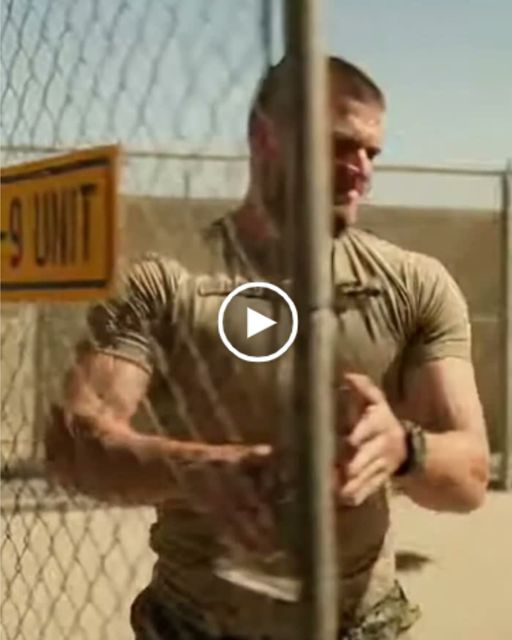
A Rough Welcome at the K9 Yard
I was leaning on the chain-link fence that afternoon, doing my best to stay out of the way, when the so-called initiation began. The veteran handlers had that familiar glint in their eyes, the kind that said they were about to do something they would later call tradition and the rest of us would recognize as trouble.
Bradley, one of the loudest voices in the room on any given day, pushed the gate shut with a clang and smirked at the woman they all kept calling the new girl. “Hope you run fast, sweetheart,” he said, loud enough for the whole kennel to hear.
Inside the pen stood a hundred-pound Belgian Malinois with a hard stare and a name the handlers had given him: Titan. They said he was aggressive and untouchable, a washout who had been starving for attention and missing meals because no one could get near him. To the onlookers, he was a weapon with fur. To me, he was a storm waiting for a reason to break.
Phones were out, the way they always are these days when people expect chaos. A few of the men joked, shoulders bumping against the fence, waiting for the same old outcome—fear, a chase, a scream. It made my stomach twist. I knew Titan’s reputation. I knew he had been through more than any of them admitted. I wanted to yell for them to stop. I didn’t. Not in time.
Titan lowered his head, the sound that rolled from his chest deep and ugly, the kind that makes even seasoned handlers take a step back. He lunged, dirt scattering under his paws, teeth bared for the bite everyone assumed was coming.
The woman they’d shoved in there didn’t take a single step. She didn’t lift her hands or turn her body or shout for help. She just stood still and made a quiet, low clicking sound with her tongue, easy and steady, like a small metronome meant for one set of ears.
Everything changed in a heartbeat. Titan stopped mid-charge, sliding to a halt on the hard-packed ground. The growl shut off as if someone had closed a door. The yard went suddenly quiet, so quiet I could hear the dust settling. Bradley’s smile vanished. Phones dipped. Someone muttered, “What the hell?”
Titan’s tail tucked. He stepped forward, not to bite, but to breathe in the scent of the woman’s boot, as if he were searching for something he remembered. Then, with a small, aching sound that didn’t match his size at all, he exhaled in relief.
She knelt and spoke one soft word I didn’t catch. Titan rolled onto his back like a dog who had finally found his person. She scratched the thick scar behind his right ear as though she had known it was there the whole time.
She stood up slowly, her face calm. “You call him Titan,” she said, her eyes on Bradley. “But that isn’t his name.” Then she added, just as evenly, “And I’m not a rookie.”
The Truth Walks In
Right then, the Chief of Police strode around the corner with a look that could peel paint. He didn’t glance at the woman. He walked directly to Bradley, stopped a foot away, and spoke in a voice that left no room for misunderstanding. “You just locked Captain Vance in a cage,” he said. “The woman who wrote the handling manual you’re supposed to know by heart.”
Color drained from Bradley’s face as the words landed. Captain. Vance. The woman in the pen—calm as a morning lake with the dog glued to her side—wasn’t a trainee at all. She was the authority the rest of us had only studied on paper.
She opened the gate, and the dog rose and heeled at her left, no leash, no hesitation, nothing forced. Passing me, she pressed a folded sheet of paper into my hand and said, almost gently, “Leave this on Bradley’s desk. Let him find it.” She gave the dog a quiet click, and they moved off with the Chief.
I waited until they were out of sight to look. I expected suspension papers at the very least. What I unfolded wasn’t a form at all. It was a DNA report, printed clean and cold. My eyes went to the names. I read them twice before the meaning hit me like a shove. Bradley wasn’t just getting into trouble at work. He was about to learn that the three-year-old he believed was his son wasn’t his at all—and that the child’s biological father was his quiet, often-ridiculed junior partner, Officer Peterson.
My hands shook as I refolded the page. Around me, the handlers who had been laughing minutes ago had gone silent. A few couldn’t meet each other’s eyes. Bradley tried to apologize to the Chief in a rush of words that felt more like noise than regret. The Chief only stared at him, heavy and cold. “You are a disgrace to this unit,” he said, each word dropping like a hammer. “An embarrassment.”
I slipped away to the handlers’ office, the paper burning in my palm. The room smelled like stale coffee and biscuit crumbs, the kind of scent that seeps into walls over time. Bradley’s desk was the same mess it always was—notes, wrappers, the leftovers of a man who thought the world would pick up after him. I set the folded DNA test in the center of his keyboard and backed away like I had just set down something that could explode. In a way, I had.
The Paper on the Desk
I returned to my small workspace and tried to look busy. People filtered in slowly, heads down. No one spoke. The laughter from earlier had faded into a worried hush that seemed to curl into the corners of the room. Finally, Bradley came in. His stride was slower now, his shoulders curved forward as if under a sudden weight. He dropped into his chair and dragged a hand over his face.
Then he saw the paper.
He unfolded it. I watched the color vanish from his cheeks the moment he reached the second line. It wasn’t the gentle fade of surprise. It was the sharp turn of a man who had just looked over the edge and realized there was no ground beneath him. He read it again, lips moving without sound, the page quivering between his fingers.
His eyes lifted and drifted around the room as though he could find a different reality in someone else’s expression. He seemed to be searching for Officer Peterson, but Peterson was already out on patrol, sent away an hour earlier. There would be no show, no scene, no rescue.
The chair screeched across the floor as Bradley stood up too fast. “No,” he whispered, voice cracked. “No. It’s a lie.” He fumbled for his phone and stabbed at the screen as if he could dial his life back to the moment before he opened that paper.
When the Chief walked in and said, “My office. Now,” Bradley didn’t move. He stared at his phone, waiting for an answer that did not come. Two senior officers approached and guided him out. He walked like a man in a dream, the DNA report still resting where he had dropped it—a quiet obituary for the life he thought he had.
By late afternoon, every handler involved in the so-called initiation had been called in, one by one. There were suspensions. There were orders for retraining. No one snickered about tradition anymore. The mood had shifted. We all felt it. And at the center of it all stood Captain Vance, steady and unshakable.
Why She Came
In the days that followed, the precinct felt different. Bradley was put on leave, rumors circling him like crows. People whispered in hallways and then stopped when someone rounded the corner. No one wanted to be caught on the wrong side of whatever was coming next.
Captain Vance moved through it all with a quiet gravity. She didn’t shout. She didn’t grandstand. She changed the rhythm of the place simply by insisting on the right way to do the work. The first clear sign of that came when she walked into the kennel and said, “His name is Echo.” She stroked the dog’s neck the way you would greet an old friend. The name fit him the second it left her mouth. Titan had always sounded like a dare. Echo sounded like a memory answered.
One afternoon, I was cleaning Echo’s kennel when she stopped by. Echo leaned his head against my boot and sighed, more relaxed than I had ever seen him. She watched him for a moment and said, “He likes you.” I said what had been building in me for days. “He’s a good dog. He was just misunderstood.” She gave a small, tired smile. “Most of the broken ones are.”
I had to ask the question that had been knocking around in my chest. “Captain,” I said, trying to keep my voice steady, “the dog—I understand that. But with Bradley, all of it… it felt like more than discipline. It felt personal.”
She looked across the training yard, her gaze fixed far beyond the fence line. “Echo belonged to my younger brother,” she said quietly. “Sergeant Ben Vance.” The name hit me hard. I remembered the memorial service. I remembered the whispers that his death had been a tragic accident during a raid.
She continued in a voice that traveled steadily, like a river finding its path. “Ben trained Echo from the time he was a pup. That clicking sound you heard? That was theirs. It meant friend.” She placed a hand on Echo’s back. He pressed a little closer, almost as if he could read her heart through her palm.
“Echo wasn’t a washout,” she said. “He was grieving. He was scared.” The scar behind Echo’s ear. The way he flinched from certain people and settled around others. All the pieces I had half-noticed came together, clicking into place with a terrible kind of sense.
The Night That Went Wrong
“The night Ben died,” she said, “Bradley was his backup. There was a call about armed suspects holed up in a warehouse. Ben and Echo cleared the interior first—by the book. Bradley’s post was the west exit to keep the suspects from slipping out.” She paused, steadying herself. “But Bradley didn’t hold it. He hung back.”
A suspect slipped out that unattended door and came up behind Ben’s position. Echo alerted, but there are moments in this line of work that turn on a breath and a heartbeat. Ben never saw it coming. By the time help reached him, it was too late. The official report said accident. It never mentioned the west exit that wasn’t actually covered.
“Bradley lied,” Captain Vance said. “He told investigators the exit was secure. He let people think Ben made a fatal mistake. He let them blame my brother for his own death.” She spent months after that night gathering details, talking to people quietly, stitching together the truth in the gaps between what had been said and what had actually happened. She knew she might never make the cowardice stick on paper. But she could stop the culture that had fed it. She could pull it up by the roots.
Exposing the Lies
When I finally found the courage to ask about the DNA report, she didn’t flinch. “While I was uncovering the truth about the raid, I learned other things,” she said. “How Bradley bullied junior officers. How he boasted and cut corners. How he was unfaithful to his wife.” She explained—without relish, without spite—how Sarah, Bradley’s wife, had confided in her friend, who happened to be Officer Peterson’s wife, about the fear and loneliness she lived with. How a line had been crossed during a dark, isolated time. It happened once. A child came of it. A truth sat quietly in the background until the day it could no longer hide.
“Bradley built his world on lies,” she said. “That he was a good cop. That he was a good husband. That he was a father. He hurt people because scaring them made him feel strong. It had to end.” There was no gloating in her voice, only a firm, steady sorrow. Justice sometimes looks calm from a distance, but up close you can see the miles it had to walk to get there.
Cleaning House and Starting Over
Within a month, our unit looked and felt different. The showy shouting and swagger disappeared. In their place came clear expectations and quiet accountability. People started studying the manual again because the person who had written it was here, teaching us not just the words on the page but the respect behind them.
Captain Vance noticed the way Echo and I fell into step together. She saw the patience and the curiosity in how I worked with him. One morning she handed me a training schedule and said, “Advanced handler program starts Monday. I want you in it.” I said yes before the sentence was fully out of her mouth. By the end of that week, Echo and I were partners.
Our first patrol together felt right, like slipping into a shirt that has already grown to fit you. He watched me, I watched him, and between us was a trust I didn’t have to force. Echo wasn’t the monster some had painted him to be. He was a professional, shaped by love and loss, now given the chance to do his work the way it was meant to be done.
As for Bradley, the fall came fast. He was terminated, and the consequences followed him out the door. The pension he counted on was gone. His reputation collapsed under the weight of his own choices. Sarah filed for divorce. The truth about the child became the precinct’s worst-kept secret, and the gossip he once fed on turned him into a story people told as a warning, not as entertainment.
Officer Peterson asked for a transfer and was granted one, starting fresh with Sarah and the boy. I saw him once before he left. He looked tired, but his shoulders were lighter somehow, as if he had put down a load he had carried for too long. We nodded to each other. There wasn’t much to say. The air around it all was too full of history, and sometimes respect is quiet.
A Brother’s Memory, A Dog’s Loyalty
On a cool evening after a long shift, Captain Vance stopped me as Echo and I headed for the lot. The sky was doing that fading-blue thing that makes the world feel softer. Echo bumped my leg, content and ready for dinner.
“Ben would have liked you,” she said simply. “He would have been glad to know Echo has a partner who respects him.” Coming from her, those words felt weightier than any commendation. They settled in my chest like a steadying hand.
I still think about that first day when people planned a cruel joke they thought would get them a laugh. They chose the wrong person to push and the wrong dog to underestimate. They didn’t realize the woman in that pen wasn’t there to prove she could run. She was there to set the record straight. And the dog wasn’t a threat to be mocked. He was a partner waiting for someone to speak his real name.
What the K9 Pen Taught Me
For all the noise and bravado that used to fill our yard, the lesson that lingered came quietly. Real strength doesn’t roar. It doesn’t need to. It shows up, listens, and does the work the right way, every time. It does not humiliate to teach. It does not lie to cover fear. It does not hide behind jokes or traditions that break spirits instead of building teams.
I watched a woman walk into a pen with a so-called dangerous dog and treat him with understanding—and watched that dog answer with trust. I saw her put a stop to cruelty, not by throwing her weight around, but by insisting on respect and truth. I watched a false story unravel, thread by thread, until what remained was the plain fact of what had always been there: a good handler lost too soon, a brave dog mislabeled by grief, and a culture that needed to be rebuilt from the ground up.
Echo and I go to work now with a sense of purpose that feels clean. He glances up at me for a signal, and sometimes, just for a second, I hear that soft clicking sound Captain Vance made on the first day—the one that meant friend. It reminds me that the best partnerships, on two legs or four, are anchored in trust.
When people ask what changed our unit, I think of that DNA report on the desk, yes. But I think far more of the moment in the dust when a dog chose calm over fear because someone spoke to him in a language he remembered. That’s the heart of what we do. We read the situation, we respect the lives in front of us, and we choose what heals instead of what harms.
In the end, the most important battles in our line of work are rarely won by force. They are won by patience, by steady hands, by telling the truth even when it’s hard, and by honoring the ones who can’t speak for themselves. Echo never forgot his real name. And thanks to Captain Vance, neither did we.



