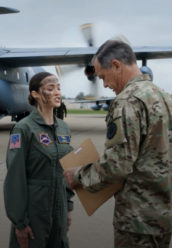
The wind off the Atlantic didn’t just blow at Marine Corps Air Station Blackstone; it gnawed. It carried a fine, abrasive salt that pitted the paint on the F-35s and got into the teeth of the men who fixed them. Colonel Marcus Harlan felt that grit in his joints as he watched the transport’s ramp hiss open.
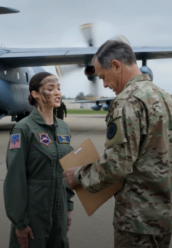
A single pilot stepped out. She didn’t have the swagger of the new Top Gun replacements. She moved with the heavy, deliberate gait of someone who knew exactly how much the ground beneath her cost.
Her flight suit was a blank slate. No squadron patch. No history. Just a name tape that read VAUGHN in stark, black letters.
Harlan flipped open the thin file in his hands, the paper feeling unnaturally dry. “You’re the transfer?” he asked, his voice competing with the dying whine of the transport’s turbofans.
“Yes, sir,” she said. She didn’t snap to attention. She stood like a piece of iron pipe – unyielding, weathered, and indifferent to the weather.
Harlan’s eyes drifted to her left shoulder. The absence of a patch was a scream in a room full of whispers. At Blackstone, you were your unit. Without it, you were a ghost or a problem.
“Where’s your patch, Captain?”
“It wasn’t issued,” she replied. The cadence of her voice was flat, like a dial tone.
Harlan felt a prickle of heat at the back of his neck. He didn’t like walls, and this woman was a fortress made of rusted secrets. He looked past her at the hangar – Hangar Three – where the corrugated metal groaned under a gust of wind.
“Call sign?”
He meant it as a dismissal. A way to categorize the intruder before he shuffled her into a dark corner of the ready room.
Rina Vaughn looked him dead in the eye. The salt-air seemed to freeze. Behind them, a corporal stopped his grease gun mid-pump. The tower controller, visible through the green-tinted glass above, leaned closer to the pane.
“Phantom Seven,” she whispered.
The world didn’t end, but the air in Harlan’s lungs suddenly turned to wet concrete. His knees almost buckled.
Phantom Seven didn’t exist. Phantom Seven hadn’t existed since the Karaj Incident in 2007, when he was a Major sitting in a black room in Nevada, signing the papers that buried four pilots and one classified airframe at the bottom of the Caspian Sea.
He had signed her death certificate himself.
He had folded the flag for her mother in Dayton, Ohio.
Harlan’s hand drifted instinctively to his sidearm, not because he wanted to draw it, but because his body remembered something his mind had spent eighteen years trying to forget. The grease-stained corporal was staring now. Word travels fast on a flight line, and “Phantom Seven” was a word that wasn’t supposed to travel at all.
“That call sign is retired, Captain,” Harlan said, his voice cracking like old leather. “Permanently.”
“I know, sir.” She tilted her head, and for the first time, he saw the burn scar peeking out from beneath her collar—the exact pattern a canopy melts into a person’s skin when an ejection seat fires two seconds too late. “I’m the one who retired it.”
She reached into her flight suit and pulled out a single, laminated photograph. She didn’t hand it to him. She held it up between her thumb and forefinger, letting the Atlantic wind try, and fail, to tear it away.
Harlan didn’t want to look. He had to look.
The photo was old. Grainy. Taken from the gun camera of an aircraft that the U.S. government swore on the Bible had never been built. And there, in the cockpit of the jet she was supposed to have died in, sitting right next to her in the back seat…
Was him.
“I’m not here for a transfer, Colonel,” Rina said softly. “I’m here because the other three are coming. And they remember what you ordered us to drop that night.”
Harlan’s mouth went dry. He looked back down at the thin file in his hand—the file Washington had sent him that morning—and finally noticed the small red stamp on the bottom corner that he had missed during his first read.
The stamp didn’t say “TRANSFER.”
It said “DECOMMISSION.”
The word hit him harder than a G-force turn. It wasn’t a military term. It was a corporate one. What you do with outdated equipment. What you do with a liability.
“My office,” Harlan rasped, his authority suddenly feeling like a costume he was wearing. He turned, not waiting for her to follow, but knowing she would.
The walk was the longest in his life. Every salute he returned felt like a lie. Every passing Marine a potential witness to the ghost he was escorting.
His office was his sanctuary. The walls were covered with his life: photos of him with generals, framed medals, a model of the first F-18 he ever flew. It was a shrine to a man who followed the rules.
Rina Vaughn walked into that shrine and made it all feel like a counterfeit. She didn’t look at the awards. Her eyes scanned the room’s layout, the exits, the window overlooking the flight line. She was assessing a threat, not admiring a history.
“Sit down,” he said, gesturing to one of the stiff leather chairs.
She remained standing. “I prefer to stand, sir.”
Harlan sank into his own chair, the aged leather groaning in protest. He tossed the file onto his desk. The red “DECOMMISSION” stamp stared up at him like a bloody eye.
“They think you’re a threat,” he stated, the words tasting like ash. “They sent you here for me to… handle.”
“We are a threat,” she corrected him, her voice still unnervingly steady. “But not to the country. To them. To the men who made us.”
He looked at the scar on her neck again. “The crash… we were told it was catastrophic failure. Unrecoverable.”
“It was a catastrophic success, Colonel. Then they tried to recover us with a surface-to-air missile.”
The room’s air conditioning hummed, but Harlan felt a cold sweat break out on his forehead. “Your own side shot you down?”
“A loose end is still a loose end,” Rina said. “And the payload we were carrying created four very big ones.”
Harlan leaned forward, his hands clasped on the desk to hide their trembling. “The payload. What was it? They told me it was a non-lethal chemical agent. To neutralize an underground lab.”
“Was it non-lethal, sir?” she asked, her question carrying the weight of eighteen years. “You trained us. You flew the prototype. Did you ever ask what was in ‘Zephyr’?”
Zephyr. The project name. A name he hadn’t heard spoken aloud since his final debrief in Nevada. He had flown the plane, tested its impossible maneuverability, but he’d never flown it with a live payload. He had raised concerns about the unknown bio-agent it was designed to disperse, about its potential effects on the pilots.
They had thanked him for his service, promoted him to a desk, and told him the project was being re-evaluated. They lied.
“They said it was shelved,” he whispered, the lie he’d told himself for nearly two decades crumbling.
“They gave it to us, sir,” Rina said. “A little parting gift. It wasn’t meant to neutralize the lab. It was meant to test itself on the people inside. And on us.”
She finally moved, taking a slow step toward his desk. “It doesn’t work like a chemical, Colonel. It’s biological. It re-codes you under extreme stress. It was supposed to create the perfect soldier. Heightened reflexes, no need for sleep, photographic memory. The ultimate weapon.”
“Did it work?” Harlan asked, unable to stop himself.
A ghost of a smile, so faint it was barely there, touched her lips. “Too well. And not at all.”
“What does that mean, Rina?” He used her first name, a breach of protocol that felt entirely necessary.
“It means Daniel, our comms specialist, Phantom Two… he doesn’t just remember codes. He sees them. Everywhere. In power grids, in satellite signals, in stock market fluctuations. He doesn’t hack systems, Colonel. He talks to them. His call sign is Ghost now.”
She paused, her eyes focused on something far beyond the walls of his office.
“It means Sarah, Phantom Four… the agent enhanced her spatial awareness. She feels the air currents in a room, the footsteps of a man on the roof, the weak point in any structure. They called her Wraith. She got out of a black site in Yemen by walking through the walls… or so they say.”
Harlan felt his heart pound against his ribs. This was beyond anything he could have imagined.
“And Carter… Phantom Six. He was our weapons guy. Spectre. The agent took what was aggressive in him and sharpened it to a razor’s edge. He’s the reason we’re here. He’s tired of hiding. He wants to bring the whole rotten house down.”
“And you?” Harlan asked, his voice barely audible. “Phantom Seven. What did it do to you?”
“It took everything,” she said, and for the first time, a flicker of pain crossed her features. “My past. My future. My ability to forget.” She tapped her temple. “It’s all still in here, Colonel. Every moment. The feel of the stick in my hand, the heat of the fire, the look in your eyes when you handed my mother that folded flag. It’s all right here. All the time. The agent made me a perfect witness.”
The phone on his desk buzzed, a harsh, intrusive sound. The secure line.
Harlan stared at it. He knew who it was. The world outside this room was about to come crashing in.
He looked at Rina. She had given him a choice. He could answer that phone, follow his orders, and try to “decommission” the people he had helped create. Or he could stand for something, for the men and women he had led, for the young Major he used to be who knew something was wrong.
He let it buzz a second time, then a third.
Finally, with a deep sigh that seemed to drain the last of his youth from his body, he picked up the receiver. “Harlan.”
“Marcus,” the voice on the other end was smooth, cold, and utterly devoid of warmth. General Thorne. The same man who had overseen the program from the Pentagon. “We have a situation on your base. An asset has breached containment.”
“I have a Captain Vaughn in my office,” Harlan said carefully, his eyes locked on Rina.
“You have a piece of broken equipment, Colonel,” Thorne snapped. “It’s malfunctioning, and it’s brought its friends. Your network has been compromised, and we have an unauthorized signal piggybacking off your main comms tower. That’s Phantom Two.”
So Ghost was already inside.
“The asset, Vaughn, is to be detained using any means necessary,” Thorne continued. “An Asset Reclamation team is en route. ETA is twenty minutes. Your job is to keep her there until they arrive. Is that clear?”
Any means necessary. Decommission. Broken equipment. The words circled in Harlan’s mind.
He looked at the photograph on his desk, the one of him and his wife on the day he made Colonel. A life built on duty. A life built on a lie.
He looked at Rina, at the scar on her neck and the unbearable weight in her eyes. She wasn’t equipment. She was a pilot. His pilot.
“Colonel, did you hear me?” Thorne’s voice was sharp with impatience. “Is that clear?”
Harlan took a deep breath. He thought of the folded flag, the empty coffin, and the lie he’d told a grieving mother. The debt had come due.
“Perfectly clear, General,” Harlan said, and hung up the phone.
He stood up, the grit in his joints gone. For the first time in years, he felt light. He walked over to the wall and took down the framed model of his F-18. Behind it was a small, concealed keypad.
Rina watched him, her expression unreadable but her posture shifting, a hint of surprise in her rigid stance.
“They gave me this office because it has a direct line to the base command center and a lockdown protocol for the entire station,” Harlan said as he typed in a long-dormant code. “They thought it was to protect me from the outside. I always thought it was to keep me in.”
Across the base, sirens began to blare. Red lights flashed. Heavy metal gates slammed shut. It was the base-wide emergency lockdown drill, something he was required to run twice a year. He just started it three months early.
“Ghost can’t get us out if the whole system is offline,” Harlan said, turning back to Rina. “And that Reclamation team isn’t going to land on a base under total security lockdown. It’ll buy us an hour. Maybe more.”
Rina stared at him, the fortress around her eyes showing the barest of cracks. “Sir… why?”
“Because eighteen years ago, I followed an order I knew was wrong,” Harlan said, his voice firm and clear. “I chose my career over my people. I’m not making that mistake again. You said you were the one who retired Phantom Seven. You were wrong.” He picked up the file from his desk and tore it in half. “I was. And I’m the one who’s bringing it back.”
“The others…” Rina began. “Spectre is on his way here. He’s not coming to talk.”
“Then we’d better have a plan,” Harlan said, picking up his desk phone and dialing an internal line. “Sergeant, get me Hangar Three on the line. Tell them to prep the old bird for a systems check. The one in the back, under the tarp.”
There, in the darkest corner of the biggest hangar, sat the only other aircraft of its kind. The original prototype. The one he had flown. The one everyone believed had been scrapped years ago.
“What’s the plan, Colonel?” Rina asked, a new light in her eyes. She was a pilot again, not just a witness.
“The Pentagon wants to bury its ghosts,” Harlan said, a grim smile on his face. “Fine. But tonight, we’re going to make sure they hear them rattle their chains on the evening news.”
They didn’t have much time. As Rina relayed tactical information to her unseen team—Ghost redirecting the Reclamation chopper to a “fueling emergency” at a civilian airfield miles away, Wraith mapping the team’s real-time movements via their own satellite comms—Harlan worked his own magic.
He wasn’t a tech whisperer or an invisible soldier. He was a commander. He called in favors. He moved his most loyal men to “guard” key access points, giving them confusing but specific orders that would inadvertently trip up the incoming black-ops team. He made the base a maze of his own design.
The showdown happened in Hangar Three. The Reclamation team, led by a humorless professional in sterile black gear, finally breached the hangar, expecting to corner their targets.
Instead, they found Colonel Harlan, standing alone in the center of the cavernous space.
“This is a restricted area, Colonel,” the team leader said, his rifle pointed unwaveringly at Harlan’s chest. “Stand down.”
“This is my base,” Harlan replied calmly. “And you are an unauthorized force on it. I’d say the same to you.”
Suddenly, the hangar’s massive screens flickered to life. Not with schematics or maintenance logs, but with a full, unredacted file. It was the Karaj Incident. There were names. Dates. Signed authorizations from General Thorne himself, along with audio recordings of him ordering the cover-up and the shoot-down.
Ghost had done his work. It was all there. And at the bottom of the screen, a progress bar showed the file being uploaded simultaneously to every major news network in the world.
The team leader saw it. He looked from the screen to Harlan. His mission wasn’t to stop a file; it was to retrieve assets.
“It’s over,” Harlan said. “You can still walk away.”
From the catwalks above, a shadow detached itself. It was Spectre, armed and furious. “They don’t get to walk away,” he growled.
But before he could act, Rina was there, moving with quiet speed. She didn’t draw a weapon. She just put a hand on his arm. “No, Carter. Not like this. We’re not them.”
Behind the stunned Reclamation team, the hangar’s main door began to rumble open. Outside wasn’t a squad of Marines. It was the base press corps, who’d been anonymously tipped off about a “major security announcement” by the Colonel.
Trapped between the public evidence, the press, and a base commander who had just outmaneuvered them at every turn, the Reclamation team lowered their weapons.
The aftermath was swift. General Thorne was finished, his career ending in a quiet, disgraceful hearing. The Zephyr program was exposed, a dark stain on the Pentagon’s record.
Harlan was forced into early retirement, as he knew he would be. He lost his command, his uniform, his office shrine.
A month later, Marcus Harlan was standing on a small fishing boat hundreds of miles from any air base, the ocean breeze feeling clean for the first time in years. He wasn’t a Colonel anymore. He was just a man who had finally balanced his own internal ledger.
His phone buzzed with a text from an unknown number. He opened it. The message contained only a grainy photo and a short line of text.
The photo was of a new, unofficial squadron patch. It was a simple black circle with four silver specters surrounding a single, central star.
ispod nje je pisalo: “Fantom jedan. Hvala vam.”
Marcus smiled, a true, heartfelt smile. He had lost his career, but he had found his honor. He had been grounded, but he had finally helped his pilots fly free.
The story of the Phantom Squadron became a quiet legend, a cautionary tale whispered in ready rooms and intelligence briefings. It’s a story that reminds us that true loyalty is not to an order, but to the people you lead. It teaches us that some secrets refuse to stay buried, and that it is never, ever too late to do the right thing, no matter the personal cost. The path to redemption isn’t about erasing the past, but about having the courage to build a better future from its broken pieces.