
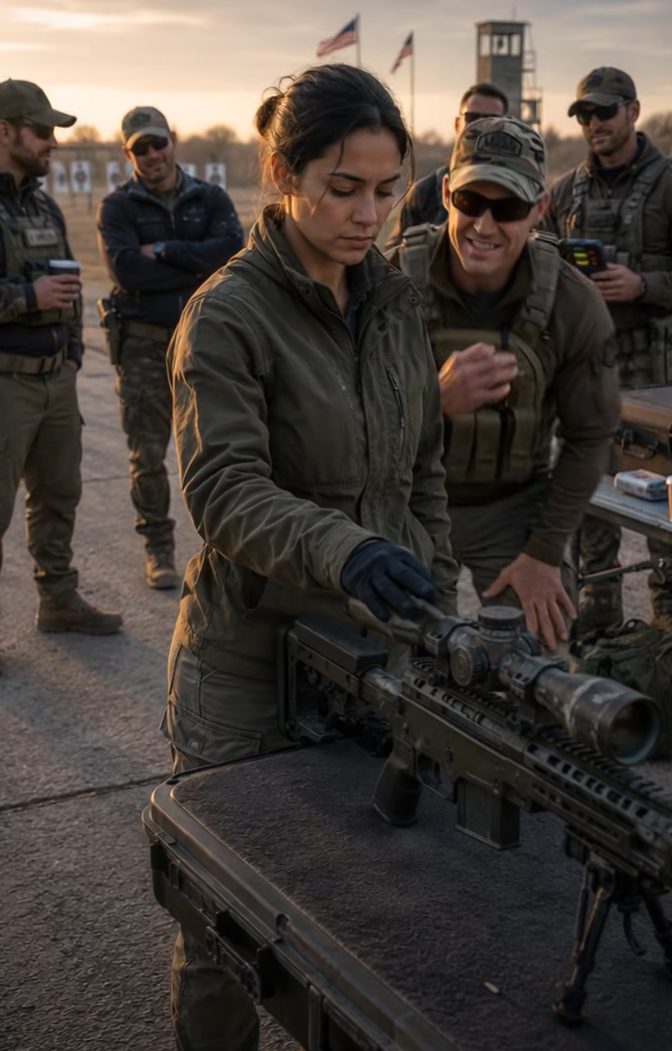
“You laughed at her scope before you knew what it had survived.”
The words cut across the range so sharply that even the wind seemed to stop.
Sarah Martinez stood beside her bench, one hand resting near the rifle case, her face unreadable in the pale morning light. Around her, men who had been smiling minutes earlier now stared at the battered optic mounted on her rifle as though it had suddenly become evidence in a crime.
No one laughed now.
What the Morning Had Been
The long-range line had looked perfect from a distance.
Matte-black rifles gleamed under the sunrise. Fresh precision optics sat locked into polished mounts. Digital wind meters blinked softly in gloved hands. Everything smelled like gun oil, dust, hot coffee, and expensive confidence.
Then Sarah arrived with a plain case and a scope that looked like it had crawled out of a war zone.
Its edges were stripped silver from years of handling. The finish had faded wherever hands had touched it, over and over, season after season. It didn’t shine. It didn’t impress. It didn’t belong beside equipment that still wore its showroom finish.
A man two benches over noticed first.
“You trust that thing at this distance?”
Sarah didn’t look up immediately. She tightened the mount once, checked the rail, then pressed her thumb along the worn metal as if confirming something only she could feel.
“I trust what I know.”
Her voice was quiet.
That made it worse.
A few men smiled into their coffee. Another leaned toward his neighbor, barely hiding his amusement. In places like this, silence was easily mistaken for weakness, and old equipment was treated like a confession.
“This line doesn’t forgive outdated systems,” someone said.
Sarah nodded once.
“Sometimes.”
The single word sat there, calm and faintly irritating.
The Rifle That Didn’t Need an Audience
The first round was called under a sky still pale with morning.
Shooters settled behind their rifles. Screens glowed. Turrets clicked. Phones checked ballistic tables. Small corrections passed from mouth to mouth like gospel.
Sarah looked through her old glass once.
She didn’t touch the turrets.
She breathed out.
Fired.
The steel rang.
Clean.
Not lucky. Not dramatic. Just exact.
A few heads turned, but only for a moment. One hit could still be dismissed – wind, instinct, timing, chance. Men who wanted to keep smiling always found room for chance.
Then she did it again.
And again.
By the second distance, the jokes had thinned. By the third, they were gone entirely.
“That grouping shouldn’t look that easy,” someone muttered behind her.
But Sarah never made it look easy. She simply refused to show the struggle. Her face stayed still. Her shoulder settled the same way every time. Her breathing held a rhythm so controlled it made everyone else’s movements look restless by comparison.
Others watched their screens.
Sarah watched the world.
Heat shimmer bent the line of sight. Dust lifted low and strange across the range floor. The wind moved one direction near the flags and another near the targets. The digital tools tried to translate it all into numbers, but numbers always arrived a moment after truth.
Sarah read the moment before it became data.
One shooter adjusted, fired, cursed under his breath, adjusted again. Another tapped his display as though the machine had personally betrayed him. A younger evaluator frowned at his results, then looked back at Sarah’s bench.
Logbook. Rifle. Old scope. Still hands.
That was all.
Where Confidence Goes When It Runs Out of Room
At the longest station, things started cracking.
The expensive optics recalculated too late. Wind calls disagreed. Men who had arrived polished and certain now shifted on their elbows, wiping sweat from their upper lips despite the cool morning air.
Sarah remained unchanged.
When the target cards came back, people left their benches to look at them. Not casually. Carefully. The holes told a story no one wanted to say out loud. Tight. Repeated. Controlled. The kind of consistency that didn’t come from equipment alone – the kind that made experienced shooters stop pretending.
“You don’t get that by accident,” one man said quietly.
“Not out here,” another answered.
Sarah heard them. She gave no sign that she did. She was already cleaning the rifle, moving with the same quiet discipline she had carried in with her. No victory. No smugness. No desire to punish them with the truth.
She set a worn cloth on the bench. Ran it along the barrel. Put it away.
The man two benches over – the one who had spoken first that morning – was looking at her scope again. His expression had changed completely. He looked like someone who had made a joke at a funeral without knowing it was a funeral.
He didn’t say anything.
Neither did she.
Patricia Hayes Doesn’t Miss Much
Director Patricia Hayes arrived at half past nine, and the whole range changed around her.
Spines straightened. Voices dropped. Men who had been lounging suddenly looked busy. Hayes walked with the sharp focus of someone who had spent enough years around false confidence to smell it before anyone opened their mouth.
Big woman. Compact. The kind of person who had learned to take up exactly the space she needed and not one inch more. She’d run evaluations in three different theaters before she ran this range, and the people who knew that history tended to stand a little straighter when she walked past.
The scoring lead met her with a folder. His tone was careful. Too careful.
That was when people started paying attention again.
Hayes opened the folder and moved through the target records, page after page. Her expression gave nothing away – until she paused.
The silence tightened.
She looked toward Sarah’s bench.
“Who is that?”
The scoring lead answered quietly. Hayes didn’t blink.
“Bring her here.”
Sarah stood without hurry and without hesitation. She walked forward with her hands relaxed at her sides, stopping in front of the director with the ease of someone who had already stood in rooms where judgment carried consequences far heavier than pride.
Hayes opened another file.
The range seemed to narrow around the paper.
No rifles moved. No one coughed. Even the flag near the tower barely stirred.
“Martinez,” Hayes said.
“Yes, ma’am.”
The director scanned the first page. Then the second.
Something changed in her face. It was small – a slight stilling, a shift behind the eyes – but everyone on the line felt it move through them.
The scoring lead went motionless beside her. Two of the men who had smiled earlier leaned forward without realizing it, mouths slightly open, already bracing for something they sensed they did not want to hear.
Hayes looked down once more.
Then she lifted her eyes to Sarah and read the first line aloud in a voice that carried across the entire range without rising.
“Overseas,” she said. “Four thousand two hundred meters.”
The Number That Rearranged Everything
The number landed like a physical blow.
Not shock. Recognition. The kind that moves through a room and quietly rearranges every insult, every smirk, every careless assumption made since morning.
Four thousand two hundred meters wasn’t a range-day achievement. It wasn’t a clean hit under controlled conditions with time to think and nothing at stake. It was patience stretched to the outermost edge of human ability. It was wind, heat, fear, silence, and consequences that didn’t stay on paper. It was a distance most people never attempted because the cost of failure was not always measured in points.
Sarah’s face did not change.
That made it worse.
Hayes slowly closed the file. Her gaze moved from Sarah to the worn scope mounted on the rifle, and for the first time all morning, the scratches no longer looked like embarrassments. They looked like scars.
“This optic,” Hayes said quietly, almost to herself, “has seen more than most people on this line.”
Sarah said nothing.
She didn’t have to.
Every man who had laughed now had to stand inside the memory of his own arrogance. Every quiet smile from earlier returned to the room, uglier than before. No one could hold her gaze for long.
The man two benches over had gone completely still. His expensive glass sat in front of him, and he wasn’t looking at it.
Please Don’t
Hayes stepped closer. The folder remained shut in her hand, but her fingers tightened around it.
“There’s another line in this file,” she said.
Sarah’s eyes shifted. Just slightly.
The director noticed. So did everyone else.
For the first time all morning, something moved across Sarah Martinez’s face – something that broke through the careful stillness she had maintained since she arrived. Not fear exactly. Not shame. Something older. Something that had learned to breathe without making a sound.
The range held its breath with her.
Hayes looked at the page again. Then back at Sarah.
And before she could read the next sentence, Sarah whispered – barely loud enough for the front row to hear – “Please don’t.”
Hayes stopped.
She looked at Sarah for a long moment. Long enough that the scoring lead shifted his weight. Long enough that two people near the back of the line exchanged a glance.
Then Hayes closed the folder.
Completely. Both covers. Tucked it under her arm.
She didn’t look at the line. She didn’t make a speech. She didn’t explain herself to any of the men watching her, and they all understood they were not owed one.
She said, to Sarah only: “Walk with me.”
The two of them moved away from the benches, away from the targets, toward the far end of the range where the morning light came in flat and white off the berm. Their voices didn’t carry. Whatever Hayes said out there stayed out there.
What remained on the line was the rifle.
The old scope still mounted. Still worn. The finish rubbed away at every point where a hand had held it through something worth surviving.
The man from two benches over walked over to it. He stood there for a minute, not touching it, just looking. Like he was trying to read something written in a language he hadn’t learned.
He went back to his bench.
He didn’t say a word for the rest of the morning.
None of them did.
—
If this one stayed with you, pass it on. Some stories are worth more than one pair of eyes.
For more incredible stories from the field, check out My Commander Knocked My Tray Out of My Hands in Front of Everyone.



