
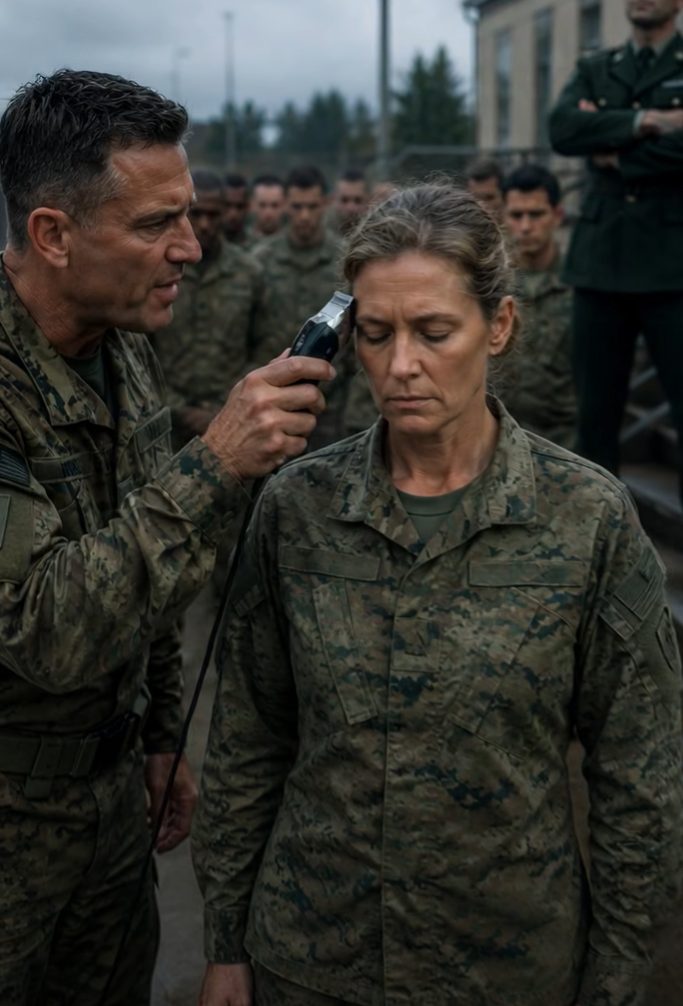
“Shave her head.”
The words landed like something cold dropped on stone. Even the younger soldiers stopped breathing. In the middle of the yard – dust on her boots, dozens of eyes waiting for her to break – the woman they wanted to humiliate lowered her chin. Not in defeat. None of them knew who she really was.
Sergeant Harlan Briggs stepped closer, dropping his voice to something that felt almost personal.
“If discipline can’t break her,” he said, “maybe shame will.”
A few soldiers looked away.
Not because they disagreed.
Because they were afraid to be seen disagreeing.
Fort Blackwood had a long tradition of teaching people silence.
—
Weeks earlier, General Marcus Hale had sat alone in his office past midnight, staring at reports that should have been impossible to ignore. Former soldiers described punishment rituals disguised as training. Supply funds vanishing into sealed budgets. Readiness numbers polished until they gleamed. Careers quietly ended the moment someone asked the wrong question.
Every inspection reached the same conclusion.
Perfect barracks. Perfect paperwork. Perfect officers with steady smiles and empty eyes.
Someone inside Fort Blackwood knew how to bury the truth before outsiders arrived. Hale needed more than rumors. He needed a witness who could survive long enough to bring something back.
That was when Colonel Evelyn Carter walked into his office and quietly volunteered.
At forty-four, she had commanded convoys through active war zones, rebuilt shattered supply chains under fire, and earned enough decorations to make younger officers stand a little straighter when she entered a room. But what she proposed made even Hale go still.
She wanted to disappear.
No rank. No protection. No history anyone could trace.
She would enter Fort Blackwood as Megan Blake – an older enlisted transfer with an unremarkable file and no powerful friends. Exactly the kind of soldier a cruel command felt comfortable overlooking, using, or destroying.
Hale refused.
“If even half of this is true,” he said, “you’d be walking into a cage.”
Carter didn’t blink.
“Then someone needs to see what happens inside it.”
Within days, Colonel Evelyn Carter ceased to exist on paper.
Megan Blake arrived at Fort Blackwood with one duffel bag, a plain uniform, and calm eyes that missed nothing.
—
Captain Derek Shaw barely glanced up when her file crossed his desk. He was polished, handsome, and lazy in the particular way of men who had decided power would protect them forever.
“Another slow transfer,” he muttered, tossing the folder aside. “Briggs can deal with her.”
That was the first mistake.
Sergeant Briggs found her outside the barracks ten minutes later. Thick-necked, sharp-eyed, with the practiced smile of a man who had made a habit of making people feel smaller, he circled her slowly – the way someone inspects equipment they already plan to discard.
“Older than I expected,” he said.
Megan kept her hands at her sides. “Yes, Sergeant.”
His smile widened.
Around them, soldiers pretended not to watch.
“You’ll learn fast here,” Briggs said. “Nobody cares what you used to be. Nobody cares what you think you deserve. At Blackwood, you earn the right to stand.”
Megan gave a small nod.
But her eyes moved – once, briefly – to the camera mounted above the administration building, angled just slightly away from the yard.
Noted.
—
Over the days that followed, Fort Blackwood showed her its real face.
A private scrubbing the same floor until his knuckles split and bled. A supply clerk trembling as Captain Shaw instructed him to correct a discrepancy in the inventory numbers. A young woman crying silently behind the laundry room because her formal complaint had somehow become a disciplinary mark on her own record.
Megan watched. Listened. Memorized names.
And every time Briggs tried to provoke her, she gave him nothing.
That was what made him hate her.
—
By Friday morning, he had assembled half the unit in the yard beneath a flat gray sky and ordered Megan to step forward.
Her boots stopped in the center of the yard.
Briggs raised a pair of clippers. The motor buzzed to life – a small, ugly sound in the silence.
Captain Shaw stood on the steps with his arms crossed, watching with the mild interest of a man who expected to be entertained.
“Last chance,” Briggs said. “Admit you’re weak.”
Megan raised her eyes slowly.
For the first time since arriving at Fort Blackwood, she smiled.
Not warmly. Not kindly. The way a door smiles when it finally unlocks.
Then the black government SUV rolled through the front gate.
And General Marcus Hale stepped out.
Nobody Moved
The clippers were still running.
That detail stuck. Briggs hadn’t turned them off. His hand was still raised, the motor still buzzing in that small, stupid way, and for about four seconds nobody in that yard did anything at all.
Shaw straightened first. Reflex. Twenty years of training telling his body to perform before his brain caught up to what was happening.
Hale didn’t look at Shaw.
He walked directly into the yard, aide at his shoulder, and stopped six feet from Megan Blake. He looked at the clippers in Briggs’s hand. Then he looked at Megan.
She hadn’t moved.
“At ease,” Hale said.
The word landed different than it usually does. Not a formality. Something else.
Briggs clicked the clippers off. The silence afterward felt enormous.
What Shaw Said Next
Shaw came down the steps with his hands open, the universal gesture of a man who has decided his best play is confidence.
“General Hale. We weren’t informed of an inspection – “
“No,” Hale said. “You weren’t.”
Shaw smiled. The smile of a man who had talked his way through inspections before, who knew which words to arrange in which order, who had spent years learning exactly how much a polished report could cover.
“Sir, what you’re seeing here is a disciplinary procedure. Entirely within – “
“Captain Shaw.”
Shaw stopped.
Hale turned to look at him for the first time. Not a long look. Just long enough.
“Stop talking.”
Shaw’s mouth closed.
Behind him on the steps, two junior officers took a small, unconscious step backward. Not dramatic. Just enough. The kind of step bodies make when they’re trying to quietly exit a situation they never wanted to be part of.
The File
Hale’s aide opened a folder.
It wasn’t a thin folder.
Carter had been filing reports for nineteen days. Not through any official Fort Blackwood channel, obviously. She’d been using a protocol Hale’s office had established for exactly this kind of operation – encrypted, routed through a dead address, timestamped automatically so nothing could be backdated or denied.
Nineteen days of names, dates, incident numbers, and budget line items.
The private with the bleeding knuckles was named Doug Farris, twenty-two years old, from Odessa, Texas. The supply clerk Shaw had pressured to alter inventory records was named Phil Garza, and he’d done it three times because the first time Briggs had made clear what happened to people who didn’t cooperate. The young woman behind the laundry room was Specialist Tara Kowalski, and her original complaint – filed eight weeks ago, before Megan Blake ever arrived – had been about something Shaw had said to her in a corridor at 2100 on a Tuesday, something she’d written down word for word and then watched get quietly reclassified as a performance concern.
Carter hadn’t just collected impressions.
She’d collected evidence.
Hale handed the folder to Shaw without a word.
Shaw opened it.
His face didn’t change exactly. But something in it went flat. The calculation behind the smile stopped calculating.
Briggs Tried
Give him this much: Briggs tried.
He stepped forward with his chest out and his voice pitched to carry. “Sir, with respect, I don’t know what that file claims, but I’ve run this unit by the book. If there are complaints, they come from soldiers who couldn’t handle – “
“Sergeant Briggs.”
Megan spoke for the first time since Hale had walked through the gate.
Her voice was different than it had been for nineteen days. Not louder. Just no longer compressed into the shape of someone smaller than she was.
Briggs looked at her. Actually looked, maybe for the first time.
“The camera above the administration building,” she said. “The one angled away from the yard. I documented that on day two. Maintenance logs show it was repositioned fourteen months ago. There’s no work order.”
Briggs stared at her.
“The supply discrepancies run back thirty-one months,” she continued. “Not three incidents. Forty-seven. The pattern matches the rotation schedule for your unit’s weekend duty assignments.” She paused. “You’ve been doing this a long time.”
The yard was completely still.
Somewhere behind the barracks, a door opened and closed and nobody turned to look.
Briggs’s jaw worked once. Nothing came out.
Who She Actually Was
Hale looked at the assembled soldiers in the yard. Maybe sixty people. Some of them had watched things happen here and said nothing, because saying something cost too much. Some of them had been the ones things happened to. A few of them had done the things.
Most of them were just tired.
“Colonel Carter,” Hale said.
Megan Blake straightened.
The reaction moved through the yard like a current through water. Invisible but felt by everyone.
Colonel.
Shaw actually looked up from the folder. His face did something complicated – the arithmetic of a man rapidly recalculating how badly he’d miscalculated.
Carter didn’t acknowledge it. She kept her eyes on Hale.
“Sir.”
“Your assessment?”
She thought for a moment. Not because she didn’t know. She’d known for about two weeks. She was deciding how to say it in a yard full of people who would have to live with whatever happened next.
“The command culture here is broken from the top down,” she said. “The enlisted personnel performed under conditions designed to grind them down, and the majority of them held. That’s not nothing.” She glanced at Farris, who was standing near the back with his hands at his sides and his face completely unreadable. “They deserve better than what they got.”
Farris looked at the ground.
After
Shaw and Briggs were escorted to separate vehicles within the hour.
Shaw went quietly. Of course he did. Men like Shaw always go quietly when the math stops working in their favor. Briggs said something to the MP who took his arm, something low and mean that the MP didn’t respond to, which was the correct call.
Hale stayed for three hours. He walked the barracks. He sat in the mess and drank bad coffee with Specialist Kowalski and two other soldiers who’d filed complaints that went nowhere, and he listened without writing anything down.
Carter changed back into her actual uniform in a supply room off the main corridor. Someone had brought it – pressed, with the insignia in the right places. She stood in front of a scratched metal mirror for a moment, just looking.
Nineteen days. One duffel bag.
Forty-seven supply discrepancies, sixty-three documented incidents, and a camera that had been pointed the wrong way for over a year.
She put on her jacket.
Farris was waiting in the corridor when she came out. He looked like he hadn’t slept right in months, which was probably accurate. He opened his mouth, closed it, tried again.
“I didn’t know,” he said. “What you were. I mean – I didn’t know anyone was – ” He stopped. “I thought this was just how it was.”
Carter looked at him for a moment.
“It’s not,” she said.
She walked past him toward the yard, where the flat gray sky had started to break up a little at the edges, thin light coming through in patches, the kind that doesn’t commit to anything.
The clippers were still on the ground where Briggs had dropped them.
Nobody had picked them up yet.
—
If this one stayed with you, pass it along to someone who needs to read it.
For more powerful stories of quiet defiance, check out She Asked the Director Not to Read the File Out Loud and My Commander Knocked My Tray Out of My Hands in Front of Everyone.



