He was invisible – until the morning Admiral Vance decided to make an example of him.
At 0500, the Naval Special Warfare mess hall was quiet except for the rhythmic drag of a mop across polished concrete. Gary moved like a shadow, head down, unhurried. To the young SEALs who passed him each morning, he had long since ceased to be a man. He was a fixture. A nickname murmured with a smirk: Mops. Nobody asked questions. Nobody cared enough to.
That changed the morning Admiral Vance walked in.
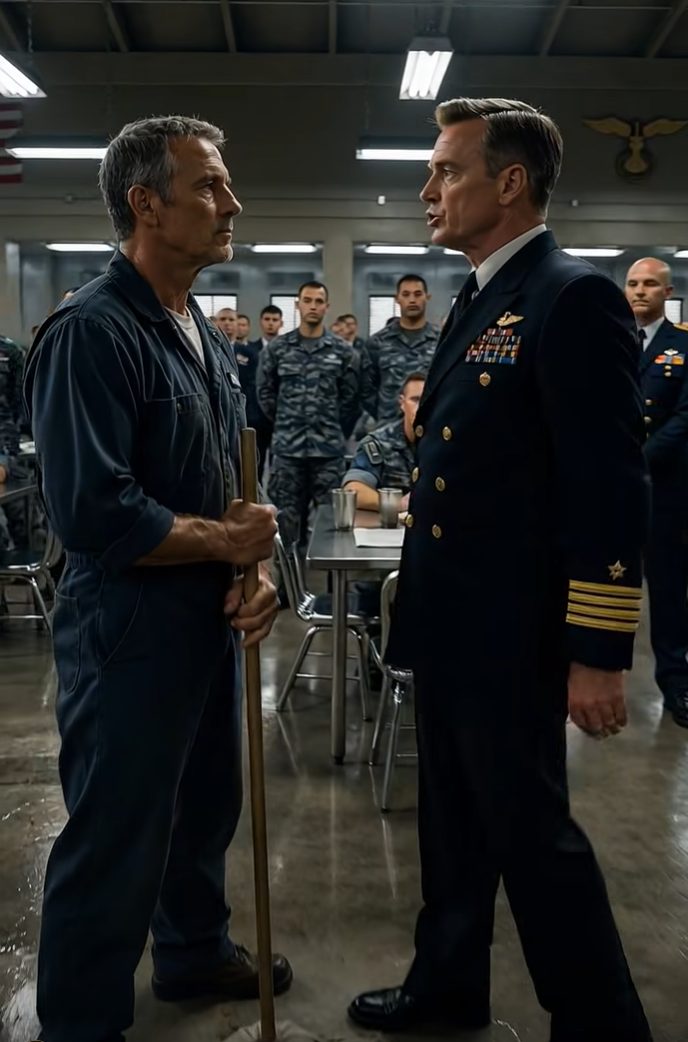
New command. Fresh authority. And an appetite to establish both. Vance surveyed the room the way a man does when he already knows he owns it – until his gaze snagged on the old janitor near the head table. Without breaking stride, he kicked the wet floor sign. It skittered across the tiles and spun to a stop.
“Hey, Mops.” His voice carried easily through the hall. Officers nearby chuckled on cue. “You missed a spot. And when an officer addresses you, you salute.”
The room went still.
Gary stopped mopping. The handle hung motionless in his grip. He didn’t answer. Didn’t look up. He simply breathed – slow, measured, deliberate – like a man who had learned long ago how to carry weight that doesn’t show.
Vance stepped closer, savoring the silence he believed he controlled.
“What’s your rank, old man? Private? Janitor?” A beat, then the punchline: “Officer of the latrine?”
Scattered laughter rose, then died awkwardly, unsure of itself.
Gary set the mop against the wall.
Then he straightened.
The transformation was neither dramatic nor loud. It was something quieter and more unsettling than that – a shift in the very gravity of the room. The tired slouch dissolved. The rounded shoulders squared. Decades of invisible weight seemed to redistribute itself into something deliberate, something earned. The hall didn’t grow louder. It grew smaller.
“My rank,” Gary said, his voice low and unhurried, cutting through the room the way a blade cuts when it doesn’t need to be raised, “is Major General.”
Silence landed like a physical thing.
Then Vance laughed – sharp, loud, wrapped in the particular arrogance of a man who has never once considered that he might be wrong.
“Major General.” He let the words hang in the air. “Mopping floors.” His lip curled. “That’s stolen valor, old man. You know what we do with that?”
Gary didn’t flinch. Didn’t blink.
“I don’t mop because I have to,” he said quietly. “I mop because it’s the only place left where I can think.”
The laughter didn’t just fade. It evaporated.
Vance’s smile held its shape, but something behind it had shifted – a hairline fracture, barely visible, spreading fast. He reached for his secure tablet, fingers moving quickly, jaw set with the focused energy of a man who needs very badly to be right.
“Let’s find out exactly who you are,” he muttered, not quite meeting Gary’s eyes.
Gary didn’t move. Didn’t speak. Didn’t need to.
He simply waited – with the patience of a man who has stood in rooms like this before, in uniforms that left no room for doubt, and watched lesser men scramble to catch up.
For the first time since he’d walked through the door that morning, Admiral Vance was no longer the most powerful person in the room.
He was just the one holding the tablet.
What the Tablet Said
The thing about a secure military personnel database is it doesn’t editorialize.
It just lists facts. Dates. Decorations. Commands held. Operations attached to, some of which still carry classification headers that make junior officers straighten up involuntarily when they see them.
Vance’s thumb moved across the screen. Stopped. Moved again.
The color left his face in stages, the way it does when a man isn’t just wrong but catastrophically, publicly, permanently wrong. First the bluster drained out. Then the certainty. Then something that might have been his sense of the morning, of the week, of his first days in this command.
Gary Caulfield. Major General, USMC, retired. Two combat tours in Vietnam. A third in a country Vance’s clearance level still didn’t fully cover. Silver Star. Two Bronze Stars with Valor. A commendation signed by a name that even now made people in certain rooms go quiet.
Retired 1987. Widowed 1994. No next of kin listed.
Vance looked up from the tablet.
Gary was watching him with the particular expression of a man who has been patient for so long that patience has stopped feeling like a virtue and started feeling like just the way his face sits.
“Sir,” Vance said.
One word. All the architecture of the morning collapsed into it.
The Reason He Was There
Nobody had actually asked Gary why he mopped floors at a Naval Special Warfare facility. Not the base commander who’d cleared him for access three years ago. Not the young petty officer who handed him his cleaning cart each morning. Not the SEALs who stepped around him without looking down.
The answer wasn’t complicated. It just wasn’t the kind of answer you’d think to ask for.
His wife, Carol, had worked on this base. Civilian staff, administrative. She’d come home every day for eleven years talking about the young men she saw in that mess hall, the ones who ate fast and quiet and left before dawn. She’d said once, over a dinner Gary barely remembered eating, that she thought those boys needed someone to look after them. Not in any way they’d accept or even notice. Just someone keeping things clean and orderly and right.
She died in March of 1994. Ovarian cancer. Fourteen weeks from diagnosis to the end.
Gary had sold the house in Stafford six months later. Drove west without a particular destination. Ended up back here, where she’d worked, where she’d been happy, where the floors needed mopping.
He’d walked in, shown his retired ID, and asked if they needed help.
They did.
That was nine years ago.
He hadn’t told anyone who he was because nobody had asked, and because the kind of man who volunteers his own biography to strangers was never the kind of man Gary had been. In the Corps, rank was something you wore. When you stopped wearing it, you stopped leading with it. Simple as that.
Besides. The floors needed mopping.
What Vance Did Next
To his credit, and this is the part that mattered, Vance didn’t try to walk it back with rank.
He didn’t manufacture a graceful exit or pretend the tablet had shown him something ambiguous. He stood there for a moment, in front of a room full of men who were doing a remarkable job of suddenly finding their coffee cups very interesting, and he did the only thing left available to him.
He pulled a chair from the nearest table, turned it around, and sat down.
“Sir,” he said again, differently this time. “I’d like to buy you breakfast.”
Gary looked at him for a long moment. The kind of look that doesn’t rush.
“I’ve already eaten,” he said.
“Then coffee.”
Gary picked the mop up from where it leaned against the wall. He looked at the wet section of floor, then at Vance, then back at the floor.
“Give me ten minutes,” he said.
He finished the section. Methodical. Corner to corner, the way he always did it. Vance sat and waited and didn’t say a word, and the men in that mess hall who witnessed it filed it away in the part of their memory reserved for things that reorder how you understand the world.
When Gary set the mop in the bucket and pulled a chair across from Vance, a petty officer appeared with two coffees before either man asked. Black for Gary. He hadn’t told anyone how he took it. Someone had noticed.
The Part Nobody Expected
They talked for forty minutes.
Not about the incident. Not about Gary’s service record or Vance’s career or the particular arithmetic of rank and humiliation that the morning had produced. They talked about Carol. About the mess hall in the eighties, when Gary had come through once on a liaison assignment and eaten here and thought it was the cleanest facility he’d seen on any base, ever, and told Carol that when he got home, and she’d laughed and said she’d pass it along.
Vance had lost someone too. His son. Not combat. The other kind of loss, the kind that doesn’t come with a flag or a citation, just a phone call and a drive to a hospital in Baltimore and then a drive home with an empty passenger seat.
Gary didn’t say he was sorry. He said, “How long ago.”
“Four years,” Vance said.
Gary nodded. Drank his coffee.
That was it. That was the whole exchange on the subject. But something in Vance’s posture changed after it, the way a man’s posture changes when he’s been carrying something alone for long enough that even two words of acknowledgment from the right person shifts the load slightly.
They didn’t become friends. That’s not what this was.
But when Vance stood up and extended his hand, Gary shook it. Firm, brief, no performance in it.
“I’ll have the wet floor sign replaced,” Vance said.
“I’ve got a spare,” Gary said.
The Morning After
The next day, 0500. Same hall. Same cart. Same polished concrete.
Gary moved through the space the way he always had, head down, unhurried. The rhythm of the mop across the floor. The squeak of rubber wheels on tile.
Two things were different.
The first: when the young SEALs came through for early chow, a few of them nodded. Not salutes, not ceremony. Just the nod one person gives another person when they’ve decided the other person exists. Small thing. Not nothing.
The second: Vance came in at 0520. Not in his dress uniform. Khakis, no cover. He got his own coffee, sat at a corner table with a folder of paperwork, and worked quietly for an hour.
He didn’t speak to Gary.
Gary didn’t speak to him.
But at 0620, when Gary maneuvered the cart past Vance’s table, Vance picked his feet up off the floor without being asked, without looking up from his papers, so Gary could mop underneath.
Gary mopped underneath.
Then he moved on to the next section.
The hall filled up around them, loud with the particular noise of men who have work to do and are ready to do it, and Gary moved through it all like he always had.
Unhurried.
Head down.
Thinking.
—
If this one stayed with you, pass it along to someone who’d get it.
If you enjoyed this, you might also like to hear about the captain who told him to sit down, or perhaps read up on Red Clay and The Ceremony.