The Ceremony
Chapter 1
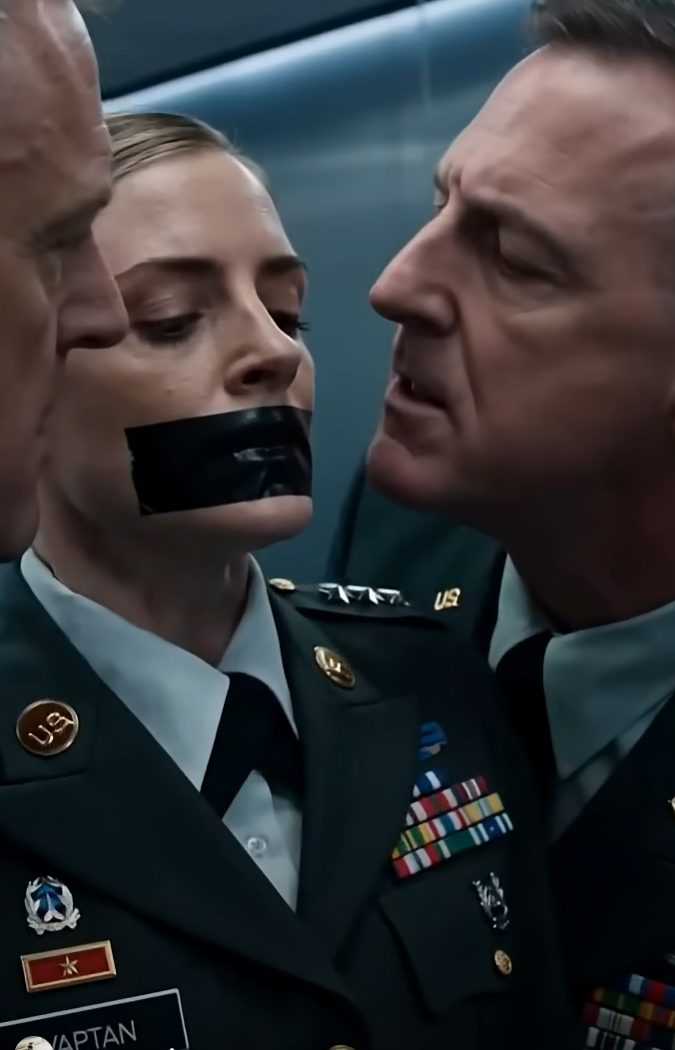
The electrical tape made a sharp, tearing sound that cut straight through the silence of the briefing room – a precise, violent little noise. Before I could flinch, Captain Marcus Vance leaned forward, his breath carrying the stale ghost of black coffee and wintergreen mints, and pressed the thick black strip directly over the bronze letters of my surname.
“There.” His voice carried that smooth, low drawl he reserved for moments of exceptional cruelty dressed up as leadership. “Now you’re nobody, Miller. Just a clean slate. Let’s see if you can remember the words when you aren’t hiding behind your daddy’s combat record.”
The room was freezing. The air conditioning in Building 3200 at Fort Meade always ran too cold, holding the windowless administrative boxes of the third floor at a temperature that made your breath catch. I stood at rigid attention, eyes locked on the small framed portrait of the President on the far wall, refusing to look at Vance or the three senior officers arranged behind the heavy oak desk. My spine felt like a rod of ice. Every muscle in my thighs trembled from the effort of staying perfectly still – heels together at a flawless forty-five-degree angle, chin tucked, shoulders pinned back.
“Sir.” The word came out clipped and hard, catching slightly in my dry throat. “The protocol for the promotional review requires the candidate to wear their standard-issued nameplate and unit insignia. Regimental standard operating procedure, paragraph four – “
“I know what the regulation says, Specialist.” Vance stepped back and folded his thick arms across his chest. He didn’t look like a man breaking a rule. He looked like a judge delivering a sentence. “But out here in the real world, we don’t always get the luxury of standard operating procedures. Sometimes you lose your identity. Sometimes the enemy strips away everything you are, and you have to prove you still know what the hell you’re fighting for. Consider this an ad-hoc situational assessment.”
Behind him, Lieutenant Colonel Thomas Blake leaned back in his leather swivel chair, the springs groaning softly beneath his weight. He said nothing. He simply watched through narrowed, watery eyes, his fingers tapping a slow, rhythmic beat against the glossy surface of a mahogany swagger stick. To his left sat Major Sarah Jenkins, the administrative chief, her face an unreadable mask of pale makeup and sharp lines. She was studying her manicured fingernails with the detached patience of someone waiting for a delayed flight, not watching a twenty-four-year-old soldier get methodically dismantled in a closed room.
“Now.” Vance stepped directly into my personal space, close enough that I could see the tiny network of broken red veins across the bridge of his nose. “From the top, Miller. The Oath of Enlistment. And don’t give me that rapid-fire, mechanical garbage you memorized from the basic training guides. I want to hear the weight of it. Every syllable. Because right now, looking at you, I don’t see a sergeant. I see a little girl playing dress-up in her dead father’s boots.”
The mention of my father hit me like a blow to the sternum.
It was an old, deep ache – a jagged piece of shrapnel embedded in my chest that had never quite stopped migrating. General David Miller had died in a dusty, unmarked ditch outside Fallujah when I was twelve years old, leaving behind a legacy that felt less like a protective shadow and more like an impossible, suffocating weight. I had spent every waking moment of my adult life trying to earn the right to wear the same uniform he had, trying to prove that the blood in my veins wasn’t just water. Vance knew that. He had served under my father a decade ago – a bitter chapter of his career that had apparently left him with a bottomless reservoir of resentment.
“I am waiting, Specialist,” Vance said, his smile widening just enough to show the edges of his teeth. “Or should we write down that you failed the oral evaluation due to a lack of emotional readiness? It’s a long walk back to the motor pool.”
I took a slow, deliberate breath through my nose, trying to steady the frantic hammering of my heart. My eyes shifted slightly – just an inch to the right – catching the reflection of the room in the massive floor-to-ceiling mirror that occupied the entire northern wall. It was a strange feature for a standard administrative space, a massive piece of dark, silvered glass that belonged in an interrogation suite rather than a promotion board office. Cold, dark, and perfectly still, it threw back the image of my own pale face, the ugly black tape covering my chest, and four officers watching me with various degrees of amusement and apathy.
They thought this was a private theater. They thought the thick concrete walls of Building 3200 could contain whatever petty cruelties they chose to inflict on a soldier who lacked the rank to fight back.
They had no idea the world was watching.
—
To understand how I ended up in that freezing room, you have to understand Fort Meade’s old logistics command.
The base is a sprawling labyrinth – Cold War-era red-brick barracks, high-security glass monoliths belonging to the intelligence agencies, and decaying administrative buildings the Department of Defense seemed to have forgotten about somewhere around 1994. Building 3200 was one of the relics. It sat on the edge of the old airfield, a low-slung, flat-roofed concrete structure that had originally served as a tactical operations center during the height of the Berlin crisis.
I had been assigned to the 742nd Military Intelligence Battalion as a logistics analyst six months prior, a transfer that was supposed to be a quiet, routine stepping stone toward my promotion to Sergeant. My record was spotless – maximum scores on my fitness tests, a stack of commendation letters from my deployment in Kuwait, and a reputation for keeping my mouth shut and my boots shined.
But I had made one critical mistake: I had noticed the numbers didn’t add up.
Two months into my tenure, while auditing the quarterly readiness reports for the regional vehicle maintenance contract – a multi-million-dollar program overseen by Lieutenant Colonel Blake and managed by Captain Vance – I found a series of recurring discrepancies. Shipments of high-grade tactical communications equipment marked as “received and deployed” at remote outposts had no corresponding shipping manifests. Invoices for heavy-duty generator parts were being paid to a logistics firm registered to a suburban post office box in Delaware, while the actual units on the line were still running on rusted components held together with zip ties and prayers.
When I brought the discrepancies to Major Jenkins, assuming a clerical error, she had taken the folder, looked at me for a long, silent moment, and said, “Specialist Miller, the military is a massive machine with many moving parts. Sometimes looking too closely at a single gear keeps you from seeing the direction the vehicle is traveling. Go back to your desk, focus on your own lane, and let us handle the macro-level logistics.”
The following week, my name was pulled from the automated promotion board. I was informed instead that I would undergo a live, in-person “exceptional review panel” due to unspecified irregularities in my personnel file. It was a classic administrative ambush. They couldn’t fire me, and they couldn’t court-martial me without exposing the files I had access to, so they decided to break me – to humiliate me thoroughly enough that I would accept a voluntary reassignment to some dead-end supply depot in North Dakota, far from their ledger books.
—
“We’re losing patience, Miller.” Vance’s voice dropped an octave, shedding its playful edge and turning into something ugly and flat. He stepped even closer, his chest nearly touching mine. “The Army doesn’t need people who think they’re special because of their last name. We need soldiers who know how to follow orders. Who know how to submit. Now look into that mirror, see what you actually are without your little badge, and repeat the damn oath.”
I stared into the glass. The black tape over my right breast pocket looked like a scar. It covered the word MILLER – the name my father had died for, the name my mother had worn on her widow’s pin until the day cancer took her too.
“I, Maya Miller,” I began, my voice trembling despite every effort to hold it steady.
“No!” Vance barked, clapping his hands together with a sound like a pistol shot. “I said you don’t have a name right now, Specialist. You start with ‘I,’ and then you leave it blank. You are a blank space until we say otherwise. Try it again.”
I looked at Major Jenkins. Her eyes were still fixed on her nails. I looked at Lieutenant Colonel Blake. He had picked up a green army-issue pen and was spinning it slowly between his thick fingers, his face completely blank, completely complicit.
They believed they were entirely safe. They believed the hierarchy of the uniform protected them from everything.
They didn’t know that three days ago, a quiet man in a charcoal-gray civilian suit had met me at a diner three miles outside the base gates. He had shown me a gold badge from the Department of Defense Office of the Inspector General and a federal warrant signed by a federal judge. He had told me that they had been monitoring Blake and Vance’s procurement ring for over a year, but lacked the inside testimony needed to prove the culture of coercion and intimidation that kept lower-ranking soldiers silent.
“We need them to do it on the record, Specialist Miller,” the investigator – a man named Henderson – had told me over a plate of untouched eggs. “We need them to display the malice. We need them to show exactly how they handle subordinates who threaten their operation. We’ve set up an observation room in Building 3200. The old briefing room has a two-way mirror. It hasn’t been active since the nineties, but our techs rewired it yesterday. There will be a full federal review panel behind that glass – three civilian prosecutors, two congressmen from the House Armed Services Committee, and a major general from the Criminal Investigation Division. Every word, every gesture, every regulatory violation will be captured on high-definition digital video.”
He had looked at me then with heavy, professional pity. “It’s going to be brutal, Maya. They are going to try to break you to protect themselves. You have to let them dig their own grave. Can you handle that?”
I had told him I could. But standing here now, with the cold air biting at my skin and Vance’s sneering face inches from mine, the reality of it felt a thousand times heavier than the promise.
“I…” My voice cracked. A single bead of sweat tracked down my temple, cutting through the light layer of regulation powder on my cheek. “I… do solemnly swear…”
“Who are you?” Vance taunted, his voice dropping to a harsh whisper near my ear. “Tell the room who you are without your daddy’s medals. You’re nothing. You’re a supply room clerk who got too smart for her own good. Say it.”
“I do solemnly swear,” I repeated, my eyes locking onto the dark mirror – staring directly into the hidden camera I knew was nestled behind the silvered glass – “that I will support and defend the Constitution of the United States against all enemies, foreign and domestic…”
“And who is the enemy, Specialist?” Vance asked, leaning his arm against the wall beside my head, abandoning all pretense of a standard military evaluation. “Is the enemy the people who run this base? The people who sign your paycheck? Because from where I’m standing, the enemy is any low-ranking nobody who thinks she can disrupt the order of this command.”
He reached out and tapped the black tape on my chest with two fingers – a demeaning, patronizing gesture that sent a jolt of pure adrenaline straight into my bloodstream. “You’re failing the test, Miller. You look like you’re about to cry. Is that what the Miller legacy looks like? A puddle of tears on a briefing room floor?”
Behind the desk, Lieutenant Colonel Blake finally spoke, his voice deep and gravelly and dripping with a terrifying, practiced authority.
“That’s enough preparation, Captain.” He folded his hands on the desk. “Specialist Miller, we have a document here – a voluntary statement regarding certain clerical discrepancies in the logistics logs. It states that you made an administrative error in your independent audit, that you misread the shipping codes, and that you wish to formally retract your previous report. Sign it, and we conclude this review. You’ll receive your promotion, your transfer to Fort Totten, and we can all forget this unfortunate misunderstanding ever occurred.”
He slid a single sheet of paper across the desk. It lay there, white and stark against the dark mahogany – a quiet little suicide note for my career and my integrity.
I looked at the paper. Then I looked back at the mirror. The reflection was sharp and clear, but in my mind I could see past it – past the glass, into the dark room beyond. I could see the men and women sitting in silence on the other side. I could see the red recording lights ticking steadily, capturing every second of this performance.
“And if I refuse to sign, sir?” I asked.
My voice had stopped trembling. It was cold now, and perfectly level.
The room went dead silent. The playful, mocking energy evaporated instantly, replaced by a heavy, suffocating hostility that made the air feel thick as mud. Vance straightened up, his face darkening, his eyes narrowing to two black slits.
“If you refuse,” Blake said softly – his voice stripped of all warmth, all humanity – “then this panel will find you permanently unfit for promotion due to gross insubordination and emotional instability. You will be reassigned to the lowest-priority maintenance detail on this post. Your security clearance will be revoked pending an investigation into your own financial records. And I will personally see to it that the name Miller becomes a joke in every command from here to the Pentagon.” He paused, letting the silence do its work. “Do you understand me, soldier?”
I stood there – a young woman alone in a uniform stripped of her name, facing four powerful people who believed they owned the world.
I took a deep, steadying breath. I felt the memory of my father’s hand on my shoulder from a lifetime ago. And I made my choice.
For more insights into the unwritten rules of engagement and unexpected power dynamics, check out The Clippers Were Already Running When the General Walked Through the Gate or consider the quiet defiance in She Asked the Director Not to Read the File Out Loud. You might also find something to chew on in My Commander Knocked My Tray Out of My Hands in Front of Everyone.