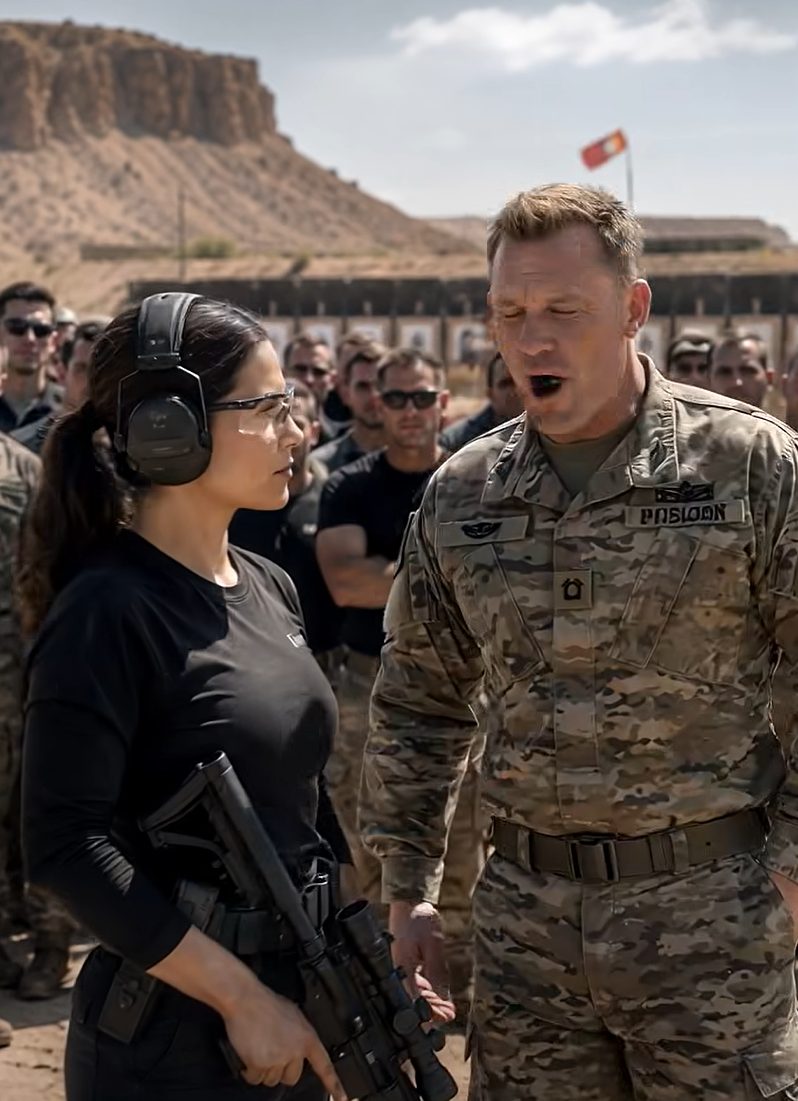
“Ma’am, the rifle’s facing the wrong way,” Lieutenant Colonel Ryan Cole called out, and his laugh cracked across the firing range like a warning shot.
More than a hundred Special Operations shooters turned to look.
The woman at the farthest lane did not flinch.
She stood beneath the pale Arizona sun with a black range shirt tucked into dark tactical pants, safety glasses hiding her eyes, and no patch anywhere on her body. No name tape. No rank. No unit insignia. Nothing that gave anyone a reason to treat her as important.
That was enough for Ryan Cole.
He stepped away from the observation line with his coffee still in one hand, smiling like the entire morning had finally given him something worth enjoying.
“Hey,” he said louder. “I’m talking to you.”
The woman continued checking the rifle.
A few operators near the benches exchanged looks.
One of them muttered, “Bad day to be lost.”
Another snorted.
Ryan heard it and smiled wider.
The desert range stretched out behind them, all gravel, dust, heat shimmer, and steel targets positioned at brutal distances. White number markers stood beside each lane. Wind flags snapped hard in the dry air. Beyond the shooting line, the 800-meter steel plate sat small and dull against a beige berm, barely more than a gray square in the glare.
The woman lowered the rifle slightly and checked the chamber with calm, practiced fingers.
Ryan tilted his head.
“First time on a military range?”
“No,” she said.
Her voice was quiet.
Not defensive.
Not embarrassed.
Just quiet.
Ryan’s smile faded half an inch.
“No?” he repeated. “Then you know people don’t just wander onto this line.”
“I didn’t wander.”
That got a few more laughs.
Ryan turned a little so the watching shooters could see his face.
He had built his career on rooms like this. Hard men. Hard rules. Hard silence when he spoke. At forty-two, he was broad, clean-shaven, sharp-eyed, and still moved like he expected people to get out of his path before his boots reached them.
He looked at the rifle in her hands.
Then he looked at her stance.
Then at the absence of rank.
“You know what’s downrange?” he asked.
“Yes.”
“Distance?”
“Eight hundred meters.”
Ryan’s mouth twitched.
“At least you can read a sign.”
Laughter spread down the firing line.
The woman did not look at the men laughing.
She set the rifle stock lightly against her shoulder.
Ryan held up a hand.
“Hold on. Don’t rush yourself. We’ve got all morning.”
“I don’t,” she said.
The laughter dropped a little.
Ryan stared at her.
“You don’t?”
“No.”
Something about the answer bothered him. It was too flat. Too clean. She wasn’t trying to win the room. She wasn’t trying to impress anyone. She spoke like the range, the men, and Ryan himself were just items on a checklist she wanted to finish.
Ryan stepped closer.
“You got a name?”
She adjusted the sling.
“Not one you need yet.”
The nearest shooters stopped smiling.
Ryan’s jaw tightened.
He glanced back at the group, then returned his attention to her with a colder expression.
“Listen carefully,” he said. “This isn’t a public gun club. This is a restricted evaluation range. Everyone here earned the right to stand on this line.”
The woman finally turned her head toward him.
Behind her clear lenses, her eyes were steady.
“I know.”
Ryan leaned in slightly.
“Do you?”
“Yes.”
“Then maybe you also know no one here has put five consecutive hits on that plate today.”
“I heard.”
Ryan laughed once.
Not because it was funny.
Because he wanted everyone to remember who controlled the air around him.
“You heard,” he said. “Great. Then you know the standard.”
“I know the old standard.”
A small silence opened.
It moved faster than the wind.
Ryan’s eyes narrowed.
“What did you say?”
The woman looked back downrange.
“I said I know the old standard.”
The operators no longer laughed easily. A few straightened. A few looked from Ryan to the woman as if the conversation had shifted into a place nobody understood yet.
Ryan set his coffee down on a steel table.
“Old standard,” he repeated. “That’s cute.”
The woman said nothing.
Ryan pointed toward the distant plate.
“That steel has humbled better shooters than whoever signed your visitor badge.”
“I don’t have a visitor badge.”
Now the range went almost still.
Only the wind flags moved.
Ryan looked at her shirt again.
No badge clipped to her waist.
No credentials around her neck.
No escort nearby.
For the first time, his voice lowered.
“How did you get on my range?”
“I walked in.”
“You walked in.”
“Yes.”
Ryan gave a humorless smile.
“Through two gates, an armed checkpoint, and a command building?”
“Yes.”
Several men turned toward the access road, as if guards might appear to explain themselves.
Ryan stepped fully into her lane now, close enough that his shadow cut across the rifle.
“You think this is a joke?”
“No.”
“You think because you watched a few training videos, you can stand beside professionals?”
“No.”
“Then what exactly are you doing here?”
The woman looked at the target.
“Saving time.”
Ryan stared.
“Saving time?”
“Yes.”
The phrase landed badly.
Nobody Laughed That Time
He waited for her to explain it. She didn’t.
Ryan looked at the men. A few of them looked back at him with expressions he didn’t like. Not disrespect. Something worse. Curiosity.
He turned back to her.
“You’ve got about thirty seconds to tell me who authorized your access before I have this range cleared and you escorted out in whatever vehicle you came in.”
She reached into the left cargo pocket of her pants and produced a folded card. No ceremony. She held it out without looking at him, the way you’d hand someone a parking stub.
Ryan took it.
He read it.
His face did not change immediately. The change happened slowly, the way ice moves, which is to say you don’t see it happening but then suddenly things are different.
He read it again.
The card carried a seal he recognized. The authorization code beneath it he recognized too, though he’d only seen that particular code twice in his career, and both times it had meant someone was coming to his unit that he did not get to question.
He handed it back.
His voice came out flat.
“Why didn’t you lead with this.”
“You didn’t ask.”
Ryan stood still for a moment. Around him, nobody moved. The wind flags snapped. One of the operators near the bench had his arms crossed now, watching Ryan with the particular blankness of a man who has learned not to show what he’s thinking when his commanding officer is in an uncomfortable spot.
Ryan picked his coffee back up.
He stepped out of her lane.
“Carry on,” he said.
It came out smaller than he wanted.
Eight Hundred Meters
She didn’t acknowledge him leaving.
She settled into position with her feet at roughly shoulder width, weight forward but not forced, the rifle seated into her shoulder like it had been there before and was just returning. Her left hand was under the forestock, not gripping, just carrying. Her right index finger stayed outside the trigger guard.
Ryan walked back to the observation line.
He didn’t say anything to the men around him. They didn’t say anything to him.
Two of them, a staff sergeant named Pruitt and a warrant officer named Garfield who had been on the range since 0545, drifted down toward the far end of the benches. Not obvious about it. Just drifting.
The woman looked downrange.
At 800 meters, in full Arizona morning sun, with a crosswind coming off the desert at somewhere between twelve and fifteen miles per hour, that steel plate was a technical problem with a specific solution. Every shooter on the line that morning had failed to find it five times running. The best run so far had been three consecutive hits before a miss. That belonged to Pruitt, who had a shelf of marksmanship trophies in his office and didn’t let anyone forget it.
She controlled her breathing.
The first shot broke clean.
The steel rang. Distant, flat, the sound arriving a beat after the impact the way it always does at that distance.
Nobody said anything.
She worked the bolt. Settled again.
Second shot.
Same sound.
Ryan’s jaw moved. He was chewing nothing.
Third.
Fourth.
Between four and five she paused. Maybe two seconds. She adjusted something with her support hand, barely a shift. Then she fired.
The plate rang a fifth time.
Done.
She stood up, cleared the chamber, set the rifle on the bench with the action open, and looked at her watch.
Pruitt said, quietly, to no one in particular: “Jesus.”
The Part Nobody Wrote Down
What happened next didn’t make it into the official evaluation report. Ryan Cole made sure of that, not out of malice but out of the particular instinct senior officers develop for keeping paperwork clean.
But Garfield told Pruitt. Pruitt told his team sergeant, a guy named Doucette who had been in long enough to remember things the institution preferred to forget. And Doucette, eventually, told the story the way old soldiers tell the stories that matter to them, which is without embellishment but also without mercy.
After the fifth shot, Ryan walked back to her lane.
He didn’t have his coffee anymore. He’d set it down somewhere and forgotten it.
He stood beside her and looked at the target card clipped to the bench. The evaluation criteria. Five hits, 800 meters, wind-variable conditions, standard issue optic, no support equipment beyond a bipod.
“How long have you been shooting this platform?” he asked.
“Eleven years.”
He nodded once, slowly.
“Where?”
She looked at him.
“Places you’ve heard of,” she said. “And a few you haven’t.”
Ryan had spent twenty years around people who said things like that. Usually it was posturing. The kind of line you deliver when you want someone to think you’re carrying classified weight you can’t discuss.
But she said it the way someone says the store’s out of milk. Just a fact. Slightly inconvenient to explain.
He looked at the rifle.
“You said you know the old standard.”
“Yes.”
“What’s the new one?”
She picked up the rifle and checked it again, even though she’d already cleared it. Habit. Deep habit.
“Six hits,” she said. “And the sixth one’s moving.”
Ryan looked downrange.
There was no moving target.
“That’s not on this range,” he said.
“Not yet.”
What Ryan Cole Did Next
He called the range cold.
He walked back to the command building, which was a squat beige structure with a gravel lot and a broken flagpole bracket that maintenance had been promising to fix for four months. He went into his office, closed the door, and sat at his desk.
He had a decision to make.
The card she’d handed him authorized her presence. It did not explain her purpose. It did not tell him who sent her, what she was evaluating, or what she intended to do with whatever she’d seen that morning.
In Ryan’s experience, that kind of authorization came from one of two places.
Either someone very high up wanted an independent assessment of his unit’s capabilities. Or someone very high up wanted an independent assessment of his unit’s problems.
He thought about the morning. The laughter. His voice carrying across the line. The way he’d stepped into her lane.
He opened his desk drawer and found the card she’d given him. He didn’t know when she’d put it there. He’d thought he handed it back.
On the back, in plain black ink, was a phone number and a single line of text:
When you’re ready to talk about the sixth target, call.
Ryan set the card flat on the desk.
He looked at it for a long time.
Outside, through the single window, he could see the range. The dust was settling. The wind flags had gone slack in the mid-morning lull.
The farthest lane was empty.
She was already gone.
What Pruitt Said
Three weeks later, Pruitt was running a night qualification when one of his younger guys, a kid named Webber who’d been in the unit eight months, asked him about the woman on the range.
Word had gotten around. It always did.
Pruitt kept his eyes on the line.
“She hit five,” Webber said. “In that wind.”
“Yeah.”
“Who was she?”
Pruitt watched a shooter work through a malfunction drill.
“Don’t know.”
“Garfield said she had some kind of special authorization.”
“Garfield talks too much.”
Webber was quiet for a moment.
“You think Cole called her?”
Pruitt didn’t answer right away.
The shooter downrange cleared the malfunction, got back on target, finished the string.
“He called somebody,” Pruitt said finally.
Webber waited for more.
There wasn’t more.
Pruitt marked the scorecard and moved to the next lane, and the night qualification continued, and the wind picked back up off the desert the way it always does after dark, and the steel targets stood at their distances in the dark, and somewhere out past the 800-meter berm the ground was flat and empty and went on for a long time.
Plenty of room for a moving target.
If you know someone who’d enjoy this one, send it their way.
For more tales of unexpected twists and powerful women, check out He Reached for Her Hair and Learned Who She Was Too Late, My Lieutenant Told Me to Get on My Knees in Front of the Whole Cafeteria, and The General Asked My Kill Count as a Joke. He Stopped Laughing at Seventy-Three..