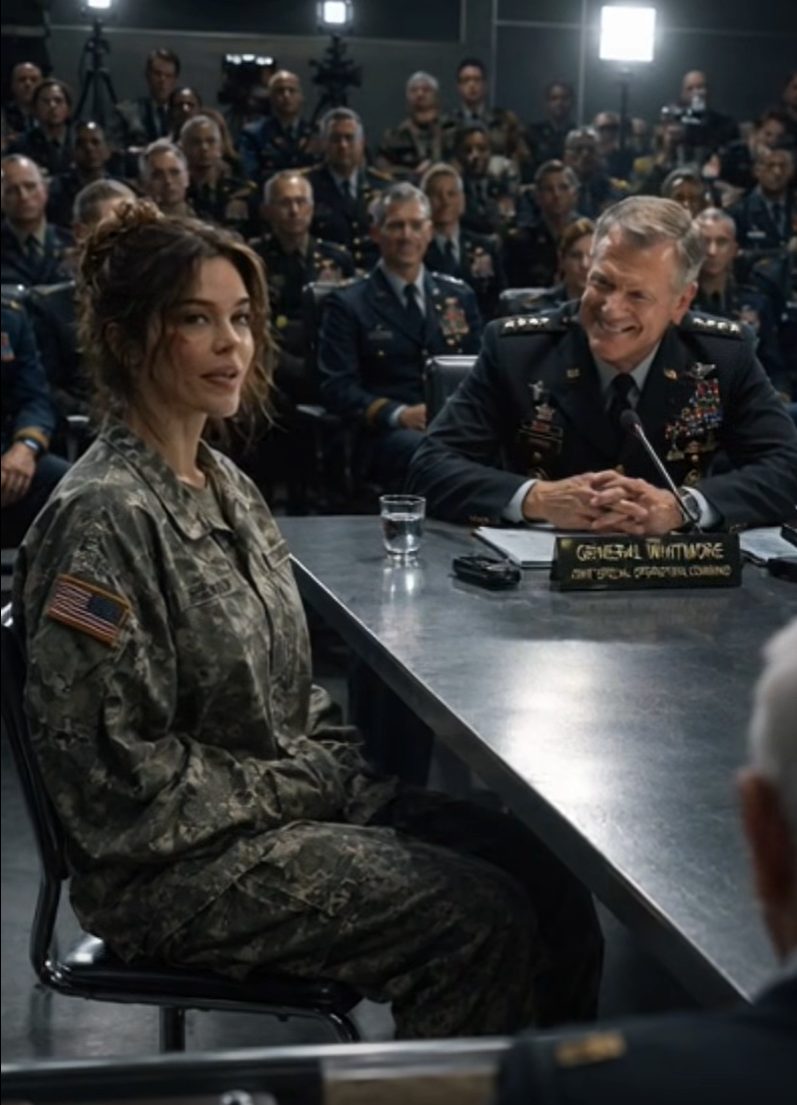
“Answer the question, Sergeant – unless you can’t.”
“Careful, General… you might not like the answer.”
Staff Sergeant Tessa Brennan sat alone at the cold metal table. No medals adorned her chest. No lawyer stood at her side. Just a young woman in a uniform that seemed a size too large – quiet, still, and completely unreadable.
Across from her, General Whitmore smiled for the cameras, the kind of smile meant to control a room. To him, the tribunal was theater – a formality he intended to end quickly, with her humiliation as the closing act.
“Let’s not drag this out,” he said with a low chuckle, leaning into the microphone. “So, Sergeant… what’s your confirmed kill count? One? Maybe two?”
A ripple of laughter spread among the officers. They expected her to shrink under it. Tessa did not flinch. Did not blink. She held his gaze without hesitation.
“Seventy-three.”
The laughter collapsed into silence. The temperature in the room seemed to drop.
“Excuse me?” The General’s smile faltered, skepticism creeping in. “Seventy-three? That’s impossible. You’re an analyst.”
Tessa leaned forward slightly, her voice calm – flat in a way that felt far more dangerous than anger.
“I didn’t say I shot them, General.”
From the back row, a four-star Admiral – silent for hours – suddenly shoved his chair back with a violent scrape. His composure shattered as he turned toward the cameras, panic written across his face.
“Cut the feed!” he roared, lunging toward the stenographer. “Shut it down – now!”
The General blinked, thrown off balance. “Admiral? What is going on?”
The Admiral slammed a heavily redacted file onto the desk, his hands trembling.
“You fool,” he snapped. “This hearing was never supposed to happen. Do you have any idea what she is?”
The General opened the folder. His eyes scanned the first line – and all color drained from his face.
What Nobody in That Room Knew
The tribunal had been scheduled for a Tuesday. Room 14-C, Building 7, Fort Hargrove, Virginia. The kind of room designed to feel permanent – cinderblock walls, fluorescent lights that hummed at a frequency that got inside your skull, a single window painted shut sometime around 1987.
Tessa had been sitting there since 0630. An hour and forty minutes before the session started. Just her, a paper cup of bad coffee, and whatever she was thinking about, which her face gave absolutely no indication of.
The charges against her were administrative. Gross insubordination. Misappropriation of classified communication channels. Conduct unbecoming. The kind of charges you file when you want someone gone but you can’t prove the thing you actually want to prove.
Colonel Deb Marsh had filed them. Marsh, who had been Tessa’s direct supervisor for eleven months before she requested a transfer and got one inside of four days, which was its own kind of answer.
Nobody had asked Marsh why she wanted out. Nobody had asked Tessa what happened between them. The paperwork was clean, the timeline was clean, and the charges had been sitting in a drawer for six weeks before someone decided to move on them.
That someone was Whitmore.
A Career Built on Other People Underestimating Her
Tessa Brennan grew up in Rockford, Illinois. Middle of three kids. Father drove a delivery truck, mother worked the front desk at a dental office on State Street. She enlisted at nineteen, right after a semester and a half at community college that she doesn’t talk about much.
She tested into intelligence work. Not because anyone steered her there – because she scored so high on the analytical portion of her assessment that the evaluating officer, a tired warrant officer named Greer, had flagged it and passed it up the chain. Greer told her later, over bad commissary food, that he’d only flagged a score like that twice in fourteen years.
She didn’t make a thing of it. That was her way.
She spent three years doing signals work out of a base in Germany. Then two years in a joint task force that she can’t name in a setting like this, doing work that officially didn’t happen. Then a posting in the Middle East, then another one, and then she was back stateside with a desk job in Arlington that her file called “analytical support” and that her colleagues called paper-pushing.
That’s what Whitmore had heard. That’s the whole story he’d built her from.
Paper-pushing. Desk jockey. The girl with the spreadsheets.
He had not read her full file. Almost nobody had. Most of it was redacted anyway, thick black bars through entire paragraphs, sometimes entire pages. But the Admiral had read it. The Admiral knew exactly who was sitting at that table in Room 14-C, and he’d spent the last three weeks trying to find a reason to kill the hearing before it got this far.
He hadn’t found one in time.
Seventy-Three
The number sat in the room like a stone dropped into still water.
The junior officers at the far end of the table looked at each other. Nobody laughed now. The stenographer’s fingers had stopped moving.
Whitmore recovered first – or tried to. “That’s a remarkable claim, Sergeant. You understand that kind of number would require – “
“Documented confirmation from three independent intelligence sources, cross-referenced with field reports and signals intercepts, all filed through proper channels within seventy-two hours of each confirmed outcome.” She didn’t blink. “I know the standard, sir. I wrote part of it.”
That landed wrong for him. She could see it in his jaw.
“You’re an analyst,” he said again, slower this time, like the word meant something different now and he was trying to work out what.
“Yes, sir.”
“Analysts don’t – “
“Analysts identify targets, build the intelligence packages, establish patterns of movement, confirm identities, and provide the operational data that lets other people pull triggers.” Still flat. Still calm. “The person who pulls the trigger is one person. The work that makes it possible can be one person too. It was, in my case. Seventy-three times.”
The General’s aide, a young captain named Holloway, had gone completely still. He was twenty-six years old and he had never been in a room like this before. He would think about this Tuesday for a long time.
“That’s – ” Whitmore started.
“Seventy-three confirmed,” Tessa said. “The methodology is in the file. The one with the black bars.”
That’s when the Admiral moved.
The File
The folder hit the desk hard. Three inches thick, standard manila, with a classification cover sheet that had been stamped so many times in so many colors it looked almost abstract.
Whitmore opened it like a man opening something he expected to be familiar. He was not prepared for what was on page one.
His eyes moved across the first paragraph. Stopped. Went back to the beginning.
Tessa watched him read. She’d watched people read that file before. There was always a moment – usually around the third sentence – where their face did something involuntary. Whitmore’s happened at the second.
“This is – ” He looked up at the Admiral. “This can’t be current.”
“It’s current,” the Admiral said. He was standing now with his arms crossed, his back to the cameras that had, mercifully, been cut. “As of fourteen months ago.”
“She’s a staff sergeant.”
“Yes.”
“She’s twenty-eight years old.”
“Twenty-nine. She had a birthday in March.”
Whitmore looked back at the file. His thumb moved to the next page, then stopped. There are things you can’t un-know, and his hand seemed to understand that before his brain caught up.
“Why is she here?” he said. Not to Tessa. To the Admiral. “Why is she at a tribunal for – ” He glanced at the charge sheet. “Misappropriation of communication channels?”
“Because Colonel Marsh filed the charges,” the Admiral said. He said it like a man who’d been trying not to say it for weeks.
“And why did Colonel Marsh – “
“Because Marsh didn’t know.” The Admiral pulled out the chair next to Whitmore and sat down, heavily, like his legs had decided the conversation was going to take a while. “Marsh thought she had a problem analyst who was going around her to talk to people she shouldn’t be talking to. She didn’t know why. She filed charges. Standard procedure.”
“And nobody stopped it.”
“I tried.” The Admiral looked at Tessa for the first time since he’d started talking. Something in his expression that wasn’t quite apology but was in the neighborhood. “I was twelve days too late.”
What Tessa Was Actually Doing
The communication channels she’d allegedly misappropriated were direct lines to three people. A colonel at CENTCOM. A deputy director at an agency that isn’t named in this room. And a retired general who now worked for a think tank in McLean, Virginia, and who had been, for the past two years, quietly feeding information to Tessa about a procurement fraud scheme that went six levels above Colonel Marsh’s pay grade.
Tessa had been building the case for fourteen months. On her own time. Using her own analytical skills. Routing information through channels that Marsh didn’t have clearance to see, which is why Marsh thought she was going rogue.
She wasn’t going rogue.
She was almost done.
The fraud scheme involved defense contracts. Eleven of them. Totaling, at last count, somewhere north of four hundred million dollars. The names on the contracts included two sitting defense industry executives, a retired three-star, and one name that Tessa had not yet confirmed and was not going to say out loud in a room with cameras until she was certain.
She’d flagged it to the three contacts because they were the only people she trusted to handle it without burying it.
She had not flagged it to Marsh because Marsh’s husband sat on the board of one of the contracting companies. Tessa had found that out in week three and had not said a word about it to anyone.
The Admiral knew this. He’d known it for six weeks. He’d been trying to figure out what to do about Marsh, and about the charges, and about the fact that Tessa Brennan – a twenty-nine-year-old staff sergeant from Rockford, Illinois – had apparently built a federal fraud case in her spare time that three agencies had failed to build in four years.
The Room After the File
Whitmore closed the folder.
He sat with his hands flat on the table. Not moving.
Tessa watched him. She’d been watching him the whole time – not with hostility, not with satisfaction. Just watching. The way she watched everything.
“The charges,” Whitmore said.
“Will be withdrawn,” the Admiral said.
“And the case she’s been building – “
“Will be handled through the appropriate channels. Which are not this room.” The Admiral looked at Holloway, the young captain who hadn’t moved in ten minutes. “Son, I need you to step out.”
Holloway stepped out.
There were four people left in Room 14-C. Whitmore. The Admiral. The stenographer, who had been told to stop recording and who was now sitting very still, staring at her hands. And Tessa.
Whitmore looked at her.
She looked back.
“Sergeant,” he said. And then stopped. Started again. “I owe you an – “
“You don’t,” she said. Not unkindly. Just efficiently. “Sir.”
He nodded once. Slowly.
The Admiral stood up and gathered the file. He tucked it under his arm like it was something he didn’t want to put down. “We’ll be in touch, Sergeant. Within the week.”
Tessa nodded.
She picked up her paper cup, found it empty, set it back down.
Then she stood, pushed in her chair, and walked out of Room 14-C the same way she’d walked in. Quiet. Still. Completely unreadable.
The door closed behind her with a soft, ordinary click.
Whitmore stared at it for a long moment.
“How long,” he said, “has she been doing this kind of work?”
The Admiral was already halfway to the door. He paused with his hand on the frame.
“Since Germany,” he said. “She was twenty-two.”
He left.
The stenographer gathered her things and didn’t look at anyone.
Whitmore sat alone at the cold metal table, the charge sheet in front of him, the name Staff Sergeant Tessa Brennan at the top of it, and he did not move for a very long time.
—
If this one got under your skin, pass it to someone who needs to read it.
If you’re looking for more stories about unexpected twists and turns, you might enjoy reading about how one woman silenced the kennel and saved three military malinois or the time he humiliated me in front of fifty soldiers – then went pale the second he heard my last name. And for another tale of a general’s face going pale, check out what happened when they dragged me into court in chains and called me a traitor.