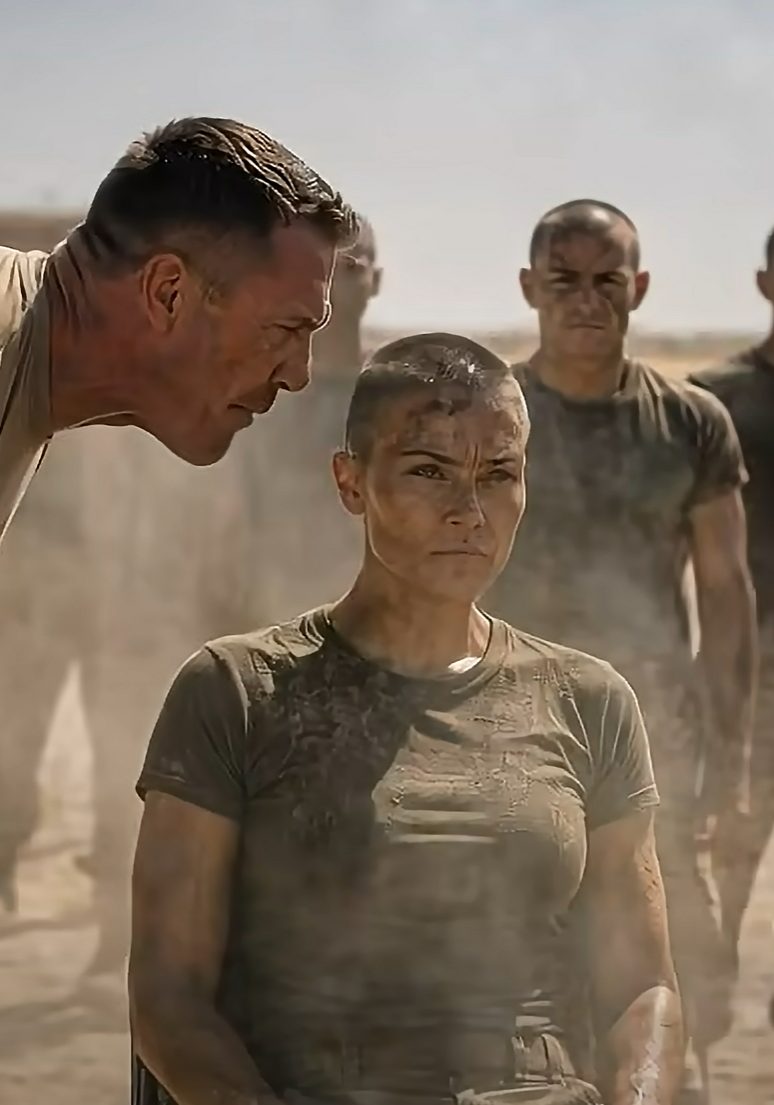
The desert never forgives weakness. That is what they told us on the first day. The sun pressed down like judgment, stripping away comfort, ego, and illusion. By the third week, the air itself felt like a test. Every breath tasted like dust and heat, and the back of my throat had forgotten what moisture felt like. I made sure to look exactly how they expected – quiet, forgettable, just another recruit trying not to fall apart. I let them believe I did not belong. Because sometimes, the best way to see everything is to be seen as nothing.
Sergeant Lance noticed me early. Men like him always do. He fed on control, on humiliation dressed up as discipline. His voice carried across the yard like a whip, sharp and deliberate. I watched how others reacted – how their shoulders tightened, how their eyes dropped. Fear had a pattern, and he knew exactly how to create it. What he did not know was that I had been watching him long before he ever noticed me.
That morning, the air felt heavier than usual. Not from the heat, but from expectation. I could feel it in the way the platoon avoided eye contact, in the way boots shifted in the sand. Something was coming. Lance walked in with that same smirk, the kind that meant someone was about to become an example. His gaze locked onto me, and for a brief second, I saw satisfaction flicker in his eyes. He had chosen his target.
“Take it all off,” he said, holding up the clippers like a weapon. The buzzing sound cut through the silence, loud and aggressive. A few recruits flinched. I did not move. I stepped forward when he pointed. The metal chair was hot from the sun when I sat down – hot enough that I felt it through my uniform, a small, stupid discomfort that almost made me shift. I did not. I kept my back straight, my hands resting on my thighs, fingers loose. The kind of stillness you have to fight for. No resistance. No reaction. Exactly what he expected – and exactly what I needed.
Before the Desert
Three months earlier, I was sitting in a conference room on the fourth floor of a building that had no sign on the outside.
The man across from me had kind eyes and a voice that never rose above a conversational tone. He slid a folder across the table and let me open it myself. I read the first page. Then the second. By the third, I understood why they had called me specifically.
His name was Lance Pruitt. Eighteen years in. Commendations going back to his second posting. The file was thick with the right words – leadership, discipline, excellence – but there were other words threaded through the internal memos, the kind of language bureaucracies use when they want to say something without saying it. Conduct concerns. Pattern of behavior. Repeated informal complaints.
The formal complaints were in a separate section. Seven of them over six years. All from recruits. All resolved quietly.
The man with kind eyes said, “We need someone inside. Someone he won’t see coming.”
I asked why it had taken six years and seven complaints.
He didn’t answer that. He just tapped the folder.
I took the assignment.
What Lance Was
By week two, I had a working picture of him.
He wasn’t stupid. That was the first thing you had to understand. Stupid men are predictable in one direction. Lance was precise. He knew exactly how far he could push before something became reportable. He knew which recruits would talk and which ones would go quiet. He knew how to make humiliation look like training and cruelty look like standards.
He had a system.
New recruits came in already afraid – that part was standard, that part was the desert doing its work. But Lance accelerated it. He’d pick two or three in the first week, put them under pressure that had nothing to do with performance. Make them small. And then, once they were small, he’d build them back up just enough to keep them compliant. Not confident. Compliant.
The ones he couldn’t break, he isolated. Made the others watch what happened to someone who didn’t fold.
I watched him do it to a kid named Garrett Fischer. Twenty-two years old, out of rural Ohio, hands like he’d been working since he was ten. Good instincts. Quiet strength. Lance clocked him in the first four days and spent the next two weeks dismantling him piece by piece. By the time I arrived in week three, Garrett barely made eye contact with anyone.
That was the other thing Lance was good at: making sure no one talked to each other about what was happening. Isolation inside a group of forty people. It’s harder to do than it sounds, and he did it without any visible effort.
I wrote two pages of notes that night, lying on my bunk with a small flashlight and a notebook that looked like a cheap personal journal. The kind recruits keep. The kind no one looks twice at.
The Chair
The clippers were loud.
Lance worked slowly. That was deliberate. He wasn’t in a hurry. The whole point was the duration, the audience, the performance of it. Forty recruits standing in loose formation, nobody looking directly at me, everybody watching.
I felt the first pass across the back of my skull. The hair came off in strips. It was warm from the blade. I kept my eyes on the middle distance, on nothing in particular, the way you look when you’re waiting for a bus.
Lance said something. I don’t remember the exact words – something about standards, something about how some people couldn’t even maintain basic grooming without being corrected. The words weren’t the point. The tone was. He wanted the room to feel the hierarchy, to feel him at the top and me somewhere below the floor.
Garrett Fischer was three rows back. I’d angled my position in formation over the past week so that I had a sightline to him most mornings. Old habit. I wanted to see how recruits responded to Lance’s performances, and Garrett was the most useful data point because Lance had already worked on him. He was the before-and-after in one person.
Garrett was looking at the ground. His jaw was tight.
The clippers went over my head again. Lance said something to the recruit standing nearest to me – something low, almost a joke, the kind that invites laughter and punishes you if you don’t give it. A few people did the obligatory half-laugh. The sound of people managing their own fear.
I sat still.
The whole thing took maybe six minutes.
When it was done, Lance put his hand on top of my bare head and gave it a single pat. Like a dog. Then he walked away.
I stood up, ran my palm across my scalp once, and rejoined formation.
That night I added four more pages to the notebook.
What I Was Actually Collecting
The public moments were almost secondary.
What I needed was the pattern. Lance was careful about the obvious stuff – he’d been doing this long enough to know where the cameras were, metaphorically speaking. The scalp incident looked like a grooming correction. Aggressive, humiliating, but technically defensible. That’s how he’d survived seven complaints.
What he couldn’t control was the accumulation.
I tracked everything. The specific language he used with Garrett versus the language he used with recruits he’d already broken. The timing of his pressure campaigns – always heaviest in the first and third weeks, when recruits were most disoriented. The way he used food and sleep indirectly, never directly ordering deprivation but creating conditions where it happened. The recruits he favored and why – and the pattern there was its own document.
I also talked to people.
Not about Lance. Not directly. But in the small hours, when the desert got cold and people stopped performing, conversations happened. I was good at being the person people talked to. I asked about home, about why they’d enlisted, about what they wanted after. And then I listened for the other things, the things they said around the edges.
Garrett told me about the first week, about a specific morning where Lance had made him do something that wasn’t in any training manual and wasn’t survivable as a formal complaint because nothing physical had happened. Nothing Lance could be written up for. But Garrett had stopped sleeping properly after that, and he said it in a way that meant he hadn’t told anyone else.
I wrote it down that night. Not his name. Just what happened, and when, and where, and what Lance had said.
That was the piece I’d been missing. The thing that didn’t show up in any of the seven prior complaints because the recruits who experienced it either didn’t recognize it as reportable or didn’t trust the process enough to try.
The Folder Gets Thicker
By week five, I had enough.
Not enough to feel good about. Enough to do what I’d come to do.
The notebook went out in a sealed envelope on a Tuesday, through a channel that looked like a personal letter home. The man with kind eyes had a copy on his desk by Thursday. I know because he sent back a single word through the same channel.
Confirmed.
What happened after that was not my department. I stayed through the end of the cycle because pulling me early would’ve raised questions, and questions would’ve muddied the process. So I finished the training. I ran the drills. I ate the food and slept badly and kept my scalp shaved because it was easier than growing it back for three weeks.
Lance never changed. That was the thing about men like him – they didn’t have an instinct for danger because they’d never been in real danger from below. He kept running his system. Kept making examples. The week before the cycle ended, he went after a new recruit, a woman named Deborah Park, with the same careful precision he’d used on Garrett.
I documented that too.
The Last Morning
The final day of the cycle, Lance did his usual address. Standing in front of the formation, full posture, the voice that carried. He talked about what it meant to have survived the training. About what the desert had taken from us and what it had given back.
He believed it, I think. That was the strange part. He genuinely believed he was building something.
I stood in formation and listened and kept my face neutral.
Two weeks later, he was pulled from duty pending a formal investigation. The investigation took four months. At the end of it, eighteen years of commendations weren’t enough to outweigh a documented pattern with corroborating testimony from six recruits, including Garrett Fischer, who I’d quietly told – after the cycle ended, after I was clear – that there was a process, and that his account mattered, and that he wouldn’t be the only one.
I don’t know what Garrett did with that. It wasn’t my job to know.
What I know is that Lance Pruitt sat in a metal chair in a conference room somewhere, in front of people with folders, and had to answer for six years of careful, deliberate cruelty dressed up as discipline.
I hope the chair was hot.
—
If this one stayed with you, pass it on to someone who’d get it.
For more tales of unexpected turns and powerful comebacks, check out She Walked Into a Military Training Room and Asked One Question That Ended Careers or see what happened when He Slapped Her in Front of Two Thousand Troops. Then Nobody Moved.. You might also enjoy the story of She Told Him She Was “Saving Time.” He Was Still Laughing When She Shot..