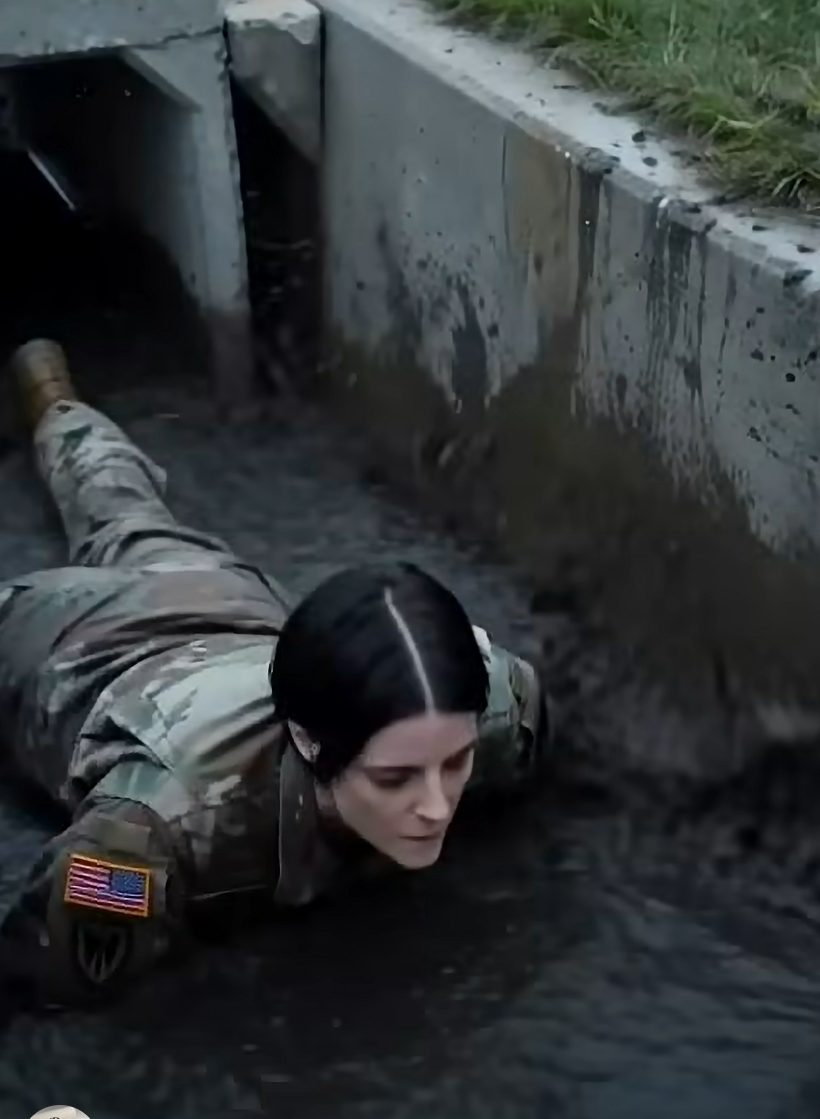
They pushed a quiet female soldier into a freezing mud ditch to cover up their crimes, completely unaware that she was hiding a legendary four-star general’s last name – and his tactical federal team was already at the front gates.
Chapter 1: The Weight of the Mud
The water in the drainage ditch tasted like diesel fuel, rusted iron, and the bitter red clay of North Carolina.
When Specialist Clara Vance hit the bottom, the impact knocked the air clean out of her lungs. A sharp, hot pain flared in her left shoulder where it slammed against the jagged concrete culvert, but she didn’t let out a single sound. She lay there for a long moment, staring up at the gray, overcast sky, feeling the freezing water seep through the heavy seams of her Operational Camouflage Pattern uniform, soaking her to the bone.
Above her, the laughter sounded hollow, echoing sharply against the concrete walls of the trench.
“Look at that,” Specialist Brody Jax sneered, spitting a dark stream of tobacco juice onto the dying winter grass just inches from Clara’s face. “The high-and-mighty Vance finally found her proper place. Down in the gutter where the rats live.”
Jax was a massive man, built like a concrete block wall, with a fading, poorly drawn tattoo of a coiled pit viper running up his right forearm. He smelled of stale energy drinks, cheap cigarettes, and dried sweat, his face permanently twisted into a bully’s easy, consequences-free grin. He was twenty-four, a high school football washout from a small town in Georgia who had only joined the Army because a judge gave him a choice between a uniform and a jail cell. He was the kind of soldier who only felt big when he was making someone else feel small. His strength was his sheer physical presence; his weakness was a volatile, fragile ego that shattered whenever someone challenged his illusion of dominance.
Standing right next to him was Staff Sergeant Marcus Miller, the squad leader. Miller didn’t laugh. He just stood there, his arms crossed tightly over his chest, his wintergreen dip tucked neatly into his lower lip.
Miller was a career soldier whose ambition had curdled into venom years ago after being passed over for promotion to Sergeant First Class twice. At thirty-six, he possessed a cruel, magnetic authority over the weaker-willed men in the platoon. He knew how to manipulate the system, how to hide his tracks, and how to make a junior soldier’s life a living hell without ever leaving a paper trail.
In his right pocket, he always kept a pristine, gold-plated Zippo lighter – a trophy he’d stolen from a deceased private’s footlocker during his last deployment to Kandahar. It was a subtle, daily token of his complete lack of a moral compass, a reminder to himself that in this world, the ruthless take whatever they want from the weak.
“You brought this on yourself, Vance,” Miller said, his voice flat, devoid of any human warmth. “You wanted to play the hero. You wanted to run your mouth about inventory discrepancies to the logistics clerk. In my squad, we protect each other. We don’t have room for snitches.”
A few feet behind them stood Private First Class Sarah “Pip” Pippin. She was holding Clara’s dropped patrol cap in her trembling, grease-stained hands. Pip was a quiet, painfully thin twenty-one-year-old who constantly chewed on the cuffs of her uniform sleeves until the threads unraveled. She didn’t want to be here. She hated the cruelty, she hated the corruption, but she was absolutely terrified of Miller.
Pip’s memory was defined by a single, desperate reality: she had a younger brother named Tommy with Down syndrome back home in Ohio, and she sent every single cent of her meager paycheck to her single mother to pay for his specialized medical therapy. Her strength was her profound empathy and her talent for administrative organization, but her weakness was a paralyzing fear of authority. She couldn’t risk her career, her rank, or her clearance. So she stayed silent, a passive, weeping accomplice to the rot eating away at the unit.
Clara slowly pushed herself up onto her elbows. The freezing, oily mud sucked at her combat boots, trying to hold her down. Her left cheek was stinging, scraped raw by the coarse gravel at the bottom of the ditch.
She looked up at the three of them. Her face was an unreadable mask of absolute, chilling calm.
For six long months, she had endured their subtle, systematic torments. It had started small: extra guard shifts on holiday weekends, missing mail from her few relatives, sabotaged gear during pre-combat inspections, and cruel whispers that followed her like a foul odor into the chow hall. They thought she was weak because she didn’t complain to the chain of command. They thought she was an easy target because she never threw a punch back or raised her voice.
But Clara wasn’t hiding from them. She was hiding from her own name.
Beneath her uniform shirt, hanging right next to her standard-issue dog tags, was a faded silver ring on a thin, sturdy steel chain. It had belonged to her mother, Sarah Vance, who had passed away from aggressive pancreatic cancer five years ago while Clara’s father was deployed to an undisclosed, highly classified location halfway across the world.
Clara had joined the Army under her mother’s maiden name, requesting a manual override on her initial entry administrative paperwork to keep her true lineage obscured from her local command. She had wanted to escape the suffocating, monolithic shadow of her family’s legacy. She wanted to prove to herself, and to the memory of her mother, that she could survive the harshest corners of the world on her own merit, without a powerful last name protecting her.
But looking up from the freezing mud at the smirking, arrogant face of Marcus Miller, Clara realized a fundamental truth about human nature. Some men couldn’t be reformed by patient endurance. Some men couldn’t be reasoned with through proper channels. They could only be utterly broken by reality.
She slowly reached down to her left wrist, wiping a thick smear of dark mud away from the rugged face of her black Casio watch. The digital numbers blinked back at her through the grime. It was exactly 1459 hours.
“Miller,” Clara said, her voice dropping into a low, crystalline tone that cut straight through the biting North Carolina wind. “Jax. You have exactly thirty seconds to apologize to me. And you have thirty seconds to reach down and pull me out of this ditch.”
Jax let out a loud, barking laugh, slapping his heavy thigh. “Oh, man! Hear that, Sergeant? The private is giving us orders! What are you gonna do, Vance? Write a strongly worded letter to the battalion commander? Call your mommy? Oh, wait, I forgot – your file says you ain’t got one.”
Miller’s eyes narrowed slightly. He didn’t laugh. Something in Clara’s voice – a total, unnatural lack of fear, a freezing composure that didn’t belong to a twenty-two-year-old specialist – made the hairs on the back of his sun-baked neck stand up. For a split second, an old survival instinct from his early days in the infantry whispered that he was stepping on a landmine.
But his arrogance, fueled by years of getting away with petty crimes and logistics fraud, quickly took over. He stepped closer to the slippery edge of the ditch, looking down at her like she was a minor inconvenience.
“You don’t dictate terms to me, Specialist,” Miller hissed, leaning over. “You’re nothing in this motor pool. You’re a body in a uniform that I own until your contract is up. You’ve got ten seconds before I decide to leave you in this ditch until the morning accountability formation. Let’s see how tough you are after a night below freezing.”
Clara kept her eyes locked on the digital display of her watch.
Twenty seconds.
In the silence of her mind, she thought about her father. General Raymond Vance. A man whose name was whispered with absolute terror and profound, unyielding respect through the highest corridors of the Pentagon. He was the newly appointed Director of the Joint Federal Investigation and Corruption Task Force (JFICTF) – a ruthless, autonomous watchdog agency created by the Department of Defense to tear down corrupt officers, dismantle black-market military supply rings, and enforce the absolute letter of federal law without regard for rank or political fallout.
He was a cold, distant father who had put his duty above his own family for three decades, a man who had missed birthdays, anniversaries, and his wife’s final breaths because he was hunting monsters in the dark. Clara had resented him for it for years. She had despised his rigidity. But she had never, not once, doubted his absolute, terrifying commitment to justice.
Before she shipped out to this duty station, her father had sat her down in his austere, wood-paneled study in Alexandria. He had looked at her with eyes that had seen the worst of humanity and said, “Clara, the world is full of men who treat power like a personal piggy bank. If you find them, you give them one chance to choose the right path. Just one. Because when I come, I do not bring mercy. I bring the law.”
Clara had begged him not to interfere with her career. She had demanded to be left alone to prove herself.
Well, she had her answer now. She was strong enough to survive the mud. She was strong enough to bear their cruelty without breaking. But these men… these men weren’t strong enough to survive the category-five storm that was about to hit this base.
Ten seconds.
Pip stepped forward, her combat boots clicking nervously against the gravel. Her voice was a tiny, frantic squeak that trembled with impending panic. “Sergeant… maybe we should just help her up. Seriously. Someone might see us out here by the perimeter of the training grounds. If Chief Reyes or the First Sergeant catches us doing this – “
“Shut up, Pippin,” Jax snapped, not even bothering to look back at her. He took another step toward the ditch, his face hardening. “She ain’t doing nothing. Look at her. She’s terrifying, ain’t she? Just a little girl playing soldier.”
Five seconds.
Clara let her arm fall slowly to her side into the freezing water. She looked up at Miller, a faint, razor-sharp smile finally touching the corners of her split lips. It wasn’t a smile of anger or petty defiance. It was a smile of absolute, terrifying finality.
“Time’s up,” Clara whispered.
Before Jax could utter another mocking insult, before Miller could tell her to shut her mouth, the heavy winter air was suddenly ripped apart.
A high-pitched, deafening scream shattered the quiet of the afternoon. It wasn’t the standard, rhythmic, testing chirp of a routine base siren. It was the continuous, rising-and-falling, bone-chilling wail of a Tactical Level-IV Emergency Federal Lockdown.
The sound tore through the pine trees, vibrating deep inside the marrow of their bones.
Jax froze mid-stride, his arrogant laugh dying instantly in his throat. Miller spun around on his heel, his hand instinctively dropping toward his empty thigh holster, his face instantly tightening into a mask of military alertness. Pip dropped Clara’s muddy patrol cap straight into the grass, her hands flying up to cover her ears as the massive decibels blasted from the giant voice towers scattered across the isolated motor pool.
Then came the rumble.
It started as a low, deep vibration in the earth beneath their boots, a heavy, synchronized thudding that sounded like an approaching, apocalyptic thunderstorm. Down the long, gravel access road that led directly from the main security gates of the installation to their platoon’s isolated maintenance bay, a massive, unbroken convoy appeared.
These weren’t standard-issue, olive-drab army transport trucks.
Leading the tactical pack were four midnight-black, heavily armored civilian SUVs, their grilles cut deep with flashing blue and red emergency strobe lights that sliced through the gray afternoon gloom. Behind them rolled three massive, heavy tactical armored vehicles packed to the brim with federalized Military Police wearing sleek, black federal tactical vests, their customized carbines held at a disciplined, terrifying low-ready position.
The convoy didn’t slow down for the concrete speed bumps or the warning signs. They tore through the motor pool’s chain-link gates, their massive tires screeching violently against the cold asphalt, kicking up huge, blinding plumes of red dust, gravel, and exhaust fumes.
“What the hell is that?” Jax muttered, his face turning an asymmetric shade of pale as he stepped back three full paces from the edge of the ditch. “Is that CID? Why the hell are they coming to our bay? We didn’t do nothing that big.”
Miller didn’t answer. His eyes were wide, fixed on the prominent markings on the sides of the armored vehicles. His breath hitched in his throat.
The convoy swerved with flawless, military precision, executing a high-speed tactical containment formation. Within seconds, they had completely surrounded the maintenance bay, blocking every single exit, every escape route, and pinning Miller’s squad against the concrete culvert.
Soldiers from neighboring platoons dropped their heavy wrenches, impact guns, and clipboards, standing frozen as federal agents began spilling out of the black vehicles, immediately establishing a hard, unyielding security perimeter with weapons raised.
The heavy, reinforced door of the lead black SUV swung open.
A man stepped out into the biting cold wind. He didn’t wear the standard camouflage uniform of the line units. He wore a crisp, flawlessly tailored dark grey three-piece suit beneath a heavy, knee-length black wool overcoat. On his shoulders, even from fifty yards away, the four silver stars of a full United States Army General gleamed with a brilliant, blinding authority against the bleak winter afternoon.
His hair was cropped short, silver at the temples, and his face looked like it had been carved out of a block of unyielding New England granite.
General Raymond Vance looked at the chaotic, filthy scene before him, his piercing grey eyes scanning the maintenance bay with terrifying, clinical precision. Behind him, a team of twenty federal investigators in windbreakers emblazoned with the gold letters JFICTF began offloading heavy, tamper-evident plastic crates of federal evidence warrants and digital forensic scanners.
The base speakers suddenly crackled to life with a deafening blast of static, the base commander’s voice sounding incredibly strained, panicked, and breathless over the installation-wide intercom:
“All personnel, freeze exactly where you are. Secure all electronics immediately. Do not touch any computer terminals or logistics logs. This installation is under an immediate Federal Administrative Seizure and Operational Lockdown by direct order of the Secretary of Defense. Repeat, do not move. Stand down.”
Miller’s hands began to shake violently. The gold-plated Zippo lighter in his right pocket suddenly felt like a heavy block of solid ice pressing against his thigh. His mind raced, cataloging the thousands of dollars of stolen night-vision equipment, the black-market diesel sales, and the falsified inventory logs he had ordered Pip to sign over the last six months.
He looked down into the dark drainage ditch, his wide, terrified eyes locking onto Clara.
The quiet, compliant, unremarkable private was now slowly, deliberately standing up in the freezing mud. She didn’t look broken. She didn’t look defeated.
She wiped the dirty, diesel-tinged water from her pale face with the back of her sleeve, her posture shifting from a submissive posture to a rigid, commanding stance that mirrored the four-star general who had just stepped out of the black SUV. Her eyes were cold, steady, and blindingly bright with the fire of an approaching executioner.
“Thirty seconds,” Clara said softly, her voice carrying clearly through the sudden, terrified silence of the motor pool as she looked up at her trembling squad leader. “I told you.”
The Moment He Understood
Nobody moved.
Not Jax, whose big hands were suddenly doing nothing useful at his sides. Not Pip, who had taken three small steps backward and pressed herself flat against the corrugated metal wall of the maintenance bay like she was trying to disappear into it. Not the dozen soldiers from the neighboring platoon who had drifted out of the bay doors to watch, their breath fogging in short, shallow bursts in the cold air.
Miller was staring at the general.
The general was not staring at Miller.
He was looking at Clara.
Just looking. No expression. No wave. Nothing that would register as warmth to anyone watching. But his grey eyes tracked her as she climbed out of the ditch one boot at a time, her soaked uniform dragging heavy with mud and ice-cold water, and there was something in the set of his jaw that shifted by about two degrees. Anyone who didn’t know Raymond Vance would have missed it entirely.
Clara knew it. She’d spent twenty-two years learning to read that face.
She got her second boot up onto solid ground, straightened to her full height, and pulled her shoulders back. Mud dripped from her elbows. Her cheek was still bleeding a little where the gravel had scraped it. She looked like she’d been through something genuinely terrible, and she stood there like it was nothing.
One of the federal investigators, a compact woman with a silver lanyard and a tablet computer, broke away from the main group and walked directly to Miller. She didn’t introduce herself. She held up a printed document and said, “Staff Sergeant Marcus Allen Miller. You are the subject of Federal Warrant 7-Delta-119 under the Uniform Code of Military Justice and the Military Extraterritorial Jurisdiction Act. You will not speak. You will not reach for any personal items. Put your hands where I can see them, please.”
Please. Like it was a suggestion. It wasn’t.
Miller’s hands came up slowly. The color had drained completely out of his face. He looked like a man who’d been running a long time and had just realized the road ended at a cliff.
“I want a JAG officer,” he said. His voice cracked on the last word.
“You’ll have access to counsel at the processing facility,” the investigator said, already moving behind him with zip cuffs.
Jax took one look at the federal agents fanning out around the bay and made a decision that was, in hindsight, the worst one of his life. He turned and ran. Full sprint, toward the gap between the maintenance bay and the perimeter fence, his big legs churning up gravel.
He made it about forty feet.
Two MPs cut him off from the left. A third came around the corner of the bay at a dead run and hit him from the right. Jax went down hard on the asphalt, and the sound it made was not a good sound. He didn’t get back up on his own.
Pip hadn’t moved. She was still pressed against the wall, both hands over her mouth, watching. Her eyes were red and wet.
Clara walked past Miller without looking at him. She walked past the investigators, past the MPs establishing their perimeter, past the rows of black vehicles still idling with their emergency lights cutting red and blue across the grey afternoon. She walked until she was standing six feet from her father.
He looked at her for a long moment. Then his gaze dropped to her cheek, to the blood and the mud.
“You look terrible,” he said.
“Yes, sir.”
“Are you injured?”
“Shoulder. It’ll be fine.”
He gave one short nod. “Medical evaluation. Before anything else.”
“I know.”
That was it. No embrace. No scene. Raymond Vance was not built for scenes. But he held her gaze for three full seconds before he turned back to his team, and in those three seconds Clara saw everything she needed to see. The two-degree shift in his jaw was back. She knew what it cost him to keep the rest of his face still.
She’d known since she was nine years old.
What Pip Did Next
The federal investigators worked the maintenance bay for four hours.
They pulled hard drives. They photographed the diesel storage logs, the night-vision equipment manifests, the falsified maintenance records going back fourteen months. They bagged Miller’s gold Zippo in a clear evidence pouch, labeled it, and set it in a crate with forty-seven other items. One investigator found a second set of inventory books hidden inside a hollowed-out technical manual on the shelf above Miller’s desk. She photographed it without saying a word and kept moving.
Clara sat in the back of a JFICTF medical vehicle with a corpsman named Darnell who had the quiet, efficient manner of someone who’d patched up people in worse situations than this. He cleaned the scrape on her cheek, taped her left shoulder, and told her she’d probably torn something minor in the rotator cuff. She’d need imaging.
“I know,” she said.
“You keep saying that.”
“Because I keep knowing things.”
He laughed, short and surprised, and handed her a foil blanket.
Outside, through the vehicle’s small rear windows, she watched Pip. The young private had been separated from the others and was sitting on a folding chair that someone had brought out from the bay. A JFICTF investigator sat across from her, not with handcuffs, not with a warrant. With a notepad and a bottle of water.
Pip was talking.
Clara could tell from the way her hands moved. She was talking fast, the way people talk when they’ve been holding something too long and the dam finally gives. The investigator wasn’t interrupting. Just writing.
Clara had made one phone call three weeks ago. Not to her father directly. To his chief of staff, a Colonel named Hargrove who had known Clara since she was twelve and who had the institutional memory of a man who’d watched Raymond Vance dismantle seventeen separate corruption investigations from the inside out. She’d given Hargrove the names, the dates, the approximate dollar amounts, and the name of the logistics clerk who’d first flagged the discrepancies to her. She’d also given him Pip’s name separately, with a note attached.
This one was coerced. She has a brother. Handle accordingly.
She didn’t know if her father had read that note himself. She suspected Hargrove had passed it along verbatim, because Raymond Vance didn’t do anything halfway, including reading his daughter’s notes about junior enlisted soldiers with complicated home situations.
The investigator with Pip closed her notepad, said something, and handed over a card. Pip looked at it for a long time. Then she put it in her breast pocket and pressed her hand flat against her chest for a moment, like she was checking to make sure it was real.
What It Cost
The medical imaging was done at the base hospital at 1900 hours. Partial rotator cuff tear, minor. Eight weeks restricted duty, physical therapy twice a week.
Her father was waiting outside the radiology suite when she came out. He’d taken off the overcoat. The four stars on his shoulders looked smaller indoors, somehow. Or maybe just different.
“Sit,” he said, nodding at the row of plastic chairs in the hallway.
She sat. He sat next to her, which was not something Raymond Vance did easily. He was a standing-up person. Chairs in hallways were for waiting, and he didn’t wait for things.
He waited now.
“I didn’t call you,” Clara said.
“No.”
“I called Hargrove.”
“I know. He told me.”
“I specifically asked him not to – “
“He told me that too.” Her father folded his hands in his lap. His hands were large, the knuckles scarred in the particular way that only came from decades of physical work done in cold weather. “I made a command decision.”
Clara looked at the ceiling. “Of course you did.”
“The warrant was already being drafted. The logistics clerk your unit contacted had filed a federal tip three weeks before you called Hargrove. We were coming regardless.”
She hadn’t known that part.
She sat with it for a moment. The six months of extra guard shifts, the missing mail, the sabotaged gear. The systematic, grinding pressure of it. She’d endured all of it thinking she was the only thing standing between Miller’s operation and permanent obscurity. Thinking her call to Hargrove had set the whole thing in motion.
It had already been in motion.
“You could have told me,” she said.
“You asked me not to interfere.”
“That’s not – ” She stopped. Breathed. “That’s not the same thing.”
“No,” he agreed. “It isn’t.”
The hallway was quiet. Somewhere down the corridor, a door opened and closed.
“Your mother would have told you,” he said. It came out flat, factual. Not a confession exactly. More like a man reading a line from a report about himself that he’d already accepted was accurate.
Clara didn’t answer.
“She was better at it than I am.” He cleared his throat. “The part where you tell people what’s happening so they don’t feel alone.”
She looked at him then. His profile. The granite jaw, the silver temples, the eyes that had spent thirty years staring at the worst versions of human behavior without flinching.
He was staring at the opposite wall.
“The ring,” he said quietly. “You’re still wearing it.”
“Every day.”
He nodded once. His jaw did the two-degree thing. He stood up, straightened his jacket, became General Raymond Vance again in the space of one breath.
“Eight weeks restricted duty,” he said. “Use them.”
“Yes, sir.”
He walked back down the hallway toward the exit. His footsteps were very even. Very controlled.
At the door, he stopped without turning around.
“Clara.”
“Sir.”
“You did well.”
The door swung shut behind him.
She sat in the plastic chair for another few minutes. The fluorescent light above her buzzed faintly, a tiny, irregular tick in the circuit somewhere. Her shoulder ached. Her cheek pulled tight where the tape held the gauze in place.
She reached up under her collar and found the steel chain, the silver ring, cold from a day spent in drainage water. She held it in her fist.
Down the hall, she could hear someone’s radio crackling. A duty roster being read aloud. The ordinary sounds of a base at evening, carrying on.
She let go of the ring, tucked it back against her chest, and stood up.
—
If this one stayed with you, pass it on to someone who needs to read it today.
If you’re looking for more stories about unexpected twists and turns in the military, you might enjoy reading about how one soldier’s opponent outweighed her by ninety pounds, with the whole base watching, or the time someone shaved a soldier’s scalp in front of the whole company, completely unaware of her true purpose. And for another tale of quiet power, check out how a single question asked in a military training room ended careers.