
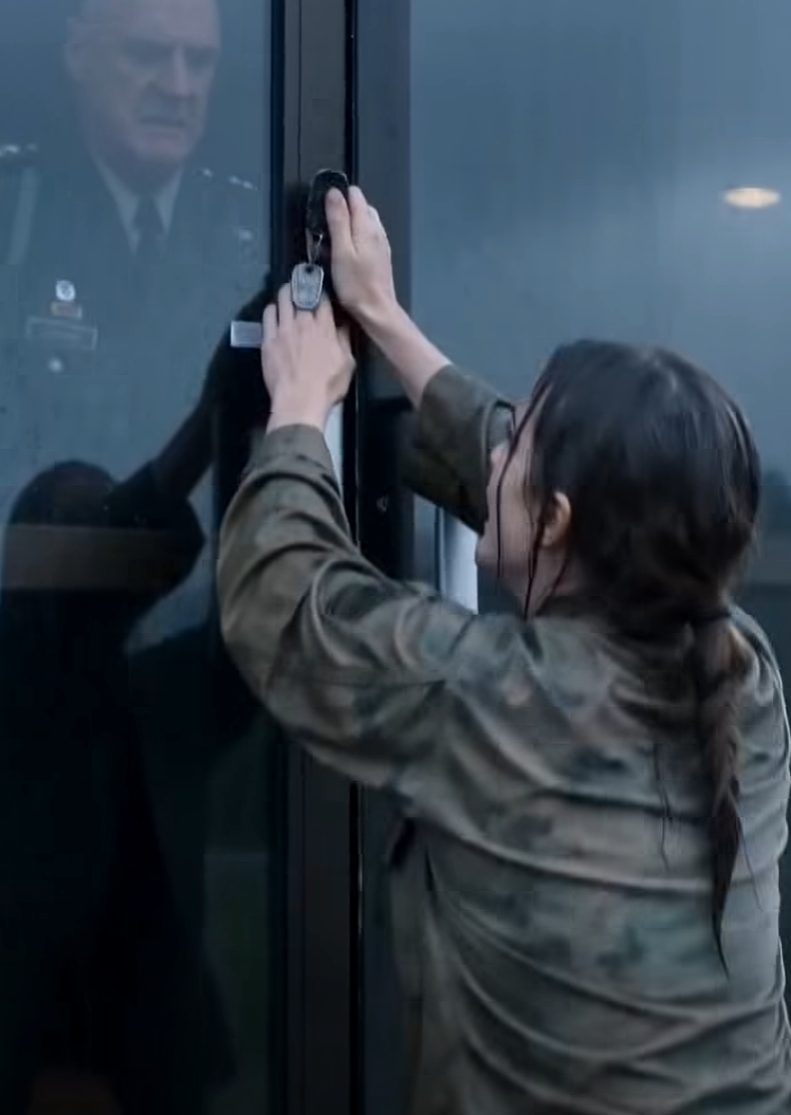
They locked the female soldier outside the chapel in the pouring rain, but nobody understood she refused to leave until the Brigadier saw her burned dog tags.
I’ll never forget the sound her fists made against the thick reinforced glass of the chapel doors.
It wasn’t just knocking. It was the desperate, rhythmic pounding of someone who had completely run out of time.
The rain was coming down in sheets that afternoon at Fort Campbell, freezing cold and relentless.
Inside the post chapel, it was warm. The air smelled of polished brass, old wood, and expensive floral arrangements.
It was a closed-casket memorial service. Highly classified. High security.
Brigadier General Vance was standing at the pulpit, delivering a eulogy for seven soldiers who had supposedly died in a helicopter crash during a routine training exercise over the Pacific.
That was the official story, anyway.
I was just a junior Military Police Corporal, standing guard inside the glass vestibule with Sergeant First Class Hayes.
Our orders were simple: Absolute lockdown. Nobody goes in. Nobody comes out until the General is finished.
But then, she appeared out of the storm.
At first, through the distortion of the rain and the thick glass, I thought she was just a local transient who had wandered onto the base.
She was covered in thick, dark mud from the knees down.
Her uniform was a torn, unrecognizable mess. It wasn’t even the standard-issue camouflage we wore stateside. It looked tactical. Unmarked.
And it smelled. Even through the heavy weather stripping of the chapel doors, a faint, metallic scent of ozone and scorched earth seeped into the vestibule.
She stumbled up the marble steps, her boots leaving dark, wet streaks.
She didn’t look angry. She looked terrified.
She grabbed the heavy brass handles of the outer doors from the outside and yanked.
They were locked. I had turned the deadbolt myself ten minutes ago.
She rattled the handles again, harder this time. Her knuckles were split and bleeding.
“Hey,” I whispered, nudging Hayes. “Look at this.”
Hayes, a massive guy with zero patience, glared through the glass. “Drunk,” he muttered. “Or one of those stolen valor nuts. Ignore her.”
But she wasn’t going away.
She pressed her face against the glass. Her lips were blue. Her eyes were bloodshot and completely wild.
She locked eyes with me.
There was something profoundly wrong with her gaze. It wasn’t the look of someone causing a disturbance. It was the look of a survivor trying to warn people of a fire.
She raised her fist and slammed it against the glass. Bang.
“Open the door!” she screamed. Her voice was muffled by the storm, but the raw panic in it made the hairs on my arms stand up.
“Ignore her, Corporal,” Hayes snapped, adjusting his duty belt.
Bang. Bang.
She hit the glass again. Harder.
A smear of crimson blood wiped across the clean pane as her knuckles broke open further.
“Sergeant, she’s bleeding,” I said, my chest tightening. “She’s wearing boots. She’s one of ours. Maybe she needs a medic.”
“She needs the psych ward,” Hayes growled. He tapped his radio. “Dispatch, we have a 10-37 at the main chapel doors. Need a patrol unit to scrape her off the glass.”
“You don’t understand!” the woman outside screamed, her voice cracking.
She wasn’t looking at us anymore. She was trying to look past us, down the long aisle of the chapel, straight toward the altar where the General was speaking.
“They’re not in the coffins!” she shrieked.
My breath caught in my throat.
What the hell did she just say?
“They’re not in the coffins!” she screamed again, slamming her bloody hands against the glass. “He lied! He left them!”
Hayes’ face went dark red. The solemn notes of Amazing Grace had just started playing on the organ inside, but her screaming was getting louder.
“That’s it,” Hayes barked.
He unclipped his baton, reached forward, and unlocked the deadbolt.
“Sergeant, wait,” I said, stepping forward.
But Hayes threw the door open. The freezing rain immediately blasted into the warm vestibule, bringing with it that horrible smell of burned metal and ash.
Before I could blink, Hayes shoved his massive hand into the center of the woman’s chest.
He didn’t just push her. He launched her.
She flew backward, her boots slipping on the wet marble, and tumbled down the first three concrete stairs, landing hard on her shoulder in the freezing puddles.
“Stay down!” Hayes roared, stepping out into the rain. “You are disrupting a military funeral! If you get back up, I will put you in the dirt!”
I stood in the doorway, frozen.
This felt wrong. Everything about this felt wrong.
She wasn’t fighting back. When Hayes shoved her, her arms hadn’t flailed wildly. She had tucked her chin and rolled. It was muscle memory. It was tactical.
She lay in the puddle for a second, the rain hammering down on her small frame.
I thought she was going to stay down. I hoped she would stay down, for her own sake.
But she didn’t.
Slowly, agonizingly, she pushed herself up onto her hands and knees.
Water poured off her face. Blood from her split lip mixed with the rain.
“I’m not leaving,” she choked out.
“Corporal, get the cuffs,” Hayes ordered me, pulling his baton back.
I stepped out into the rain. The cold hit me like a physical punch.
“Ma’am, please,” I begged her, keeping my voice low so Hayes wouldn’t hear. “Just stay down. Please. I’ll get you a medic. Just stop yelling.”
She looked up at me.
“You don’t know what he did,” she whispered.
“Who?” I asked.
“Vance,” she said.
Hearing a Brigadier General referred to by just his last name, by a woman lying in the mud, sent a spike of pure adrenaline through my veins.
“Cuffs, Miller! Now!” Hayes screamed, grabbing her by the collar of her ruined jacket.
He yanked her to her feet, preparing to spin her around and slam her against the brick wall.
But as he pulled her up, the fabric of her jacket tore open at the collar.
Something fell out from under her shirt.
It was a chain.
It dangled in the rain, heavy and twisted.
At the end of the chain were two metal dog tags.
But they weren’t silver.
They were completely warped. Blackened by extreme, unimaginable heat. The edges were melted into jagged drops of slag.
Hayes froze. Even he recognized what that meant. You don’t get dog tags that look like that from a training accident over the ocean. You get tags that look like that from a catastrophic, fuel-fed fire. From a combat zone.
The woman didn’t try to punch Hayes. She didn’t try to run.
She just reached down, grabbed the blackened metal tags in her bleeding fist, and ripped the chain completely off her own neck.
With a sudden burst of violent strength, she shoved Hayes off balance.
She didn’t run away. She ran straight back up the stairs, past me, and straight toward the open chapel doors.
“Stop her!” Hayes yelled, recovering his footing and lunging after her.
I turned and grabbed her arm just as she reached the threshold.
She fought like a wild animal, her muddy boots kicking against the doorframe, trying to pull herself inside the quiet, peaceful sanctuary.
“Let me go!” she screamed. “He has to see them!”
“Get her on the ground!” Hayes roared, tackling her from behind.
The three of us crashed onto the floor of the vestibule. My knee hit the tile hard. Hayes put all of his 220 pounds onto the small of her back, pinning her face to the floor.
“Stop moving! Stop moving!” Hayes screamed, pulling her left arm behind her back with enough force I thought I heard a pop.
But her right arm was still free.
She stretched it out across the polished tile floor, her knuckles bloody, her fingers desperately clutching those burned, blackened tags.
She was reaching toward the inner doors of the chapel.
“He left them!” she screamed, her voice echoing off the vaulted ceilings. “General Vance left them to burn!”
The organ music inside abruptly stopped.
A terrible, suffocating silence fell over the building.
The only sound was the rain pounding outside and the heavy, ragged breathing of the woman pinned to the floor.
I looked up.
Through the glass of the inner doors, I saw the congregation turning around in their pews. Hundreds of high-ranking officers, staring in shock toward the vestibule.
And then, I saw him.
Brigadier General Vance stepped down from the altar.
He marched down the center aisle, his face like thunder. His medals clinked softly against his dress uniform. He looked furious. The most powerful man on the base was coming to personally destroy whoever was ruining his service.
“You’re dead,” Hayes hissed into the woman’s ear, pressing his knee harder into her spine. “You are going to federal prison for the rest of your pathetic life.”
The inner doors swung open.
General Vance stood over us, casting a long shadow across the tile.
“What is the meaning of this?” Vance demanded, his voice low, cold, and vibrating with absolute authority. “Get this garbage out of my chapel immediately.”
“Sir, yes sir,” Hayes said, breathless, trying to pull the woman up by her hair. “She’s a transient, sir. She’s high or something. We’re removing her.”
But the woman didn’t look up at the General.
She just slid her right hand across the tile, pushing the blackened dog tags until they rested exactly at the toe of the General’s polished black dress shoes.
General Vance looked down in disgust.
He looked at the muddy boots. The torn clothing. The bleeding hand.
And then, his eyes fell on the dog tags.
I was watching his face. I will never, for the rest of my life, forget what happened next.
The furious, commanding Brigadier General didn’t yell. He didn’t order us to drag her away.
He simply stopped breathing.
All the color instantly drained from his face. His skin turned the color of old parchment. His jaw went completely slack.
His eyes locked onto the burned metal.
He slowly leaned down. His hands, which had been resting confidently on his belt, began to shake violently.
He picked up the blackened tags.
He wiped away the soot with his thumb, revealing the name stamped into the warped metal.
General Vance dropped to his knees right there on the hard tile floor, completely ruining his dress uniform, and let out a sound I had never heard a grown man make. It was a hollow, suffocating gasp.
“Let her go,” Vance whispered, his voice trembling so violently I barely heard him.
“Sir?” Hayes asked, confused, keeping his knee on her back. “She assaulted – “
“I said get your hands off her!” Vance roared, the sheer volume of his voice echoing like a gunshot in the vestibule.
Hayes scrambled backward, terrified.
The woman slowly pushed herself up off the floor. She was bruised, bleeding, and shaking from the cold.
She stood over the kneeling General.
“They waited for the extract, General,” she said, her voice dead quiet. “They waited for three days. You told them the birds were coming.”
Vance couldn’t speak. Tears were openly streaming down his face as he clutched the burned tags to his chest.
“Whose… whose are these?” Vance choked out.
The woman looked down at him with eyes that had seen the end of the world.
“You already know,” she said. “Now tell the people in that room whose empty coffins they’re crying over.”
What Happened Next Is What Kills Me
I was twenty-two years old that day.
I’d been in the Army for three years. I’d been yelled at, frozen out, run into the ground, and treated like furniture by officers who outranked me. I thought I understood the chain of command. I thought I understood how the institution worked.
I did not understand a single thing.
General Vance stayed on his knees for a long time. Longer than felt real. Longer than I thought a man with that many stars on his shoulder was capable of staying.
The congregation behind the glass doors had gone completely still. Nobody moved. I could see the faces of colonels and lieutenant colonels and their wives in black dresses, all of them pressed against the pews, watching through the glass like people watching a car fire from the highway. You know you shouldn’t look. You look anyway.
Hayes had backed himself against the far wall of the vestibule. He was holding his baton in both hands like he’d forgotten what it was for.
Nobody said anything for what felt like four full minutes.
Then Vance stood up.
He didn’t look at Hayes. He didn’t look at me. He looked only at the woman, and the expression on his face was something I don’t have a clean word for. It wasn’t guilt, exactly. Guilt is what you feel when you knock over a glass. This was older. Heavier. The kind of thing that lives behind a person’s eyes for years before it finally gets out.
“Come inside,” he said to her.
She didn’t move.
“Please,” he said.
She studied him for another second, rain still dripping off the ends of her hair, blood drying on her chin. Then she walked through the inner doors.
Vance followed her.
The doors swung shut behind them.
What I Found Out Later, Piece by Piece
I never learned her name that day. I asked Hayes afterward and he told me to shut my mouth and write up the incident report as a 10-37, unauthorized civilian disturbance, resolved without arrest. That was the official version.
But Fort Campbell is not a large place. And soldiers talk.
Over the next three weeks, working the same rotation, I started picking up pieces.
The crash that killed the seven soldiers had not happened over the Pacific. The official coordinates in the report were fabricated, which anyone in aviation could tell you if they looked at the flight logs long enough. The actual location was somewhere else entirely. Somewhere the U.S. government was not officially operating at the time.
The extraction that was supposed to come on day one had been delayed. Then delayed again. Then quietly cancelled, with a notation in the mission file that all personnel were confirmed KIA at the crash site.
Three of them were.
Four of them weren’t.
Those four had survived the initial impact. They’d pulled themselves out of the wreckage. They’d set up a defensive position and waited. They had radio contact for the first thirty-six hours. They were told, repeatedly, that birds were inbound.
The birds were never inbound.
The decision to classify them as KIA and close the mission had come from somewhere above the field commanders. How far above, I never found out. But the woman who showed up at that chapel had been one of the four survivors. She had gotten out on her own, through means nobody ever explained to me, carrying the tags of the man who hadn’t.
She’d walked back into official military existence at Fort Campbell with mud on her boots and a dead man’s burned tags around her neck, and the first thing the institution tried to do was throw her down a flight of stairs.
The Thing About Hayes
I want to be fair to Hayes, because I’ve thought about him a lot over the years.
He wasn’t a bad person. He was a person doing exactly what he’d been trained to do, which was follow orders and control the situation and not ask questions above his pay grade. The Army runs on that. You can’t have twenty thousand soldiers all independently deciding which orders deserve scrutiny. The whole structure falls apart.
But.
He had looked at a woman in a torn uniform with split knuckles and tactical muscle memory and called her a transient. He’d put his knee on her spine. He’d told her she was going to federal prison.
He’d been wrong about every single thing.
I don’t think Hayes ever lost sleep over it. I think he wrote up his incident report and went to the chow hall and ate a burger and watched football. I think he processed the whole thing as a weird afternoon that got resolved by the brass, which is what weird afternoons at Fort Campbell usually did.
I couldn’t do that.
I kept seeing her hand sliding across the tile. Those blackened tags scraping toward the General’s shoes. The way she’d tucked her chin when she fell, because her body remembered how to fall even when the rest of her was coming apart.
The Last Thing I Heard
About six months later, I was on a different rotation, working the motor pool gate. A Staff Sergeant named Pruitt who’d been around since the nineties told me, unprompted, while we were standing around waiting for a vehicle inspection, that there’d been some kind of closed-door thing with the IG’s office and a general officer. He didn’t know details. He’d heard it involved a classified mission that went sideways. He’d heard somebody got relieved of command.
He said it like it was gossip. Like it was nothing.
I didn’t say anything.
I just thought about General Vance dropping to his knees on that tile floor, clutching two pieces of burned metal, making a sound no one in that building was ever going to forget.
I thought about seven empty coffins at the front of a chapel.
Four of them.
Four of them should have been empty for a different reason.
What I Know For Sure
I’ve told this story a handful of times over the years, to people I trusted, and every time I get to the part where she slides those tags across the floor, I have to stop for a second.
Not because it’s hard to tell.
Because I still don’t know what to do with it. I was twenty-two. I was standing guard at a door. I followed my orders and I didn’t follow my orders and I’m still not entirely sure which moments were which. I didn’t open the door for her. Hayes did, and Hayes did it to throw her down the stairs. I didn’t stop Hayes. I didn’t do anything brave.
What I did was watch.
And I watched close enough that I saw Vance’s face when he read that name. I saw what it did to him. And I saw the woman standing over him, soaked through, bleeding, having crawled back from somewhere that doesn’t officially exist, and she didn’t look victorious.
She looked tired.
The kind of tired that doesn’t come from a hard day. The kind that’s been building for three days in a field somewhere, next to a burning wreck, listening for helicopters that were never coming.
She’d made it back.
She’d made him look at what he’d done.
That had to be enough. Because it was all there was.
—
If this one stayed with you, pass it on to someone who needs to read it.
For more gripping tales of defiance and unexpected turns, check out what happened when my blood was on the floor and he told me to stay down, or the time he poured soda on my head in front of my entire platoon. And don’t miss the story of how a room full of soldiers laughed at her, then the General walked in.



