
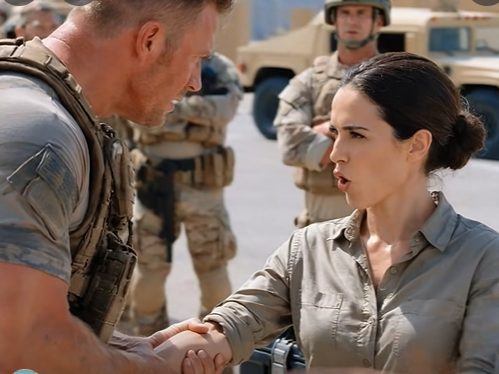
“Take your hand off me,” the woman said quietly, “or every man on this base is about to watch your pride hit the ground first.”
For one second, nobody breathed.
The parking lot at Forward Operating Base Viper went still beneath the Afghan sun. Heat bent the air above the asphalt. Dust hung over the Humvees like smoke after an explosion. Somewhere beyond the barracks, an engine coughed and died, but no one turned toward it.
They were all staring at her.
Dr. Livia Hale stood beside a black transit case, her wrist locked inside Master Chief Nolan Voss’s fist.
She did not scream.
She did not flinch.
That was the part that made the younger SEALs stop laughing.
Nolan Voss was built like a weapon and carried himself like one. Broad shoulders. Thick neck. Voice loud enough to turn humiliation into entertainment. Men knew his name before they knew his face, and he liked it that way.
On most days, his reputation moved people out of his path.
Today, it had carried him straight into a mistake.
Livia looked almost breakable beside him. Small frame. Plain field khakis. No visible rank. No sidearm. Her dark hair was pulled back with the practical severity of someone who had spent years being underestimated and had stopped correcting people unless it mattered.
At her feet, the black case sat open, rows of classified equipment sealed in foam.
She had been checking serial numbers when Voss crossed the lot.
He had seen a civilian woman kneeling near operator gear and decided the entire base needed a reminder of who belonged where.
“Move,” he had said.
Livia had not even looked up.
“This lane was cleared through logistics command.”
A few men nearby heard it.
Then a few more slowed.
Voss smiled like she had handed him a performance.
“Logistics command?” he repeated, turning just enough so the watching SEALs could hear. “That supposed to impress me?”
Livia closed the case with a precise click.
“No,” she said. “It’s supposed to inform you.”
The first laugh came from behind a transport truck.
Then another.
Not loud. Not yet. But enough.
Voss’s face changed by inches. The smile stayed, but the skin around his eyes hardened. Men like him could take pain. They could take danger. What they could not take was the sound of their own authority shrinking in public.
He stepped closer.
“You got a desk credential and a radio badge, and now you think you can talk to operators like you’re one of us?”
Livia stood.
The difference in size should have ended the conversation in his favor. He towered over her, casting a heavy shadow across her face. Sweat ran down the side of his temple. Her breathing stayed slow.
“I think,” she said, “you’re blocking a secured route.”
That was when the laughter stopped being funny.
More men turned now. More boots scraped asphalt. Four hundred operators were moving through the lot between training blocks, supply checks, and transport rotations, and a current passed through them as they realized something was happening.
Voss lowered his voice.
“You don’t know who you’re talking to.”
Livia looked at his hand before he moved it.
“I know exactly who I’m talking to.”
The words were calm.
Too calm.
That calmness offended him more than defiance would have.
His hand shot out and clamped around her wrist.
The sound was small.
Skin against skin.
But it moved through the lot like a rifle bolt sliding into place.
Livia’s eyes lifted to his.
For the first time, Voss seemed to notice there was no fear in them. Not arrogance. Not anger. Something worse.
Assessment.
Like she was no longer a woman being grabbed by a decorated SEAL.
Like he had become a problem she was deciding how gently to solve.
“Let go,” she said.
Voss leaned down, his voice thick with humiliation.
“Make me.”
Nobody moved.
Some of the younger operators exchanged looks, uncertain now. The joke had gone too far, but no one wanted to be the first man to step between a Master Chief and a civilian specialist.
Then Livia moved.
Not backward.
Into him.
It happened so cleanly that half the men watching did not understand it until Nolan Voss was already falling.
Her free hand touched his elbow – not struck it, not forced it. Guided it. Her shoulder turned beneath his line of strength. Her hips shifted a fraction. She stepped across his stance and redirected the pressure he had put into her wrist straight through the weakness of his balance.
Voss’s eyes widened.
His boots betrayed him.
For one impossible heartbeat, the biggest man in the lot looked like he had misplaced the ground.
Then Livia dropped her weight.
Voss hit the asphalt flat on his back.
Hard enough to knock the air from his lungs.
Controlled enough that everyone knew she could have done worse.
The silence afterward was terrifying.
No one laughed.
No one spoke.
A bottle of water rolled from someone’s hand and clicked once against the pavement.
Livia released his wrist and stepped back, her expression unchanged. She adjusted the cuff of her sleeve with two fingers, as if he had left dust there.
Voss coughed, one hand pressed to his chest, shock spreading across his face before rage could cover it.
Four hundred SEALs had just watched him go down.
Not in a fight.
In a lesson.
He rolled to one side, trying to push himself up, but the humiliation was heavier than his body armor.
“You – ” he rasped.
Livia looked down at him.
“Don’t.”
One word.
It pinned him harder than the throw had.
Then a shadow crossed the asphalt behind her.
Colonel Elias Grant had arrived without anyone noticing.
He stood at the edge of the crowd, sunglasses in one hand, jaw locked so tight the muscles jumped beneath his skin. He looked at Voss on the ground. Then at Livia. Then at the hand Voss had used to grab her.
Every operator in the lot straightened.
Grant’s voice did not rise.
It didn’t need to.
“You just put hands on the woman who wrote the close-combat doctrine your team trains under.”
The sentence froze the base.
Voss stopped moving.
Livia’s face remained unreadable, but something colder passed through her eyes.
Grant stepped closer, and the men parted for him without a sound.
“And that,” he said, staring down at Voss, “is not the worst part.”
Livia slowly turned her head toward him.
For the first time, her calm cracked.
Not with fear.
With warning.
Colonel Grant looked at the black transit case beside her feet.
Then he said the one thing that made every weapon-trained man in that parking lot understand this was no longer about pride.
“Open the case.”
What Was Inside the Case
Nobody moved for a full two seconds.
Then Livia crouched, thumbed both latches, and lifted the lid.
The men closest stepped forward without meaning to. Then stopped.
The foam-lined interior held twelve devices, each sealed in a clear evidence bag. Small. Matte black. No visible markings. The kind of thing you could hold in one hand and not know what you were holding unless you’d seen the classified briefings, and almost no one on that base had.
Almost.
Senior Chief Dale Pruitt, standing three rows back, was the first to recognize them. His face went the color of old concrete. He had seen prototype specs for those devices eight months ago in a secure facility in Virginia. They were supposed to be in a lab. Not in a transit case. Not in a parking lot in Kandahar province.
“Sir,” Pruitt said, and his voice came out wrong.
Grant didn’t look at him.
“Dr. Hale was transporting recovered units for analysis,” Grant said. “Units that went missing from a forward cache six weeks ago.” He paused. “Units that several people on this base were told had been destroyed.”
The air changed.
Voss was still on the ground, but nobody was looking at him anymore.
Livia stood, case still open at her feet. She scanned the crowd with the same flat attention she’d used on Voss. Not searching for a face, exactly. More like confirming the presence of one.
“Twelve units recovered,” she said. “Fourteen were logged missing.”
Grant’s jaw moved once.
“Meaning two are still out there,” he said.
The younger operators didn’t fully understand what they were looking at. But the senior men did. The ones who’d been on base for the full rotation, the ones who’d signed off on inventory audits, the ones who’d written the reports that said destroyed.
Two of them started calculating exits.
The Part Nobody Had Planned For
Livia had not come to FOB Viper to make a scene in a parking lot.
She’d been on base for eleven days, embedded as a technical consultant under a cover designation that listed her as logistics support for a signals intelligence contractor. The cover was thin by design. Thin enough to move around without drawing attention. Thick enough to explain the equipment and the access and the hours she kept.
She had a room in the civilian annex, a single cot, a folding table covered in printed manifests. She ate in the main hall at off-hours and spoke to almost no one. The operators who noticed her at all thought she was auditing supply chains. Dull work. The kind that kept a person invisible.
That was the point.
What she was actually doing was tracing a leak that had been bleeding classified hardware out of the base for four months. Small quantities. Irregular intervals. Nothing that triggered automatic flags. The kind of operation that required someone who understood both the technical specs of what was being taken and the human architecture of how a place like Viper actually ran, which was nothing like how it looked on paper.
She’d been three days from closing the trace when Voss crossed the parking lot.
She’d known who he was before she ever set foot on base. His file was thirty pages. Decorated. Decorated again. Two deployments in this region, one in the previous rotation. Access to every secured area on the compound. His name appeared on four of the six inventory audits she’d flagged.
She had not planned to move on him yet.
She had planned to be invisible for three more days.
Then he grabbed her wrist, and the math changed.
What Grant Knew That Nobody Else Did
Colonel Grant had been read into Livia’s operation on day two of her embed. He was one of three people on base who knew her actual clearance level, which sat four brackets above his own and had required a phone call from a number he didn’t recognize to confirm.
He had not liked her when they met.
She had sat across from him in his office with a folder he wasn’t cleared to open and explained, with the patience of someone explaining something for the third time, that she would need full movement access and zero interference. He had asked her chain of command. She had written a name on a piece of paper, slid it across the desk, and waited while he read it.
He had not asked again.
What Grant knew, and what the men in the parking lot were only beginning to understand, was that Livia’s throw had not been a reaction. She had felt Voss’s hand close around her wrist and made a decision. A fast one. But a decision.
She had weighed the cost of staying invisible against the cost of what Voss’s behavior confirmed.
A man who believed he could grab a civilian woman in front of four hundred witnesses and face no consequence was a man who believed the base’s command structure would cover for him.
That belief didn’t come from nowhere.
She’d put him on the ground in front of everyone because the two missing units were still somewhere on this base, and whoever had them was watching to see how the next thirty minutes went.
She needed them scared.
She needed them moving.
Moving people make mistakes.
Voss Figured It Out Last
He was upright by then, standing off to the side, his face rebuilt into something that looked like anger but was mostly embarrassment trying to find a shape.
Grant had stopped looking at him. That was almost worse.
Livia closed the case, latched both locks, and handed it to a young corporal she’d apparently pre-selected, because she said his name, Reyes, without looking at a roster. The corporal took it with both hands.
“Secure that in the annex,” she said. “The room with the blue tag.”
Reyes left at a pace that was not quite a run.
Voss watched him go, then looked back at Livia.
“You set that up,” he said.
Not an accusation. More like someone finishing a math problem they’d been doing in their head.
Livia looked at him for the first time since he’d hit the ground.
“You set it up,” she said. “I just let you.”
He opened his mouth.
Closed it.
Grant put one hand briefly on Voss’s shoulder, not a comforting gesture, more like pinning a document to a board. “Master Chief. My office. Fifteen minutes.”
Then Grant looked out at the crowd, which was still standing there, four hundred men trying to look like they hadn’t just watched what they’d watched.
“Everyone else has somewhere to be,” he said.
They dispersed. Fast. Quietly.
Livia picked up her clipboard from the ground, where it had fallen during the throw. She checked the top sheet, made a small mark with her pen, and started walking toward the annex.
She didn’t look back.
The Two Missing Units
They found the first one that afternoon.
A staff sergeant named Coburn had it wrapped in a shemagh inside a duffel in his bunk. He’d been on base eleven months. Clean record. Quiet. The kind of man who got overlooked in every direction. When the MPs came to his room, he sat on the edge of his cot and didn’t say anything for a long time. Then he asked if he could call his wife.
The second one took until the following morning.
It turned up in a vehicle inspection, tucked into a wheel well of a transport truck scheduled to leave the base at 0600. The driver, a contractor named Hatch, had been hired eight weeks ago through a logistics firm with an address in Bahrain that dissolved three days after it submitted its last invoice.
Hatch was gone before the truck was found. How, nobody could say with certainty. The base had four exit points and a perimeter that looked tighter than it was.
Livia filed her report from the annex that evening. She sat at her folding table under a single overhead light, the manifests pushed to one side, and typed for two hours without stopping. The room smelled like dust and generator exhaust and the cold coffee she hadn’t touched.
When she finished, she closed the laptop, lay down on the cot with her boots still on, and was asleep inside of ninety seconds.
What Voss Said, Eventually
Grant kept him for two hours.
Voss came out of that office a different kind of quiet. Not chastened, exactly. Something more like recalibrated. He’d spent fifteen years building a version of himself that worked in a specific environment, and the environment had just shifted without warning.
He found Livia the next morning, outside the mess hall, 0530. She was reading something on a tablet, standing up, because she apparently didn’t sit down for anything that wasn’t critical work.
He stood in front of her until she looked up.
“I need to say something,” he said.
Livia waited.
“I didn’t know who you were.”
She looked at him for a moment. “That’s not actually the relevant part.”
He took that. Didn’t argue it.
“No,” he said. “I guess it isn’t.”
She went back to her tablet.
He stood there another few seconds, then turned and walked toward the training block. His stride was the same. His shoulders were the same. But something in the way he moved through the space had changed, some assumption about where the edges were that he’d been carrying so long he’d stopped noticing it.
He noticed it now.
Behind him, Livia turned a page.
The base hummed back to life around her. Boots on asphalt. Radio chatter. The smell of diesel and morning and another day starting in a place where most things were exactly what they looked like and a few things were not.
She made a note on the tablet’s margin.
Then she kept reading.
—
If this one got you, pass it on to someone who’d appreciate it.
If you’re looking for more tales of unexpected twists and turns, you might enjoy reading about The Marine Who Said “Women Like You Don’t Last Out There” or the time My Cousin Slapped Cuffs on Me at the Family BBQ.



