
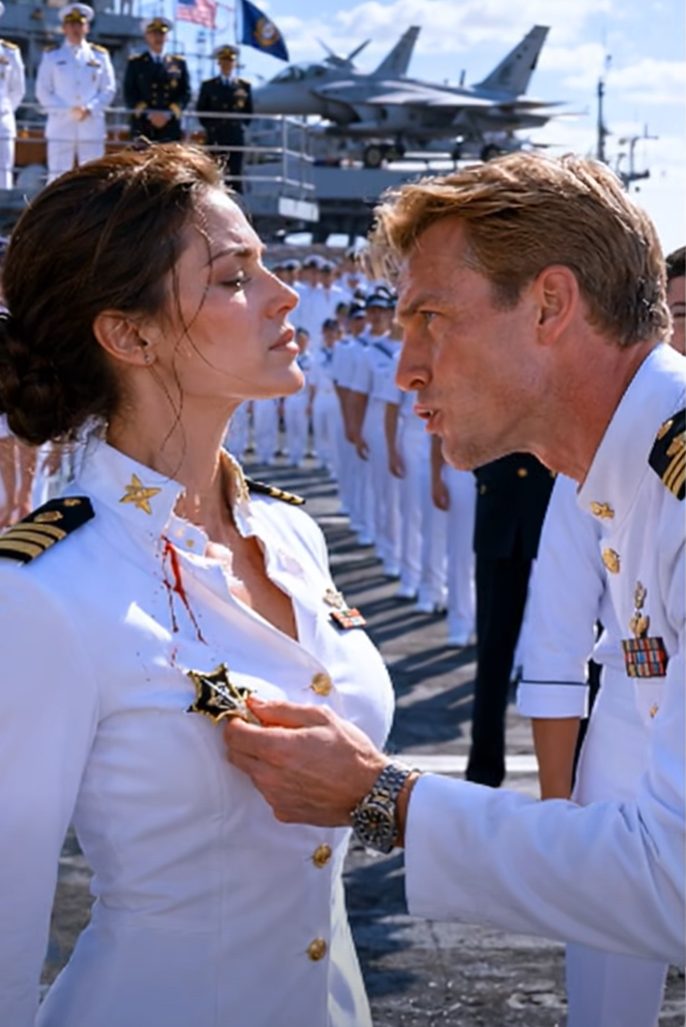
They Stripped Her Rank in Front of 5,000 Sailors… But They Forgot the Ocean Knew Her Name.
Commander Evelyn Carter stood beneath the brutal Pacific sun while the charges were read aloud across the flight deck. Five thousand sailors watched in silence as the admirals turned her punishment into a public spectacle. To them, she was the officer who disobeyed orders. To Evelyn, she was the only person who had stopped a strike that would have killed innocent civilians.
The legal officer’s voice echoed over the steel deck as Lieutenant Jake Caldwell stepped forward, his face calm with satisfaction. He reached for her collar, grabbed her insignia, and tore it away in front of everyone.
Caldwell leaned close, his voice low. “You should’ve remembered your place.”
For the first time all morning, Evelyn moved. She tilted her head toward him, her expression cold and unreadable.
Evelyn whispered. “Oh, Lieutenant… you should’ve remembered mine.”
Caldwell’s confidence cracked for one second before he stepped back too fast. The cameras caught it. The sailors saw it too, and a ripple of doubt moved through the formation like water finding a crack.
They stripped her of her badge, her weapon, and even the watch her father had given her. Then, locked in a holding room below deck, Evelyn was handed one final phone call. She did not call a lawyer. She did not cry. She dialed sixteen numbers from memory, stayed silent, and hung up.
An hour later, dressed in plain civilian clothes and carrying her life in a cheap plastic bag, she was marched back toward the gangway. Captain Pike watched with cold satisfaction. Caldwell stepped close with a sneer.
Caldwell asked. “Any final request?”
Evelyn looked past him, out toward the suddenly silent ocean. “Yes.”
Caldwell waited.
Evelyn said softly. “Tell your son not to go near the windows tonight.”
The blood drained from his face.
Caldwell whispered. “How do you know I have a son?”
Then the first alarm began to scream.
What Was on the Other End of That Call
The alarm wasn’t a drill. Everyone on that deck knew the difference between a drill and the real thing within about four seconds, and these were people who had spent years training to make that distinction fast.
It was the communications array. The entire ship’s outbound network had gone dark.
Not down. Dark. There’s a difference the Navy doesn’t like to talk about publicly. Down means a failure. Dark means something outside the ship decided it was time to stop listening.
Caldwell was already moving, hand on his radio, barking orders at two junior officers who looked genuinely scared. Captain Pike had gone from cold satisfaction to something closer to controlled panic. His jaw was tight. His eyes kept cutting toward Evelyn.
She hadn’t moved. She was standing at the top of the gangway with her plastic bag, watching the ocean.
The sixteen-number sequence she’d dialed from memory wasn’t a phone number. Not exactly. It was a routing code for a satellite relay that officially did not exist, connected to a network that officially had no civilian access, which routed to a man named Raymond Foss who had no official title, no official office, and who had been monitoring this specific ship’s operations for eleven days.
Raymond had served under Evelyn’s father for three years in the late nineties. He owed her father a debt that couldn’t be paid in cash. When she’d called, she said nothing. She didn’t need to. The silence was the message. It meant: it’s time.
Raymond had made four calls of his own in the six minutes that followed. One to a retired admiral in Virginia Beach who still had friends on the Senate Armed Services Committee. One to a woman named Donna Pruitt at a think tank in D.C. that did quiet work for people who needed quiet work done. One to a journalist – a specific journalist, a former Navy man named Greg Sloan who’d broken two stories in the last decade that had ended careers – and one to a number Evelyn herself didn’t know, which Raymond had never told her about, and which she’d trusted him to use correctly.
She’d trusted him because her father had. And her father had never been wrong about people.
The Ship That Went Quiet
The USS Hargrove had a crew of 4,800. In the forty minutes following the communications blackout, word moved through that ship the way it always does on a ship – fast, wrong in the details, accurate in the feeling.
What people knew: the woman they’d just publicly humiliated was standing on the gangway and not leaving.
What people suspected: she was waiting for something.
What nobody said out loud: she didn’t look like someone who’d lost.
Petty Officer First Class Dennis Hatch had been standing in the third row of the formation during the ceremony. Twenty-two years in. He’d seen two public reductions in rank before this one, and both times the person being stripped had looked the same way – small, collapsed inward, like something had been taken from them that they couldn’t get back.
Carter hadn’t looked like that.
He’d told his bunkmate afterward, before the alarms started: “She looked like she was letting them do something she’d already accounted for.”
His bunkmate, a twenty-four-year-old from outside Fresno named Tommy Briggs, had said that was a weird thing to say.
Dennis Hatch said, “Yeah.”
He didn’t have a better way to put it.
What Caldwell Didn’t Know About the Civilian Village
Forty-eight hours before the ceremony, a Senate staffer named Mark Osei had received a thumb drive in a FedEx envelope with no return address. On it were three files. A targeting brief. A signals intercept translated from Mandarin that had been misread – deliberately misread, the metadata suggested – before it reached the command chain. And a photograph of a village that the strike coordinates would have hit directly.
The village had a school. Forty-one children, ages six to thirteen, attended it six days a week.
The strike had been called off because Commander Evelyn Carter had looked at the raw intercept herself, run the translation independently using a contact she had at a signals intelligence desk in Pearl Harbor, and then walked into Captain Pike’s operation center and told him, flat out, that the targeting brief was wrong.
Pike had told her to stand down. She hadn’t. She’d gone over his head, then over that head, until she hit a wall, and when she hit the wall she’d done the one thing they couldn’t forgive: she’d been right in a way that left a paper trail.
The strike was canceled. The village was not destroyed. Forty-one children went home that afternoon.
Three weeks later, she was standing on a flight deck getting her insignia torn off by a man who knew none of that, or knew it and didn’t care.
Caldwell knew about the strike. He’d helped write the targeting brief.
That’s the part nobody had said in the official record. Not yet.
The Journalist Who Was Already There
Greg Sloan had arrived at the port in San Diego two days earlier. He’d told his editor he was working on a piece about readiness metrics in Pacific Fleet. Which was true, in the way that a lot of things are technically true.
He’d been sitting in a rental car in a parking structure with a direct sightline to the Hargrove’s berth when his phone rang. Raymond Foss. Thirty-second conversation. Then he was out of the car with his recorder.
He had the photograph of the village on his phone already. He had the translated intercept. He had a source, someone still serving, who had been in the operations center when Evelyn Carter walked in and laid out exactly why the coordinates were wrong. That source had signed a statement. Their name wasn’t on it yet, but it would be.
Sloan was fifty-three. He’d covered two wars and one court martial that had nearly gotten him killed in a different kind of way – professionally, legally, the kind of death that happens in conference rooms. He was not a dramatic man. He wore the same brand of hiking boots he’d been wearing since 1998 and he had a habit of chewing the cap of his pen when he was thinking.
He was thinking very hard as he walked toward the dock.
What “Don’t Go Near the Windows” Actually Meant
Caldwell’s son was fourteen. His name was Tyler. He lived with Caldwell’s ex-wife, Pam, in a house in Coronado, about two miles from the base.
The night before the ceremony, someone had been parked on Pam’s street for four hours. Not watching the house. Just parked. When Pam mentioned it to her neighbor the next morning, the neighbor said he’d seen the same car two nights before that.
Caldwell didn’t know about the car. But Evelyn did, because Raymond had told her about it – not as a threat, as information. Someone was already watching Caldwell’s family. Someone who was not Raymond, not Donna Pruitt, not Greg Sloan.
Someone else had an interest in what happened next.
When Evelyn told Caldwell to keep his son from the windows, she wasn’t threatening the boy. She was telling Caldwell that she knew things he didn’t know, about his own life, and that whoever was watching his family was not her doing and not under her control.
It was a warning. The only kind she could give him in that moment, with that much audience.
The blood leaving his face wasn’t guilt. It was the specific terror of a man who suddenly understood that the situation was larger than the ship, larger than the ceremony, larger than anything he’d been briefed on – and that the woman he’d just humiliated in front of five thousand people had been operating in that larger situation for weeks while he was reading the charges against her.
The alarm screaming behind him was the communications array going dark.
And Evelyn was still standing there. Plastic bag. Civilian clothes. Watching the water.
The Gangway
Captain Pike crossed the deck himself. That surprised people. He didn’t send an aide.
He stopped six feet from her. She turned to look at him.
“What did you do,” he said. Not a question, exactly.
“Nothing you can prove,” Evelyn said. “Today.”
Pike’s mouth went thin. “You’re off this ship.”
“I know.”
“Whatever you think you’ve started – “
“Greg Sloan is at the gate right now,” she said. “He has the intercept translation. He has the photo of the school. And he has a source who was in your operations center.”
Pike was quiet for four seconds.
“You’ll never serve again,” he said.
Evelyn picked up her bag. “Forty-one kids went home that day, Captain.”
She walked down the gangway.
At the bottom, she stopped. Just for a second. The Pacific was gray-green and enormous and it smelled like salt and diesel and something older than both. She took one breath of it.
Then she kept walking.
Sloan met her at the gate. He had his recorder out. She shook her head once – not yet – and he put it away without argument.
They walked to his rental car. He drove. She looked out the window at the water until it disappeared behind the buildings.
Her father’s watch was still on the ship, in a plastic evidence bag in a room she’d never see again.
She’d worn it every day for eleven years. He’d given it to her the morning she made Lieutenant. It was a cheap Timex with a cracked crystal and the word ALWAYS scratched into the back with a key, which he’d done himself the night before and which she’d never asked him about because she already knew.
She put her hand against the car window.
Cold glass. Moving road. Forty-one kids.
She counted that. She’d been counting it since the day it happened, and she planned to keep counting it for a long time.
—
If this one got under your skin, send it to someone who needs to read it.
For more tales of tenacity, check out how she built the jet he couldn’t fly or the night my corner booth at Anchor Point wasn’t empty – it was a trap. And don’t miss the story of how the monitor knew her name even without rank on her sleeve.



