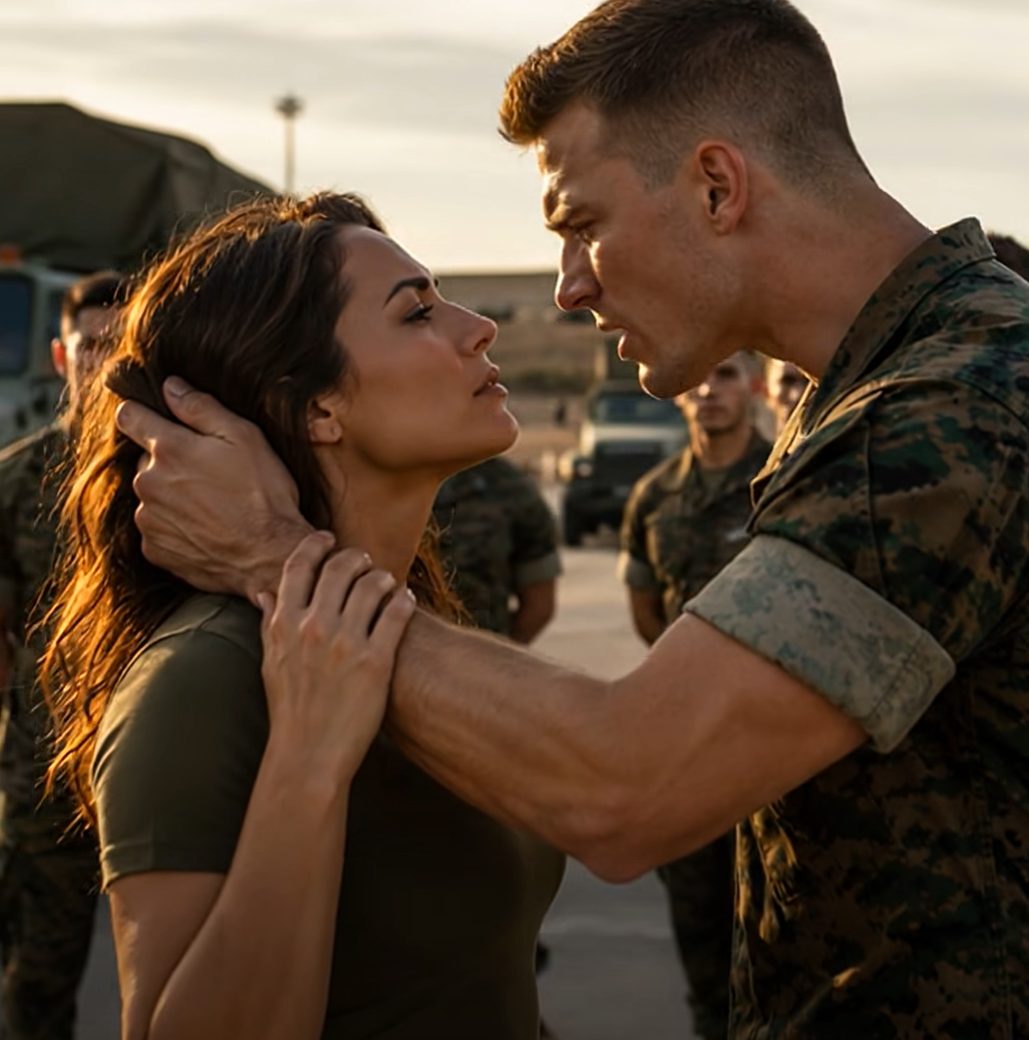
“Let her go. Now.”
“You don’t decide who matters here.”
“I said move. You don’t belong.”
His fingers twisted deeper into my hair as the words left his mouth.
It wasn’t a suggestion. It wasn’t even a warning.
It was a command, thrown loudly enough for nearby Marines to hear. The tone sliced through the sharp morning air with deliberate cruelty. Several heads turned before quickly looking away again.
For one brief second, the world narrowed into a single painful point.
The pressure against my scalp.
The forced angle of my neck.
The quiet certainty inside his grip.
That certainty said I would obey. It assumed I would shrink beneath him. It expected me to fold neatly into whatever role he had already assigned me.
Then time seemed to slow.
I didn’t react immediately.
I let the moment settle around us.
I let the silence stretch longer than he expected, just enough for something subtle to shift beneath the surface of the scene. The change was almost invisible. Too quiet for him to notice.
Not yet.
Men like him rarely noticed the shift until it was already working against them.
Usually, by then, it was far too late.
My breathing stayed slow and controlled.
My posture never faltered.
Even with my head pulled back painfully, I remained balanced. My feet stayed planted firmly against the concrete. My weight remained centered. My body held its alignment with quiet precision.
There was no panic inside me.
No flinch.
No desperate recoil.
That alone caused the first crack.
People expected resistance.
Or submission.
They understood anger. They understood fear.
What they didn’t understand was control.
I lifted one hand slowly between us.
Not to hit him.
Not to tear his hand away.
Only to rest my fingers lightly against his wrist.
The contact barely existed. There was no force behind it. No urgency. No trembling tension.
Still, the gesture carried intention.
Quiet.
Deliberate.
Absolute.
Then I turned toward him.
Not because he forced me.
Because I chose to.
The movement stayed calm and measured, controlled down to the smallest detail. I eased my head forward slightly, reducing the strain just enough to face him directly without jerking away.
His fingers still tangled through my hair, but now they had to adjust to my motion instead of controlling it completely.
That became the second crack.
When our eyes met, I offered him nothing.
No anger.
No fear.
No visible challenge.
Only stillness.
The kind that didn’t provoke.
The kind that refused to surrender.
For the smallest fraction of a second, something shifted behind his eyes.
Confusion.
It flickered there briefly before disappearing beneath something louder and easier for him to reach.
Arrogance.
Corporal Mason Hale leaned closer, broad chest lifting with confidence. His smirk widened like he believed he had found a stronger angle for his performance.
Up close, every detail sharpened.
Twenty-three. Maybe twenty-four.
Strong from endless hours in the gym. Wide shoulders. Thick arms. Carefully built strength shaped by repetition instead of experience.
His uniform stretched tightly across his chest. The sleeves hugged his biceps so perfectly they almost looked intentional.
His boots were spotless.
Too spotless.
The heavy scent of artificial body spray clung to him aggressively, overpowering the clean salt air drifting across the base.
Everything about him felt constructed.
Manufactured confidence.
Confidence designed for an audience.
Not the kind earned beneath pressure.
Not the kind forged in moments that truly mattered.
“Or what?” he asked quietly.
Even lowered, his voice still carried across the concrete.
His grip tightened slightly.
Not enough to injure me.
Just enough to remind me he believed he could.
Around us, the atmosphere shifted again.
A pair of Marines walking nearby slowed instinctively. Their attention caught for half a heartbeat before caution pulled it away again.
One glanced toward us quickly, then lowered his gaze.
Another stared slightly longer than he should have.
No one intervened.
Not yet.
To them, it still looked like a scene.
An uncomfortable moment.
Not a serious mistake.
The morning wind swept across the open pavement. It carried the distant rhythm of marching boots, the metallic rattle of equipment, and the low hum of a military base waking fully into motion.
Camp Pendleton always felt controlled in the early morning hours.
Structured.
Ordered.
Predictable.
But moments like this lived inside the cracks.
Inside assumptions.
Inside the dangerous confidence of someone who believed they already understood the situation before they actually did.
My fingers remained lightly against his wrist.
Steady.
Relaxed.
Completely calm.
“Take your hand off me,” I said softly.
The words landed without strain.
Without fear.
Without urgency.
Something subtle changed in the space around us after that.
Not dramatic.
Not loud.
Just enough.
Mason noticed it too, even if he didn’t understand why.
His smile stiffened slightly around the edges.
His fingers remained buried in my hair, but the certainty behind the gesture weakened for a fraction of a second. It happened quickly enough that most people would never notice.
I noticed.
Because men like him relied heavily on momentum.
Control only worked when everyone accepted the performance.
The moment hesitation entered the room, even briefly, the foundation started weakening beneath them.
The Marines nearby continued moving, but more attention drifted toward us now. People sensed tension instinctively. They felt it before they fully understood it.
The base remained alive around us.
Engines hummed somewhere in the distance.
Voices echoed across the training yard.
Metal clanged sharply against metal.
Yet the space surrounding us felt strangely insulated, separated from everything else by the tension tightening between us.
Mason shifted his jaw slightly.
He wanted a reaction from me.
Anger would have satisfied him.
Fear would have satisfied him even more.
Even resistance would have fit neatly into the role he expected me to play.
But calmness unsettled him.
It denied him rhythm.
Denied him control over the scene.
His fingers flexed once more in my hair.
The movement looked deliberate, but now it carried the faintest trace of uncertainty underneath.
He leaned closer again, invading my space with practiced intimidation.
“You hearing me?” he asked.
His tone hardened.
Sharper this time.
Less playful.
I looked directly into his eyes.
Still calm.
Still steady.
The wind brushed loose strands of hair against my face. Somewhere behind us, a whistle sounded across the base, short and sharp against the morning noise.
No one stepped forward.
But people were watching now.
Carefully.
Quietly.
The atmosphere had changed enough for them to feel it.
Mason noticed the attention too.
That only fed him further.
His shoulders straightened slightly as if he needed the audience again. His confidence swelled outward, feeding from nearby eyes.
Men like him often confused attention with authority.
He smirked again, though the expression no longer reached his eyes completely.
“You think staring fixes anything?” he asked.
I didn’t answer immediately.
Silence stretched between us once more.
Not empty silence.
Controlled silence.
The kind that forced people to sit inside their own discomfort.
His grip loosened slightly without him realizing it.
Only slightly.
But enough.
I kept my hand resting lightly against his wrist.
The contact remained calm and almost gentle. That somehow made the moment heavier.
Because I wasn’t fighting him.
I wasn’t struggling.
I wasn’t giving him anything he knew how to overpower.
A muscle tightened briefly along his jaw.
The Marines nearby slowed again.
One stopped completely before another quietly nudged him forward.
Nobody wanted involvement.
Not yet.
The cold ocean air rolled through the base again, lifting dust softly across the concrete. The sunlight had strengthened now, casting sharp morning shadows beneath boots and vehicles.
Everything looked painfully clear.
Mason’s spotless uniform.
The artificial shine on his boots.
The tension hidden beneath his smirk.
The confidence trying desperately not to crack.
“You got a problem?” he asked.
There it was again.
That need.
That hunger for confrontation.
He needed the moment to become louder because silence had stopped working in his favor.
I remained still beneath his grip.
Still balanced.
Still composed.
Even with my head tilted awkwardly from his hold, my posture stayed controlled. Calmness settled through my body with practiced precision.
That unsettled him more than anger ever could.
Because calmness suggested preparation.
It suggested certainty.
And certainty made people dangerous.
Especially when they didn’t need to announce it.
His fingers tightened again reflexively.
A little rougher this time.
The movement drew another glance from nearby Marines.
This time, fewer people looked away immediately.
Mason noticed that too.
His breathing shifted subtly.
Not enough for most people to hear.
Enough for me.
The performance was becoming harder to maintain.
I could see it happening in real time.
His confidence kept trying to reassert itself, but small fractures continued spreading underneath it.
Fractures created by patience.
By silence.
By refusing to collapse beneath him.
I finally spoke again.
My voice remained low and even.
“Take your hand off me.”
The words carried no threat.
That made them heavier.
Because certainty never needed volume.
For one suspended second, neither of us moved.
The wind swept across the base again.
Boots echoed somewhere behind us.
Metal rattled in the distance.
And his hand remained tangled in my hair while the entire moment balanced quietly on the edge of something neither of us had fully spoken aloud yet.
What He Didn’t Know
He didn’t know my name.
That part mattered more than anything else happening between us on that concrete.
He saw a woman on a military base who didn’t look like she belonged there, and he made a fast decision about what that meant. It took him maybe four seconds. Maybe less. He filed me under a category he thought he understood and started performing for the people around him.
That was his whole mistake, built in the first four seconds.
My name is Donna Pruitt. I’m thirty-eight years old. I’ve been a federal law enforcement contractor working base security assessments for eleven years, and I’ve been cleared for Camp Pendleton specifically for the past three. The laminated badge clipped to my jacket said all of that in plain text. My name, my clearance level, my authorization code, the name of the contracting agency, and a direct contact line for the base’s provost marshal office.
Mason Hale had never looked at it.
He’d seen me walking toward the restricted vehicle lot at 0640 on a Tuesday morning in November, decided I was in the wrong place, and grabbed me before any other thought completed itself.
That was the whole story of how we got here.
His story, anyway.
Mine was longer.
What Eleven Years Teaches You
The first time a man put his hands on me on a job, I was twenty-seven. Different base, different state. I’d been doing the work for about eight months. I was still learning how to exist in spaces where my presence made certain people uncomfortable, which is a polite way of saying I was still learning how to absorb hostility without letting it change my posture.
That first time, I flinched. Not badly. But enough that the guy felt it, and the moment shifted in his direction.
I thought about that for a long time afterward. Not with anger, exactly. More like a cold, technical interest in what had happened and what I could do differently.
I talked to a woman named Carol Hatch who ran the agency’s field training at the time. She was fifty-one, built like a fire hydrant, and had spent fourteen years doing close-protection work before she moved into contracting. She sat across from me in a folding chair in a beige conference room and said something I’ve thought about probably three hundred times since.
“They’re not actually after your compliance,” she said. “They’re after your attention. The second you give it to them the way they want it, you’ve handed them the scene.”
She didn’t explain further. She just looked at me and waited.
It took me about two years to fully understand what she meant.
By the time I was standing on that concrete at Camp Pendleton with Mason Hale’s fingers twisted into my hair, I’d had eleven years to work on it.
The Audience Shifts
The Marine who had stopped walking earlier hadn’t moved on.
His name was Corporal Dennis Webb, which I learned later. He was twenty-six. He’d been at Pendleton for two years. He had a reputation, I was told afterward, for being the kind of person who watched things carefully and said very little.
He was watching now.
Not obviously. He’d positioned himself near a vehicle about thirty feet away and was doing something with his phone, which meant he was doing nothing with his phone. His attention was entirely on us.
Two other Marines had drifted into a similar arrangement. Slow, unconscious clustering. The way people move toward something without admitting they’re moving toward it.
Mason hadn’t fully registered the shift yet.
He was still working the performance. Still feeding on the confrontation he believed he was winning. His grip on my hair stayed firm, and his chest stayed forward, and his jaw stayed set in that particular way men set their jaws when they want to look like they’ve already decided how things end.
But the audience had changed quality on him.
It had stopped being passive.
And somewhere in the back of whatever self-awareness he carried, something was starting to register that.
“You going to answer me?” he asked. His voice had dropped. Not softer, exactly. Tighter.
I looked at him for a moment without speaking.
Then I said, “I’ve answered you twice. You haven’t moved your hand.”
The words were still quiet. Still flat. No edge on them.
Dennis Webb looked up from his phone.
The Thing That Finally Happened
Mason’s grip released.
Not because I forced it. Not because he made a graceful decision. It released the way a bluff releases when the other player doesn’t fold: slowly, with the specific quality of something that has run out of room.
His fingers came free from my hair.
He stepped back half a step.
His jaw stayed set. His shoulders stayed back. He was still performing, still trying to hold the shape of the moment even as the moment stopped cooperating with him.
“You’re in a restricted area,” he said. Quieter now. Reaching for procedural ground.
“I’m authorized,” I said. “The badge has been on my jacket since I walked through the gate.”
He glanced at it. Finally.
The read took about three seconds. I watched him process the clearance level. Watched him find the provost marshal contact. Watched something in his face go very still in a way that had nothing to do with composure.
Dennis Webb had walked over. He stopped about eight feet away and stood there saying nothing, which was the loudest thing anyone did in the next thirty seconds.
Mason looked at him. Looked back at me. Looked at the badge again, briefly, like he was hoping the information had changed.
It hadn’t.
“I didn’t – ” he started.
I waited.
He stopped.
There wasn’t a version of that sentence that was going to help him, and some part of him knew it. The words had nowhere to go. The performance had nowhere to go. The whole architecture of the thing he’d built in the first four seconds was standing there with nothing underneath it.
He straightened his uniform. A small, automatic gesture. The kind of thing hands do when they don’t have anything useful left.
Then he walked away.
Not fast. He didn’t run. He kept his shoulders back and his stride controlled, because even now he was thinking about how it looked from behind.
Dennis Webb watched him go. Then he looked at me.
“You good?” he asked.
“Yeah,” I said.
He nodded once. Walked away.
After
I filed the report at 0820 that morning from a desk inside the provost marshal’s building.
It took forty minutes. I was specific about times, about what was said, about who had been nearby. I listed Dennis Webb as a witness. I listed two others I’d identified by unit patch.
The woman who took my statement was a staff sergeant named Gloria Reyes. She was thorough and professional and wrote everything down without commentary. At the end she slid a form across the desk and said, “Do you want to add anything before I close this out?”
I thought about it for a second.
“No,” I said. “That covers it.”
I don’t know exactly what happened to Mason Hale after that. I know the report went up the chain. I know I received a formal communication from the base six weeks later confirming the matter had been reviewed and appropriate action taken, which is military language that tells you almost nothing and also tells you everything.
I went back to Pendleton four months later for a follow-up assessment. Different lot, different time of morning, different weather. Colder. The ocean air had real teeth to it.
Nobody grabbed me.
Nobody said anything about the previous visit.
I did my job and drove off the base at noon and stopped for coffee at a gas station on the 5 and sat in my car for a few minutes before getting back on the freeway.
Carol Hatch had retired by then. I thought about calling her.
I didn’t. But I thought about it.
—
If this one sat with you, pass it on to someone who needs to read it.
For more stories of resilience in the face of adversity, check out what happened when The Colonel Saw My Arm and Didn’t Say a Single Word or when He Told Her to Fetch His Coffee. He Had No Idea Who She Was. And don’t miss the tale of how They Stripped Her Rank in Front of 5,000 Sailors, But She Made One Phone Call First.