
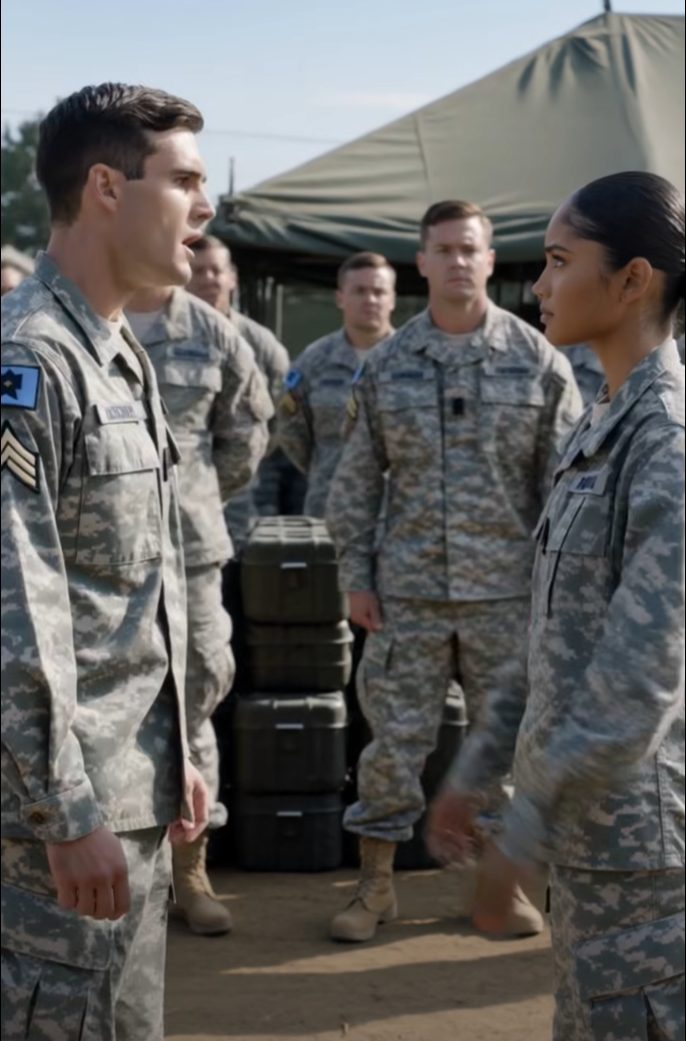
“Bring me some coffee, woman – your job here is to serve us!”
The words cut through the busy military office like a blade. The higher-ranking soldier leaned back in his chair, arms crossed, a smirk playing at the corner of his mouth. He didn’t even bother looking up from his desk as he said it.
The young woman paused. Set down her files. Straightened her back.
She said nothing.
Around the room, a few heads turned. A couple of junior officers suddenly found their paperwork fascinating. Nobody spoke. Nobody ever spoke.
She walked to the break room, poured the coffee, and returned without a word. She placed the mug on his desk with quiet, deliberate calm – the kind of calm that, had he been paying any real attention, might have given him pause.
He wasn’t paying attention.
He had no idea that the folder tucked under her arm contained the performance review his commanding general had personally requested. He had no idea that she had spent the last three years earning a law degree at night. He had no idea that she was the commanding general’s daughter.
He had no idea what tomorrow morning would bring.
He just drank his coffee.
She just smiled.
—
Some people announce their power. Others simply wait.
The Office on Ridgecrest Road
The 14th Administrative Support Division occupied the third floor of a building that smelled like recycled air and old carpet. Fort Ridgecrest wasn’t a glamorous posting. No one put it on their wish list. It processed paperwork, managed personnel files, and shuffled the bureaucratic weight of a mid-sized base through a series of beige hallways and underfunded printers.
Captain Dennis Farrell had been there eight months.
He’d transferred in from a logistics role in Georgia, carrying a reputation that arrived slightly before he did. Not a bad reputation, exactly. More like a specific one. The kind that made certain people in HR sigh quietly when they saw the name on the incoming roster.
He was good at his job. He knew it. He made sure everyone else knew it too.
Forty-one years old, seventeen years in, the kind of guy who’d peaked at the rank just below where he thought he deserved to be. He had a framed photo of himself shaking hands with a colonel at some ceremony in 2019, and it sat on his desk facing outward. Not toward him. Outward. So visitors would see it first.
He called the admin staff “the support people.” Never by name. Just “the support people.” Or, depending on his mood, something less.
Second Lieutenant Cassandra Holt had been posted to Ridgecrest for eleven months. She’d come in quiet, done the work, kept her head down. She was twenty-seven. Slim file on the surface. Bachelor’s in political science from a state school in Virginia, standard officer track, nothing that flagged attention.
That was deliberate.
Her father, Major General Robert Holt, had made one request when she commissioned. Just one. Don’t use my name. Don’t lean on it. Don’t mention it. She’d agreed without hesitation. She didn’t want the name. She wanted the work.
So she did the work. She processed the files. She attended the briefings. She stayed late when the quarterly audit hit, which it always did, and she was the one who found the discrepancy in the contractor invoices that saved the base roughly forty thousand dollars in duplicate billing. Nobody made a speech about it. She didn’t expect one.
Seventeen Months of Small Cuts
Here’s the thing about men like Farrell. It’s never one big moment. It’s a hundred small ones.
It’s the way he’d interrupt her mid-sentence in briefings, then repeat what she’d just said as if he’d thought of it himself. It’s the way he’d CC her supervisor on emails asking for things she’d already provided, just to create a paper trail that implied she hadn’t. It’s “sweetheart” when he wanted something quickly. It’s “honey” when he was in a good mood. It’s the way he’d glance at her when a new male officer walked in, like he was checking to see if she’d clock the comparison.
Small cuts. Constant. Designed to be deniable.
She kept a log.
Not because she was building a case, not at first. She kept it the way you keep a headache journal, just to confirm you’re not imagining things. Dates, times, exact words. She had a spiral notebook in her bottom desk drawer, the cheap kind from a drugstore, and she’d started filling it around month four.
By month eleven, she had forty-three entries.
She never showed it to anyone. She just kept adding to it.
The Folder Under Her Arm
The performance review request came through on a Tuesday.
She knew about it before Farrell did, because she processed the administrative routing. Major General Holt had called in from his command in Colorado, not to her, he never called her at work, but through the standard request chain. He wanted a 360 evaluation on all O-3 and above personnel in the division. Routine. Done every eighteen months.
Except this one had a flag on it. A specific flag.
She didn’t put the flag there. The general’s aide had. But it meant the evaluation would be reviewed personally by the commanding general before going through the standard chain. It meant it mattered more than the usual paperwork that got shuffled and filed and forgotten.
She was one of three people assigned to compile the supporting documentation. She pulled the files, cross-referenced the performance metrics, and drafted the summary notes the way she always did. Clean, factual, specific.
She didn’t editorialize. She didn’t need to.
Farrell’s numbers were middling. His peer feedback was worse. There were two formal complaints in his HR file that had been resolved quietly, the way those things often are, but they were still there, still in the record, still part of what the folder contained.
She clipped everything together. Tucked it under her arm. Walked back toward the main office.
That’s when he said it.
What the Room Heard
“Bring me some coffee, woman – your job here is to serve us.”
She heard it land. She felt the room shift.
The junior officers, Specialist Kim and a new kid named Pruitt who’d been there maybe three weeks, both went very still. Not the stillness of shock. The stillness of people who’ve learned that going still is the safest response.
Staff Sergeant Doyle, who was fifty-two and had seen more than he talked about, looked up from his monitor. His eyes found hers for half a second. He didn’t say anything. He looked back down.
She paused. Set down the files on the nearest flat surface.
Straightened her back.
Walked to the break room.
The coffee maker was one of those institutional ones, a big silver urn that sat on a warmer plate and produced something that tasted like hot brown water with ambitions. She poured a mug. The mug was white with a faded Army logo on the side, the kind that had been through the dishwasher so many times the eagle looked tired.
She stood there for a moment. Just a moment.
Her hands were steady. That surprised her a little. She’d expected them not to be.
She carried the mug back out. Crossed the room. Set it on his desk. Not hard. Not soft. Just placed it there with the kind of precision that comes from deciding exactly what you’re going to do and then doing it without hesitation.
He didn’t look up.
She picked up her files. Walked back to her desk. Opened her notebook. Wrote down the date, the time, and what he’d said, word for word.
Entry forty-four.
What He Did Next
He drank the coffee.
He made a comment to the officer next to him, Loughlin, a captain who laughed a little and then looked away. He took a call from someone in procurement. He complained about the printer for the third time that week. He ate a granola bar at his desk at 3:15 and left the wrapper next to his keyboard.
He went home at 5:30, same as always.
He had no idea.
Cassandra stayed until 6:45, finished the documentation packet, double-checked every attachment, and sent it through the routing system with a time stamp.
She drove home. Made dinner. Called her mother, not her father, her mother, a retired school principal named Beverly who had strong opinions about pasta and stronger ones about patience.
“How was your day?” Beverly asked.
“Fine,” Cassandra said. “Productive.”
0730, The Following Morning
The email came from the general’s office at 7:12 a.m.
It went to the division commander, Colonel Marsh, first. Then to the relevant supervisors. Then, in a separate thread, to HR.
Farrell was in the building by 7:45. He had a coffee from the vending machine downstairs, the decent one, not the urn. He was in a decent mood. He had a parking spot close to the door. Small victories.
Colonel Marsh called him into the office at 8:05.
Cassandra was at her desk when Farrell walked past on his way to Marsh’s office. He didn’t look at her. He was checking his phone.
She was reviewing a supply requisition. She didn’t look up either.
She heard his footsteps stop at Marsh’s door. She heard the door close.
Pruitt, the new kid, leaned over about twenty minutes later and said, “Do you know what’s going on in there?”
She said, “Paperwork.”
He nodded like that made sense and went back to his monitor.
Doyle, from across the room, made a sound that wasn’t quite a laugh. Quiet. Low. Gone before you could be sure you’d heard it.
What Power Actually Looks Like
The outcome wasn’t dramatic. It never is.
Farrell wasn’t court-martialed. He wasn’t publicly dressed down. He was reassigned, a lateral move on paper, to a posting in a different state, the kind of posting that signals something to anyone who knows how to read signals, but means nothing to people who don’t. His promotion timeline, which had already been questionable, quietly stopped moving.
The two resolved complaints in his file got a second look.
He never knew about the notebook. He never knew about the forty-four entries. He never knew that the folder she’d been carrying when he told her to fetch his coffee had gone to a general who happened to be her father, who happened to read every word, who happened to make two phone calls that afternoon.
He probably thought it was bad luck. The wrong time. Some bureaucratic shuffle that caught him in the gears.
That’s fine. He can think that.
Cassandra didn’t tell anyone the full story, not for a long time. Not because she was protecting him. Because it wasn’t really about him. It was about the forty-four entries. It was about Kim and Pruitt going still. It was about Doyle looking back at his monitor because there was nothing else a staff sergeant could do.
She made major two years later. Her father called to congratulate her.
“You didn’t need my name,” he said.
“No,” she said. “I had my own.”
—
If this one got under your skin, pass it to someone who needs the reminder.
If you like stories where the underdog comes out on top, you’ll love how she made one phone call first and how she built the jet he couldn’t fly. And for another tale of unexpected twists, check out why my corner booth wasn’t empty – it was a trap.



