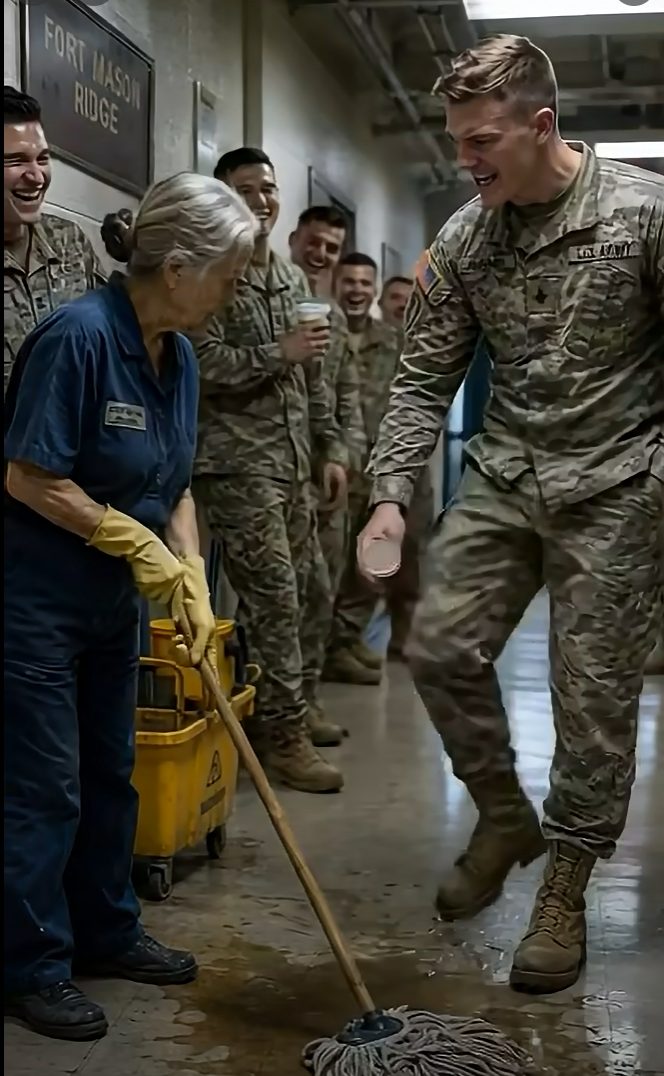
“Clean it up, old lady.”
The boot came down on the mop handle hard enough to crack the silence in the hallway.
For a moment, nobody moved. Not the young soldiers leaning against the cinderblock wall. Not the private with a half-empty paper cup in his hand. Not the old janitor standing beneath the harsh fluorescent lights with both hands still wrapped around the mop.
Dirty water spread across the polished floor of Fort Mason Ridge, a vast Army base outside Colorado Springs. It crawled in thin gray streams toward the wall, carrying dust, boot prints, and the sharp smell of bleach.
The young soldier pressing his boot onto the mop smiled like the whole hallway belonged to him. “Come on,” he said. “You missed a spot.”
The others laughed.
The old woman did not.
Her name tag read E. Walker, though the letters had faded so badly most people never noticed them. Her janitor uniform hung loose on her small frame. The sleeves were worn pale at the elbows. Her white hair was pinned tightly under a plain navy cap. She looked like the kind of person people passed every day without apology.
That was exactly why they thought they could do this.
Her hands tightened around the mop handle. Not in anger, not visibly – just a quiet, almost imperceptible shift in her grip, the kind that comes from a person who has learned exactly how much patience costs and pays it anyway. Somewhere behind her sternum, she felt the old familiar pressure. Not hurt. Not quite. Something older than hurt, worn smooth by decades of being looked through rather than looked at.
Her eyes didn’t flash. They settled. Still and dark, like water before it decides where to go.
She had cleaned this hallway every morning for eleven years. She knew every scuff on every baseboard. She knew which ceiling tiles leaked when it rained hard and which light fixture buzzed at a frequency that gave the younger staff headaches. She knew things about this building that no one had ever thought to ask her.
That was exactly why they were wrong.
The Hallway at 0630
The soldier’s name was Garrett. PFC Garrett Simms, twenty-two years old, eight months at Fort Mason Ridge, the kind of kid who’d learned fast that rank meant a lot here and that civilian staff meant almost nothing. Not a bad kid, necessarily. Just one who hadn’t been taught the difference between authority and cruelty, and hadn’t yet met anyone who’d bother to show him.
He had three buddies with him. They were waiting on a briefing that had been pushed back forty minutes. Bored, standing in a corridor that smelled like floor cleaner and old coffee, doing what bored young men sometimes do when no one important is watching.
E. Walker had seen his type before. Many times. Different faces, same posture, same smile that didn’t quite reach the eyes. She’d learned to read the hallway before she even turned the corner each morning. The way sound carried off cinderblock told her things. Laughter at that pitch, at that hour, usually meant something was about to get worse before it got better.
She’d turned the corner anyway.
She always did.
She bent down slowly, the way her back made necessary, and she lifted the mop from under Simms’ boot without a word. She wrung it out over the bucket. She started cleaning the spilled water.
Simms watched her for a second, his smile flickering with something uncertain. He’d expected more. Resistance, maybe. Tears, maybe. Something to push against. The quiet bothered him in a way he couldn’t name.
“Seriously,” he said, louder now, performing for the others. “Does this lady even speak English?”
One of the others – a kid named Pruitt, twenty years old, barely – laughed the way you laugh when you’re not sure if something’s funny but you don’t want to be the one who isn’t laughing.
E. Walker kept mopping.
Her jaw moved once, just slightly. Not toward speech. Just the small mechanical thing a jaw does when a person is deciding not to say the thing they could say.
What Eleven Years Looks Like
She’d taken the job in 2013. January. Colorado Springs in January is a specific kind of cold, the kind that gets into the joints and stays. She’d driven herself to the interview in a 2004 Civic with a heater that worked only on the passenger side, and she’d worn her good coat, the charcoal one she’d bought at a Goodwill in Pueblo in 2009.
She got the job because she showed up on time, answered every question in full sentences, and didn’t complain about the pay.
The pay was not good.
Her supervisor at the time, a woman named Cheryl Doyle, had shaken her hand at the end of the interview and said, “You’re overqualified, you know.” Not unkindly. Just stating a fact.
E. Walker had said, “I need the work.”
Cheryl had nodded and that was that.
She’d been a reliable presence ever since. First in, sometimes last out. She learned the rhythms of the base the way you learn a person’s habits when you live with them long enough. She knew which officers liked the break room cleaned before 0700 and which ones didn’t show up until nine. She knew that the third-floor conference room always needed extra attention on Thursdays because of the weekly command briefings. She knew that the men’s bathroom near the east entrance flooded slightly when it rained because the drain had a slow clog that maintenance had been meaning to fix for four years.
She reported things when they needed reporting. She stayed out of conversations that weren’t hers. She did her work.
And she was invisible.
Completely, totally, deliberately invisible. She’d cultivated it, in a way. Kept her head down. Kept the name tag faded. Kept the cap low. It wasn’t shame. It was something more like strategy, though she’d never have used that word for it. It was just the knowledge that some places, you get further by not being noticed.
Fort Mason Ridge was not the first place she’d learned that.
The Man Who Saw the Name Tag
Colonel Dennis Hatch had been at Fort Mason Ridge for fourteen months when it happened.
He was fifty-six. Gray at the temples, a little heavy around the middle, the kind of career officer who’d spent enough time in enough places that he’d stopped being impressed by most things. He walked the corridors in the morning because he’d read somewhere that visible command presence mattered for morale, and he believed it, and so he walked.
He turned the corner at 0638 on a Tuesday in March and he saw Garrett Simms standing over the old janitor with his boot on her mop handle.
He heard the remark about English.
He stopped.
His brain did something that took about two seconds. He looked at the woman bent over the mop bucket. Small frame. White hair under a navy cap. The worn uniform, the deliberate quiet of her. And then the name tag. Faded, barely legible.
E. Walker.
He stood still for a moment.
Then he said, “Simms.”
One word. Flat as concrete.
Simms turned. Saw the rank. Straightened immediately, the smile gone so fast it was like it had never been there. “Sir.”
“Step away from the equipment.”
Simms stepped back. The others went rigid.
Hatch walked forward until he was standing directly in front of E. Walker. She had straightened up, both hands on the mop, watching him with the same still expression she’d been wearing the whole time.
He looked at the name tag again.
“E. Walker,” he said.
She met his eyes. Said nothing.
“Your first name,” he said. “Is it Evelyn?”
Something shifted in her face. Not much. Just a small tightening around the eyes, there and gone.
“Yes,” she said.
Hatch nodded slowly. Then he turned to Simms and the others, and his voice came out at a register that didn’t require volume to carry weight.
“Do you know who this woman is?”
Nobody answered.
What Nobody Had Thought to Ask
Evelyn Walker had enlisted in 1974 at the age of nineteen. She’d been one of a few hundred women to go through the Army’s new administrative training programs that year, back when most of the doors were still closed and the ones that weren’t were barely cracked.
She’d pushed through anyway.
She spent twenty-three years in uniform. She did two tours, logged time in three countries, and by 1989 she was a Master Sergeant with a record that her commanding officers described, in writing, as exemplary. She cross-trained into logistics and intelligence support when the Army was still figuring out what to do with women who kept proving themselves in roles they weren’t supposed to want. She mentored younger soldiers, women mostly but not only. She made the kind of decisions under pressure that don’t make the news because they’re not dramatic, just correct, and correct decisions made quietly by the right person at the right moment is usually how disasters get prevented before they happen.
She retired in 1997 with full honors.
Then life happened. A husband who got sick, then sicker, then gone. A daughter in Phoenix who had her own kids and her own trouble. Medical bills that didn’t care about a service record. The Civic with the broken heater. The Goodwill coat. The interview with Cheryl Doyle in January 2013.
She’d never told anyone at Fort Mason Ridge. Not because she was ashamed. Not even because she was private, exactly. Just because nobody asked, and she’d long since stopped expecting them to.
The Hallway After
Hatch told them.
Not everything. Just enough. Master Sergeant, retired. Twenty-three years. The kind of service record that most people in that hallway were still decades away from approaching.
Simms had gone the color of old chalk.
Hatch let the silence run longer than was comfortable. Then he looked at Simms and said, “You will apologize. You will mean it. And then you will spend the next thirty days thinking carefully about what it means to earn the right to wear that uniform.”
Simms apologized. It was stilted and too fast and his voice cracked once in the middle. But he said it.
Evelyn Walker listened to the apology with the same expression she’d worn through the whole thing. When he finished, she nodded once.
“Okay,” she said.
That was all.
Hatch looked at her for a moment. “Sergeant Walker,” he said, using the rank deliberately. “Thank you for your service.”
She looked at him. Something moved behind her eyes, brief and unreadable, and she said, “Thank you, Colonel.”
Then she picked up her mop bucket and moved down the hallway.
The men watched her go.
She turned the corner without looking back, and the squeak of the bucket wheels faded, and then the corridor was quiet except for the buzzing of the light fixture that the maintenance team had been meaning to fix for two years.
She had a lot of hallway left to clean.
—
If this one stayed with you, pass it to someone who needs to read it today.
For more incredible tales of hidden strength and unexpected recognition, check out The Admiral Stood Up and Saluted Me First. The Room Went Dead Silent., The Marine Grabbed My Hair in Front of His Whole Unit and Told Me I Didn’t Belong, and The Colonel Saw My Arm and Didn’t Say a Single Word.