
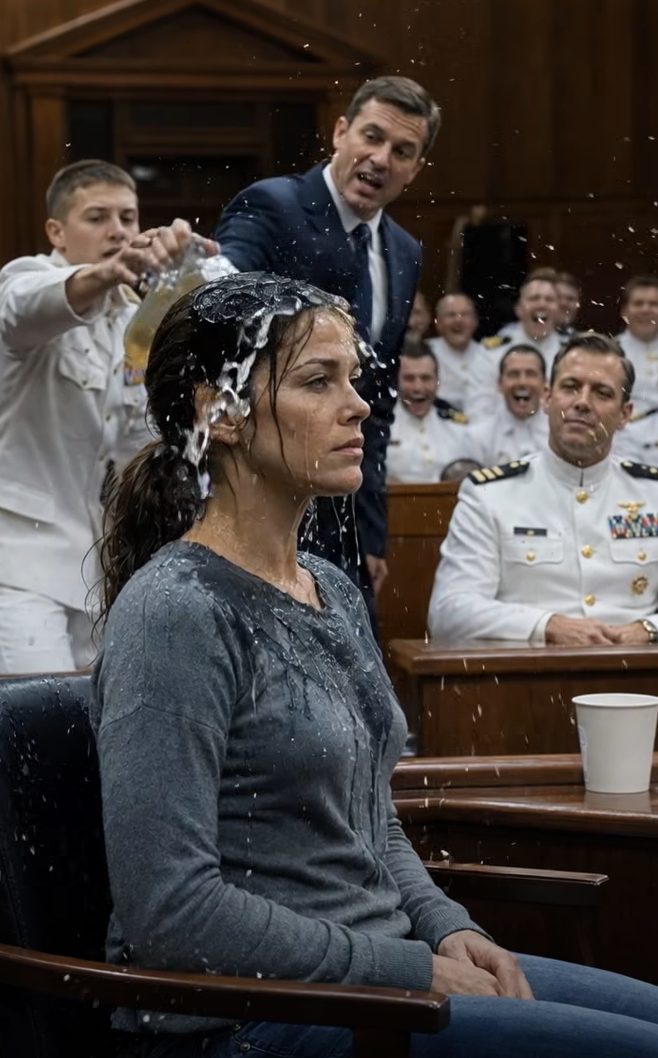
The first mistake they made was laughing at my clothes.
The second was throwing water in my face.
The third was assuming the woman sitting quietly in faded denim had never killed a target from six hundred yards away in wind so cruel it could bend a bullet.
The military courtroom smelled of polished mahogany, starch, and old power. Every surface gleamed. Every uniform was pressed sharp enough to cut skin. Rows of Navy whites filled the gallery like a wall of judgment, medals catching the overhead lights while whispers moved from officer to officer.
And then there was me.
A faded gray sweater. Worn-out jeans. No ribbons. No rank. No gleaming proof that I had ever belonged to the world they guarded so fiercely.
I looked like a civilian who had wandered into the wrong room.
They wanted me to feel that.
I sat at the witness table, thumb tracing the rim of a paper cup, my hands perfectly still. They were always still. The military had spent millions training that calm into my bones, into my breath, into the tiny muscles behind my trigger finger. They could take the uniform. They could redact my file until I barely existed on paper.
But they could not take that.
Across the aisle, Captain Hawkins sat like a statue carved from honor.
Immaculate uniform. Perfect posture. Decorated chest. The kind of man civilians saluted in airports without knowing what his hands had done when no cameras were watching.
But I knew.
I had seen him in Kunar Province.
I had watched him order an evacuation and abandon three of my spotters in the dirt because saving them would have endangered his own transport. Men who had trusted him. Men who had followed his commands until their final breaths.
Hawkins thought the valley had swallowed the truth.
He thought no one survived.
He forgot about the sniper six hundred yards above him on Ridge 4, looking through a high-powered scope while betrayal unfolded below.
Me.
Three years later, after fourteen surgeries, a medical discharge, and a file so heavily censored it looked like black ink had bled across my life, I was no longer Lieutenant Rachel Foster. Not here. Not officially.
On paper, I was only “Miss Rachel Foster, civilian contractor.”
And they were counting on that.
Lieutenant Commander Hayes, Hawkins’s defense attorney, paced before the tribunal with the confidence of a man who had made a career out of turning truth into smoke.
He stopped in front of me and smiled.
“Miss Foster,” he said smoothly, “you are asking this court to believe a rather extraordinary story.”
The gallery quieted.
“You claim you were stationed on Ridge 4. You claim you had visual confirmation of Captain Hawkins’s departure. And, most remarkably…” His eyes flicked over my sweater, my jeans, my civilian shoes. “You claim to be a Tier-One designated marksman. A sniper.”
The word landed like a punchline.
Soft laughter rippled through the room.
I did not blink.
“I am,” I said.
My voice was low, but it carried. It had crossed mountain wind, radio static, and battlefield smoke. A courtroom was nothing.
Hayes chuckled, turning toward the seated officers as if inviting them into the joke.
“You’ll forgive me if I find that difficult to accept. The records we have show you as a logistics coordinator. A supply clerk injured during a mortar attack. No graduation from elite programs. No assignment to a sniper unit. No rifle. No operational clearance proving you belong anywhere near this tribunal.”
“The records are classified,” I said. “Because my unit didn’t officially exist.”
A louder laugh broke from the gallery.
Hayes lifted both hands theatrically. “How convenient. A phantom sniper. A ghost in civilian clothes accusing a decorated officer of treason.”
Behind me, someone muttered, “She’s crazy.”
Another voice whispered, “Stolen valor.”
Then the paper cup vanished from beside my hand.
I turned just as a young lieutenant from Hawkins’s side stepped forward, smirking, and flung the water into my face.
Cold liquid struck my cheek, ran down my sweater, dripped from my chin onto the witness table.
The courtroom exploded with laughter.
Hawkins smiled.
Hayes did not stop them.
I slowly lifted my eyes.
For the first time all morning, my hands moved.
Not to wipe my face.
Not to defend myself.
I reached into the inside pocket of my sweater and placed a battered black challenge coin on the table.
The laughter died one breath at a time.
At the judges’ bench, the presiding admiral went completely still.
His face drained of color.
Then, in front of every officer in that room, Admiral Thomas Greer rose from his chair.
His boots struck the floor.
His spine locked straight.
And before anyone could understand what was happening, the most powerful man in the courtroom raised his hand…
And saluted me first.
What a Challenge Coin Actually Means
If you’ve never served, you might not know what a challenge coin is.
It’s not a trinket. It’s not a souvenir you pick up at a base gift shop next to the keychains and the bumper stickers. A challenge coin is a contract. A record. It says: I was there, and the people who were there with me know exactly what that means.
Mine was black on both sides. No branch insignia. No motto printed in Latin around the edge. Just a small raised emblem on the front that I won’t describe here, because I can’t, and a serial number stamped on the back so worn you’d need a magnifying glass and good light to read it.
Greer had one just like it.
He’d carried his for eleven years. I knew that because the same man who handed him his coin had handed me mine, in a room with no windows, four days before my first deployment to a place that doesn’t appear on any map the public can access. Commander Dale Pruitt, who died of a heart attack in 2019 and is buried in a cemetery outside Knoxville, Tennessee, under a headstone that says Beloved Father and nothing else about what he spent thirty years doing for this country.
Greer recognized it the moment it hit the table.
That’s why the color left his face.
The Silence After
The laughter didn’t stop all at once. It petered out the way fire does when you cut the oxygen. One chuckle, then a cough, then someone realizing no one else was laughing anymore, then nothing.
Hayes froze mid-step.
The young lieutenant who’d thrown the water was still smirking, but his eyes had moved to Greer, and the smirk was going stiff.
Greer held the salute for a full three seconds. Maybe four. Long enough that every person in that room understood it wasn’t a mistake, wasn’t a reflex, wasn’t some confusion about protocol. He was doing it on purpose, in front of all of them, and he was not going to stop until he was ready.
I returned it.
My right hand came up clean, elbow level, fingers flat. Fourteen surgeries and my arm still worked the way the Army built it to. Some things hold.
Then Greer sat back down.
He picked up his pen. He made a note. He did not look at Hayes.
“Lieutenant Commander,” he said, and his voice was the kind of quiet that fills a room better than shouting, “I’d recommend you adjust your line of questioning.”
Hayes opened his mouth.
Closed it.
Opened it again.
“Admiral, I’m not sure I understand the – “
“Yes you do,” Greer said. Still not looking at him.
What Hawkins Did Next Told Me Everything
Hawkins had been still through all of it. Trained stillness, the kind officers practice until it becomes reflex. But when Greer saluted me, I watched something shift in Hawkins’s face.
Not fear exactly.
Calculation.
He leaned toward his attorney and said something low, three or four words, and Hayes straightened his jacket and nodded and turned back to the tribunal with a completely different expression than the one he’d been wearing thirty seconds ago.
I’d seen that calculation before. Kunar Province. 0340 hours. The moment Hawkins decided three men in the dirt were an acceptable loss.
The same math. Different variables.
He was already figuring out his next move. Already deciding which version of the story he could still sell.
That’s the thing about men like Hawkins. They don’t break when they’re caught. They pivot. They’ve spent careers learning to pivot, and they’re good at it, and they count on everyone around them being just a little bit slower.
I’d had three years to prepare for this room. Three years of recovery beds and physical therapy and two lawyers who believed me and one federal investigator named Donna Reyes who had worked sixty-hour weeks for eight months to pull together enough unclassified documentation to get this tribunal convened in the first place.
Hawkins had had three years to build his wall.
But he’d built it without knowing about the coin.
What Donna Had Told Me the Night Before
We’d sat in a Hampton Inn conference room off the interstate, bad coffee in styrofoam cups, printed documents spread across a folding table. Donna wore reading glasses on a chain and had a habit of tapping her pen against her thumbnail when she was thinking.
“They’re going to come after your credibility hard,” she said. “Everything classified is going to stay classified. Hayes knows that. He’s going to paint you as a civilian with a grudge and a story that can’t be verified.”
“I know.”
“Rachel.” She looked at me over the glasses. “The coin is a last resort. If you show it before you need it, they’ll find a way to explain it away. You need to let them go as far as they’re going to go first.”
I understood what she meant. Let them build the joke. Let them laugh. Let them throw the water if that’s what they were going to do. Let them construct the entire story of who I was supposed to be, the delusional civilian, the supply clerk with delusions of grandeur, the woman who wandered into a room where she didn’t belong.
Let them finish.
Then put the coin on the table.
I’d waited longer than Donna expected, honestly. The water was a surprise. Even she hadn’t anticipated that. She told me later her hand had gone to her phone under the table, ready to call a halt to the whole thing, when she saw my arm reach into my sweater instead.
She said she let out a breath she’d been holding for about forty-five minutes.
I didn’t tell her I hadn’t flinched because cold water on my face was so far down the list of things that had been done to me in service of this country that it barely registered. That felt like a conversation for another time.
What Came After the Salute
The tribunal recessed for nineteen minutes.
I sat at the witness table and a court aide brought me a dry towel, which I accepted, and a fresh cup of water, which I also accepted, and did not find funny even a little.
Hayes spent the recess in a corner talking on his phone. His posture had changed. He was standing differently, weight back on his heels, one hand pressed to his forehead.
Hawkins sat alone.
His attorney wasn’t with him. His supporters in the gallery had gone quiet, the murmuring stopped, the little social ecosystem of winks and nods that had been running all morning suddenly offline. A couple of the junior officers who’d laughed loudest were now studying their own hands with great concentration.
Hawkins didn’t look at me.
That was new.
He’d been looking at me since I walked in. Sizing me up, deciding I was manageable, confirming for himself that the redacted file had done its job and left nothing behind but a woman in a gray sweater who couldn’t prove a thing.
Now he stared at the table in front of him.
When the tribunal reconvened, Hayes dropped two of his three main challenges to my testimony. He asked me four more questions, all of them careful, all of them narrow, none of them anything like the theatrical performance he’d been running before the recess.
I answered each one.
My hands stayed still.
What the Coin Couldn’t Do
I want to be clear about something, because this story isn’t a movie and it doesn’t end the way movies end.
The coin proved I was who I said I was. It proved I had standing. It stopped the laughter and it changed the temperature of the room and it made Hayes put his theatrics back in his pocket.
What it couldn’t do was bring Marcus back. Or Delgado. Or Tran.
Three men. Marcus Webb from Decatur, Georgia. Enrique Delgado from El Paso. Jimmy Tran from San Jose. I knew their faces better than I knew my own by the time I came home, because I’d spent eight months watching them through my scope from above, tracking their positions, keeping count of who was where so I could keep them breathing.
I watched two of them die.
The third made it to a rock formation forty meters from the extraction point and held on for six hours before blood loss finished what Hawkins’s decision had started.
That’s what I came to the courtroom to say.
Not to perform. Not to win. Not to watch Hayes’s face change when Greer stood up, though I won’t pretend there wasn’t something in that moment that I needed, something I’d been waiting three years to feel.
I came because Marcus Webb’s mother, Cheryl, had called me from Decatur on a Tuesday night eight months after I got home, and she’d asked me in a voice that had already done all its crying whether her son had died for something real or whether he’d just been left.
I told her I was going to find out.
This was me finding out.
The Verdict Isn’t the End
The tribunal’s findings took six weeks to come back.
I won’t detail the legal specifics because some of it is still restricted and Donna would have opinions about what I put in writing. What I can say is that Hawkins’s decorated chest got a little lighter, and the men in that gallery who’d laughed went back to their posts with something new to think about, and Donna Reyes went home to her family in Alexandria and slept for approximately fourteen hours straight.
I drove back to the small town in eastern Tennessee where I’d been living, in a truck that needed new brake pads, and I stopped at a diner outside of Cookeville because it was late and I hadn’t eaten since morning.
The woman at the counter had a name tag that said Pat. She was probably sixty-five, maybe older, with reading glasses pushed up on her head and the specific tiredness of someone who’d been on her feet since dawn.
She brought me coffee without asking.
I sat at the counter and drank it and didn’t think about the courtroom or Hawkins or the coin or Greer’s salute or any of it.
I thought about how good the coffee was.
Pat came back with a slice of pie I hadn’t ordered and set it down in front of me.
“You look like you earned it,” she said.
She walked away before I could answer.
I ate the pie.
—
If this one stayed with you, pass it on to someone who needs to read it.
If you’re looking for more stories about powerful women defying expectations, check out what happened when The Marine Grabbed My Hair in Front of His Whole Unit and Told Me I Didn’t Belong, or the silence that followed when The Colonel Saw My Arm and Didn’t Say a Single Word. And you definitely won’t want to miss the tale of when He Told Her to Fetch His Coffee. He Had No Idea Who She Was.



