
The first time my father called me a failure, he did it with his hand on my shoulder and pride in his voice – as if disappointment could be disguised as love.
“You tried,” he said, standing in the driveway of our Virginia home while my mother cried quietly behind the screen door. “Not everyone is built for the Navy, Samantha.”
I was twenty years old then, wearing jeans, a gray sweatshirt, and a silence so heavy it felt stitched into my skin. My older brother, Mason, stood beside Dad with his arms folded, already a lieutenant, already golden, already everything I was supposed to be and wasn’t. My younger brother, Ethan, was only ten, staring at me with wide, confused eyes.
Nobody asked why I had come home in the middle of the night with two military officers who never gave their names.
Nobody asked why my duffel bag was missing.
Nobody noticed the bruise beneath my collar or the sealed envelope I kept pressed against my ribs like a second heartbeat.
They only saw what they were allowed to see.
Samantha Hayes, Navy dropout.
That lie followed me for fifteen years.
It sat at Thanksgiving dinners while my father discussed Mason’s deployments and Ethan’s future. It lingered at Christmas when my mother gave me polite gifts and avoided mentioning the service at all. It stood beside me at family weddings when relatives asked, “So what are you doing now?” and smiled with pity when I said I worked in administrative compliance for an insurance firm.
The truth was more complicated.
The truth had no photographs, no medals on the mantel, no proud speeches over barbecue. The truth lived in sealed rooms, under red lights, behind doors that opened only after retinal scans. It lived in countries my family had never heard of, in names I never used twice, in missions that officially never happened.
I did not quit the Navy. I disappeared into something deeper.
At twenty, I had been pulled from naval training after a classified psychological and language assessment flagged me for a joint program no one was supposed to know existed. Naval Intelligence. Air Force Special Operations. Interagency command. I signed papers that erased my path and replaced it with a failure story.
My family believed it because believing I had broken was easier than wondering why I had vanished.
For years, I let them.
Then Ethan joined the Navy.
He was twenty-five when he made it through SEAL training. He had Dad’s square jaw, Mom’s soft eyes, and a stubborn kindness that somehow survived our family’s obsession with rank and pride. Unlike Mason, Ethan never mocked me. Unlike Dad, he never used my supposed failure as a lesson.
But he never defended me either.
Three weeks before his graduation, he called.
“Sam,” he said, voice low, “I want you there.”
I sat in my apartment in Maryland, still wearing a black tactical undershirt beneath a blazer from a briefing at Andrews. Rain tapped against the window. On my kitchen table lay a folder stamped with markings that would make my family’s blood turn cold.
“Ethan,” I said carefully, “Dad will be there.”
“I know.”
“Mason?”
“Yeah.”
“Mom?”
“Yes.”
I closed my eyes. “Then you know what it’ll be.”
A long pause followed. Then Ethan said, “I’m not asking them. I’m asking you.”
That was why I went.
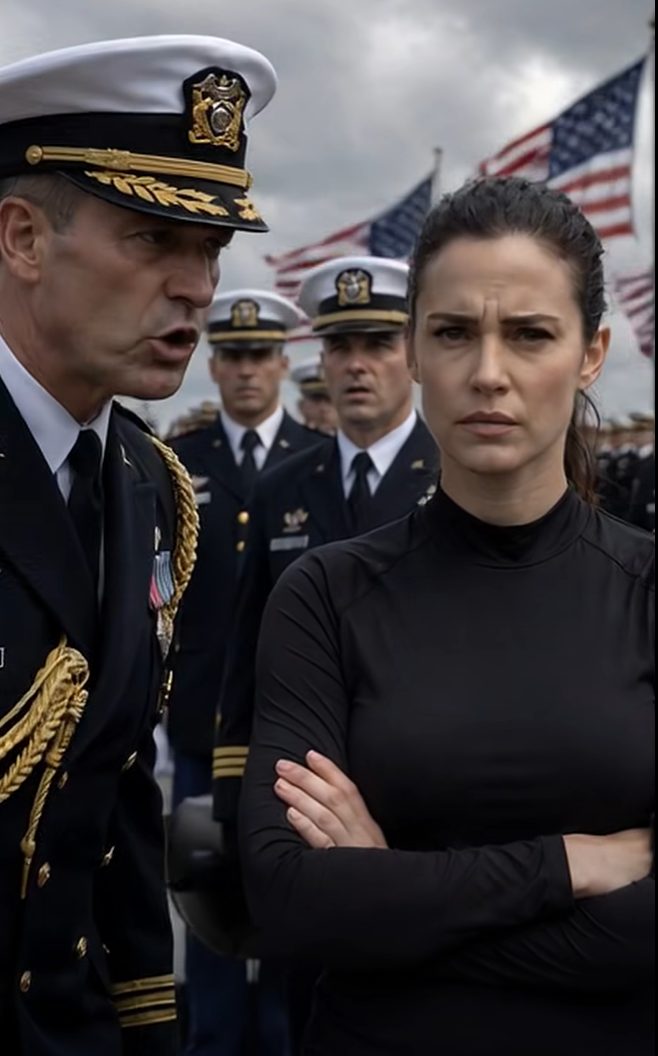
The ceremony was held beneath a gray coastal sky that looked like steel pulled thin across the horizon. American flags snapped sharply in the wind. Families gathered in neat rows, dressed in summer linen and polished shoes, while uniformed officers moved with crisp purpose across the field.
I wore black.
Black long-sleeve shirt. Black jeans. Hair tied tight. No jewelry except my mother’s old silver bracelet, the one she had given me before she stopped knowing how to speak to me without sadness.
I stood at the back.
Invisible. Controlled. Familiar.
My father saw me first.
His expression tightened as if I had arrived late to embarrass him personally. He wore a navy blazer with a lapel pin from Mason’s old command and stood beside my mother, who gave me a small, nervous smile. Mason was beside them in dress uniform, polished and smug.
“Samantha,” Dad said when I approached. “You came.”
“I was invited.”
Mason glanced at my clothes. “Back row suits you.”
My mother whispered, “Mason.”
I looked past them toward the field where Ethan stood among his class, face forward, jaw locked, young and proud and terrified in the way all warriors are before the world names them.
Dad leaned closer. “Today is about your brother. Please don’t make it uncomfortable.”
I almost laughed.
Fifteen years of swallowing humiliation, and they still thought silence was my talent.
“I’ll stand in the back,” I said.
“That’s probably best,” Mason muttered.
So I did.
The ceremony began with music, commands, applause, speeches about sacrifice and brotherhood. I watched Ethan receive his trident, watched his face tremble for half a second before discipline caught it. I felt pride rise in my throat so sharply it hurt.
Then Rear Admiral Thomas Wilson stepped to the microphone.
And my world tilted.
I knew Wilson.
Not socially. Not distantly.
He had once pulled me bleeding from the wreckage of a convoy outside a place that never made the news. He had watched me refuse morphine until my team was extracted. He had recommended my promotion after an operation still buried under classification codes so deep even most generals couldn’t request them.
His eyes moved across the graduates, then the families.
Then they stopped on me.
For one impossible second, the wind died.
Wilson’s mouth parted.
The applause faded unevenly, like a machine losing power.
He stepped away from the microphone.
A junior officer whispered something to him. Wilson ignored him.
Then, in front of Ethan’s class, my family, and half the command staff, he looked directly at me and said, “Colonel Hayes… you’re here.”
The field froze.
My father turned slowly.
Mason’s face drained.
My mother’s hand flew to her mouth.
Ethan stared at me from formation, confusion breaking through military discipline.
I did not move.
I had survived interrogations, explosions, betrayal, and orders that kept me awake for years. But nothing prepared me for the sound of my father whispering, “Colonel?”
The Thing About Covers
Wilson was already walking toward me.
Not a casual walk. Not a social one. The kind of walk that parts crowds without asking.
The junior officer trailed him for three steps, then stopped. You don’t follow a two-star when he’s moving like that. You just wait.
I stayed still. Hands at my sides. Chin level. Every instinct I’d spent fifteen years building told me to control the space, read the room, manage the variables. But there was no managing this. Wilson had made his choice the moment he said my name out loud, and there was nothing left to do but let it happen.
He stopped two feet in front of me.
Up close he looked older than the last time I’d seen him. More gray at the temples. The lines around his mouth deeper. But his eyes were the same. Sharp. Certain. The eyes of a man who had made decisions in rooms that didn’t exist and slept fine afterward.
“Colonel,” he said again, quieter this time.
“Admiral.”
He held my gaze for a moment. Then he brought his hand up.
A full salute.
Clean. Deliberate. The kind you give to someone whose rank you respect more than their title.
Behind me, I heard my father make a sound I had never heard from him before. Not words. Just air leaving his body wrong.
I returned the salute. Then Wilson dropped his hand and did something I genuinely did not expect. He smiled. Not the practiced ceremony-day smile he’d been wearing at the podium. Something real.
“Your brother know?” he asked.
“No.”
Wilson glanced over at Ethan, who was still standing in formation but had gone completely rigid, like a man trying very hard not to break rank and sprint across a field. “He’s going to be good,” Wilson said.
“I know.”
“Runs in the family.” He said it simply, then turned and walked back to the microphone.
The crowd was quiet in that uncertain way crowds get when they’ve witnessed something they don’t have context for. People were looking at me. Rows of them. Officers, families, strangers.
My father was four feet to my left.
I didn’t look at him yet.
What Fifteen Years Looks Like From the Outside
The rest of the ceremony finished. It had to. The Navy doesn’t stop for family drama.
Ethan’s class was dismissed in groups. Families surged forward. There was noise again, relief, cameras, kids running. The normalcy of it felt strange after the last ten minutes.
Ethan found me before he found anyone else.
He pushed through the crowd in his dress whites and stopped in front of me and said, “What the hell, Sam.”
“Congratulations.”
“What the hell,” he said again, but his voice broke on the second word, and then his arms were around me and he was squeezing hard, the way he used to when he was ten and scared of thunderstorms and I was the one who sat with him on the hallway floor.
I let him hold on.
When he pulled back his eyes were red. “Colonel?”
“It’s a long story.”
“How long?”
“Fifteen years long.”
He looked at me the way you look at someone when you realize you’ve been reading the wrong book about them your whole life. Not angry. Just recalibrating. “Did Mom know?”
“No.”
“Dad?”
“No.”
Ethan wiped his face with the back of his hand, which was a very Ethan thing to do, unselfconscious about it. “Mason?”
“No.”
He exhaled through his nose. “Okay.” A pause. “Okay.”
That was Ethan. He didn’t need the whole answer immediately. He’d always been like that. Patient in a way the rest of us never were.
Our father arrived thirty seconds later.
The Driveway, Reversed
Dad had aged in ways I’d catalogued at every holiday. More white in the hair. The belly he’d never had at fifty. The way he moved slightly slower now, more deliberate, as if his body was finally negotiating with him.
He stopped beside Ethan and looked at me.
“Samantha.” His voice was careful. Measured. The voice he used when he didn’t know the ground under him.
“Dad.”
“The Admiral called you Colonel.”
“He did.”
His jaw tightened. “You’re going to make me ask.”
“I’m not making you do anything.”
Mason appeared at Dad’s shoulder, still in his dress uniform, and I watched him work through the math in real time. Mason had made commander. He knew rank. He knew what a colonel meant, and he knew what it meant that a rear admiral had walked across a ceremony field to salute one.
His face did something complicated.
“How,” Mason said. Not a question really. Just a word that needed somewhere to go.
“I was recruited out of training,” I said. “Joint interagency program. Classified. I signed a cover agreement. The story you got was the story I was required to give.”
My mother had reached us by then. She’d been hanging back, I think because she understood something was happening that she needed to see before she stepped into it. She was holding her purse with both hands, knuckles pale.
“The officers,” she said. “The night you came home. The two men.”
“My handlers. They were there to make sure the transition looked clean.”
She closed her eyes for a second. Opened them. “The bruise.”
“Training incident. Two weeks before the pull. I wasn’t supposed to still have it.”
“I noticed,” she said. “I didn’t say anything because your father – ” She stopped. Looked at him.
Dad’s face had gone somewhere I couldn’t read.
“Because I thought if I asked you’d leave again,” she finished.
That sat there for a moment. Just sat.
What Nobody Says at First
Dad didn’t apologize at the ceremony. That would have been too fast, too public, and honestly too easy. What he did was stand very still while the crowd moved around us and look at me like he was doing arithmetic that kept coming out wrong.
Mason said nothing for a long time. Then: “What branch?”
“I can’t answer that.”
“Rank is colonel. That’s O-6. That’s – ” He stopped.
“Yeah.”
“How many deployments?”
“I can’t answer that either.”
He looked away. Looked back. “I called you a dropout at Ethan’s rehearsal dinner last year.”
“I know. I was there.”
His mouth pressed flat. “I said it twice.”
“I know that too.”
He didn’t apologize then either. But something went out of him. Some posture he’d been holding for fifteen years, that slightly lifted chin whenever my name came up, that practiced patience he performed around me like I was a chore he’d agreed to manage. It just left. And what was under it was something smaller and less certain.
I didn’t feel good about that. I want to be clear about that. There was no satisfaction in it.
Just tired.
Ethan put his hand on my shoulder. “Come eat with us.”
“I have a flight at nine.”
“Sam.”
“I have a debrief Monday morning. I can’t miss the flight.”
He looked at me. “One hour.”
I stayed for two.
The Bracelet
My mother sat next to me at the restaurant, a chain seafood place near the base that was too loud and too bright and exactly right for a celebration. She ordered a glass of white wine and didn’t touch it.
Halfway through dinner she reached over and touched the bracelet on my wrist. Her bracelet. The one she’d pressed into my hand the morning after I came home, when she thought I was broken and she didn’t know what else to give me.
“I always wondered why you kept wearing it,” she said.
“It was the only thing from home I could carry.”
She looked at it for a long moment. “Were you ever in danger?”
I thought about how to answer that honestly without answering it at all. “Sometimes.”
“Were you scared?”
“Sometimes.”
She nodded slowly. “Were you good at it?”
I thought about Wilson walking across that field. About what that walk cost him in terms of protocol, in terms of the questions it would generate, in terms of the sheer deliberateness of it. He hadn’t done that by accident. He’d done it because he wanted to.
“Yeah,” I said. “I was good at it.”
She picked up her wine then. Took a sip. Set it down and looked straight ahead at the table full of her children, two of them in uniform and one of them in black, and she said, very quietly, “I should have asked about the bruise.”
I didn’t tell her it was okay. It wasn’t okay, not entirely. But I reached over and covered her hand with mine and we sat like that while the table got loud around us.
Dad caught my eye from across the table once. Just once. He didn’t say anything. Neither did I.
But he lifted his glass slightly in my direction.
Small. Almost nothing.
Fifteen years of almost nothing, and then that.
I lifted mine back.
—
If this one got to you, pass it on to someone who needed to read it.
If you enjoyed this story, you might also be touched by The Woman They Called Old Lady or perhaps find inspiration in The Admiral Stood Up and Saluted Me First. The Room Went Dead Silent.. For another powerful tale of overcoming adversity, read about The Marine Grabbed My Hair in Front of His Whole Unit and Told Me I Didn’t Belong.



